English
 Türkçe

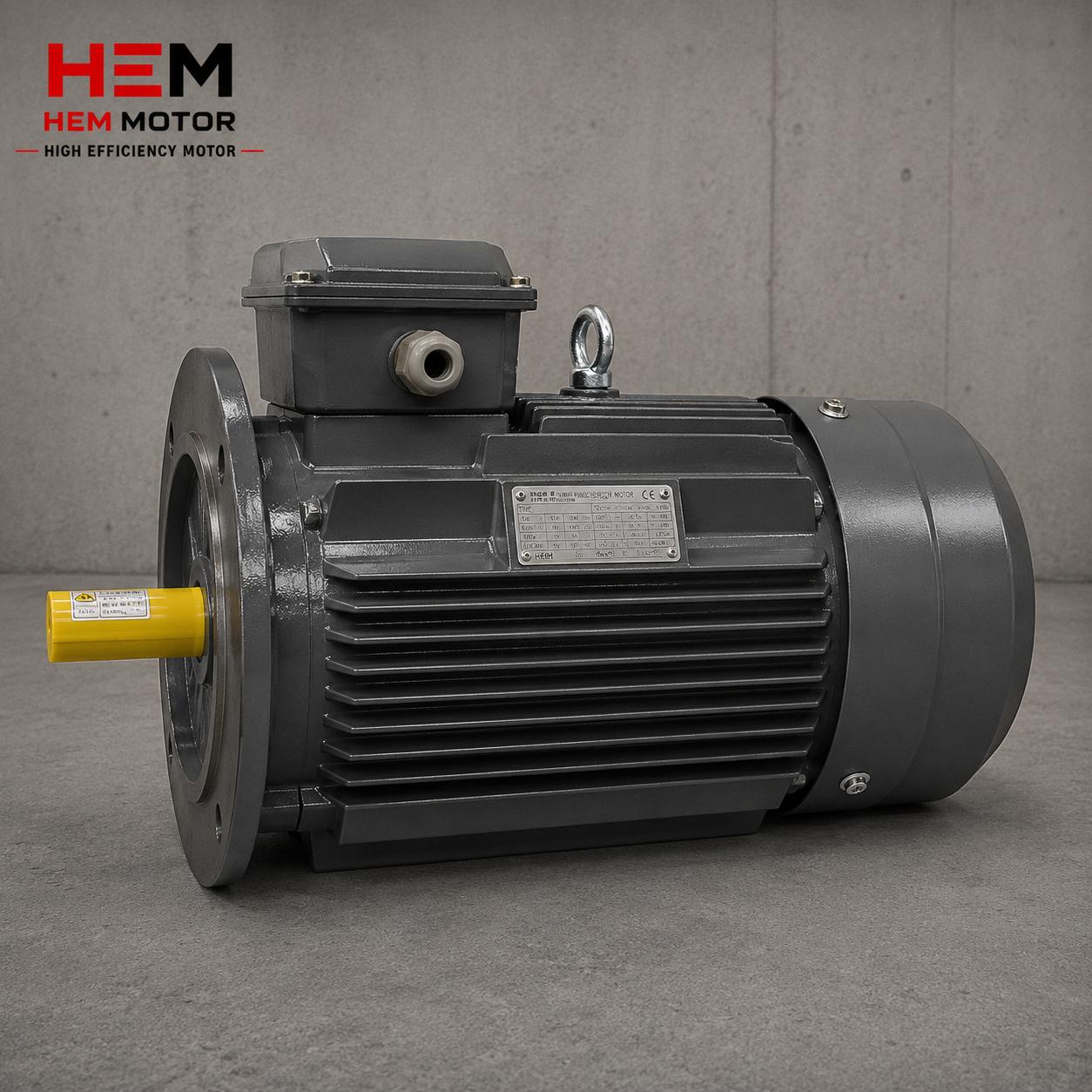

For someone looking at an electric motor nameplate for the first time, abbreviations like kW, rpm, IE3, IP55, IM B3, class F, S1 and cosφ read like a foreign language. Yet each of these terms tells you what the motor does, how it connects, in what environment it runs and how much energy it uses. To order the right motor you must master this glossary; misreading a single term can lead to the wrong motor. This guide is a comprehensive glossary explaining electric motor terms for beginners with plain definitions and everyday examples. After each term you can go deeper through links to our technical articles.
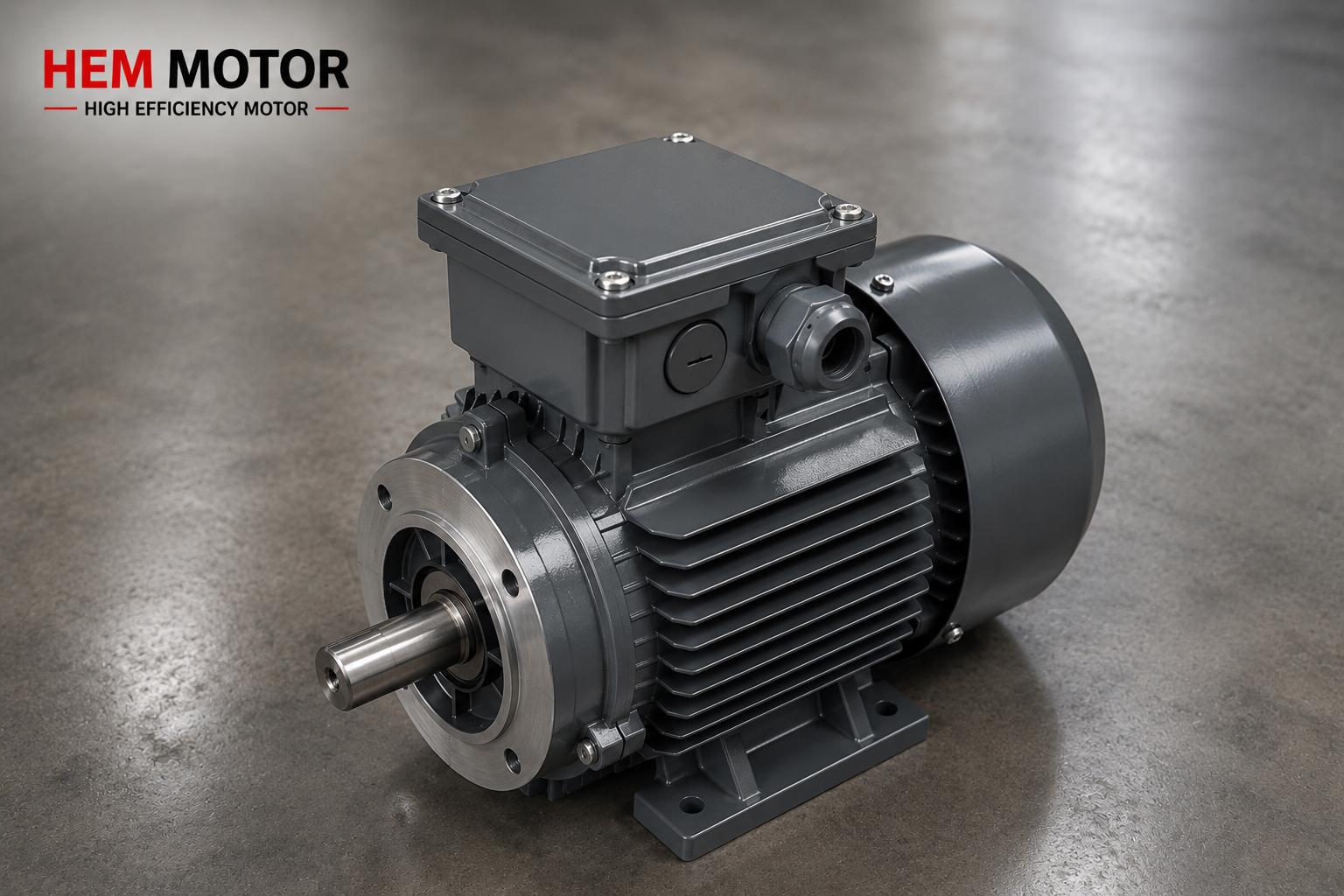
Power and Speed Terms
kW (Kilowatt) and HP (Horsepower)
kW is the mechanical power the motor can deliver at the shaft. HP (horsepower) is an older but still-used unit. Roughly, 1 HP equals 0.75 kW. For example, a 4 kW motor is about 5.5 HP. If a machine nameplate shows HP but your quote shows kW, you must convert. See HP vs kW power guide and HP-kW matching table.
Pole Count and Speed (rpm)
An induction motor's rated speed depends on pole count. On a 50 Hz grid, 2 poles give about 3000 rpm, 4 poles 1500, 6 poles 1000, 8 poles 750 rpm synchronous speed. Actual speed under load is slightly lower; this is called slip. A 4-pole motor may show 1450 rpm on the nameplate. For low-speed applications, a high-pole motor or a gearbox is used. See 2-4-6 pole selection and slip and actual speed.
Torque (Nm)
Torque is the turning force at the shaft, measured in Newton-metres (Nm). At the same kW, a low-speed motor produces higher torque. The torque needed to move the load must be lower than what the motor can deliver. Starting torque is the torque needed to set a standstill load in motion. See rated torque calculation and torque classes.
Efficiency and Electrical Terms
IE Class (IE1, IE2, IE3, IE4, IE5)
IE (International Efficiency) is the motor's energy-efficiency class. IE1 is standard, IE2 high, IE3 premium, IE4 super premium and IE5 ultra premium. The higher the number, the less electricity the motor uses for the same work. In Turkey and the EU, IE3 and IE4 are mandatory at certain powers. For a continuously running pump motor, choosing IE4 saves serious energy over the years. See IE3/IE4 mandate, IE3 vs IE4 investment and moving to IE5.
Rated Current (A) and Rated Voltage (V)
Rated current is the current the motor draws at full load, in amperes (A). This value sets cable size, fuse and contactor selection. Rated voltage is the voltage the motor is designed for (e.g. 230/400 V). Three-phase motors are usually delta-connected at 400 V and star at 690 V. For current and cable sizing see rated current and cable selection, for voltage terminal and voltage selection.
cosφ (Power Factor)
cosφ is the power factor, showing how much of the apparent power the motor draws becomes real work. The closer to 1, the more efficiently the motor uses the grid. A low cosφ draws reactive energy and can trigger a reactive penalty on the bill, so capacitor banks correct it. We covered this in power factor and correction.
Efficiency (%)
Motor efficiency shows how much of the electrical power drawn is delivered as mechanical power at the shaft. A 90% efficient motor turns 90% of the power into work and loses 10% as heat. As the IE class rises, efficiency rises. See the gap between nameplate and field efficiency in nameplate vs field efficiency.
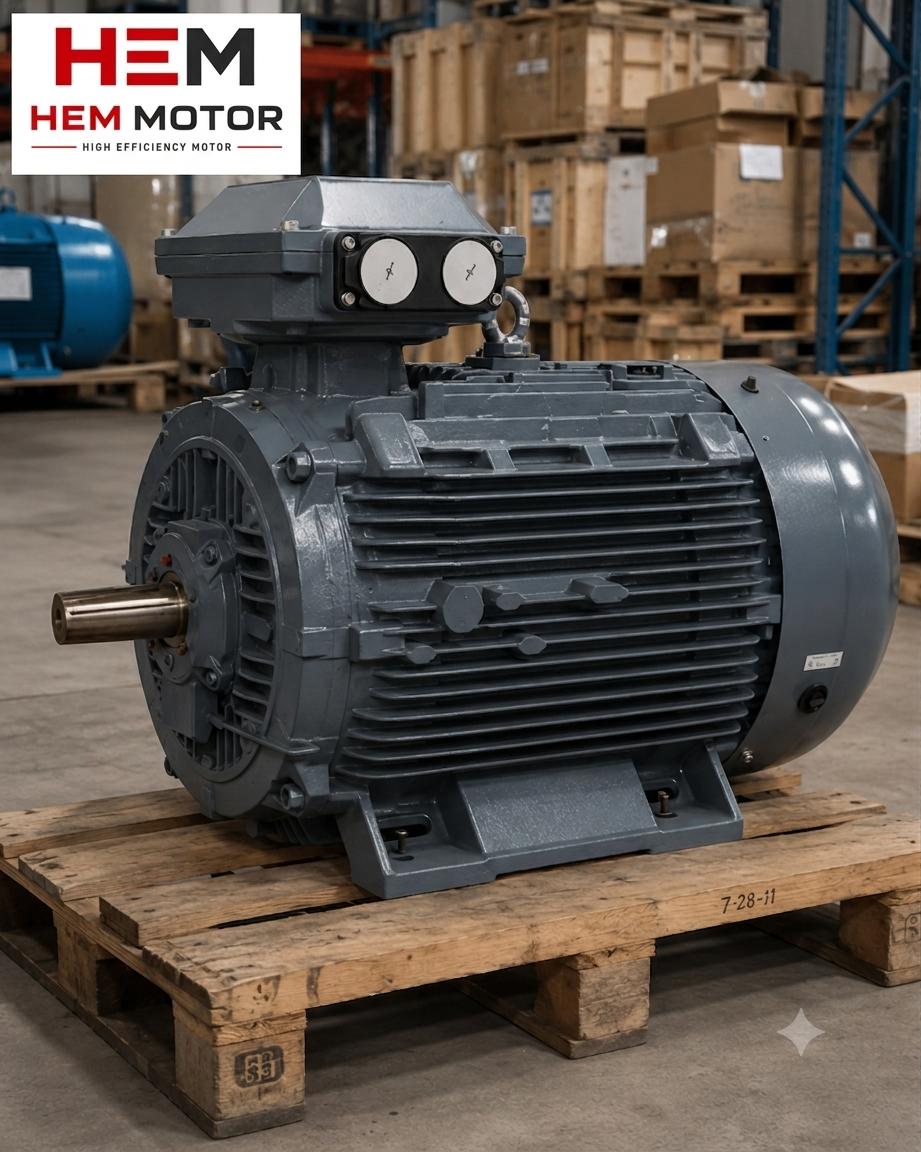
Protection and Durability Terms
IP Protection Class (IP55, IP65, IP66)
IP (Ingress Protection) has two digits: the first is dust protection, the second water protection. IP55 means dust-protected and resistant to water jets from any direction; most standard industrial motors are IP55. IP65 is dust-tight, IP66 withstands powerful water jets. A washdown food plant or open site needs higher IP. See IP protection class selection.
Insulation Class (F, H) and Temperature Rise
Insulation class states the maximum temperature the winding insulation can withstand. Class F holds up to 155 °C, class H up to 180 °C. The temperature-rise class (e.g. Delta T 80K) shows how much the motor heats up while running. An F insulation + B rise combination leaves a thermal margin and extends life. See insulation class F/H and temperature rise 80K.
Duty Type (S1–S8)
Duty type defines the operating regime. S1 is continuous; the motor runs for hours at constant load. S2 is short-time, S3 intermittent periodic, S4–S8 cover various start-stop and load profiles. A crane motor that starts and stops often should be chosen in the proper intermittent duty, not S1. We explained this in duty type S1-S6.
Service Factor (SF)
Service factor shows how much overload the motor can briefly carry above rated power. A motor with SF 1.15 can handle 15% above rated for a short time. A high SF gives a safety margin under fluctuating loads. See overload capacity in service factor and overload.
Mounting and Mechanical Terms
IM Mounting Code and Mounting Type (B3, B5, B14, B35)
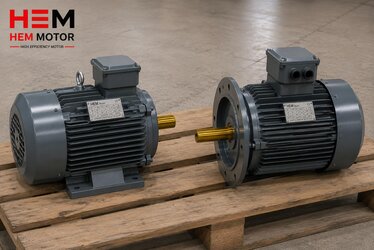
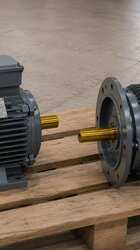
IM (International Mounting) defines how the motor is mounted. B3 is foot-mounted, B5 large flange, B14 small flange, B35 combined foot + flange. Codes like V1/V5 indicate vertical mounting. Ordering the wrong mounting type means the motor will not fit. See reading the IM code and B5 vs B14.
Frame Size and Shaft Diameter
Frame size is numbered per IEC from 56 to 355 and sets the foot-hole spacing and shaft height. Shaft diameter is the size of the shaft that connects to a coupling, pulley or gearbox. When replacing a motor with an equivalent, frame size and shaft diameter must match exactly. See shaft and frame table and shaft diameter and key dimensions.
Frame Material: Cast Iron and Aluminum
Cast iron frames are heavy, rigid and impact-resistant, preferred for heavy duty. Aluminum frames are light and common at small powers. For comparison see cast iron vs aluminum.
Motor Type Terms
The induction (asynchronous) motor is the most common industrial motor; its rotor turns slightly behind the magnetic field (slip). A single-phase motor runs on 220 V single phase, a three-phase motor on 380/400 V three phase. For an overview see single phase vs three phase and squirrel cage vs slip ring. A VFD (variable frequency drive) changes motor speed electronically; see VFD with induction motor. For a bird's-eye view of all motor types, let electric motor types and purchasing map be your starting point.
Starting and Protection Terms
DOL, Star-Delta and Softstarter
DOL (Direct On Line) connects the motor straight to the grid; simple but with high starting current. Star-delta starting connects the motor in star first to lower starting current, then switches to delta. A softstarter ramps the current up smoothly by electronics. Which one is needed depends on power and load. See star-delta vs softstarter and, for terminal bridging, star-delta wiring diagram.
Starting Current (LRA) and Thermal Protection
Starting current (LRA) is the high current the motor draws when it first moves; it can be several times the rated current. This current affects fuse, contactor and thermal-relay selection. Thermal protection guards the motor against overload and overheating. Find starting current in starting current LRA, protection selection in thermal, relay and fuse selection and the motor protection breaker in MPCB selection and setting.
PTC, PT100 and Thermistor
PTC and PT100 are sensors that monitor winding temperature. A PTC thermistor changes its resistance sharply at a set temperature to trigger the protection circuit; PT100 measures temperature continuously and precisely. On continuously running or critical motors, these sensors protect life. We covered this in protection with PT100 and thermistor.
Environment and Special-Application Terms
Explosion-Proof (ATEX)
Explosion-proof motors are used where gas, dust or vapor poses an explosion risk; ATEX is the European standard defining them. In sectors like paint, chemicals, fuel and flour/feed, explosion-proof motors are mandatory in certain zones. We explained when they are required in when an explosion-proof (ATEX) motor is required.
VFD (Frequency Drive) and Derating
A VFD adjusts motor speed by changing frequency; it saves great energy on pumps and fans but has side effects like harmonics and bearing currents. Derating is running the motor at reduced power at high altitude or in a hot environment. For VFD see VFD with induction motor, for altitude/temperature effect high altitude and derating.
Slip, Synchronous Speed and Breakdown Torque
Synchronous speed is the theoretical speed at which the magnetic field rotates; slip is how far the rotor lags behind it. So a 4-pole motor turns about 1450 rpm, not 1500. Breakdown torque is the maximum torque the motor can deliver; if the load exceeds it, the motor stalls. Find the speed-torque relationship in speed-torque curve and breakdown torque.
Frequently Asked Questions
How many kW is 1 HP?
1 HP is about 0.75 kW. So 2 HP is about 1.5 kW, 5 HP about 3.7 kW, 10 HP about 7.5 kW. If a machine nameplate shows HP but your quote shows kW, use this conversion. You can find the full table in our HP-kW matching article; always compare power in the same unit before ordering.
Should I buy a 2-pole or 4-pole motor?
It depends on the speed the application needs. A 2-pole motor gives about 3000 rpm and is used in high-speed applications like pumps and fans. A 4-pole motor gives about 1500 rpm and is the most common choice, preferred for conveyors, gearbox inputs and general industry. If lower speed is needed, 6 or 8 poles or a gearbox is used.
What is the difference between IP55 and IP65?
Both provide high dust protection; the difference is water. IP55 resists water jets from any direction and suffices for most enclosed industrial environments. IP65 is dust-tight and resists stronger water jets, preferred for dusty, humid or lightly washed environments. Choosing more than you need raises cost; choosing less puts the motor at risk.
Get a Quote
If you are unsure which kW, pole count, IE class, IP rating and mounting type you need, our expert team will define the right terms with you according to your application and prepare a clear quote. Call +90 (532) 345 49 86 now or reach us via our contact page.
Term Checklist (Before Ordering)
- Power: kW (converted from HP if needed)
- Poles / speed: 2/4/6/8 poles, rpm
- Efficiency class: IE3 / IE4 / IE5
- Voltage and frequency: 230/400 V, 50 Hz
- Rated current: A for cable and fuse
- cosφ: power factor
- IP protection class: IP55 / IP65 / IP66
- Insulation class: F / H
- Duty type: S1 / S2–S8
- Service factor: SF
- Mounting type / IM code: B3 / B5 / B14 / B35
- Frame size and shaft diameter
- Frame material: cast iron / aluminum
For more technical guides see our blog, and for our product range our home page.