English
 Türkçe


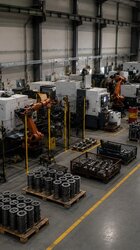

Galvanizing and hot-dip coating plants are among the most demanding industrial environments ever built to protect steel against corrosion. Molten zinc baths, pre-treatment tanks containing hydrochloric or sulfuric acid, dense acid fumes and a constantly humid atmosphere expose every electric motor on site to extraordinary corrosion and thermal stress. From the brake lifting motor of the dipping hoist to the exhaust fan drawing acid fumes and the pre-treatment and circulation pumps, all drive equipment will fail within months if the correct kW, pole/speed, protection class and special corrosion protection are not selected. In this guide we technically address the three critical motor groups of a galvanizing line (dipping hoist, acid fan and pump), reviewing the supply decision step by step from frame material and insulation class to cataphoresis coating, VFD compatibility and delivery lead-time. As HEM Motor, we supply galvanizing and coating plants with fast delivery from manufacturer stock.
Environmental Conditions That Drive Motor Selection in a Galvanizing Plant
On a hot-dip galvanizing line the environment is completely different from a conventional production workshop. In the acid pre-treatment (pickling) area, hydrochloric acid vapor in the air rusts metal surfaces within hours; around the zinc bath there is heat and zinc splashing; and in the rinse and flux tanks there is a constant risk of liquid contact. For this reason motor selection does not end with a power calculation; corrosion protection, protection class and frame material are at least as decisive as the kW. For a correct start, you should evaluate IP protection class selection for corrosive environments and then the behavior of cast-iron motors in open-field and corrosive conditions.
Protection Class: Why IP55 Is Not Enough and IP65/IP66 Is a Must
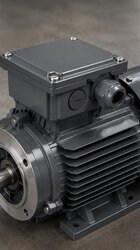
Standard industrial motors come with IP55 protection, which is sufficient against dust ingress and low-pressure water jets. However, in a galvanizing plant acid fumes form a very fine and aggressive aerosol that gradually seeps through IP55 seals and destroys the winding and bearings. For the acid fan, the dipping hoist and the pumps at the tank edge, we recommend IP65 protection, and IP66 at critical points. An IP65/IP66 motor is fully dust-tight and resistant to water jets from all directions, which is critical in a washed and steamy atmosphere. When deciding the protection class, remember that the terminal box sealing must also be of the same class.
Insulation Class: F or H?
On a galvanizing line the ambient temperature rises, especially near the zinc bath and furnace. Standard class F insulation withstands a 155 °C winding temperature and is sufficient for most applications; however, if there is high ambient temperature, frequent starting, or continuous low-speed operation under a VFD, class H (180 °C) insulation should be preferred. Class H provides a wider thermal safety margin and extends the expected life of the motor. All HEM Motor products use 100% copper windings, which directly affects thermal conductivity and long service life.
Dipping Hoist Brake Lifting Motor
The heart of the galvanizing line is the dipping hoist that lowers and raises steel parts into the acid tanks, the flux bath and the molten zinc. Because this motion is a vertical lift, the motor must always be a brake motor: when power is cut, the load must not stay suspended uncontrolled, and the spring-loaded disc brake must engage to hold the load safely. The dipping hoist motor is typically selected as a brake, geared and intermittent-duty (S3/S4) motor; on some continuous conveyor lines an S1 continuous duty also comes into play. For the fundamentals of lifting motor selection, we recommend our crane and hoist lifting motor supply and IE4 brake motor conveyor and crane supply guides.
Power, Pole and Duty Type
Dipping hoist motors are typically selected between 1.5 kW and 30 kW according to the weight of the carried part and the lifting speed; higher powers are also used on large galvanizing lines. In lifting applications a 4-pole (1500 rpm, ~1450 rpm with slip) motor combined with a reducer is generally preferred, because lifting must be slow and controlled. When intermittent duty (S3/S4) is selected, the cyclic duration factor (ED %) and the number of starts per hour must be clarified, as these values directly affect the thermal sizing of the motor. Star-delta or softstarter can be used as the starting method; for details, our article on star-delta and softstarter for asynchronous motors provides guidance.
Brake and Reducer Selection
In brake motors the brake torque is selected above the rated motor torque so that it can hold the load safely. The spring-loaded disc brake closes automatically on power loss (fail-safe), and this is the basis of safety on a dipping hoist. On the reducer side, high torque and self-locking capability are important for lifting applications; worm gear reducers provide additional safety in vertical lifting thanks to their self-locking structure, while helical-worm gear reducers can be preferred when higher efficiency is required. Since the dipping hoist motor frame is exposed to acid rising from the tanks, both the motor and the fan must be corrosion-protected.
Acid Fume Corrosive Exhaust and Extraction Fan Motor
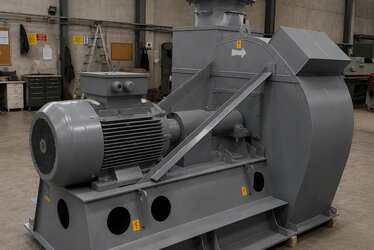
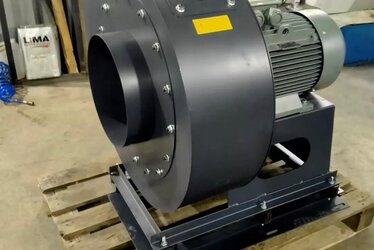
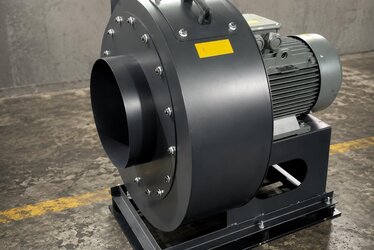
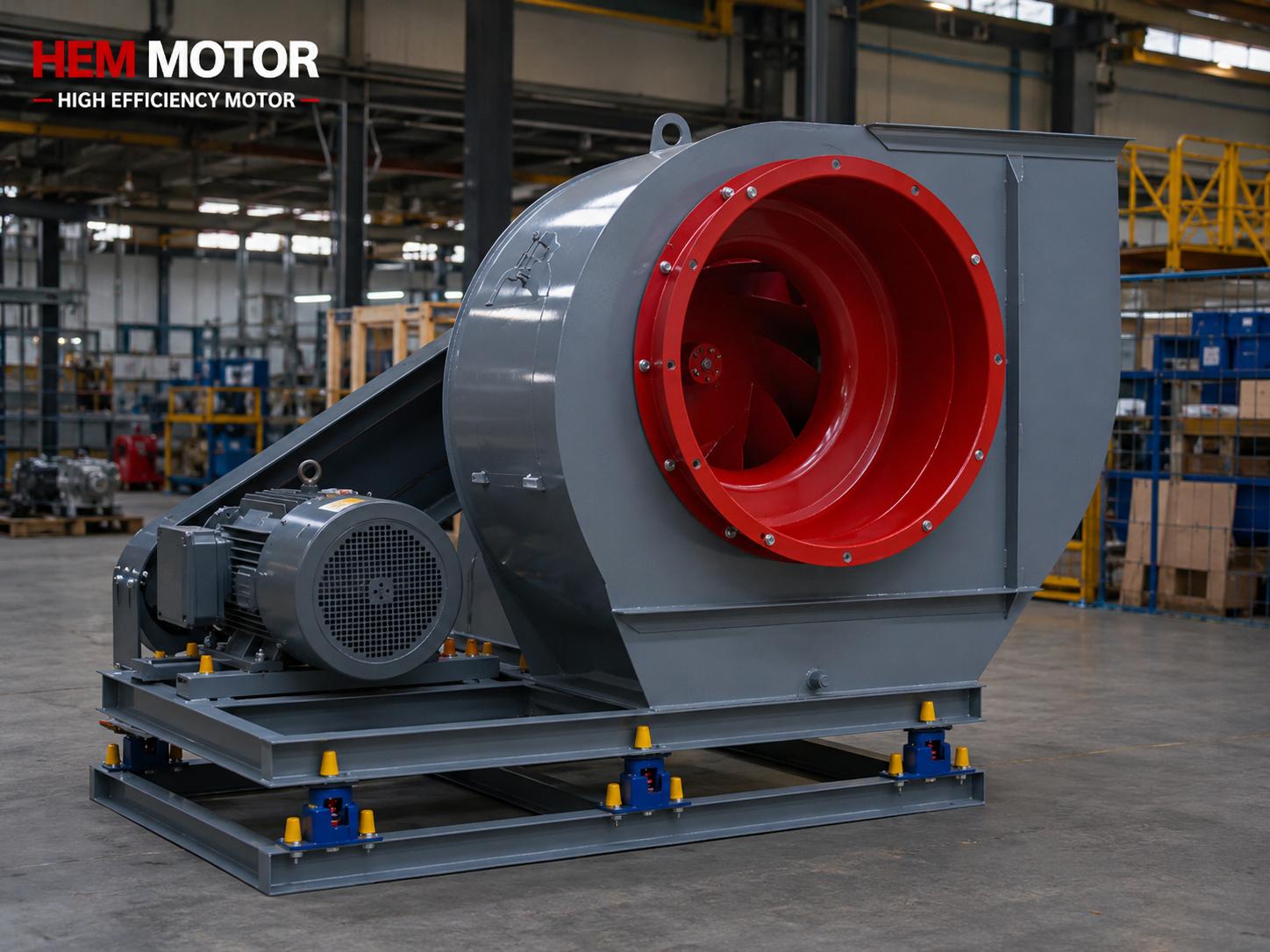
The corrosive fumes rising from the acid pre-treatment tanks and the zinc bath are dangerous both for operator health and for plant equipment. For this reason powerful extraction and hood fans operate on galvanizing lines. The motor of these fans, which carry the acid fume, is located at the most aggressive point of the environment and rusts quickly without special corrosion protection. For the basic principles of fan motor selection, you can use our aspirator and dust collection fan motor selection and centrifugal and axial fan motor selection and supply guides.
Corrosion Protection: Cataphoresis and Special Paint
The most critical decision for the acid fan motor is surface protection. Standard paint does not last for years under acid aerosol; therefore a cataphoresis (e-coat) dip coating and an acid-resistant top coat are applied to the cast-iron frame. Cataphoresis penetrates all recesses and cooling fins of the frame at an even thickness, forming a homogeneous barrier against electrochemical corrosion. For details of this protective layer, our article on paint, cataphoresis and corrosion protection on cast-iron motors provides detailed information. Since the chemical attack is similar to a coastal and salty atmosphere, the principles of coastal and salty environment protection also apply.
Frame Material and Speed
Acid fans generally require high airflow and medium pressure; therefore the motor is selected as 2-pole (3000 rpm, ~2900) or 4-pole (1500 rpm, ~1450). If variable airflow is required according to the fan curve, the speed is adjusted with a VFD and energy is saved. Cast iron is preferred as the frame material for heavy duty and corrosion protection; a cast-iron frame offers a more durable load-bearing structure in an acid environment than aluminum. When IP65 protection class, F or H insulation and cataphoresis coating are combined, the fan motor can operate for many years under acid fumes. You can find these fan and motor groups under our efficient electric motors product family.
Pre-Treatment and Circulation Pump Motor
The pre-treatment and circulation pumps that circulate the liquid in the surface preparation baths before galvanizing (degreasing, pickling, flux) are in direct contact with chemical liquids. The pump motor is located in a corrosive environment due to the splashing and evaporation of acidic or alkaline liquid. Pump motor selection is made according to flow rate and head; for a correct calculation, our article on centrifugal pump motor selection: flow and head is the basic reference. For the additional protection requirements encountered with salty and corrosive liquids, the principles of seawater and saltwater pump motor protection can also be applied to galvanizing baths.
Mounting Type and Connection
Since circulation pumps are mostly centrifugal type, flange mounting is preferred. For direct coupling, B5 (large flange) or B35 (foot + large flange) is selected; for compact pumps, the B14 small flange can be used. Ensuring that the mounting type is fully compatible with the pump body prevents vibration and axial misalignment problems. For the full list of mounting connections, you can review the mounting options on our efficient electric motors page. When the pump motor is also ordered with IP65 protection and cataphoresis coating, it becomes resistant to the aggressive environment at the tank edge.
Efficiency and VFD Drive
Because pump and fan applications operate under variable load, they achieve the highest energy savings with a VFD (variable frequency drive). The speed is adjusted according to the bath temperature and process speed, preventing unnecessary energy consumption. It is important that a motor running under a VFD has drive-compatible windings and insulation for durability against voltage spikes. In terms of energy efficiency, IE3 Premium, IE4 Super Premium and synchronous-reluctance IE5 Ultra Premium options reduce the electricity cost during the long operating hours of a galvanizing plant. The best approach is to plan the efficiency class of all motor groups across the plant together.
Neighboring Sector Experience in Galvanizing Plants
The corrosion and thermal challenges on a galvanizing line are similar to those of other heavy industrial plants. For motor selection in similar corrosive and chemical environments, our articles on chemical, pharma and detergent factory motor selection and, for high-temperature experience, aluminum extrusion plant electric motor selection provide valuable comparisons. If there are zones with solvent vapor or explosion risk in the plant, when an exproof ATEX motor is required should also be evaluated. For the selection of protection devices (thermal protection, PTC, anti-condensation heater), our electric motor protection devices purchase guide is complementary.
Galvanizing Plant Motor Selection and Purchasing Checklist
- Motor location: acid pre-treatment, zinc bath, rinse or drying — determine the corrosion and temperature severity of the environment.
- Protection class: request at least IP65 in the acid fume and washed zone, and IP66 at critical points.
- Insulation: standard F; choose class H for high ambient temperature or frequent starting.
- Frame and coating: request a cast-iron frame + cataphoresis (e-coat) + acid-resistant top coat.
- Dipping hoist motor: clearly state brake (spring-loaded disc, fail-safe), geared, duty type S3/S4 or S1.
- Power and pole: 4-pole + reducer for lifting; 2 or 4-pole for fan/pump, calculate kW according to the load profile.
- Mounting type: B5/B35 for pump, B3/B5 for fan depending on the application; verify compatibility with the pump/fan body.
- VFD compatibility: request drive-compatible windings/insulation if variable speed is required.
- Starting: star-delta or softstarter; share the number of starts per hour.
- Delivery: clarify the lead-time and fast delivery from manufacturer stock before ordering.
Providing the correct information at the quotation stage shortens the lead-time; on this subject, our article on information to provide when requesting a quote can be used as a checklist. For more products and technical information, you can visit our home page.
Frequently Asked Questions
Which protection class is required for an acid fan motor in a galvanizing plant?
At least IP65 protection class is recommended for extraction and exhaust fans where acid fume is dense; IP66 is preferred at washed or very aggressive points. In addition, applying a cataphoresis coating and an acid-resistant top coat to the cast-iron frame significantly extends the motor life.
Why must the dipping hoist motor be a brake motor?
The dipping hoist lowers and raises parts vertically into the acid and zinc baths. To prevent the load from free-falling during a power cut, a spring-loaded disc brake (fail-safe) is a must; the brake closes automatically when power is cut, holding the load safely suspended. A self-locking reducer also provides additional safety.
Does it make sense to use a VFD on the pump and fan motors of a galvanizing line?
Yes. Since pumps and fans operate under variable load, adjusting the speed with a VFD provides significant energy savings and makes the process speed flexible. A motor that will run under a VFD must have drive-compatible windings and insulation for durability against voltage spikes.
Get a Quote
For your galvanizing and hot-dip coating plant, we supply dipping hoist brake lifting motors, acid fume exhaust fan motors and pre-treatment circulation pump motors with IP65/IP66 protection, cataphoresis coating and F/H insulation, with fast delivery from manufacturer stock. Share your project for the correct kW, pole and corrosion protection; reach us through our contact page or by phone at +90 (532) 345 49 86, and let us prepare a quote for the most suitable solution and lead-time right away.