English
 Türkçe

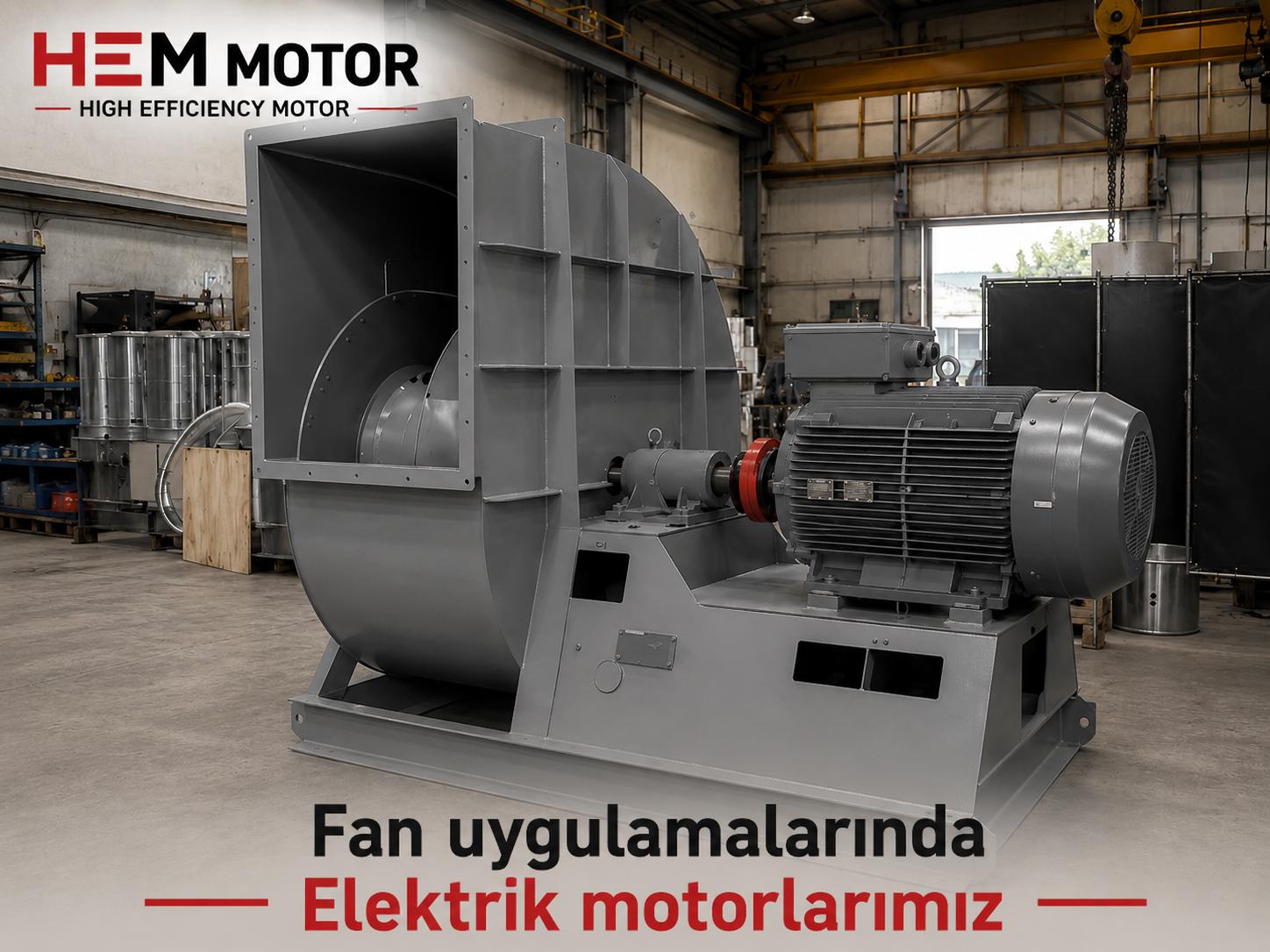

In fan and exhaust (aspirator) applications, the impeller is often mounted directly onto the motor shaft end. In this directly coupled arrangement, with no belt-and-pulley intermediary, the entire weight of the impeller hangs from the shaft extension that protrudes beyond the motor's front bearing. Engineers call this loading condition an overhung load, and as the distance from the impeller's center of mass to the bearing plane increases, the bending moment imposed on the shaft grows rapidly. A standard electric motor, however, is fundamentally designed to produce torque; carrying the radial load and bending stress generated by a large centrifugal impeller hung on the shaft end is a separate engineering matter. Choose the wrong fan motor and shaft deflection rises, the front bearing fatigues prematurely, the air gap distorts and vibration climbs. This article examines in detail how an overhung impeller load acts on the shaft and bearings, the relationship between shaft diameter and deflection, the selection of reinforced bearings and bearing units, and the criteria for choosing the correct fan and aspirator motor.
What Is an Overhung Impeller Load?
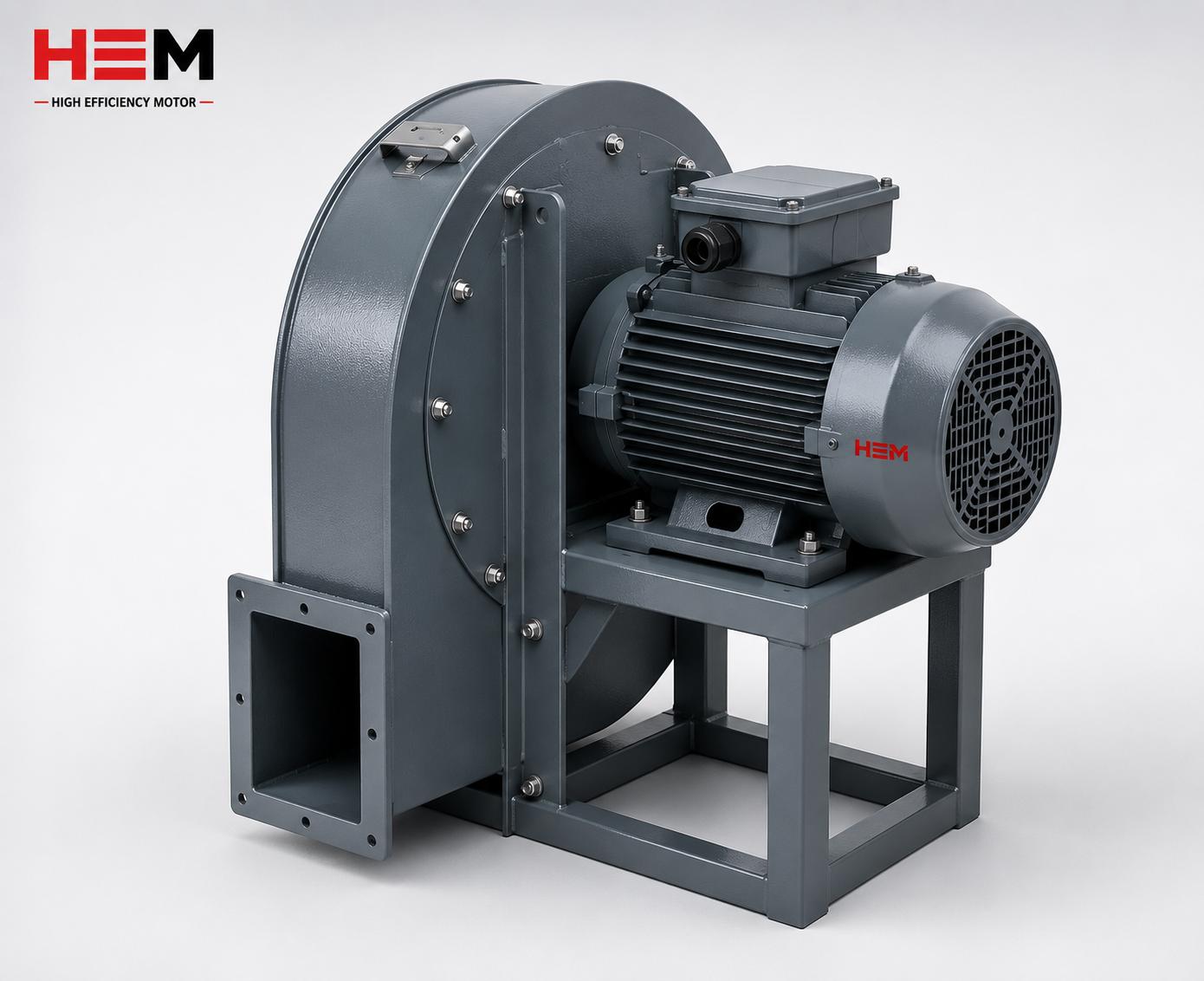
When a centrifugal fan or aspirator impeller is mounted onto the shaft end through a key and hub, the impeller's center of mass lies outside the bearing plane, suspended in air. The static weight and dynamic unbalance forces produced as the impeller rotates are transmitted toward the bearings like a lever acting from the shaft tip. The product of the overhung distance and the impeller weight gives the bending moment imposed on the shaft. This moment stresses two things at once: the shaft itself (bending and deflection) and especially the front (drive-end) bearing nearest the impeller (radial load).
In aspirator applications the situation is even more demanding. Fluid carrying dust, chips, smoke or particulate gradually sticks to the impeller, disturbs the balance and amplifies the unbalance force. That is why, when selecting a fan or aspirator motor, not only power and speed but also the impeller weight, diameter, center-of-mass distance and unbalance tolerance must be taken into account.
Bending Moment and Radial Load Relationship
The stress an overhung load imposes appears both as a bending moment on the shaft and as a radial load on the front bearing. As distance increases (long impeller hub, intermediate flange, wide impeller) the moment grows linearly; as impeller weight increases, it again grows linearly. For this reason, between two motors of the same power, the one with a reinforced shaft and bearing arrangement capable of carrying the impeller load should be preferred.
- Static load: The impeller's own weight applies a lever effect from the shaft tip to the bearing.
- Dynamic load: Unbalance produces a centrifugal force that rises with the square of the speed.
- Thermal effect: In hot-gas aspiration, shaft and bearing expansion changes the load distribution.
| Frame (IEC) | Typical shaft dia. (mm) | 2-pole permissible overhung load (approx.) | 4-pole permissible overhung load (approx.) |
|---|---|---|---|
| 80 | 19 | Low | Medium |
| 100 | 28 | Medium | High |
| 132 | 38 | Medium-high | High |
| 160 | 42 | High | Very high |
| 200 | 55 | Very high | Highest |
The values in the table show the general trend: at low speed (higher pole count) the permissible overhung load increases, because centrifugal force falls with the square of speed. In other words, a motor that can carry a given impeller at 1500 rpm faces that same impeller with a far greater dynamic load at 3000 rpm. This explains why 4- and 6-pole motors are so widely used in fan selection.
Shaft Diameter and Deflection
Shaft diameter is the most critical parameter determining how much the shaft will bend under an overhung load. Shaft deflection (the amount of bending) is inversely proportional to the fourth power of the diameter; that is, increasing the diameter modestly reduces deflection very substantially. When deflection rises, the impeller may contact the fan casing or inlet, the air gap distorts and rotor-stator centering is lost. For this reason, heavy impellers call for motors with thicker, reinforced shaft ends rather than a standard shaft.
Shaft extension length also matters: a long shaft end moves the impeller away from the bearing plane, enlarging the overhung distance and increasing both deflection and bearing load. Ideally, position the impeller hub as close to the bearing as possible and avoid unnecessary spacers. For details on shaft alignment and radial-axial load limits, see our shaft radial and axial load limit guide.
Bearings: Reinforced Bearing and Bearing Unit Selection
The greatest effect of an overhung load is on the front bearing nearest the impeller. A standard general-purpose motor has deep-groove ball bearings at both ends. But under heavy overhung loads a higher-capacity bearing is preferred at the front, and in some heavy fan applications a cylindrical roller bearing (NU type) is used. A cylindrical roller bearing has a far higher radial load capacity than a ball bearing of the same size and suits overhung fan loads.
- Deep-groove ball bearing: Standard, adequate for light-to-medium impeller load.
- Cylindrical roller bearing (front): For high radial/overhung load, on heavy impellers.
- Increased lubrication / regreasing nipple: Extends bearing life on continuously loaded fans.
- C3 clearance bearing: Tolerates thermal expansion in hot-gas aspiration.
Correct greasing directly affects bearing life; for grease type, NLGI consistency and lubrication interval, our bearing greasing guide provides detailed information. You can find the effect of bearing type on load and life in our asynchronous motor bearing type and life article.
| Bearing solution | Radial capacity | Suitable fan/aspirator type |
|---|---|---|
| Standard ball (both ends) | Medium | Light axial / small centrifugal fan |
| Front cylindrical roller | High | Heavy centrifugal impeller, large aspirator |
| Reinforced + C3 clearance | High (hot) | Hot-gas / smoke exhaust fan |
| Regreasable large bearing | Very high | Continuous heavy-duty industrial fan |
Balance and Vibration
Under an overhung impeller load, most of the dynamic force comes from unbalance. A well-balanced impeller substantially reduces the vibration load on the motor bearings. In aspirators, dust or chips accumulating on the impeller disturb balance over time, so periodic cleaning and rebalancing when needed are essential. On the motor side, choosing a low vibration class (a high balance quality grade) lowers the system's total vibration. For vibration acceptance limits, our ISO 10816/20816 vibration and balance guide can serve as a reference; for quiet operation, our noise and vibration article is helpful.
Choosing the Right Fan/Aspirator Motor
Correct selection is not merely matching power and speed from a catalog. When choosing a motor for an overhung impeller application, follow these steps:
- Determine the impeller weight, diameter and the distance from its center of mass to the shaft-end bearing.
- Choose the operating speed (pole count); where possible prefer 4/6 poles over high speed to reduce dynamic load.
- Verify that at this load and speed the motor's permissible overhung load limit is not exceeded.
- Request a reinforced shaft and a front cylindrical roller bearing option if needed.
- For hot/dusty environments, specify IP protection, C3 clearance and a suitable grease type.
For impeller-to-motor matching in aspirator and dust collection applications, our aspirator and dust collection fan motor article is useful, and for the centrifugal-axial fan distinction, our centrifugal and axial fan motor selection guide is an additional resource.
Comparing Direct-Coupled, Belt-Driven and Separately Borne Arrangements
In fan and aspirator drives, the way the impeller is connected to the motor determines how much of the overhung load lands directly on the motor shaft. There are three basic arrangements, each leading to a different selection outcome:
- Direct-coupled (impeller on shaft end): The most compact and cheapest solution, but the entire overhung load lands directly on the motor shaft and front bearing. The motor shaft and bearing must therefore be selected for this load.
- Coupled (separate fan shaft + coupling): The impeller is mounted on a separate shaft running in its own bearings; the motor only transmits torque. The overhung load does not reach the motor, but mounting and alignment precision become more critical.
- Belt-and-pulley driven: Provides speed-ratio flexibility; however, belt tension imposes a separate radial load on the motor shaft. In this case belt pull load, rather than overhung load, must be considered.
In a direct-coupled arrangement, choosing the motor correctly prevents costly failures such as impeller-to-casing contact, permanent shaft bow and premature bearing damage. If a coupling is to be used, it is important to know the difference between flexible and rigid couplings; our coupling selection and shaft alignment article offers guidance.
Effect of Mounting Position on Overhung Load
A fan motor may be mounted horizontally (B3/B5) or vertically (V1/V5). In vertical mounting, especially with the shaft pointing down, the impeller's weight also adds a component along the shaft axis, changing the oil seal and bearing load. In horizontal mounting the overhung load remains entirely radial; in vertical mounting the static weight lands on the axial bearing. For this reason, the mounting position must be stated clearly at the order stage in vertical fan applications. For the effect of vertical mounting and shaft-down position on seal/bearing selection, see our vertical-mount motor selection guide. To read mounting codes correctly, our IM mounting code article is helpful.
| Mounting position | Effect of overhung load | Point to watch |
|---|---|---|
| Horizontal (B3/B5) | Entirely radial load | Front bearing radial capacity |
| Vertical shaft-down (V1) | Radial + axial component | Oil seal and axial bearing |
| Vertical shaft-up (V5) | Radial + reverse axial | Bearing preload |
Temperature, Dust and Protection in Aspirators
Aspirator motors often run in dusty, hot or humid environments. In hot-gas exhaust the shaft and bearing expand, so C3-clearance bearings and a suitable grease type are essential. In dusty environments the IP protection class should be raised and, if necessary, the fan cowl and protection guard selected against dust and thread wrapping. On these topics our fan cowl and protection guard article and our IP protection class selection guide provide detailed information. For correct sealing, shaft oil seal and V-ring selection should not be overlooked.
Overheating is a common problem in fan motors; especially in aspirators running continuously at low speed, forced (external) cooling fans may be needed. In continuous heavy duty, the motor's temperature class, service factor and cooling method must be assessed together. A wrongly chosen fan motor both loses efficiency and shortens bearing grease life, increasing maintenance cost.
Frequently Asked Questions
Does mounting a fan impeller directly on the shaft end strain the motor?
Yes, because the impeller is suspended (overhung) on the shaft end, its weight and unbalance act on the shaft and front bearing as a bending moment and radial load. If the impeller is heavy or far from the shaft tip, a reinforced shaft and upgraded bearings are required; otherwise shaft deflection and premature bearing wear occur.
For the same impeller, is a 2-pole or a 4-pole motor safer?
Because dynamic (centrifugal) load rises with the square of speed, the same impeller produces far less dynamic load at low speed (4 or 6 poles). Therefore, choosing the lowest practical speed for heavy centrifugal impellers improves bearing life and vibration performance.
Why does dust buildup on an aspirator impeller matter?
Dust or chips accumulating on the impeller increase unbalance and raise vibration, which in turn increases the dynamic load on the bearing and the noise. Periodic cleaning and rebalancing when needed protect both bearing life and quiet operation.
For your fan or aspirator application, you can source motors suited to your impeller weight, diameter and speed, with reinforced shaft and upgraded bearing options, from the manufacturer with stock availability and fast delivery. Share your impeller dimensions and let us determine the most suitable fan-aspirator motor for your application together and prepare a tailored quotation for you.