English
 Türkçe

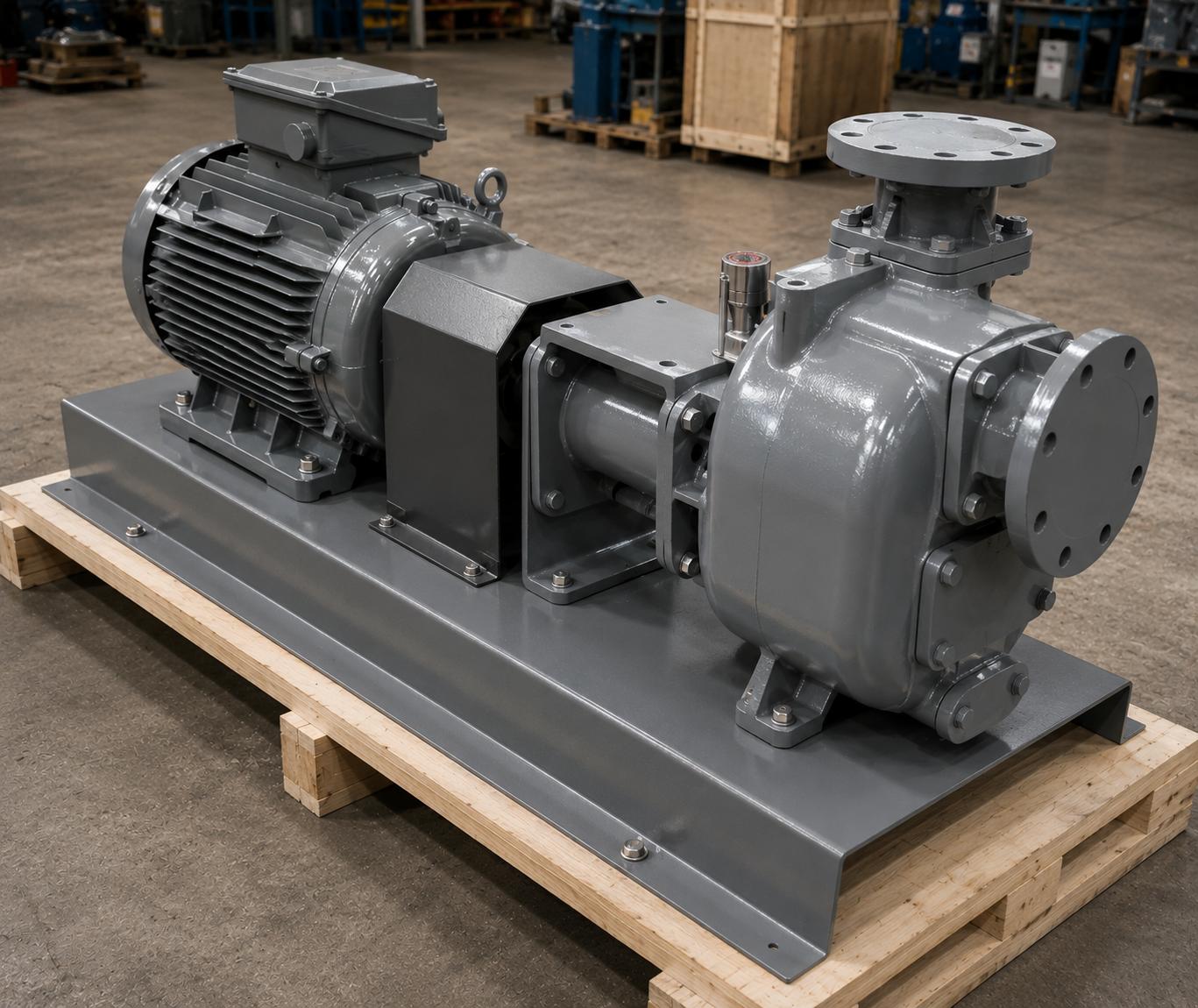

Stopping a pump or fan motor looks trivial at first glance: you cut the power and the motor stops. Yet on large-diameter pipelines, high-head centrifugal pumps and heavy-impeller fans, an abrupt stop creates a serious pressure wave driven by the inertia of the moving fluid. This phenomenon is called water hammer. The sudden slam of a check valve, line pressure spiking far above its rated value, and reverse flow forcing the motor backward all lead to expensive failures: blown gaskets, cracked welds, damaged bearings and bent shafts. Selecting the right motor and the right drive turns water hammer from an inevitability into a controllable engineering parameter. At HEM Motor, this article explains the physics of water hammer, the logic of soft-stop, controlled deceleration with a VFD, check valve selection and the correct motor/drive combination, with practical examples.
What Is Water Hammer and Why Does It Damage the Motor?
Water hammer is the pressure wave that appears when the velocity of a fluid mass in a pipe changes suddenly. When pump power is cut, the impeller decelerates quickly, but the water column in the pipe wants to keep moving because of its inertia. When the flow suddenly stops or reverses, kinetic energy converts into pressure energy and a wave propagates through the pipe at nearly the speed of sound. The peak of this wave can reach two to three times the normal operating pressure.
On the fan side the mechanism is slightly different: a heavy-impeller exhauster or centrifugal fan keeps spinning freely on its inertia long after power is removed. If a damper slams shut during this time, a shock forms in the air column; moreover the free-spinning fan (windmilling) drives the motor like a generator and pumps energy back into the drive. In both cases the cure is the same: bring the speed down to zero along a controlled ramp rather than instantly.
- Mechanical damage: hard slam of the check valve disc, blown seals and gaskets, stressed shaft and coupling.
- Hydraulic damage: leaks at joints, fatigue cracks in weld seams, loosened hangers and clamps.
- Electrical effect: reverse flow turning the motor backward, DC-bus over-voltage trip on the VFD.
- Bearings: reversed axial thrust, brinelling marks on bearing balls.
The Physical Magnitude of Water Hammer and the Joukowsky Relation
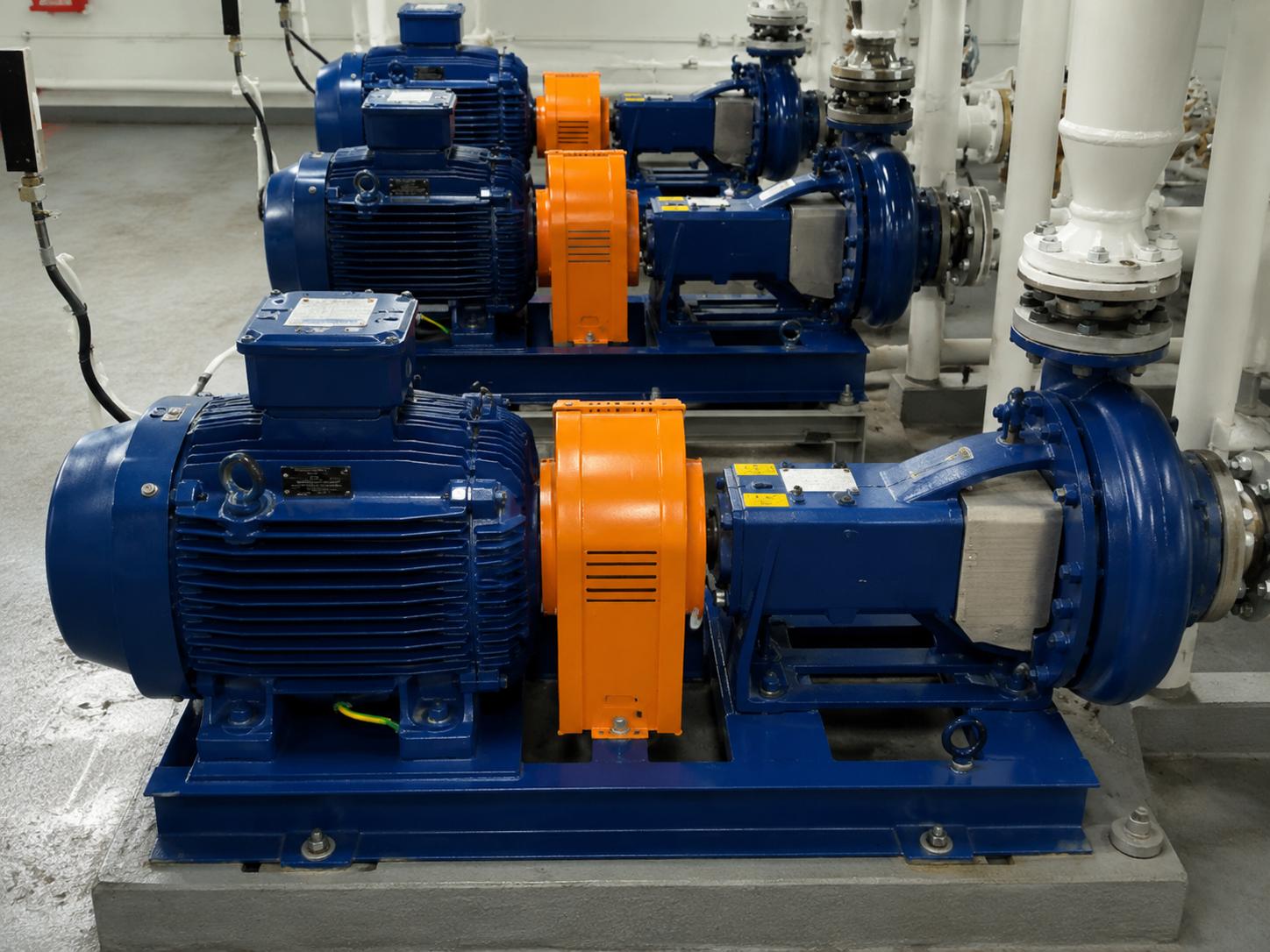
To understand how dangerous water hammer can be, you need a rough estimate of the pressure rise. The larger the sudden change in flow velocity and the shorter the time over which it happens, the higher the resulting pressure shock. In practice, instantly stopping a flow velocity of 1 meter per second in a pipe can add roughly 10-12 bar on top of the operating pressure. That is why keeping the flow velocity in the pipe within reasonable limits, and keeping the stop time longer than the time the pressure wave takes to travel from one end of the pipe to the other and back (the reflection time), effectively reduces the shock. This is exactly the logic behind the length of the soft-stop ramp: the speed is reduced gradually before the wave can renew itself.
The longer the pipeline, the longer the reflection time, which explains why longer transmission mains need longer stop ramps. On short lines the wave reflects very quickly, so even a few seconds of ramp is usually enough. Pipe material matters too: steel pipe transmits the wave faster and harder than flexible PE or PVC pipe, so protective measures are more critical on steel lines.
Soft-Stop: Controlled Deceleration with a Ramp
Soft-stop gradually reduces the voltage or frequency applied to the motor over a preset time (stop ramp / ramp-down) so the impeller coasts down smoothly. The "soft-stop" function on a soft-starter lowers the output voltage linearly; because pump flow decreases slowly, the flow is never cut abruptly and the check valve seats gently. A VFD lowers the speed in a controlled way by reducing frequency, which is the most precise method.
The correct ramp time is set by pipeline length, static head and fluid mass. Too short a ramp does not prevent the shock; an unnecessarily long ramp can overheat the motor at low speed. The table below summarizes approximate stop ramps and method selection for typical applications.
| Application / Line | Inertia & Risk | Recommended Stop Ramp | Preferred Method |
|---|---|---|---|
| Short-line small pump (< 30 m) | Low | 2 - 5 s | Soft-starter soft-stop |
| Medium-line centrifugal pump | Medium | 8 - 15 s | Soft-starter / VFD |
| Long transmission main, high head | High | 20 - 60 s | VFD ramp-down (mandatory) |
| Heavy-impeller exhauster / fan | High inertia | 30 - 90 s | VFD + brake resistor |
| Vertical column with check valve (deep well) | Reverse-flow risk | 15 - 40 s | VFD + slow-closing valve |
Controlled Stop and Regenerative Energy Management with a VFD
The variable frequency drive (VFD) is the most powerful tool against water hammer because it lets you set the acceleration and deceleration ramps separately, to the second. If, while stopping the pump, the frequency is lowered from 50 Hz to zero over 30 seconds, flow decreases gently and the pressure wave is almost fully damped. However, on high-inertia fans the drive must dump the regenerative energy the motor produces somewhere; this is where a brake resistor or a regenerative unit comes in. Otherwise the DC-bus voltage rises and the drive trips on a fault.
- Set the deceleration time to match the line inertia: too short a ramp causes shock, too long a ramp causes heating.
- Do not neglect brake-resistor sizing on high-inertia fans.
- Prefer a controlled ramped stop over coast-to-stop.
- Enable the VFD "S-curve" smoothing to soften the jolt at the start and end of the ramp.
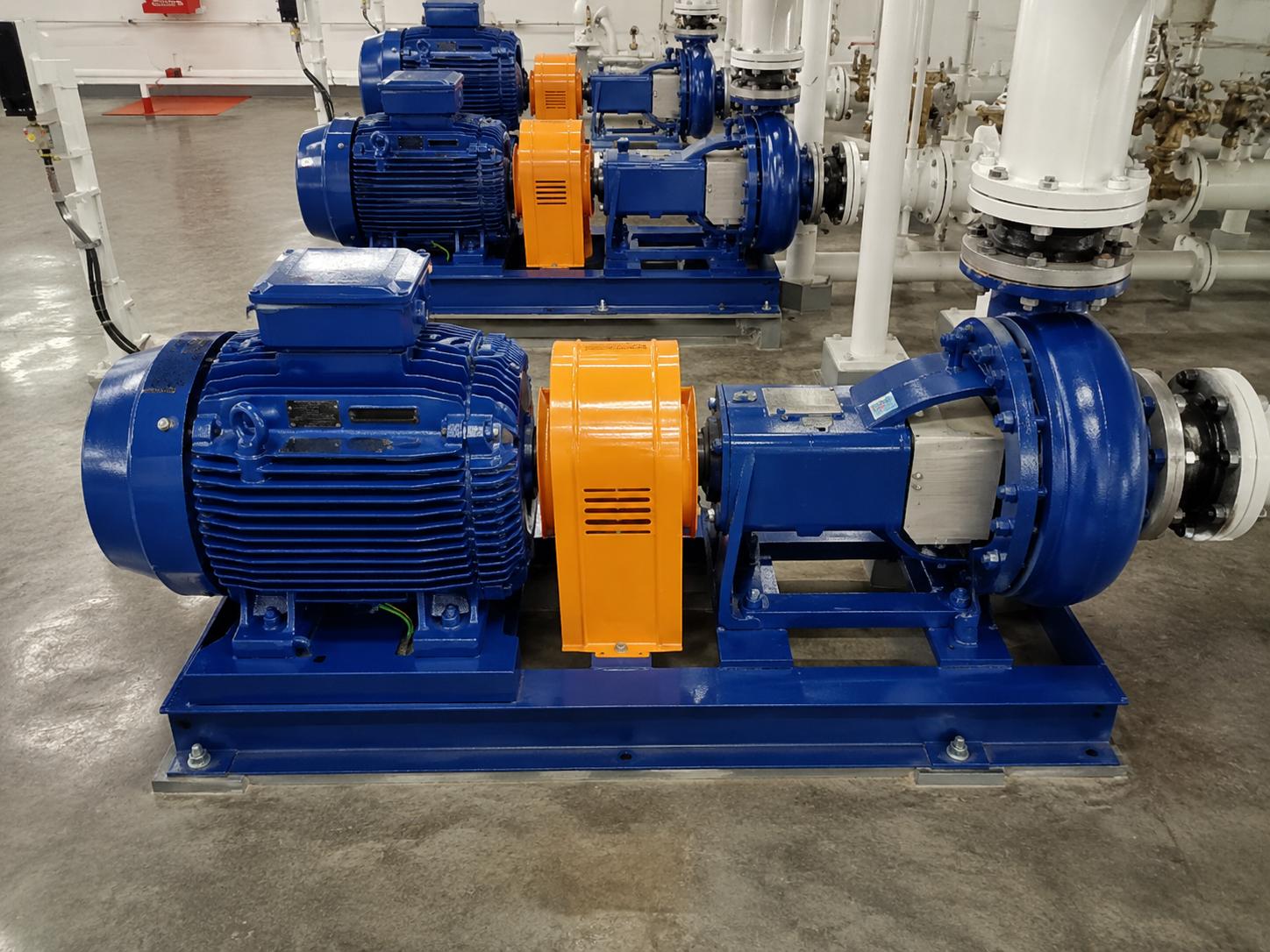
Check Valve Selection: The Unsung Hero of Water Hammer
Another factor as important as the right motor and drive is the type of check valve and its closing behavior. A traditional swing check valve slams shut hard once reverse flow begins after the flow stops, amplifying the shock. A spring-loaded (nozzle) check valve or a slow-closing damped check valve seats before the disc gains speed, greatly reducing the shock. Combining a soft-stopped pump with a slow-closing check valve is the ideal protection package.
| Check Valve Type | Closing Speed | Water Hammer Risk | Suitable Application |
|---|---|---|---|
| Swing | Slow, with reverse flow | High | Short line, low pressure |
| Spring nozzle | Very fast, before reverse flow | Low | High head, long line |
| Slow-closing damped | Adjustable, controlled | Very low | Transmission main, large pump |
| Dual plate | Medium-fast | Medium | General purpose |
How to Choose the Right Motor and Drive Combination
Managing water hammer requires not only drive settings but also an appropriately selected motor. During frequent starts/stops or ramped stops the motor may not cool adequately while running at low speed; therefore, in high-inertia fan applications a motor with a forced (separate) cooling fan is preferred. In applications where reverse flow can spin the motor backward, mechanically robust cast-iron frame motors stand out. For drive operation, inverter-duty winding is important so the insulation withstands voltage spikes. HEM Motor stocks a wide power-speed range of IE3 and higher-efficiency, soft-starter and VFD compatible motors suited to pump and fan applications.
- Pump: 2 or 4 pole, power sized to head and flow, paired with a slow-closing check valve.
- Fan/exhauster: power sized to impeller inertia plus a brake resistor; forced cooling if needed.
- For drive operation: inverter-duty winding and correct grounding/EMC connection.
- Where mechanical stress is high: cast-iron frame and reinforced bearings.
Additional Mechanical Measures That Reduce Water Hammer
Besides the soft-stop on the motor and drive side, there are classic engineering solutions on the hydraulic side that damp the shock. Used together with soft-stop, they create layered protection so you do not depend on a single measure:
- Surge tank / air vessel: Temporarily stores and releases the pressure wave, lowering the peak pressure.
- Air chamber: A trapped air cushion softens the inertia of the water column.
- Flywheel: Inertia added to the pump shaft slows the speed decay when power is lost, preventing an abrupt stop of the flow; especially effective in uncontrolled stops such as a power outage.
- Pressure relief / safety valve: Opens when a set threshold is exceeded to release excess pressure.
- Air valve (vacuum breaker): Admits air into the pipe during a negative pressure wave, preventing column separation (cavitation followed by a column-rejoin shock).
An important point: soft-stop only protects during planned, controlled stops. In a sudden power outage the drive also goes offline, so no ramp can be applied; in that scenario passive measures such as a flywheel, air vessel and a suitable check valve take over. That is why on critical transmission mains the correct approach is to design both active (drive-based) and passive (mechanical) protection together.
Commissioning and Field Checklist
Water hammer protection does not end with selecting the right equipment; it must be set and verified in the field. The following steps should not be overlooked during commissioning:
- Gradually lengthen the drive stop ramp according to the measured shock amplitude; monitor the peak pressure with a gauge or pressure recorder.
- Listen to the closing sound and vibration of the check valve; a hard "slam" is a sign of shock, so lengthen the ramp or reconsider the valve type.
- On high-inertia fans, check the brake-resistor temperature and the drive DC-bus voltage at the moment of stopping.
- Verify whether the motor is rotating backward (reverse flow) by checking phase sequence and rotation direction.
- Test the emergency-stop (E-stop) scenario; since the ramp is bypassed in that case, evaluate whether the passive measures are sufficient.
- If the motor must run at low speed for a long time, monitor winding and bearing temperatures and add forced cooling if needed.
These checks ensure that a system that looks correct on paper also runs safely in the field. Many water hammer failures stem not from wrong equipment selection but from a ramp set too short or the wrong check valve type.
Frequently Asked Questions
Is it possible to fully eliminate water hammer?
Zeroing it out is not always economical, but with a soft-stop ramp, the right check valve and, where needed, a surge tank/air vessel, the shock amplitude can be brought well below safe limits. What matters is staying under the pipeline's withstand limit.
Should I choose a soft-starter or a VFD?
If soft starting and stopping are enough, a soft-starter is economical. But if you need flow control, energy savings and precise stops on high-inertia fans, choose a VFD. On high-inertia fans a VFD plus a brake resistor is practically mandatory.
How long should I set the stop ramp?
The longer the line, the higher the static head and the larger the fluid mass, the longer the ramp. On long transmission mains, 20-60 seconds is typical. Because a very long ramp can heat the motor at low speed, cooling and duty type must also be considered.
Conclusion and Supply
Water hammer is a silent threat that wears out the motor, check valve and pipeline in pump and fan systems when no precautions are taken. With the right stop ramp, a suitable check valve and a motor-drive combination chosen for water hammer, this risk is brought under control. At HEM Motor we offer fast delivery from manufacturer stock, soft-starter/VFD compatible motors and application-specific technical support for your pump, fan and exhauster applications. Reach us with your project's flow, head and inertia figures; let us make the correct power-speed selection together and prepare a tailored quote for you.
Related guides: Star-Delta vs Softstarter, Soft Starter Compatibility on IE3 Motors, VFD with Asynchronous Motor, Pump-Fan Motor Inertia (GD²) and Starting and Regenerative Braking and Brake Resistor Selection.