English
 Türkçe

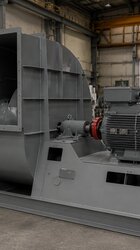

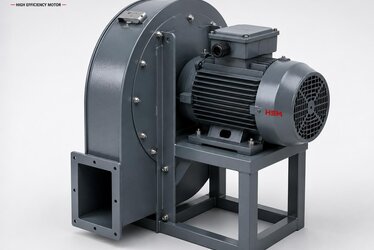
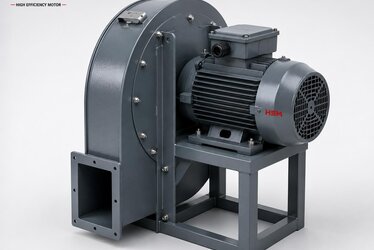
In variable air volume (VAV) fan and exhaust applications, the most critical decision is how you control airflow. For years many facilities have throttled fan flow by closing a damper or choking a vane; yet this approach wastes energy as heat, needlessly stresses the motor and lowers efficiency. The correct solution is to drive the fan motor with a variable frequency drive (VFD) and adjust its speed. Thanks to the affinity laws, when speed drops the fan power falls by a cubic ratio; a twenty percent speed reduction can mean nearly half the energy. In this article we walk step by step through motor and drive selection for VAV fans and exhausters, the minimum flow limit, the stall risk, the low-speed cooling problem and drive-motor compatibility. At HEM Motor our goal is to help you pick the right power and efficiency class and, with fast delivery from stock, get the system right the first time. In applications such as air handling units, stack exhausters, dust collection and process exhaust fans, the right setup both lowers the electricity bill and extends motor life.
Damper Throttling versus Speed Control
Throttling with a damper or vane places an obstruction in the airflow path. The fan keeps spinning at full speed, the motor draws almost full power and the excess energy is dissipated as turbulence and heat. By contrast, when you reduce speed with a VFD the entire fan curve shifts down; the system settles at a new operating point and the motor draws far less power. The difference is dramatic in exhaust and ventilation fans that run long hours at partial load. A damper actually behaves like a pressure-dropping valve; it adds artificial resistance to the system. Part of the pressure the fan produces is spent on this artificial resistance and turns to heat without doing any useful work. A VFD, instead of adding resistance, slows the fan itself, so the total energy used drops at the source.
- Damper throttling: Fixed speed, high power, low efficiency, continuously wearing vane and rising noise.
- By-pass / recirculation: Returns some air but the fan still runs at full speed; savings are limited.
- Inlet vane: Better than a damper but still does not save as much as a VFD.
- VFD speed control: Fan speed drops to match demand, power falls cubically, maximum savings and least mechanical wear.
Another important gain is starting comfort. With a VFD the fan starts up on a smooth ramp; starting current is limited, belt tension is preserved and there is no mechanical shock. In damper systems the motor starts directly at full load every time.
Affinity Laws: Speed, Flow, Pressure and Power
The affinity laws describe how a centrifugal fan or exhauster's outputs relate to speed. Flow is proportional to speed, pressure to the square of speed and power to the cube of speed. This cubic relationship is the mathematical basis for why VAV systems save so much energy. One thing to remember: these relations are for ideal conditions. In real systems, if there is a static pressure component (for example a filter resistance or a height difference) the power curve does not drop exactly cubically; still, the savings potential is extremely high.
| Speed (%) | Flow (%) | Pressure (%) | Absorbed Power (%) |
|---|---|---|---|
| 100 | 100 | 100 | 100 |
| 90 | 90 | 81 | 73 |
| 80 | 80 | 64 | 51 |
| 70 | 70 | 49 | 34 |
| 60 | 60 | 36 | 22 |
| 50 | 50 | 25 | 13 |
As the table shows, running the fan at seventy percent speed brings flow to seventy percent while absorbed power drops to roughly one third. The biggest gains therefore appear in facilities that rarely need nominal flow and mostly run at partial load. To calculate real savings you need your load profile, that is how many hours at each flow. For example, if a ventilation fan spends most of the day at sixty percent flow, more than half the annual energy consumption can be saved. This quickly pays back the initial investment in the motor and drive.
Minimum Flow, Stall and Surge Risk
You cannot reduce fan speed indefinitely. Every fan has a minimum stable operating flow; below this limit the airflow cannot stay attached to the blade and the fan enters the stall region. In stall, flow fluctuates, pressure drops, noise and vibration rise and the blades and bearings fatigue. This region must be avoided especially in backward-curved centrifugal fans and axial exhausters. Stall is not only an efficiency problem but also a life problem; repeated pressure fluctuations can cause fatigue cracks in the blades and premature bearing failure.
- Define a minimum frequency limit in the drive (typically around 20-25 Hz, depending on the fan curve).
- In high-resistance duct systems the minimum flow stays higher; evaluate the system curve together with the fan curve.
- If very low flow is required, consider staged (multiple) fans or on-off logic instead of one large fan.
- In axial fans the surge region is pronounced; in this region noise rises suddenly, which is a warning sign.
The fan maker's curve data should be the basis for determining minimum flow. If the field system resistance differs from the design, the real operating point shifts; therefore it is important to verify with current and vibration measurements during commissioning.
Motor Cooling at Low Speed
A standard induction motor's cooling fan is on the shaft end and turns at the same speed as the motor. As speed drops, the airflow this fan produces also falls; yet if the motor still produces full torque at low speed the heat load may not drop. The result: a motor running continuously at high torque and low speed can overheat. In VAV fan duty this risk is lower than for a pump or conveyor because the load torque falls rapidly with speed; still, take precautions if there is a wide speed range and long low-speed periods. Weakened cooling is not just a momentary temperature rise but a factor that shortens winding insulation life; every ten-degree continuous temperature rise roughly halves insulation life.
- External (forced) cooling fan: a separate constant-speed blower cools the frame independently of the motor and provides speed-independent cooling.
- Selecting a larger frame or power to leave thermal margin while avoiding excessive oversizing for a balanced choice.
- Monitoring winding temperature with a PTC thermistor or PT100 and configuring drive protection.
- Preventing dust buildup on the frame; in dusty environments clogged fins weaken cooling further.
Our articles on running below 50 Hz and the V/f curve and the external forced cooling fan support correct sizing.
Drive-Motor Compatibility and Correct Power Selection
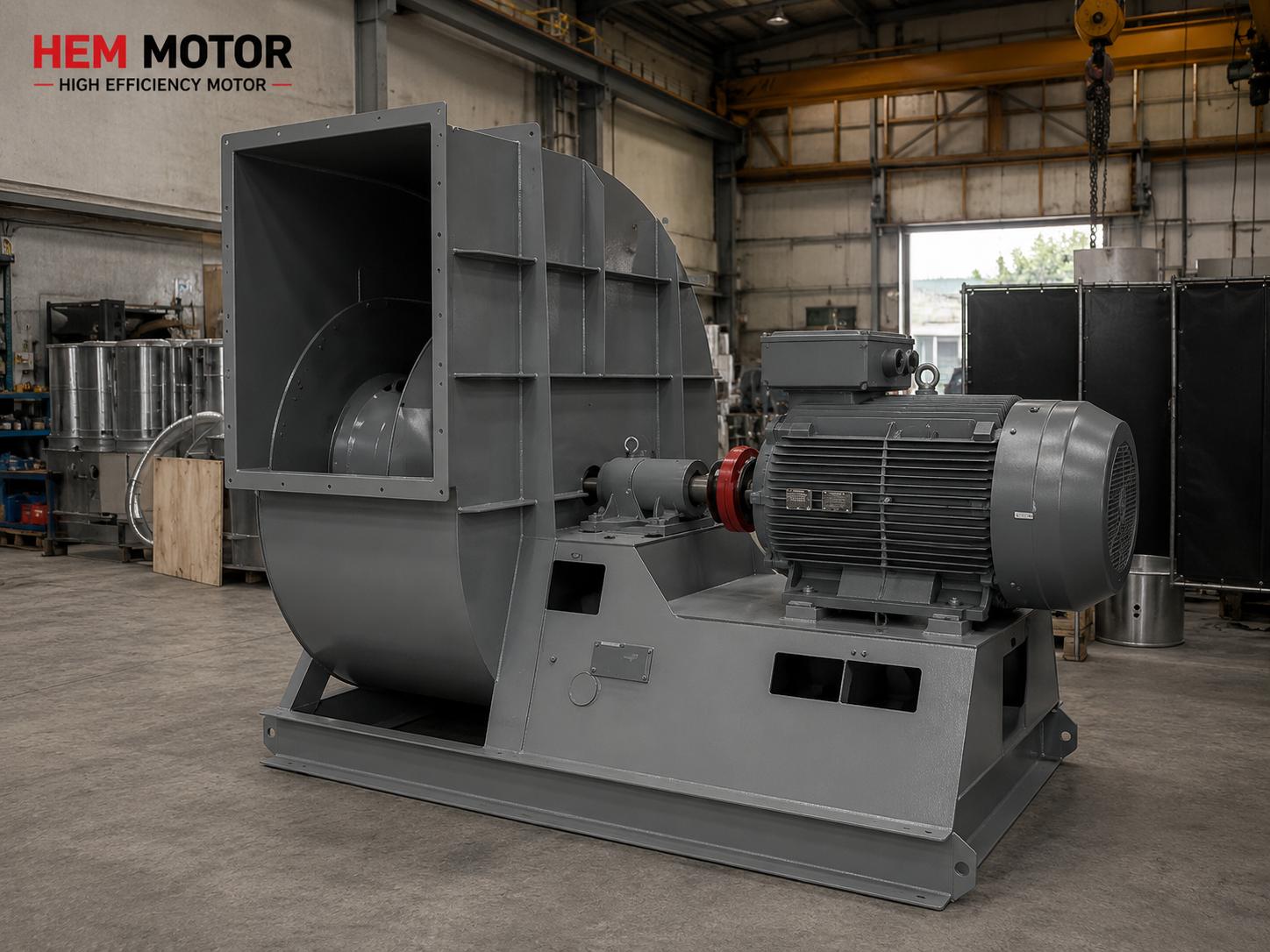
When driving a VAV fan with a drive, the motor should have inverter-duty winding insulation, withstand du/dt voltage spikes and be connected with proper shielded cable. The drive should be sized to the fan's current at its operating point rather than purely to motor power; because the fan load is quadratic the same-rated drive is usually enough, but leave margin for high inertia and long ramp times. In the drive's application profile menu, the variable torque (quadratic torque) mode should be selected; this mode is optimized for fan and pump loads and prevents unnecessary overcurrent.
| Fan type | Typical poles/speed | VFD speed range | Watch out for |
|---|---|---|---|
| Backward-curved centrifugal exhauster | 2-4 pole | 40-100% | Stall limit, minimum frequency |
| Axial ventilation fan | 4-6 pole | 50-100% | Surge at low flow |
| Plug fan (AHU) | 2-4 pole | 30-100% | Inverter-duty winding required |
| High-pressure radial fan | 2 pole | 50-100% | Cooling, critical speed |
For correct power selection it is essential to know the fan's shaft power at its operating point; oversizing hurts both the investment and part-load efficiency. Choosing a motor much larger than needed lowers the power factor (cosφ) and efficiency at partial load. Therefore it is best to select the motor to the real shaft power with a reasonable margin. Our articles on VFD with asynchronous motor selection and power selection in pumps and fans help you size correctly. For grounding and EMC see our shielded cable and bearing current in VFD systems guide, and for continuous-load efficiency in critical plants our continuous-load savings in pumps and fans article.
Commissioning and Control Strategy
The real savings of a VAV system emerge with the right control strategy. The fan speed should not be locked to a fixed value but set in closed loop according to system demand. Typically, with feedback from a pressure or flow sensor, the drive automatically lowers or raises speed to keep the duct pressure constant. This way, when demand falls the fan slows down on its own and energy use drops.
- Keep the duct pressure setpoint as low as possible; unnecessarily high pressure eats part of the gain.
- Tune the PID control parameters gently; sudden speed changes cause duct oscillation and noise.
- Define minimum and maximum frequency limits according to the fan curve.
- Verify the operating point with current, vibration and temperature measurements during commissioning.
Efficiency Class, Investment and Payback
When selecting a VAV fan motor, the efficiency class also matters. Even if a drive-controlled fan motor spends most of the year at partial load, the motor's own efficiency directly affects total consumption. A motor in the IE3 class or above produces slightly fewer losses each hour than its IE2 equivalent, and summed over a year these losses make a significant difference. In large continuously running fans, IE4 or synchronous reluctance (IE5) options, considered together with the drive, can offer the lowest life-cycle cost. The decision here should be made based on the balance of operating hours, electricity price, load profile and initial investment.
The payback calculation needs three components together: the reduction in motor efficiency loss, the large saving from speed control instead of a damper, and the drive's own losses. A drive typically consumes a small percentage of power as loss; however, the gain from the affinity laws is many times greater than this loss. Therefore, in systems that run long hours with frequently changing flow, VFD speed control almost always pays for itself. In short-running, fixed-flow systems that operate rarely, a simple on-off control may be sufficient.
- If annual operating hours are high, moving the efficiency class up one step is usually sensible.
- If flow changes frequently, VFD speed control gives the highest savings.
- Select the motor to the real shaft power; oversizing lowers part-load efficiency.
- Evaluating the drive and motor as a single package is advantageous for compatibility and warranty.
Maintenance, Noise and Long Life
A properly set up VAV fan system usually offers quieter operation requiring less maintenance than a fixed-speed system. Because the fan often turns at low speed, the air noise at the blade tips falls, the load on the bearings eases and in belt systems belt life is extended. Still, some points need attention in long low-speed operation: dust buildup on the motor frame should be cleaned, bearing lubrication intervals should be followed per the manufacturer's recommendation and vibration levels should be measured regularly. Although the noise the motor produces at low speed decreases, drive-induced high-frequency switching noise may appear; this can be managed with the correct switching frequency setting and a filter.
Frequently Asked Questions
Can I still use damper control for a VAV fan?
You can, but it is energy-inefficient. While throttling, the fan keeps spinning at full speed and the motor draws almost full power. With VFD speed control, power drops with the cube of speed, so far less energy is used for the same flow reduction. In systems that run long hours at partial load, a VFD pays for itself within a few years.
How low in Hz can I take the fan?
This depends on the fan curve and system resistance. Generally below 20-25 Hz the stall and surge risk rises and motor cooling weakens. Defining a minimum frequency in the drive and respecting the fan maker's stable operating flow is the safest approach.
Can I drive my existing standard motor with a VFD?
In low-voltage, short-cable systems most standard IE3 motors run with a drive. But with a wide speed range, long cable and frequent switching, inverter-duty winding insulation, a du/dt filter and proper grounding are recommended. If unsure, share your motor nameplate with us and we will assess compatibility together.
Select the Right Motor from HEM Motor Stock
Let us determine together the right power, pole count and efficiency class for your variable air volume fan or exhaust application. With HEM Motor's broad manufacturer stock and fast delivery, we can supply a drive-friendly motor for your VAV system quickly. Share your fan curve and operating point and contact us to request a quote for the most suitable motor. When the right motor, the right drive and the right control strategy come together, you get both energy savings and a long-lived, quiet system.