English
 Türkçe


Running an electric motor below its rated frequency (usually 50 Hz) is the most common way to reduce speed with a frequency drive (VFD). But this seemingly simple operation radically changes the motor's torque production, cooling and heating behaviour. Below 50 Hz the motor runs in the constant-torque region; as long as the correct V/f curve is kept, it largely sustains its torque. However, because the shaft-mounted fan of a self-cooled (TEFC) motor also slows down, its cooling capacity drops, and running continuously at high torque at low speed creates a heating risk. In this article we cover in detail the constant-torque region, the V/f curve, the loss of self-cooling, forced (external) cooling, the logic of derating, and correct sizing with a VFD; the aim is to build a safe and efficient drive at low speed.
The Constant-Torque Region Below 50 Hz
A drive-fed motor runs in the constant-torque region from zero speed up to rated speed. In this region the drive lowers the voltage in proportion as it lowers the frequency (V/f constant), so the magnetic flux stays constant and the motor can produce roughly the same maximum torque at every speed. That is, the torque the motor can produce at 25 Hz is close to that at 50 Hz. Because power is proportional to speed, power falls as frequency drops: at 25 Hz the motor runs at roughly half power but full torque.
This behaviour is ideal for constant-torque loads: loads such as conveyors, extruders and displacement pumps demand the same torque at every speed, and the motor meets this in the constant-torque region. But there is a hidden trap here: torque is preserved, cooling is not. Because the shaft-mounted fan also slows, the motor's heat-rejection capacity falls at low speed. This is exactly where the need for derating and forced cooling arises.
- Constant-torque region (0-50 Hz): V/f constant, flux constant, torque roughly constant.
- Power: Falls in proportion to frequency (~half power at 25 Hz).
- Cooling: The shaft-mounted fan slows, heat-rejection capacity drops.
- Risk: Continuous high torque at low speed = heating.
The V/f Curve: Voltage and Frequency Relationship
The V/f curve sets which voltage the drive applies at each frequency. In the basic (linear) V/f curve the voltage/frequency ratio is constant; for example keeping the 400 V / 50 Hz ratio, about 200 V is applied at 25 Hz. This keeps the flux constant and so provides constant torque. But at very low frequencies (for example below 5-10 Hz) the voltage drop across the stator resistance becomes dominant and the flux falls; so drives apply torque boost (IR compensation) at low frequency: they raise the voltage slightly at low speed to preserve starting and low-speed torque.
Different V/f profiles can be chosen by load type. A linear V/f is used for constant-torque loads, and a quadratic V/f profile for pumps/fans (variable, quadratic torque); the latter lowers the voltage more at low speed, providing energy savings. We covered the savings from the affinity law in pumps and fans in our VFD pump-fan energy savings, affinity law article, and when a VFD is needed in our VFD with asynchronous motor article.
| Frequency | Speed (4-pole, approx.) | Voltage (linear V/f) | Maximum torque | Power |
|---|---|---|---|---|
| 50 Hz | ~1500 rpm | 400 V | 100% | 100% |
| 40 Hz | ~1200 rpm | 320 V | ~100% | ~80% |
| 25 Hz | ~750 rpm | 200 V | ~100% | ~50% |
| 10 Hz | ~300 rpm | 80 V + boost | preserved with boost | ~20% |
Self-Cooling (TEFC) Loss and Heating at Low Speed
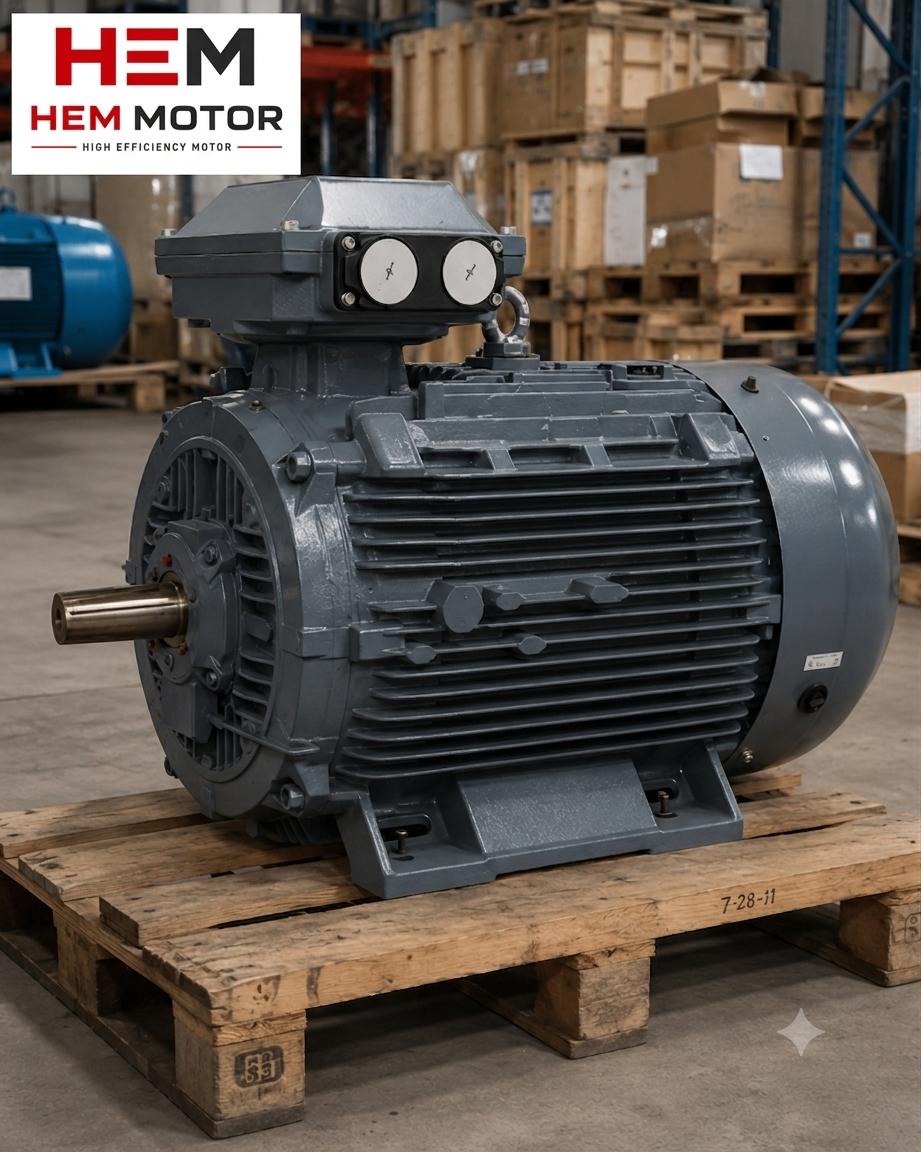
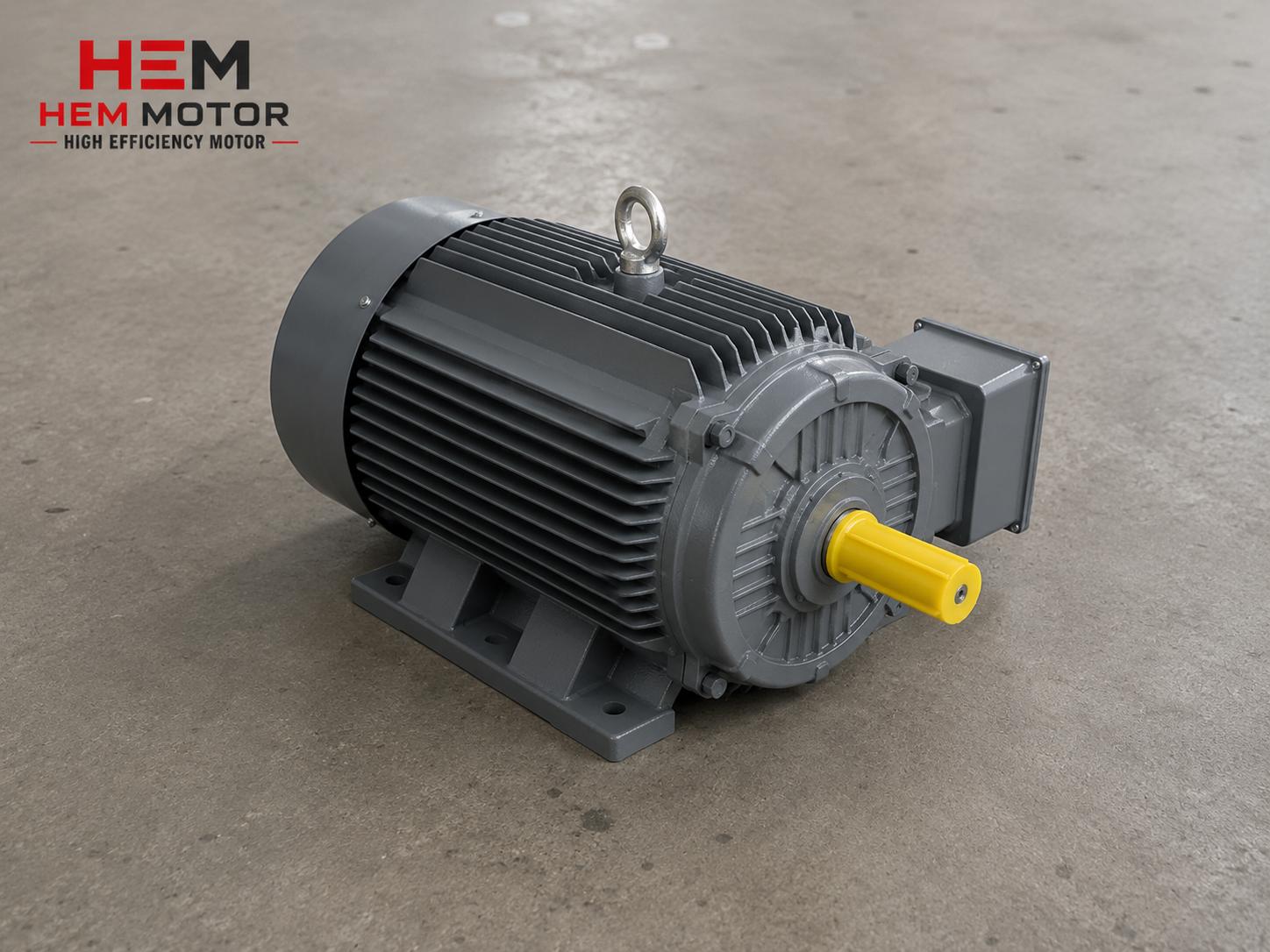
Most standard industrial motors are TEFC (Totally Enclosed Fan Cooled): a fan at the shaft end and rear of the body cools the housing. Because this fan is mounted on the motor shaft, as the motor slows the fan slows and the cooling air flow drops. Since the cooling the fan provides varies roughly with the square of speed, when speed halves the cooling falls much more. The result: a motor running at the same torque (so similar current) at low speed heats up because it is cooled less.
For this reason a TEFC motor that will run over a wide speed range on a constant-torque load (especially long durations at low speed) must be protected either by derating (lower load at low speed) or by forced (external) cooling. Otherwise the winding temperature can exceed the insulation limit and motor life is shortened. You can find the cooling methods (IC411 natural shaft fan, IC416 external fan) in detail in our cooling methods IC411 and IC416 article.
When Is Forced (External) Cooling Needed?
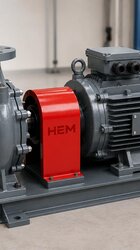
Forced cooling means adding a separately powered fan (usually with a small auxiliary motor) at the rear of the motor. This fan provides constant, full air flow independent of the main motor's speed; so the motor gets full cooling even at very low speed. Forced cooling is needed in these cases:
- When high torque (constant-torque load) is needed for long durations at low speed.
- When continuous running over a wide speed range is wanted.
- When full torque must be preserved without derating.
- Where high ambient temperature and low speed combine.
A forced-cooling fan is usually a more economical solution than derating: derating may require choosing a larger (and more expensive) motor, while an external fan lets the existing motor run at full torque across its whole speed range. We covered the external fan for continuous low-speed torque on a VFD in our external forced cooling fan article, and the forced-fan option in our accessory options (brake, encoder, forced fan) article.
Derating: Reducing the Load at Low Speed
If forced cooling is not used, the motor is protected at low speed by derating: that is, at low speed the motor is loaded not with full torque but with a lower torque. In a typical TEFC induction motor the allowed continuous torque falls as the speed drops; for example at very low speeds only a certain fraction of rated torque is allowed. The derating curve depends on the motor design and cooling type; the maker's thermal limit curve for drive operation should be used as the basis.
The derating approach is usually sufficient if the load profile does not need high torque at low speed (for example variable-torque pump/fan), because these loads already demand low torque at low speed and heating is not a problem. But on constant-torque loads derating can mean choosing a larger motor, in which case forced cooling is more economical. You can study other derating reasons such as voltage unbalance in our voltage unbalance and derating article, and high-altitude/hot-ambient derating in our high altitude and hot environment derating article.
Correct Sizing with a VFD
To correctly size a motor that will run below 50 Hz, you must assess the load profile, the speed range and the duty type together. The basic questions are:
- Is the load constant torque or variable torque? (A conveyor or a pump/fan?)
- What is the lowest running speed and how much torque is needed there?
- How long is the run at low speed? (Momentary or continuous?)
- What are the ambient temperature and altitude?
By these answers there are three routes: (1) a standard motor + suitable V/f, if there is no continuous high torque at low speed; (2) a force-cooled motor, if full torque is needed over a wide range; (3) choosing a motor one size up (derating margin). The right choice both prevents heating and avoids the cost of an unnecessarily large motor. We covered power selection by constant-torque and variable-torque load types in our constant torque, constant power and variable torque load type article.
Frequently Asked Questions
Does torque drop when I run the motor below 50 Hz?
As long as the correct V/f curve is kept, the maximum torque the motor can produce in the constant-torque region stays roughly the same; what falls is the power (power is proportional to speed). That is, at 25 Hz the motor runs at full torque but roughly half power. However, at very low frequencies torque boost may be needed, and because cooling drops there is a heating risk at continuous high torque.
Can I run every motor continuously at low speed?
No. A standard TEFC motor's shaft-mounted fan cools insufficiently at low speed. If high torque is needed for a long time at low speed, you must either add forced (external) cooling, or apply derating, or choose a motor one size up. On variable-torque loads (pump/fan) the torque is already low at low speed, so it is usually not a problem.
Is forced cooling or a larger motor more sensible?
Usually forced cooling is more economical, because it lets the motor at the existing rating run at full torque across its whole speed range. Choosing a larger motor (derating margin) is both more expensive and can lower efficiency at low load. The decision should be made by the load profile, the duration of low-speed running and the ambient conditions.
Practical Tips for the Right Choice
- Determine the load type: constant torque or variable torque?
- Clarify the lowest speed and the torque need at that speed.
- If there is continuous high torque at low speed, add forced cooling.
- Otherwise limit the load by the derating curve or choose a size up.
- Use linear V/f on constant-torque loads, quadratic V/f on pumps/fans.
- Monitor the winding temperature with PT100/PTC.
Insulation Class and Thermal Margin
When assessing the heating risk at low speed, the motor's insulation (thermal) class is a decisive margin. The common F-class insulation, when run at a B-class temperature rise, leaves a certain thermal reserve (margin); this reserve allows it to tolerate to some extent the extra heating caused by reduced cooling at low speed. A higher H-class insulation offers a wider thermal margin, protecting life in demanding thermal conditions. But the insulation class is not a solution on its own; where cooling is insufficient, forced cooling or derating is still needed.
Monitoring the winding temperature in real time is the foundation of safety in motors running at low speed. With a PT100 or PTC thermistor the winding temperature is continuously monitored; when a certain threshold is exceeded, the drive or protection relay stops the motor or reduces the load. This protects both the insulation and (if present) the bearing grease from excessive temperature. We covered the effect of insulation and thermal class on temperature rise in our insulation and thermal class (F/H) and temperature rise article, and temperature-monitoring wiring in our temperature monitoring with PT100 and PTC thermistor article.
The Practical Difference on Constant-Torque and Variable-Torque Loads
The consequences of running below 50 Hz depend largely on the load type. To make this concrete, let us compare two typical scenarios. A conveyor (constant-torque load) demands almost the same torque even at reduced speed; so the motor runs near full current at low speed, and because cooling is reduced the heating risk is high. Here forced cooling or derating is a real need.
In contrast, a centrifugal pump or fan (variable/quadratic torque load) demands far less torque at low speed; because torque falls with the square of speed, at 50% speed the torque drops to about 25%. In this case the current also drops, and even though cooling is reduced, heating is usually not a problem. This is why in pump and fan applications a wide speed range with a VFD mostly needs no extra cooling and provides large energy savings. You can find pump-fan savings with a high-efficiency motor in our high-efficiency motor, frequency drive and pump-fan savings article, and the detail of the affinity law in our affinity-law article mentioned above. In short, correctly defining the load type determines both the cooling solution and the savings potential.
At HEM Motor we offer motors that will run over a wide speed range with a VFD, force-cooled and correctly derated where needed, with fast delivery from stock. To determine the right motor and cooling solution for your load profile, your lowest speed and your ambient conditions, to build a safe and efficient drive at low speed, and to request a quote, get in touch with our engineering team. By sizing your motor correctly, let us both prevent heating and avoid unnecessary cost.