English
 Türkçe

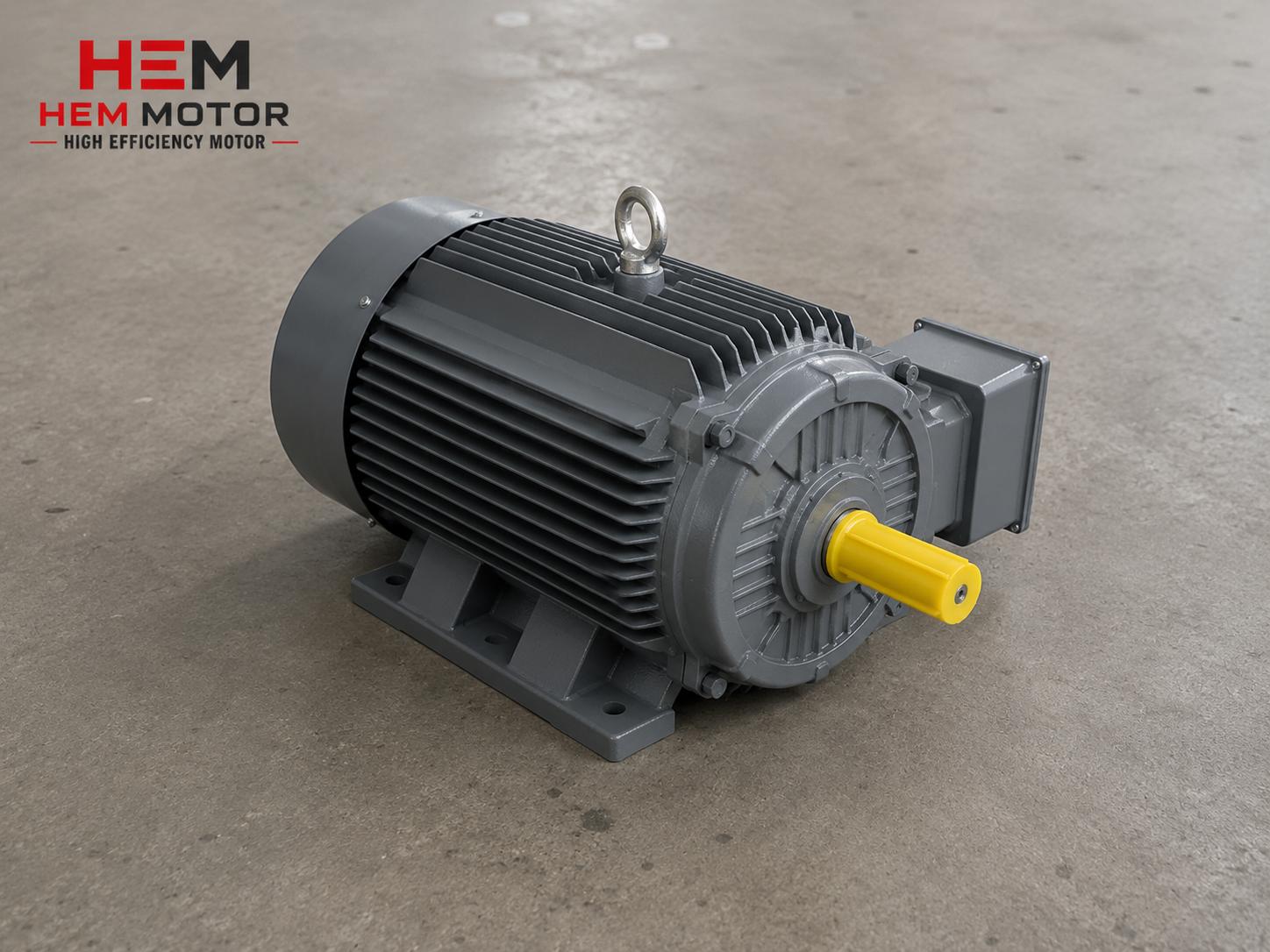

The power stated on an asynchronous motor's nameplate assumes a balanced (symmetrical) three-phase supply. In a real grid, however, the voltages of the three phases are often not exactly equal; small differences exist between the phases. This difference is called voltage unbalance, and even an apparently small percentage causes a disproportionate extra heating and loss of life in the motor. For this reason motor manufacturers and standards such as NEMA recommend reducing the motor's power (derating) under voltage unbalance. In this article we examine how voltage unbalance is calculated, why it causes extra heating, how the NEMA derating curve is applied and the methods to protect against unbalance, from an engineering perspective.
What Is Voltage Unbalance and How Is It Calculated?
Voltage unbalance expresses how much the voltages of the three phases deviate from each other. The practical definition NEMA commonly uses, the percent voltage unbalance, is calculated as follows:
% Unbalance = (Maximum deviation from the average / Average of the three phase voltages) × 100
For example, if the three phase voltages measure 400 V, 395 V and 388 V: Average = (400 + 395 + 388) / 3 = 394.3 V. The maximum deviation is 400 − 394.3 = 5.7 V (the most distant value is 400 V). Unbalance = 5.7 / 394.3 × 100 ≈ 1.45%. In this example the unbalance is around 1.5% and below the limit; however, attention is needed above 2%, and a serious problem begins above 5%.
For general grid voltage tolerance topics see IE3 motor voltage tolerance and grid fluctuation, and for rated voltage and frequency effects rated voltage and 50/60 Hz difference.
Why Does Extra Heating Occur? The Negative-Sequence Effect
An unbalanced three-phase system can be decomposed by the symmetrical-components method into positive, negative and zero sequence components. In a balanced system only the positive sequence exists and creates the motor's rotating field. When unbalance appears, a negative sequence component arises. The negative sequence produces a magnetic field rotating in the opposite direction to the motor's normal rotation.
This reverse field rotates at a very high relative speed with respect to the rotor (about twice synchronous speed); it induces high-frequency currents in the rotor and creates a large extra loss (extra heat). The key point is this: the effect of the negative sequence on the motor is highly disproportionate. A small percentage of voltage unbalance produces a much larger current unbalance in the motor; the current unbalance can be about 6-10 times the voltage unbalance. As a result, the winding in the most loaded phase heats up much more and insulation life shortens.
For the effect of heating on insulation life see temperature rise class (80K), and for winding temperature monitoring temperature monitoring with PT100 and PTC.
NEMA Derating Curve: Power Reduction
To keep the motor from suffering extra heating under voltage unbalance, it must be operated at a lower power than rated. The NEMA MG-1 standard defines this power reduction with a derating curve. The practical meaning of the curve is:
- Up to 1% unbalance: no derating needed; the motor can run at rated power.
- At 2% unbalance: derating factor about 0.95 (i.e. ~95% of rated power).
- At 3% unbalance: derating factor about 0.88 (i.e. the motor must be run at ~88% of rated power, roughly a ~10-12% power reduction).
- At 4% unbalance: derating factor about 0.82.
- At 5% unbalance: derating factor about 0.75; NEMA recommends not operating the motor above this level.
So even a relatively small unbalance such as 3% reduces the motor's usable power by about 10%. The curve descends much more steeply as unbalance increases, which shows why high unbalance is dangerous. The derating logic is applied similarly at high altitude and hot environments; on this topic see derating at high altitude and hot environment and derating at high ambient temperature.
Causes of Voltage Unbalance
Understanding the source of unbalance is essential for a lasting solution. The main causes:
- Unbalanced single-phase loads: when lighting, sockets and single-phase machines in a three-phase grid are not distributed equally across the phases, one phase is loaded more than the others and its voltage drops.
- Weak or long grid: on supply lines far from the transformer, of thin cross-section or overloaded, the voltage difference between phases grows.
- Loose connections and high contact resistance: high contact resistance in one phase at a terminal, fuse or contactor lowers that phase's voltage.
- Transformer or capacitor faults: a step fault in reactive power compensation can affect the phases unevenly.
- Partial loss in one phase: if one phase weakens without being completely lost, severe unbalance occurs.
The complete loss of one phase (phase loss) is a separate and more dangerous condition; we cover it in our article on single phasing (phase loss) and burnout risk. The subject of this article, however, is the unbalance condition where phases are present but not equal.
The Correct Approach to Protection
The most effective way to protect the motor against voltage unbalance is to use a protection relay that both measures the unbalance and disconnects the circuit when a threshold is exceeded:
- Phase protection / unbalance relay: monitors phase sequence, phase loss and voltage unbalance; stops the motor when the set threshold (for example 5-10% current unbalance) is exceeded.
- Thermal overload relay (phase-sensitive): modern thermal relays are sensitive to single phasing and unbalance; they trip faster under unbalance.
- Motor protection circuit breaker (MPCB): an MPCB set to the rated current provides additional protection.
For protection device selection see thermal, relay and fuse selection and motor protection circuit breaker (MPCB) setting. Also, the lasting solution to unbalance is usually rebalancing loads on the electrical side and eliminating loose connections; running the motor continuously with derating is a measure but does not solve the root cause.
Motor Selection and Unbalance Tolerance
On weak grids where unbalance is common, selecting the motor with some margin (slightly higher power) or choosing a quality motor designed with Class F insulation and low temperature rise increases robustness. Oversizing also has its own disadvantages (loss of efficiency and power factor at low load); balance matters. For correct sizing see motor load ratio and correct sizing and for power factor power factor (cos phi) and correction.
On generator-fed sites, voltage regulation and unbalance can be more critical; see motor selection on generator-powered sites. To explore the product family, see our asynchronous AC motors, electric motors and, for efficient options, IE3 efficient motors categories.
Applying the Derating Calculation Step by Step
Once voltage unbalance is measured, applying derating is simple in practice. First the three phase voltages are measured and the unbalance percentage is calculated. Then the derating factor corresponding to this unbalance is read from the NEMA derating curve. Finally the motor's rated power is multiplied by this factor to find the safe usable power. For example, if a motor with a 30 kW rated power runs under 3% unbalance: usable power ≈ 30 × 0.88 = 26.4 kW. So this motor should not be loaded above 26.4 kW; otherwise the winding in the most loaded phase overheats.
This calculation points to a different decision where reducing the motor's load is not possible: stepping the motor up to a higher power. If you want 26.4 kW of work under 3% unbalance, you can keep its derated capacity above the need by selecting a motor with a higher rated power (for example 37 kW). However, this approach increases initial cost and lowers power factor and efficiency at low load; therefore the priority should always be to eliminate the root cause of the unbalance. For correct power selection and load ratio see motor load ratio and correct sizing and understanding HP-kW power.
Other Effects of Unbalance: Torque, Vibration and Efficiency
Voltage unbalance not only creates heating; it also disrupts the motor's mechanical and electrical behavior. The reverse field created by the negative sequence produces a braking torque opposing the main torque; this lowers the net torque and makes starting harder especially under high load. Moreover, unbalanced currents and the reverse field create a vibration and hum at twice the line frequency (100 Hz) in the motor; this vibration both increases noise and contributes to mechanical fatigue. Efficiency also drops, because the extra losses are wasted energy.
These effects show that unbalance is not just a "heating" problem but a power quality problem affecting the motor's overall performance and life. For speed-torque behavior see speed-torque curve and breakdown torque, and for noise sources noise sources (magnetic, mechanical).
Measuring and Monitoring Unbalance
The first step in managing unbalance is to measure it. The three phase voltages can be measured with a simple multimeter and the percentage unbalance calculated; however, for a real assessment, measurements must be taken under load at different times (start of shift, peak hour), because unbalance changes with the load profile. In more advanced facilities, voltage and current unbalance are continuously logged with a power quality analyzer; this makes it easier to find the root cause (which load, at what hour, increases the unbalance). For the value of load profile logging, see our motor load profile and data logging article.
It is important to also look at current unbalance during measurement, because the actual thermal effect on the motor is shown by the current unbalance. A 2-3% unbalance in voltage can reach 15-25% in current. If the current of the most loaded phase is significantly higher than the others, that winding is the fastest-aging component. Therefore protection relay settings are made based on current unbalance.
Difference Between Single Phasing and Unbalance
Voltage unbalance should not be confused with single phasing (phase loss); they are events of different severity. In unbalance, all three phases are present but their voltages are not equal; this causes gradual, insidious heating. In single phasing, one phase disappears completely; the motor tries to run on two phases, very high current flows through the remaining two windings and the motor can burn out within minutes. Single phasing is the most extreme and dangerous form of unbalance. For detail on this topic, see our single phasing (phase loss) and burnout risk article. A good protection relay protects the motor by monitoring both conditions (unbalance and full phase loss). VFD and harmonic-related extra heating is a separate topic; see VFD and harmonic-related heating.
Frequently Asked Questions
From what percentage is voltage unbalance dangerous?
According to NEMA, no derating is needed up to 1%. Power reduction (derating) begins from 2%; at 3% about a 10% power reduction is required. Above 5%, operating the motor is not recommended, because extra heating rapidly ages the insulation.
Why does small voltage unbalance create large current unbalance?
The negative sequence of the unbalance rotates at a very high relative speed with respect to the rotor and behaves like a low-impedance circuit. Therefore the current unbalance becomes about 6-10 times the voltage unbalance, and disproportionate heating appears in the most loaded phase.
How do I prevent unbalance?
The lasting solution is to distribute single-phase loads equally across the phases, eliminate loose/high-resistance connections and improve the grid cross-section. As temporary/additional protection, an unbalance (phase protection) relay and a phase-sensitive thermal relay are used; if needed, the motor is run with derating.
Get a Quote
Contact us for robust asynchronous motor selection and protection solutions suited to your facility with a weak grid and voltage unbalance. To supply the right power, insulation and protection equipment, request a quote on +90 (532) 345 49 86 or via our contact page.
Voltage Unbalance and Derating Checklist
- Measure the three phase voltages and calculate the unbalance percentage.
- Above 2% unbalance, reduce usable power by applying the NEMA derating factor.
- Above 5% unbalance, do not run the motor; first eliminate the root cause.
- Distribute single-phase loads equally; check loose/high-resistance connections.
- Use a phase protection / unbalance relay and a phase-sensitive thermal relay.
- Monitor winding temperature with PT100/PTC under continuous load.
- On weak grids, prefer a quality motor with Class F insulation and low temperature rise.