English
 Türkçe


You are about to order a motor for a new machine, and there is always the same hesitation in the room: "Let me buy one a bit bigger, just to be safe." Yet an oversized motor wastes money, while an undersized motor is constantly strained, overheats and shortens its own life. The key to the right decision is how much of the motor's rated power you actually use, in other words the load ratio. In this guide we explain, from a purchasing perspective, the relationship between load ratio and efficiency, why the 75-100% load band is ideal, and how to select the right kW the first time.
At HEM Motor we have been manufacturing electric motors since 1979 and supply a wide power range quickly from our stock in Turkey. Correct sizing determines not only the initial investment but also the energy the motor will consume in the field over many years. That is why, at the quotation stage, we ask you for the real load profile of the application; because as much as the kW written on the nameplate, how much of that kW is actually used matters too.
What Is Load Ratio and How Does It Affect Efficiency?
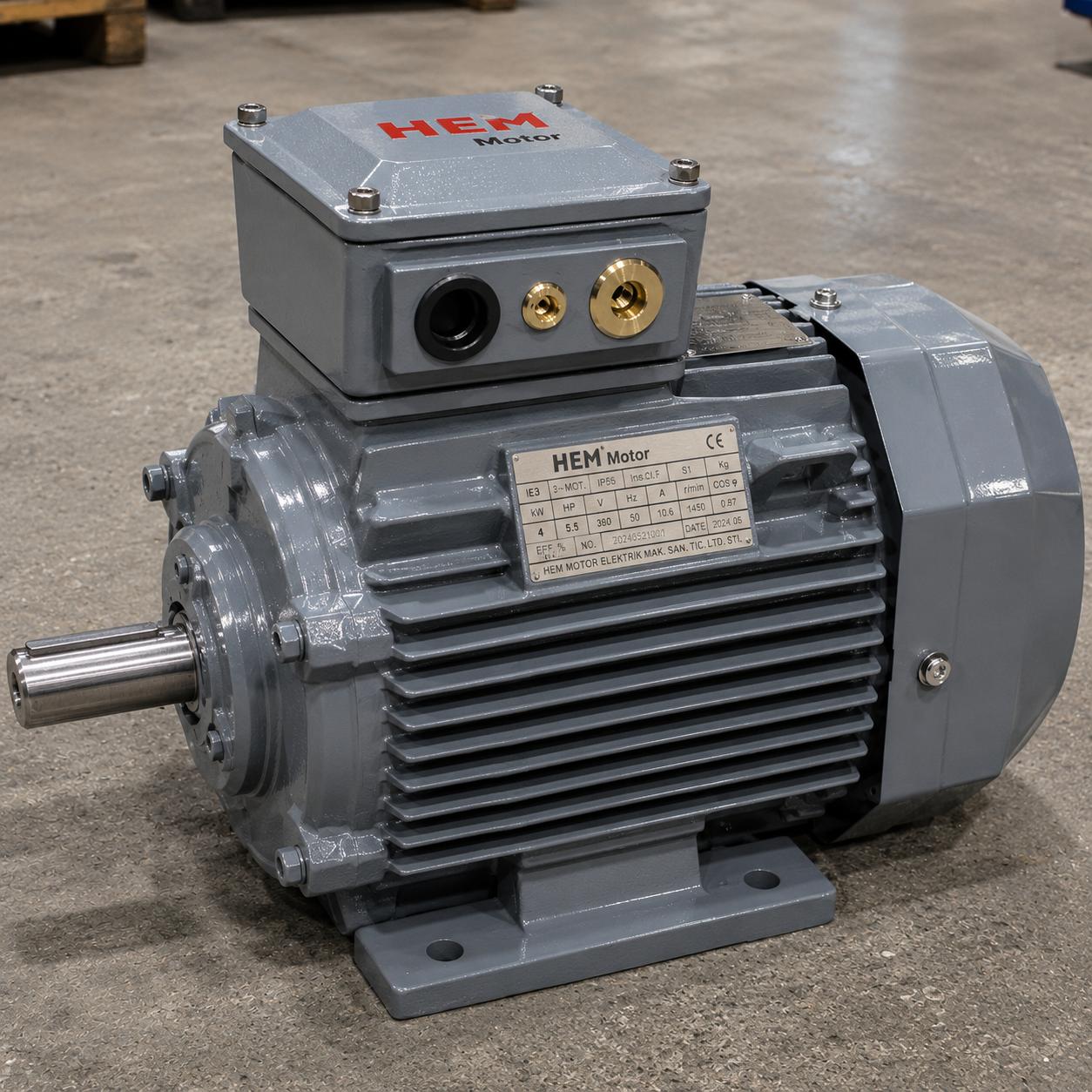
The load ratio is the ratio of the mechanical power you draw from the motor shaft to the rated power written on the motor's nameplate. If your application continuously draws 5.6 kW from a motor with 7.5 kW on its nameplate, the motor is running at roughly 75% load. An asynchronous motor reaches its highest efficiency in the band from slightly below full load up to full load. This comes from the nature of motor design: while winding losses increase with load, iron and friction losses are largely independent of load. At low load these fixed losses make up a large share relative to the small power produced, so efficiency drops.
The practical outcome is this: running a motor at its most efficient point, that is close to full load, lowers operating cost. If you select an oversized motor and run it at only 30-40% of load, that motor never reaches its rated efficiency; moreover the power factor also falls, which means reactive consumption and an additional burden on the grid side. Even if you choose a high-efficiency electric motor with a high efficiency class, incorrect sizing eats up most of that efficiency advantage.
Oversized Motor: Expensive and Inefficient
The cost of choosing an oversized motor is twofold. The first is the investment cost: a larger frame, a larger flange and shaft, and often a larger panel and cable; you pay more from the start. The second, and more insidious, is the operating cost. Because a motor running in the low-load band does not reach its rated efficiency, it consumes more energy than you expected over the years. For a continuously running drive, this difference can turn into an energy bill that compounds the purchase price of the motor.
Another side effect is the power factor. The cos φ value of a lightly loaded asynchronous motor drops noticeably; if compensation at your facility is insufficient, the risk of a reactive penalty arises. In other words, the extra kW bought thinking "I might grow later" often remains idle capacity and keeps loading cost onto your back. If the chance of growth really is high, instead of oversizing the motor it is wiser to choose a standard frame and mounting type that will make future replacement easy.
Undersized Motor: Constant Strain
The opposite situation is not healthy either. A motor that continuously draws a load above its rated power, that is beyond 100%, is overloaded. This means the winding temperature pressing against the insulation limits, heat-driven accelerated ageing and a shortened lifespan. Although a certain margin (the service factor) exists for short-term peaks, this margin is not a licence to run continuously overloaded. A continuously overloaded motor also causes production stoppages, because the protection relay trips frequently.
The right approach is to choose a kW that safely covers the expected continuous load and leaves a reasonable margin above it. For general industrial drives, a point where the continuous load corresponds to 75-90% of the motor is both efficient and safe. From the standard electric motors that offer a wide range in standard ratings, choosing the next size up closest to your calculated power is a practical rule.
Why Is the 75-100% Load Band Ideal?
When you look at the efficiency curve, an asynchronous motor shows its highest and flattest efficiency plateau in the region from roughly three-quarters of rated load up to full load. In other words, as long as your load wanders between 75% and 100%, efficiency stays almost at its peak; this lets you capture both a safe margin and the best energy performance at the same time. Below this band, efficiency and power factor fall; above it, the risk of overheating and shortened life rises.
For this reason, the goal in sizing is to place the continuous operating load within this band. For example, in an application that continuously needs 4 kW of mechanical power, a 5.5 kW motor runs at roughly 73% load; this is a reasonable point. If you fit 11 kW to the same job, the motor stays at 36% load and drops far below the efficiency plateau. Knowing the drive type and load character is decisive here: variable-torque loads such as pumps and fans require a different margin than constant-torque loads such as conveyors.
Power Margin by Application
In drives that draw constant torque, such as conveyors, crushers and mixers, the load is largely constant; here it is enough to choose one size just above the actual load. In variable-torque loads such as pumps and fans, because power changes cubically with speed, it is sensible to leave a slightly larger margin against shifts in the operating point. If there is high inertia or frequent starting and stopping, the heating during start-up must also be taken into account.
Speed selection is as important as the load ratio; the same power produces different torque at different pole numbers. To clarify which pole number suits your job, you can make use of our guide on 2, 4 and 6-pole motor selection. Evaluating power and speed combinations together lets you capture both the right kW and the right speed in one go.
Verifying the kW Calculation from the Nameplate and the Application
When replacing an old motor, the kW on the nameplate is a good starting point, but assuming that motor was correctly selected too can be a mistake. Where possible, estimating the real load by measuring the current the existing motor draws in the field prevents dropping to an unnecessarily large or small size. If the nameplate power is in HP, converting it to the correct kW is the first step of the order; you can find this conversion step by step in our article on HP and kW power conversion.
If you are selecting from scratch for a new machine, take the shaft power recommended by the machine manufacturer as the basis and determine the size that places it in the 75-90% load band. You do not have to solve all these factors on your own; when you tell us the application, the continuous load and the operating regime, we clarify the right kW and speed combination together. Our range of general purpose industrial motors, which offers a wide choice for industrial drives, answers most needs from stock. For more technical content you can also review our power and speed options blog category.
How the Load Ratio Reflects on Operating Cost
For most continuously running applications, the purchase price of a motor is a small part of the total cost of ownership; the large share goes to energy. For this reason, the load ratio is not just a single efficiency figure today, but also a determinant of the electricity the motor will consume over the years. On a drive that runs long hours a day for most of the year, the difference between staying on the plateau of the efficiency curve and staying below it turns into an energy difference that far exceeds the cost of the motor itself.
For this reason, correct sizing is the answer not only to "will it run" but also to "for how many years and consuming how much will it run." The idle kW of an oversized motor is an investment paid for in vain, while every hour spent at low efficiency is energy burned in vain. Thinking about efficiency class and load ratio together is the only way to capture real savings; remember that efficiency class alone is not enough, and that without choosing the right size that advantage cannot be used. When evaluating the return on the investment, treating these two factors together rather than separately is the soundest approach.
Sizing for Variable Loads
In most real applications the load is not constant; it varies during the day, with peaks and troughs. In this case, if you select the motor according to the instantaneous highest peak, the motor stays at low load for most of the time and efficiency drops. The right approach is to base the selection on the continuous average load and cover short-term peaks with the service factor margin. This way the motor runs on the efficiency plateau most of the time, and during short peaks the margin lets it do its job without strain.
The frequency and duration of peaks also matter. While an extra margin is enough for rare and short peaks, frequent and long peaks may require one size up. For loads that switch on and off frequently or have high inertia, start-up heating must also be taken into account. Evaluating all these details according to the field ensures you end up with a motor that is neither unnecessarily large nor insufficient.
Common Signs of Incorrect Sizing
In the field you can tell that a motor was sized incorrectly from a few signs. A motor that continuously draws low current, hardly heats up at all and never runs at full capacity for long is most likely oversized. Conversely, a motor whose protection relay trips frequently, heats up more than expected and gives off a straining sound may have been left undersized. These signs are good clues for not repeating the same mistake in a new purchase.
Noticing these signs early prevents both energy waste and premature failure. Reviewing the real load ratio of the motors in your existing fleet makes it easier to choose the right size in the next renewal or new investment. If you are unsure about the signs, you can share your measurement values with us and we can determine the right size together.
A Step-by-Step Roadmap for Correct Sizing
When choosing the right kW turns from a scattered guess into a systematic decision, the margin for error drops considerably. The first step is to determine the shaft power the application truly needs; this can be the value given by the machine manufacturer or the real consumption of the existing motor in the field. The second step is to choose the size that places the continuous load in the 75-90% band by leaving a reasonable margin above this power. The third step is to determine the speed, that is the pole number, according to the application's speed requirement.
After completing these three steps, other criteria such as mounting type, frame material and efficiency class come into play. Choosing a high efficiency class provides energy savings, but realising this advantage again depends on the correct load ratio. In other words, the order matters: first the right power and speed, then the efficiency class and other features. When you follow this roadmap, you optimise both the initial investment and the long-term energy cost together.
Taking Stock and Lead-Time Advantage into Account
After determining the right size, whether that power can be supplied quickly from stock also affects the decision. Choosing a very special size can sometimes extend the lead time, while choosing a common standard power offers the advantage of both fast delivery and easy spare availability in the future. For this reason, when sizing, preferring the nearest standard size is a practical strategy. Because we keep a wide stock in standard ratings, you can obtain the right size without waiting.
If you have several similar drives, grouping them at a common size makes both stock and spare management easier. Using several motors of the same power shortens the time to find a spare in a critical failure and simplifies the maintenance plan. When you share your requirement list with us, we evaluate both the right size and the stock and lead-time advantage together and recommend the most suitable solution.
Frequently Asked Questions
Does running a motor at full load shorten its life?
No; full load is the operating point for which the motor is designed, and here it runs both most efficiently and safely. What shortens life is running continuously above rated power, that is overloaded. A motor running in the 75-100% load band delivers the longest life and the best energy performance together. What really needs attention is that cooling is adequate and the ambient temperature does not exceed the nameplate values.
Does it make sense to buy a bigger motor in case I grow later?
In most cases it does not. A bigger motor is more expensive from the start and, because its efficiency and power factor fall at low load, it consumes extra energy for years. If growth is certain, instead of oversizing the motor it is wiser to choose a standard frame and mounting type that will make future replacement easy. When real growth comes, fitting the right size then is cheaper than financing idle capacity for years.
How do I find out the load on my existing motor?
The most practical way is to measure the current the motor draws in the field with a clamp meter and compare it with the rated current on the nameplate; the closer the measured current is to the rated current, the higher the load ratio. For a more precise assessment, it is possible to estimate the real shaft power with a power analyser. If you share the measurement values with us, we can ensure together that the new motor is the right size.
Get a Quote
If you do not want your motor to be oversized and burn energy, or undersized and constantly strained, let us choose the right kW and speed the first time. Tell us your application, your continuous load and your operating regime; let us recommend from our stock the most suitable motor that places the load ratio in the 75-100% band. For a fast and accurate price you can call us on +90 (532) 345 49 86 or reach us through our contact us page.