English
 Türkçe


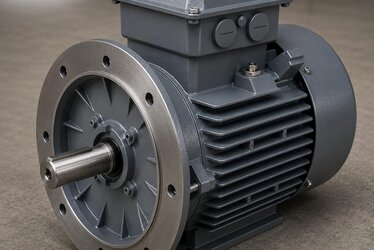
A common hesitation when ordering an IE3 three-phase motor is this: "My grid voltage sometimes reads 380V, sometimes 400V, even 415V; will the motor I buy handle this fluctuation?" This is a commercial question that directly affects the purchasing decision; because a motor whose voltage tolerance is misjudged comes back in the field as heating, efficiency loss and early failure. The good news: a standard three-phase asynchronous motor is designed to run within a certain tolerance band around the nameplate voltage. In this article we examine the voltage tolerance of the IE3 three-phase motor (usually plus/minus 10 percent), the relationship of 380/400/415V with 50/60Hz, voltage imbalance, and the effect of low/high voltage on current and heating, from a purchasing perspective. As HEM Motor, with our manufacturer and supplier identity, we help you choose the right IE3 electric motor for your grid.
What Is Voltage Tolerance? What Does the Nameplate Value Tell?
The voltage written on the motor nameplate is the rated (nominal) voltage for which the motor is designed. But the real grid never sits exactly at this value; as the load changes during the day, the voltage rises or falls a little. For this reason, motors are designed with a tolerance band: most standard three-phase asynchronous motors are made to run within plus/minus 10 percent of rated voltage and plus/minus 5 percent of rated frequency. So a motor with a 400V rated voltage continues to run roughly between 360V and 440V; although performance changes somewhat, the motor runs without damage.
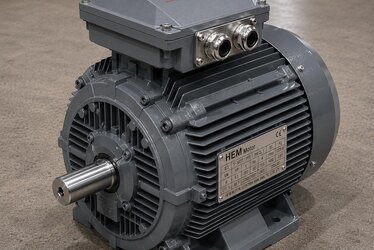
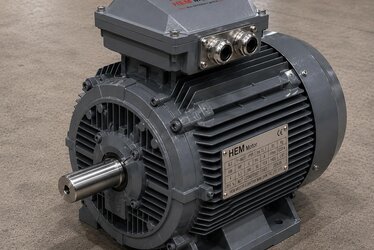
This tolerance is reassuring from a purchasing point of view: if your grid swings around 400V, an IE3 motor with the right nameplate voltage handles this fluctuation smoothly. However, as you approach the edge of the tolerance band, efficiency, power factor and heating change; for this reason the motor should not be run continuously at the band edge. Reading the nameplate values correctly is the basis of this decision; our article on reading the IE3 motor nameplate explains in detail how to interpret rated values such as kW, speed, cosφ and efficiency.
Are 380V, 400V and 415V the Same Motor?
In the Turkish and European grid, the rated voltage is standardized as 400V (phase-to-phase); however, in the field the terms 380V, 400V and 415V are often used interchangeably. Most standard IE3 motors carry a wide voltage range such as 380-415V on the nameplate; this means the motor meets all three values within the tolerance band. So the same motor can be used safely on a 380V grid, a 400V grid and a 415V grid. What to do when ordering is to clearly state your grid actual voltage range and frequency; this way the correct connection (star/delta) and the correct nameplate range are selected.
50Hz and 60Hz: Frequency Is Evaluated Together With Voltage
Voltage tolerance must be considered not on its own but together with frequency. While the Turkish grid is 50Hz, some export projects or generator-fed systems may be 60Hz. When the frequency changes, the motor speed and magnetic behavior also change; on a 60Hz grid the same motor turns faster, and if the voltage/frequency ratio (V/Hz) is not maintained, magnetic saturation or low torque problems can arise. For this reason, when fitting a motor you bought for 50Hz to a 60Hz grid, you must always check the nameplate range and the appropriate voltage.
In generator-fed sites the voltage and frequency fluctuation is more pronounced; especially at motor startup the generator voltage can drop momentarily. We covered this topic in our article on motor selection on generator-powered sites; the starting current and voltage dip require correct generator sizing so the motor starts without strain. Our article on how many kVA generator carries how many kW motor explains this matching with a numerical framework.
Voltage Imbalance: A Silent Source of Heating
In a three-phase motor, the voltage of the three phases should be equal to each other. In a real grid there are small differences between phases; but if this difference grows (voltage imbalance), a disproportionately large current imbalance arises in the motor. Roughly, even a voltage imbalance of a few percent can lead to a much larger current imbalance and therefore overheating. This heating wears down the winding insulation and shortens motor life; moreover, it often progresses unnoticed.
The main causes of imbalance are uneven distribution of single-phase loads across the phases, loose terminal connections and faulty wiring. For this reason it is important at commissioning to measure the voltage of the three phases and check the soundness of the terminal connections. Monitoring the winding temperature is the best way to catch imbalance-related heating early; our article on motor winding temperature monitoring (PT100 and PTC thermistor) explains how to set up this protection. Making the terminal and cable connection correctly also reduces imbalance; our article on the motor terminal box and cable connection shows correct connection practice.
The Effect of Low and High Voltage on the Motor
Both ends of the voltage tolerance band produce different results. At low voltage the motor draws a higher current to produce the same power; this current heats the winding and causes overheating especially in motors running at full load. In addition, low voltage lowers the starting torque; under hard-starting loads the motor may strain or fail to start. At high voltage, magnetic saturation increases, magnetizing current rises and iron losses grow; this means unnecessary heating and efficiency loss.
In practice the most critical point is heating, because heating directly determines life. The winding insulation class comes into play here; class F or H insulation affects the temperature endurance of the motor and therefore its tolerance to voltage deviations. Our article on winding and insulation class (F/H) in IE3 motors explains the effect of this endurance on life. The service factor is also important in motors that will run continuously at the edge; our article on service factor and overload capacity in IE3 motors shows how to use this reserve.
The Right Purchase Against Voltage Problems
In facilities with a fluctuating grid or voltage imbalance, the right solution is to choose the motor consciously and buy it together with suitable protection equipment. An IE3 motor with a wide voltage-range nameplate, together with quality bearings and F/H class insulation, runs more safely on a fluctuating grid. Equipment such as a thermal relay, phase protection relay and temperature protection protect the motor against voltage-related failures; it makes sense to request these together with the motor. Our article on electric motor protection devices lists what should be requested together when purchasing.
In cases where your grid stays continuously at low voltage, running with a frequency drive (VFD) protects the motor by keeping the voltage/frequency ratio under control. Our article on frequency drive (VFD) with asynchronous motor explains when this solution is needed. While searching for the right motor, we can determine together, from our efficient electric motors range, the voltage range suited to your grid.
Pre-Order Checklist
When turning the voltage tolerance discussion into an order, clarify the following information: your grid actual voltage range (for example 380-415V), its frequency (50 or 60Hz), whether it will be connected star or delta, the load type the motor will run (constant or variable) and the ambient temperature. This information ensures the motor is selected in the correct nameplate range and the correct insulation class. An order placed with missing information can cause voltage-related problems in the field; our article on information to provide when requesting a quote completes this list.
Voltage conditions also play a role when deciding between IE3 and IE4; in facilities running continuously under heavy conditions, a higher efficiency class can ease the heating margin. Our article on whether to stay with IE3 or switch to IE4 addresses this decision on an application basis. A correctly chosen IE3 motor handles grid fluctuation smoothly within the tolerance band and runs with a long life.
The Relationship Between Starting Current and Voltage Dip
A three-phase asynchronous motor draws a starting current that is many times the rated current at the moment of startup; this high current can cause a momentary voltage dip in the grid or generator. If the voltage dips, the motor starting torque also drops, because torque is proportional to the square of the voltage; on a weak grid a hard-starting load can strain the motor. For this reason, voltage tolerance must be evaluated not only for continuous operation but also for the moment of startup. Starting methods such as star-delta or soft starter limit the voltage dip by lowering the starting current.
Choosing the right starting method protects both the motor and the grid. Our article on starting AC asynchronous motors: star-delta or soft starter addresses this choice by application. To set up the connection diagram correctly, our article on the electric motor star-delta wiring diagram guides you step by step. In facilities with a weak grid or generator feed, managing the starting current prevents voltage-related failures from the outset.
Voltage, Efficiency and the Electricity Bill
Voltage deviation is important not only for failure risk but also for efficiency and therefore the electricity bill. When the motor runs at the edge of the tolerance band, efficiency and power factor drop; a low power factor can lead the distribution company to apply a reactive penalty. In other words, managing voltage conditions reflects directly on operating cost. IE3 motors are already in a high efficiency class; however, when run at the right voltage, they deliver the value closest to their nameplate efficiency.
We addressed the relationship between power factor and reactive penalty in our article on power factor (cos φ) and reactive penalty in high-efficiency motors. Calculating correctly the difference between nameplate efficiency and real field efficiency is also important; our article on the difference between nameplate and field efficiency explains how to measure the real saving. An IE3 motor running at the right voltage and the right load is both long-lived and delivers the expected saving.
Frequently Asked Questions
What is the voltage tolerance of an IE3 three-phase motor?
Most standard three-phase asynchronous motors are designed to run within plus/minus 10 percent of rated voltage and plus/minus 5 percent of rated frequency. So a motor with a 400V rated voltage continues to run roughly between 360-440V. As you approach the edge of this band, efficiency, power factor and heating change; for this reason the motor should not be run continuously at the edge. If your grid is fluctuating, choosing a motor with a wide voltage-range nameplate is the safest path.
Can I use a motor I bought for 380V on a 415V grid?
Most standard IE3 motors carry a wide range such as 380-415V on the nameplate and meet all three values within the tolerance band; in that case the same motor is used safely. Still, before ordering, the motor nameplate range and connection type (star/delta) must be verified against your grid. In case of doubt, share your grid voltage range with us and let us determine the suitable motor together.
Why does voltage imbalance heat the motor?
In a three-phase motor, a small voltage difference between phases leads to a much larger imbalance in current; this excess current heats the winding and wears the insulation. The main causes of imbalance are uneven distribution of single-phase loads and loose terminal connections. Measuring the voltage of the three phases at commissioning and monitoring the winding temperature is the best way to catch this silent heating early.
Get a Quote
A correctly chosen IE3 three-phase motor handles grid fluctuation between 380/400/415V smoothly within the tolerance band; an incorrectly chosen motor carries the risk of heating and early failure. Share your grid voltage range and frequency with us, and let us determine the right motor together with the appropriate nameplate range, insulation class and protection equipment. HEM Motor is with you with its manufacturer and supplier identity. For a fast and accurate quote, call: +90 (532) 345 49 86 or reach us through our contact page.