English
 Türkçe



Expressions such as "insulation class F" and "temperature rise class B" on an electric motor's nameplate are, for most users, treated as the same thing or confused with one another. Yet these two concepts describe entirely different things, and the relationship between them creates the critical reserve known as the "thermal margin" that determines a motor's real lifespan. Especially in high-efficiency, low-loss motors like the IE4 motor, this subject is far more important than you might think; because low loss means a cooler winding directly, and a cooler winding roughly doubles lifespan. In this guide we explain step by step the difference between insulation class and temperature rise, how the thermal reserve is formed, and why an IE4 motor offers an advantage in hot environments.
Our goal is not to give you a fixed table, but to enable you to read the nameplate values and interpret your motor's real thermal condition yourself. A correctly understood relationship between insulation class and temperature rise means an operation in which the motor runs safely for years without unexpected winding burnouts.
Two Different Concepts: Withstand Temperature and Actual Heating
The essence of the matter lies in distinguishing two separate temperature values. One tells you "how much the winding material can withstand," the other "how much the winding actually heats up."
Insulation Class: The Winding's Withstand Temperature
The insulation class denotes the maximum temperature the enamel and impregnation materials coating the winding wires can continuously withstand. This is the temperature limit at which the material can remain undamaged through its design life (usually 20,000 hours). The two most common classes are:
- F insulation class: Maximum withstand temperature of 155°C. The most widely used standard class in industry.
- H insulation class: Maximum withstand temperature of 180°C. Preferred for hotter environments and heavy-duty applications.
These values are the "ceiling" temperatures at which the winding can run continuously. Exceeding this ceiling means rapid aging of the insulation and, eventually, a short circuit that burns the winding.
Temperature Rise: The Winding's Actual Heating
Temperature rise shows how much a motor's winding heats above the ambient temperature when running at nominal load; its unit is Kelvin (K) because it is a difference value. The standard reference ambient temperature is taken as 40°C. Temperature rise is also divided into classes:
- B temperature rise: About 80 K rise. That is, in a 40°C ambient the winding heats to roughly 120°C on average.
- F temperature rise: About 105 K rise. In a 40°C ambient the winding heats to roughly 145°C on average.
Note carefully: insulation class describes the material's withstand capability, while temperature rise describes the motor's actual heating. Even when expressed with the same letter (for example F), they are different things. Grasping this distinction is the key to understanding motor life.
Thermal Reserve: The Margin That Secures Lifespan
The real engineering advantage arises from deliberately choosing the insulation class and temperature rise class differently. A very common and valuable combination is to use F insulation material yet run the motor only at B temperature rise.
In this case the winding material can withstand up to 155°C, but the motor only heats to around 120°C. The difference forms a thermal reserve of about 25-30°C. This reserve is not wasted capacity; on the contrary, it is the most valuable margin securing the motor's lifespan.
- During sudden overloads, the winding uses this reserve as a buffer before reaching the insulation ceiling.
- When the ambient temperature rises above the standard 40°C, this margin allows the motor to run without derating.
- It provides extra safety under real field conditions, such as partial clogging of cooling channels.
The 10°C Rule (Montsinger): Why Does Lifespan Double?
The relationship between insulation life and temperature is not linear but exponential. The "10°C rule," also known as the Montsinger rule, summarizes this: when an insulation system runs every 10°C below its design temperature, its life roughly doubles; when it runs every 10°C above, its life roughly halves.
The practical meaning of this rule is striking. Running an F-insulated motor at B temperature rise, keeping it about 25°C cooler, can increase the insulation life by roughly 5-6 times. So your motor not only "runs without burning out," it stays reliable for much longer. This is the concrete payoff of keeping the temperature rise class low.
Why Does an IE4 Motor's Low Loss Keep the Winding Cooler?
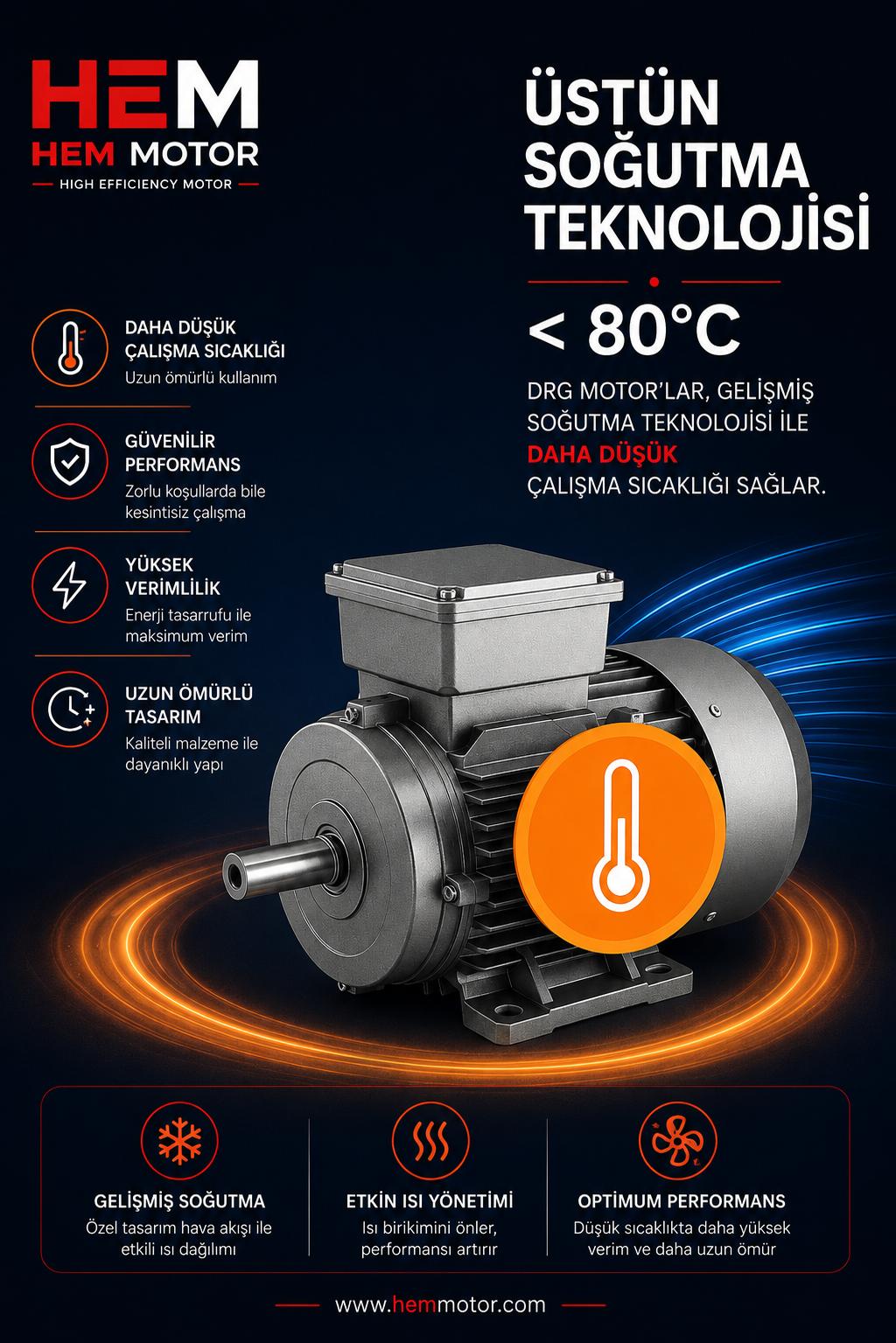
The heat a motor produces comes directly from the losses inside it. Stator and rotor copper losses (I²R), iron losses and mechanical losses are the portion of electrical energy converted to heat. As the efficiency class rises (IE2 → IE3 → IE4), these losses decrease.
An IE4 (Super Premium) class motor produces markedly fewer losses than an IE2 motor of the same power. Fewer losses, less heat; less heat, a cooler winding. This is a hidden but very valuable advantage of the IE4 motor:
- An IE4 motor runs with a lower temperature rise even at the same insulation class, gaining a natural thermal reserve.
- This cool operation extends insulation life by the 10°C rule; the motor is both efficient and long-lived.
- Bearing and grease life also extend with a cooler body; maintenance intervals widen.
In other words, choosing an IE4 motor not only lowers the electricity bill; it also eases the motor's thermal load, which reduces failure costs in the long run.
Operation in Hot Environments and Derating
The nameplate values are given for a standard 40°C ambient temperature. In environments like foundries, near furnaces, or rooftop plant rooms, the temperature can rise to 50-60°C. In this case the winding's real temperature increases and approaches the insulation ceiling.
When the ambient exceeds 40°C, the classic solution is derating — running the motor below its nominal power. However, the thermal reserve in the F insulation + B temperature rise combination reduces or eliminates this need for derating. An IE4 motor's low loss works in the same direction; a motor that starts cooler reaches the ceiling later in a hot environment. For this reason, in hot-environment applications the combination of high efficiency class and low temperature rise provides a double benefit.
- Altitude effect: Above 1000 m altitude the air thins and cooling decreases, which may require additional derating.
- Drive operation: In motors running at low speed with a frequency converter, fan cooling decreases, so temperature rise should be monitored.
- Thermal protection: A PTC thermistor or PT100 sensor monitors winding temperature in real time, securing the thermal reserve.
How Is Winding Temperature Measured and Limited?
Understanding the concept of temperature rise should not remain theoretical; you need to know how this value is measured and limited in the field. Winding temperature is typically determined by the resistance method: the winding resistance is first measured while the motor is cold, then measured again after it runs and heats up, and the average winding temperature is calculated from copper's resistance increase with temperature. This method is fair because it gives the average temperature of the whole winding rather than a single point.
However, the average temperature does not fully reflect the winding's hottest point (hot-spot). In reality the inner layers of the winding are hotter than the surface. Therefore, standards leave an additional margin for the hot-spot (usually 5-15°C) when setting average temperature rise limits. The thermal reserve in the F insulation + B temperature rise choice safely covers this hot-spot difference too.
- Resistance method: Gives the average winding temperature; the basis of standard acceptance tests.
- Embedded sensors: PT100 or PTC placed in the winding heads provide real-time monitoring.
- Hot-spot margin: The difference between average and hottest point is considered in insulation class selection.
Other Factors That Age the Insulation System
Although temperature is the strongest factor aging insulation, it is not the only one. When determining real field life, these factors must also be considered:
- Thermal cycling: In frequent stop-start applications the winding repeatedly heats and cools; this expansion-contraction cycle creates mechanical fatigue in the insulation.
- Moisture and contamination: In humid, dusty environments, leakage current paths can form on the insulation surface; a tropicalized winding reduces this risk.
- Voltage spikes: The fast voltage spikes (dV/dt) produced by frequency converters stress the winding insulation; inverter-duty insulation handles this load.
- Vibration: Excessive vibration abrades the enamel coating of the winding wires, lowering insulation life.
An IE4 motor with high thermal reserve operates with a wider safety margin against all these factors; because a winding that starts cool tolerates the effect of additional stresses better.
Correct Selection and Supply
To verify a motor's thermal safety in the field, three nameplate values must be read together: insulation class (F/H), temperature rise class (B/F) and efficiency class (IE2/IE3/IE4). For an application that will run in a hot environment or heavy duty, a motor combining F insulation, B temperature rise and IE4 efficiency is both a safe and an economical choice.
In terms of stock and supply, clarifying your application's real ambient temperature and load profile in advance lets you procure a motor of the correct insulation and efficiency class without waiting time. A request prepared with the right technical specification enables your supplier to give you a fast and clear quotation. For up-to-date electric motor prices and stock availability, the healthiest approach is to clarify your technical specifications and request a quote. For a wider range you may evaluate high-efficiency IE4 motor and H-class insulated motor options.
Frequently Asked Questions
Why is a motor with F insulation class run at B temperature rise?
Because a thermal reserve of 25-30°C forms between the material's 155°C withstand and the motor's roughly 120°C actual heating. This margin acts as a buffer against sudden overloads and high ambient temperatures, and by the 10°C rule it extends insulation life many times over.
Does an IE4 motor really run cooler?
Yes. Because an IE4 motor's losses are low, it produces little heat; this means a lower temperature rise — a cooler winding — even at the same insulation class. A cooler winding provides longer insulation life by the 10°C rule.
What should I do if the ambient temperature exceeds 40°C?
A motor with a high thermal reserve (F insulation + B temperature rise) and a high efficiency class (IE4) provides an advantage in this case, often reducing the need for derating. Still, in very hot environments, H insulation class and a winding temperature sensor (PTC/PT100) should be preferred.