English
 Türkçe

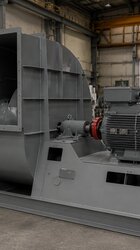
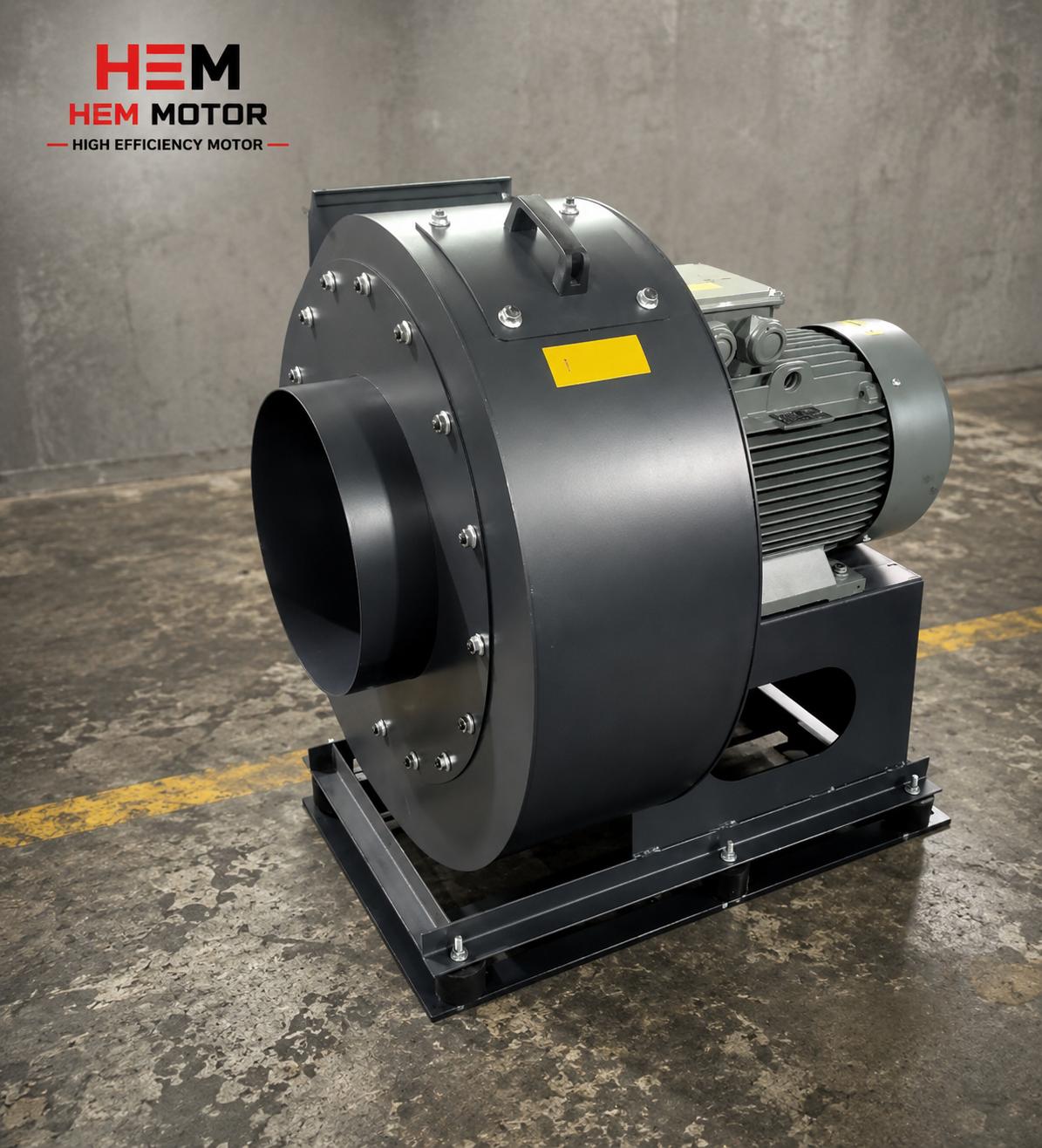

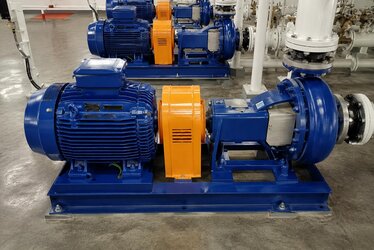
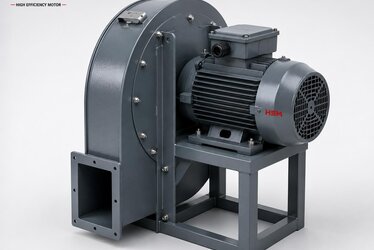
The most common mistake when buying a motor for a fan system is selecting on kW alone, without accounting for the fan type. Yet a centrifugal (radial) fan and an axial fan impose entirely different loads on the motor: one, with its high-pressure low-flow character, demands high starting torque; the other, with its high-flow low-pressure character, brings lower starting torque but high inertia. A mismatched motor either struggles at start-up or is oversized and runs inefficiently. This article clarifies, for businesses that supply fan and aspirator motors, the correct power, speed and protection selection by fan type; it covers the effect of centrifugal and axial fans on the motor, the continuous operation and IP protection requirements, and the information to provide in the quote to get the right motor in a single order.
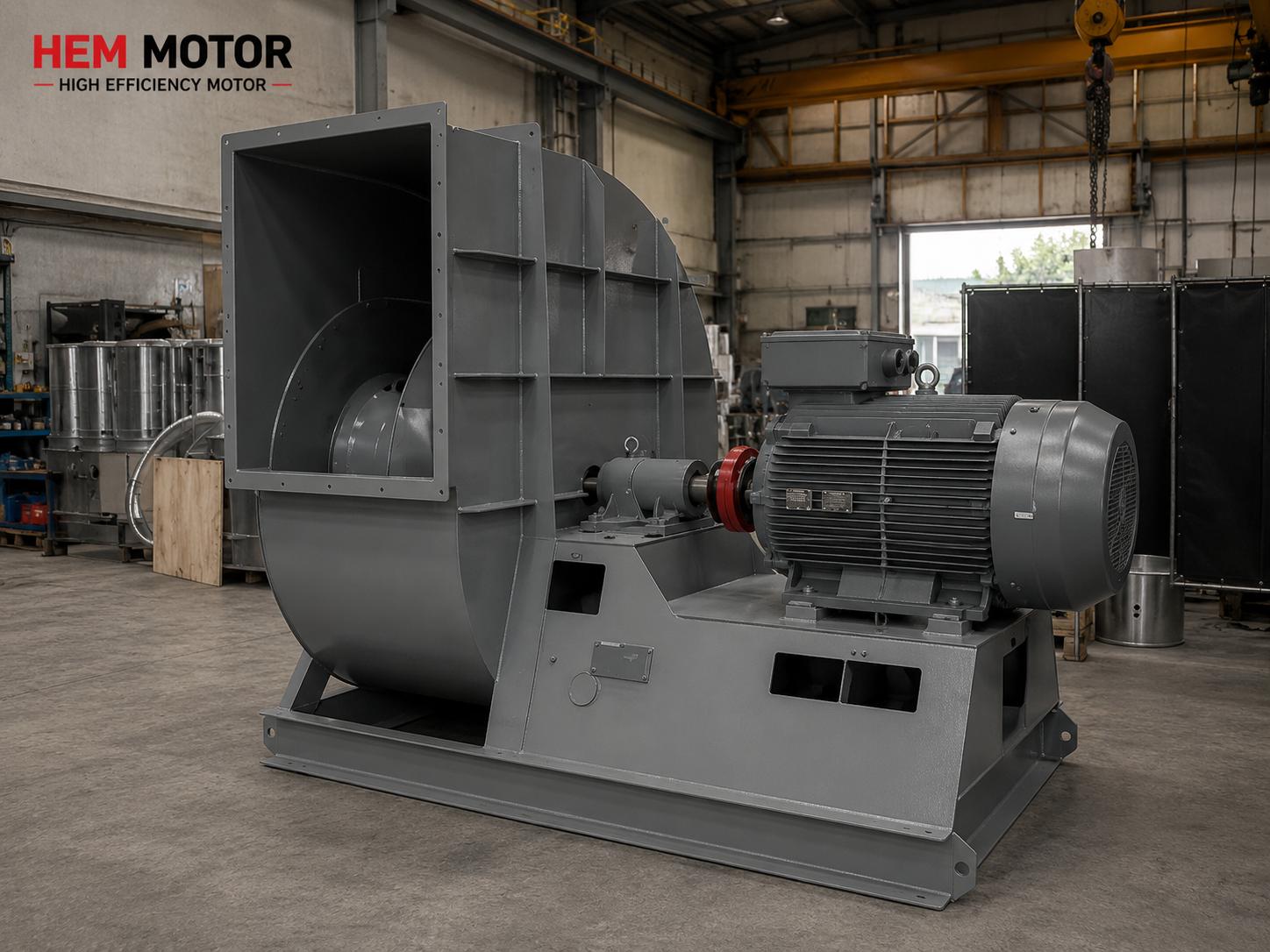
Centrifugal vs Axial Fan: Why Is the Effect on the Motor Different?
The two fan types move air in different ways, and this difference is directly reflected in motor selection.
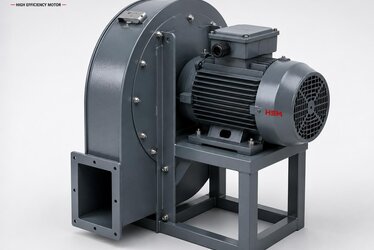
- Centrifugal (radial) fan: Throws air outward with its blades; produces high pressure and relatively low flow. Used in ducted ventilation, dust collection, aspiration and wherever high pressure is needed. Scroll-housed centrifugal fans generally carry high inertia (GD2); the motor starting torque and starting method become important.
- Axial fan: Pushes air along the shaft axis; produces high flow and low pressure. Used in cooling towers, condensers, general air circulation and wall-type ventilation. Because low pressure is required, the motor load is relatively low, but large-diameter impellers can bring high inertia.
In short: a centrifugal fan is a pressure job, attention is paid to the motor starting torque and starting method; an axial fan is a flow job, the motor speed and impeller inertia matching come to the fore. To calculate the right power, you need to know the fan curve and operating point; our required kW for pump, fan and conveyor article explains this calculation.
Inertia (GD2) and start-up in fans
Fans, especially large-diameter ones, carry high inertia; the motor draws high current for a sustained period to accelerate this inertia at start-up. On large fans, star-delta or a soft starter is preferred over direct-on-line starting; this protects both the motor and the grid. We compared the starting method in our star-delta or soft starter article.
Correct Speed (Pole) Selection: It Determines Fan Performance
In fans, speed is directly related to air flow and pressure; according to the fan laws, as speed increases, flow rises proportionally, pressure with the square and power with the cube. That is why speed selection is at the heart of fan performance:
- 2-pole (3000 rpm): High-speed, compact centrifugal fans and aspiration applications requiring high pressure.
- 4-pole (1500 rpm): The most common fan speed; general ventilation, medium-pressure centrifugal fans, most axial fans.
- 6-pole (1000 rpm) and above: Large-diameter, low-speed fans where quiet operation is desired.
We detailed the effect of pole count on the application in our 2, 4, 6 pole selection article. Important note: connecting a fan to a higher-speed motor increases power with the cube; the wrong speed either burns the motor or consumes excessive energy.
Continuous Operation and IP Protection
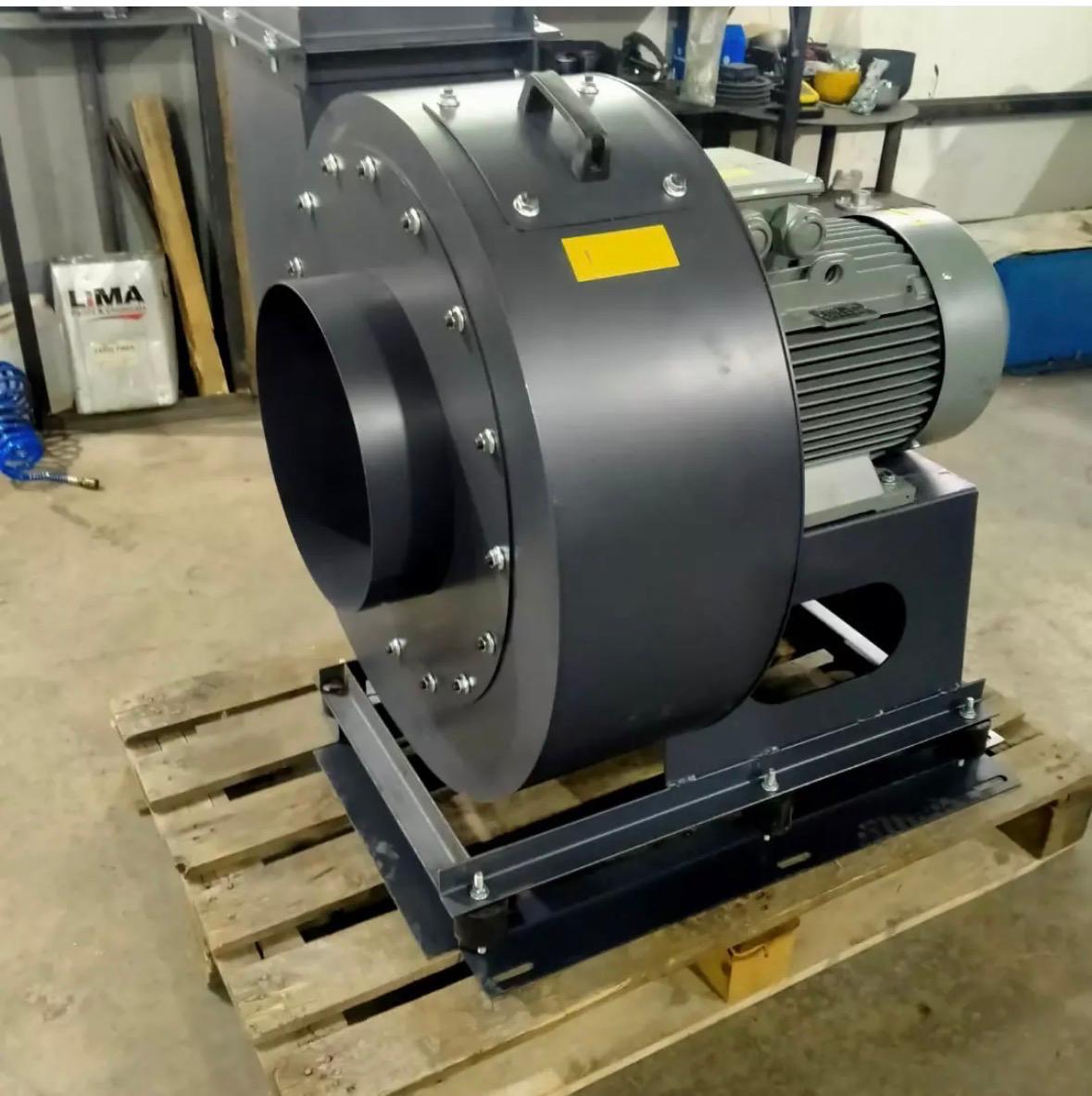
Fan motors mostly run in S1 continuous duty; ventilation and aspiration systems turn for days without stopping. That is why the motor must be suitable for continuous operation, with class F insulation and adequate cooling. We covered the requirements in continuously running blower and fan applications in our vacuum pump and blower motors article.
The IP protection class is selected according to the environment where the fan is located. While IP55 is sufficient for indoor ventilation, higher protection against rain and humidity may be needed outdoors (roof, cooling tower, open field). We examined the importance of IP protection in cooling tower and chiller fans in our cooling tower and chiller fan motors article. In dusty environments (aspiration, dust collection), set the IP class per our IP protection class selection article.
Attention in aspirator and dust-collection fans
In aspirator and dust-collection systems the fan carries particle-laden air; the motor must be protected against dust build-up and the fouling of cooling fins. In these applications a centrifugal fan is generally used and the motor runs continuously at full load. We explained aspirator fan motor selection in detail in our aspirator and dust-collection fan motor selection article.
Direct-Coupled or Belt-Pulley?
How the fan motor is connected to the fan is also an important decision in selection. There are two common methods:
- Direct-coupled (direct drive): The motor shaft is connected directly to the fan impeller. In this case the fan speed is exactly the motor speed; so the motor pole count must match the fan design speed exactly. Axial fans and compact centrifugal fans are generally direct-coupled. This method provides fewer parts, less maintenance and higher mechanical efficiency.
- Belt-pulley drive: There is a pulley and belt between the motor and the fan; the fan speed can be adjusted with the pulley ratio. This lets the motor run at a standard speed (for example 1500 rpm) and turn the fan at a different speed. It is common on large centrifugal fans, but requires belt wear and alignment maintenance.
In a direct-coupled system the motor mounting type (usually B5/B35 flange) and shaft diameter must be compatible with the fan. In a belt-pulley system a B3 foot-mounted motor is common and the motor shaft diameter and key dimension must fit the pulley. We covered motor speed and speed adjustment with the pulley-belt in our motor speed and pulley-belt article. Which method is suitable is determined by the fan design and the required speed.
Common Selection Mistakes in Fan Motors
The most common mistakes in the field in fan motor supply prevent getting the right motor on the first try. Knowing them speeds up the supply process:
- Giving kW without specifying the fan type: The same kW shows different start-up and inertia behaviour in centrifugal and axial fans. Without clarifying the fan type, the selection is incomplete.
- Changing the speed arbitrarily: Fitting a motor with a different speed than the fan design speed changes the power need with the cube; it can burn the motor or cause energy waste.
- Not choosing IP protection by environment: Putting an indoor-protected motor outdoors leads to early failure from humidity and rain.
- Not planning starting on large fans: Direct starting on a high-inertia fan creates a starting current and mechanical shock problem.
- Skipping the mounting type: B3/B5/B35 incompatibility prevents the motor from fitting the fan.
Most of these mistakes are prevented by clearly providing the fan type, operating point, speed, mounting and environment information at the quote stage.
Fan Motor Supply List
To supply the fan motor correctly, clarify the following at the quote stage:
- Fan type: Centrifugal (radial) or axial?
- Power and speed: Required kW and speed (pole); according to the fan operating point.
- Mounting: B3 foot-mounted, B5/B35 flanged; according to the impeller connection (review the mounting types on our mounting types page).
- Protection: IP55 / higher according to the environment; indoor-outdoor, dusty/humid.
- Starting: Soft starter / star-delta on large high-inertia fans.
- Efficiency: IE3/IE4; IE4 for energy saving on continuously running fans.
For your fan applications we can recommend our high-efficiency electric motors range, and our IE4 electric motor range to lower energy cost; for standard fan motors the IE3 electric motor range is sufficient. For mounting type selection see our mounting types page, and you can reach the entire range from our home page.
Energy Efficiency and Frequency Drive in Fans
Because fans generally run continuously, they have a significant share in energy consumption; this makes the efficiency class of the fan motor a direct cost matter. On a continuously running fan motor, the IE4 efficiency class pays back the initial cost through the energy difference that accumulates throughout the year. In fan and pump applications, using a high-efficiency motor together with a frequency drive provides serious energy savings at part load; because, according to the fan laws, reducing speed lowers power with the cube. So when you need to run the fan at half flow, reducing the speed with a drive is far more efficient than throttling a damper.
For this reason, in facilities with variable air needs (ventilation, cooling tower, process fans) a frequency-drive fan motor provides both energy saving and precise flow control. A motor that will run on a drive should have drive-compatible winding insulation and low vibration. On fans that run at constant flow, a drive is not mandatory; a continuous-duty IE3/IE4 motor selected at the right speed is sufficient. Which approach is suitable is determined by the load profile of the fan.
Frequently Asked Questions
Does a centrifugal fan or an axial fan need a more powerful motor?
A direct comparison cannot be made; the required power depends on the fan operating point (flow x pressure). Because a centrifugal fan produces high pressure, at the same flow it generally requires higher power and, due to high inertia, starting torque becomes important. An axial fan can be more efficient in high-flow low-pressure work. For the correct power you need to share the fan curve and operating point.
What happens if I buy the fan motor at a higher speed?
According to the fan laws, increasing speed raises flow proportionally, pressure with the square and power with the cube. So if you fit a 3000 rpm motor instead of 1500 rpm, the fan draws far more power and the motor can be overloaded. Speed must be selected according to the fan design point; arbitrary speed changes are not recommended.
What IP protection is needed for an outdoor fan motor?
Fan motors on a roof, cooling tower or open field are exposed to rain, humidity and dust; at these points protection above IP55 (IP65 if needed) and suitable paint/protection should be requested. For indoor ventilation IP55 is usually sufficient. If you share the real exposure of the environment with us, we determine the right protection class together.
Get a Quote
Let us select together the motor with the right power, speed and protection for your centrifugal or axial fan system. Share the fan type, operating point (flow/pressure), mounting and environment information; we will quote the suitable fan motor with stock and lead-time information. You can call us at +90 (532) 345 49 86 or reach us via our contact page.