English
 Türkçe

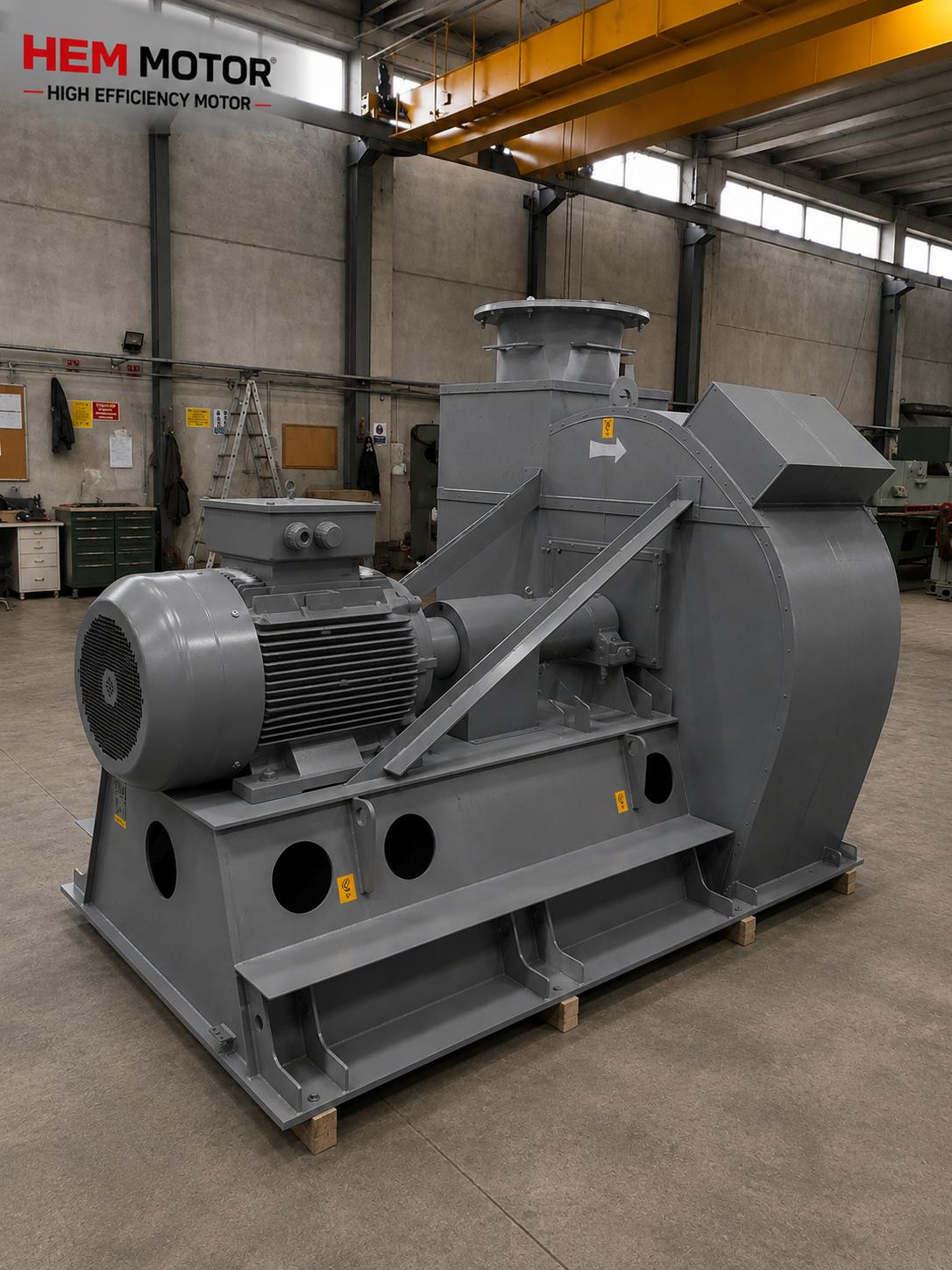

The shaft hoist and skip systems that lift ore from hundreds of metres below ground to the surface are among the most critical and most demanding pieces of equipment in a mine. At the heart of these systems is a heavy-duty, braked electric motor with high inertia that lifts and lowers heavy loads repeatedly within minutes. Selecting a mine shaft hoist motor is very different from selecting a standard industrial motor, because here high starting torque, intermittent duty (S4/S5), mechanical brake integrity and safety must all be considered together. In this article we cover the high torque, braked operation, inertia, duty type and heavy-service supply criteria to consider when selecting a shaft hoist and skip motor.
How Does a Shaft Hoist and Skip System Work?
In a mine shaft, ore is collected in a large bucket-like container called a skip and pulled to the surface with a steel rope. The drive motor that turns the drum or sheave group raising the skip pulls tonnes of load quickly upward each cycle, dumps it, and lowers it again. This cycle repeats hundreds of times throughout the day. The system's key characteristics are:
- High starting torque: As the full skip lifts off, the motor must produce a starting torque well above its rated torque.
- Intermittent heavy duty: The lift-dump-lower cycle is not a continuous constant load but repeated short-duration high loads.
- High inertia: The drum, rope and skip mass form a large rotating mass; the motor handles this inertia during acceleration and deceleration.
- Braked safety: If power is lost while the load is suspended, the mechanical brake must hold the skip instantly and prevent free fall.
You can also find our mining-specific motor range in our stone quarry and mine motor protection and mine and ore mill motors articles.
High Starting Torque: Why Is It Critical?
Lifting a full skip off the ground is the most strenuous moment for the system. To move the load from a standstill, a starting torque of 1.8 to 2.5 times the rated torque is needed. A standard Design N motor may not meet this; that is why high-starting-torque (Design H) motors or slip-ring (wound-rotor) motors are preferred in shaft hoist applications. We detail the selection of torque classes by load in our asynchronous motor torque classes (Design N/H) article. For the relationship between starting and rated torque and load-based selection on direct-on-line starting, our IE3 motor rated and starting torque article is helpful.
Slip-Ring Motor and Liquid Resistance Starter
For large shaft hoists requiring very high inertia and starting torque, a slip-ring (wound-rotor) motor may be preferred over a squirrel-cage motor. By adding resistance to the rotor circuit, high torque and soft acceleration are achieved at start. You can review the difference between squirrel-cage and slip-ring motors in our squirrel-cage vs slip-ring motor article, and the liquid resistance starting method in our liquid resistance starter (LRS) article. Our flywheel, inertia and drive article complements the challenge of starting under high inertia.
Braked Operation and Mechanical Brake
In a shaft hoist motor the brake is not optional but a vital safety element. With the load suspended in a shaft hundreds of metres deep, a free fall of the skip in a power cut or fault would be catastrophic. Therefore:
- Spring-applied (fail-safe) brake: Brakes that close with a spring and engage automatically when power is lost are used. The brake only releases while the motor is energised and under control.
- Dual brake / redundancy: Two independent brakes are the safety standard on critical lifting systems.
- Brake torque: The holding torque of the brake must exceed the load torque created by the full skip.
We address braked motor applications in our crane and hoist lifting motors and IE4 brake motor conveyor and crane articles. For the electrical side of braking, we also recommend our DC and dynamic braking article.
Duty Type: S4 and S5 Intermittent Operation
A shaft hoist motor does not run at a continuous constant load (S1) but in repeated lift-lower cycles. This operating profile falls into class S4 (intermittent periodic duty with starting) or S5 (intermittent periodic duty with electric braking) per IEC 60034-1. In S4/S5 duty:
- The motor heats up each cycle due to high starting current and braking.
- The starts-per-hour limit becomes critical.
- The motor is sized differently from a continuous-duty motor; the cycle profile, not the average load, is decisive.
You can find duty type selection in our duty type (S1-S6) selection article, the starts-per-hour limit in our starts/hour limit article, and the effect of frequent start-stop on heating in our jogging and frequent start-stop article.
Dealing with High Inertia
The combined mass of the drum, steel rope and full skip creates a large rotating inertia (GD²). The motor must accelerate this inertia on every start and decelerate it on every stop. High inertia:
- Lengthens the starting time; the motor draws high current for longer and heats up.
- Requires extra energy (kinetic energy) to be absorbed during braking.
- Directly affects the motor thermal limit and starting method.
For this reason the system's total inertia must be calculated when selecting a shaft hoist motor and the motor sized accordingly. For heat management under frequent starting, see the starts/hour article above; for the origin of starting current, our LRA and starting current article is a reference.
Heavy-Service Supply: Cast Iron and Durability
A mine shaft is an extremely harsh environment for a motor: moisture, dust, vibration and continuous heavy load. An aluminium frame is inadequate in these conditions; a cast iron frame should be preferred. A cast iron frame provides high mechanical strength against impact and vibration, better heat dissipation and long life. We cover the advantages of the cast iron frame in our cast iron vs aluminium frame article and the reason it is preferred under impact load in our impact strength and frame rigidity article. For protection in a dusty and humid shaft, our IP65/IP66 dust sealing article is important.
Bearings, Cooling and Safety
In a shaft hoist application with high radial and axial loads, bearing selection determines life. A reinforced bearing structure and correct lubrication are essential. For bearing life see our bearing type and life article, and for greasing our bearing greasing and lubrication article. For cooling management under continuous heavy load, our cooling methods article and for winding temperature monitoring our PT100 and thermistor article are useful guides.
Supply and Critical Spare Assurance
In a mining operation, a failure of the shaft hoist motor means all production stops; that is why critical spare motor planning is vital. For supply contracts and redundancy in mining, we recommend our mining motor supply contracts and critical spare motor list articles. For lead time and shipping planning of high-power supply, our high-power motor supply above 90 kW article is helpful.
Power and Speed Calculation: From the Lifting Job to the Motor
The power of a shaft hoist motor depends on the weight of the load lifted, the lifting speed and the system efficiency. The basic logic is this: the mechanical power needed to lift an object upward at a given speed equals the weight times the lifting speed; this value is divided by the rope, drum and gear efficiency to arrive at the motor output power. In practice:
- The full skip weight (ore + bucket) and lifting speed are clarified.
- System efficiency (usually 85-92%) is accounted for to cover rope, sheave and reducer losses.
- An additional power margin is added to overcome inertia during acceleration.
- An extra safety margin is left for the heating limit in S4/S5 intermittent duty.
Unlike a continuously running pump or fan, this calculation must include the cycle profile; the peak power at the moments of starting and lifting, not the average power, is decisive. You can review power calculation for different loads such as lifting, pump and conveyor in our power calculation for pump, fan and conveyor article, and the lifting-speed to speed-reducer relationship in our low-speed direct drive article. For setting output speed with a reducer, our geared motor vs separate motor + reducer article is helpful.
Starting and Speed Control
A shaft hoist motor must control its starting current while producing high torque at start. Although direct-on-line (DOL) starting is possible at small powers, the starting current of large shaft hoists stresses the supply and switchgear. Therefore:
- Star-delta starting: reduces the starting current but also lowers the starting torque; it may be insufficient under heavy load.
- Liquid resistance starter (with a slip-ring motor): provides a soft, high-torque start under high inertia and is the preferred method on shaft hoists.
- Frequency drive (VFD): offers soft start, precise speed control, and deceleration and stopping control; increasingly common on modern lifting systems.
For choosing between starting methods, see our soft starter, star-delta and direct starting article, and for extra heating and bearing current under VFD drive our VFD harmonics and bearing current article. We address the effect of starting current on generator operation in our motor selection on generator-powered sites article.
Commissioning and Periodic Inspection
Because the shaft hoist motor is a critical safety device, commissioning and periodic maintenance must be done carefully. On first start, the insulation resistance (megger), rotation direction, brake open-close timing and vibration should be measured. In periodic inspection, brake lining wear, bearing noise, grease condition and winding temperature are monitored regularly. For commissioning steps, our commissioning and first start article; for periodic maintenance our maintenance and periodic check schedule article; and for insulation testing our insulation resistance and megger test article are good guides. To catch fault symptoms early, see our motor failures: symptoms and causes article.
Frequently Asked Questions
Which torque class is needed for a shaft hoist motor?
Because lifting a full skip from a standstill requires high starting torque, high-starting-torque Design H motors are preferred over standard Design N, or slip-ring (wound-rotor) motors at very high powers. The correct torque class is determined by calculating the system's total inertia and load torque.
Why is the brake so critical?
With the load suspended in a shaft hundreds of metres deep, the mechanical brake must hold the skip instantly in the event of a power cut or fault. That is why a spring-applied (fail-safe) brake is used; it closes automatically when power is lost. Two independent brakes are the safety standard on critical lifting systems.
Why is a cast iron frame preferred?
A mine shaft is a harsh environment with moisture, dust, vibration and continuous heavy load. A cast iron frame provides much higher mechanical strength, impact and vibration resistance, better heat dissipation and longer life than aluminium. That is why cast iron is standard on heavy-duty shaft hoist motors.
Get a Quote
We supply heavy-duty, high-starting-torque, braked, S4/S5 duty cast iron motors on a project basis for your mine shaft hoist and skip systems. To determine the right motor with calculations of power, inertia, brake torque and duty profile, contact us at +90 (532) 345 49 86 or via our contact page. For mining and heavy-duty applications, see our crusher and stone crushing motor selection article and our electric motors blog.
Purchasing and Selection Checklist
- Have you determined the full skip weight and required lifting speed?
- Have you calculated the system's total rotating inertia (drum + rope + skip)?
- Have you chosen the torque class (Design H / slip-ring) for the required starting torque?
- Have you defined the operating profile (S4/S5) and cycles per hour?
- Have you specified a spring-applied (fail-safe) brake and dual brakes if needed?
- Have you verified the brake torque exceeds the full skip load torque?
- Have you chosen a cast iron frame and the appropriate IP class (IP55/IP65)?
- Have you planned bearings, greasing and winding temperature protection (PT100/PTC)?
- Have you set up a critical spare motor stock and supply lead-time plan?