English
 Türkçe

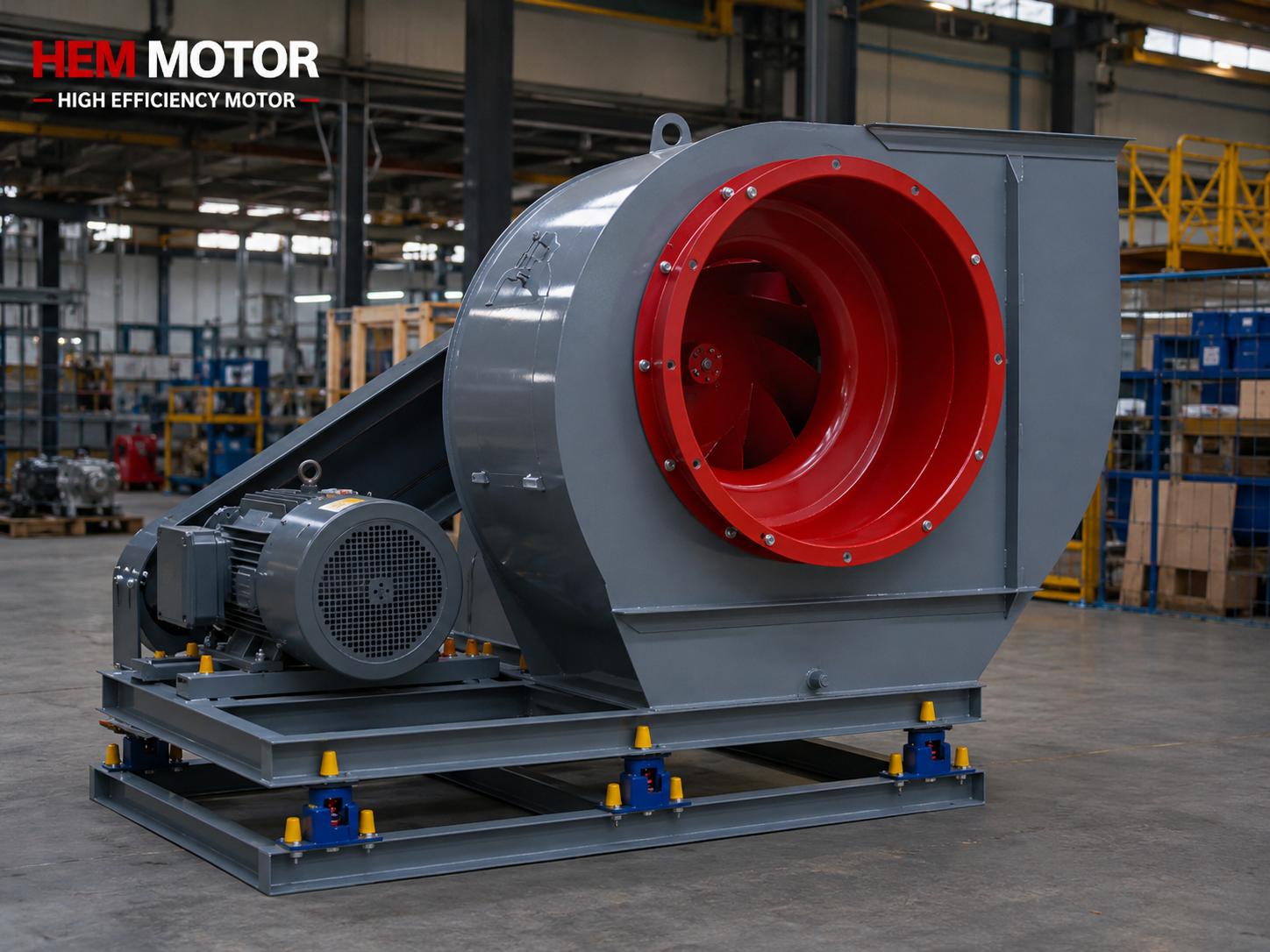

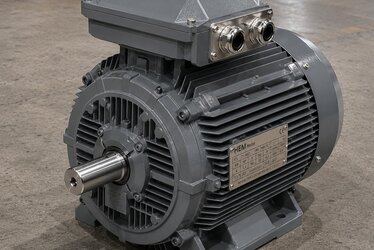
When buying an IE4 super premium efficiency class motor, most users focus only on the efficiency percentage and the power; yet one of the most critical acceptance criteria determining the motor's real field quality, life and quietness is vibration and balance. The design improvements made to minimise energy loss in a high-efficiency motor can be undone by mechanical imbalance or poor balancing: an unbalanced rotor shortens bearing life, increases noise and over time damages the shaft, couplings and the driven machine. In this article, as HEM Motor, we cover step by step vibration and balance on IE4 motors, the A/B/C/D zones of the ISO 20816 (formerly ISO 10816) vibration severity standard, the mm/s rms limits, the G2.5 balance quality grade, the measurement points and the quality acceptance criteria before ordering.
Why Is Vibration Even More Important on an IE4 Motor?
IE4 motors have a core optimised for low loss, a more precise air gap and usually a lower-noise design. This precision reduces tolerance to mechanical defects: even a small balance error can translate into disproportionately noticeable vibration and heating in a low-loss machine like IE4. Moreover, since IE4 motors are mostly used in continuous processes, with long running hours and on critical lines, the cost of vibration-induced early failure is very high. For this reason, vibration measurement in IE4 procurement should not be an optional check but a standard quality acceptance step.
For the general principles of quiet, low-vibration operation in IE4 motors, our article Quiet and Low-Vibration Operation in IE4 Super Premium Motors helps; for the effect of vibration and balance acceptance values on general motor selection, Vibration and Balance: ISO 10816/20816 Acceptance Values provides a good foundation.
ISO 20816 Vibration Severity Zones (A/B/C/D)
The ISO 20816 series evaluates vibration on rotating machines by measuring on the shaft or bearing and classifies the result into four zones. The measured quantity is usually the rms value of vibration velocity (mm/s rms). The zones mean:
- Zone A: Typical value for newly commissioned, flawless machines. Ideal for acceptance.
- Zone B: Considered healthy, suitable for unlimited running time.
- Zone C: Not suitable for continuous operation; acceptable for a short time, requires planned intervention.
- Zone D: Severe enough to cause damage; unacceptable, requires immediate action.
The table below summarises typical mm/s rms limit ranges for small-to-medium power motors on flexible mounting (non-rigid foundation). The exact limits vary by machine class and foundation type; which class applies should be clarified before ordering.
| Zone | Vibration Velocity (mm/s rms) | Assessment |
|---|---|---|
| A | ≤ 1.4 | New machine quality |
| B | 1.4 - 2.8 | Suitable for unlimited operation |
| C | 2.8 - 4.5 | Limited; planned maintenance needed |
| D | > 4.5 | Unacceptable; risk of damage |
Balance Quality G2.5: The Grade of Rotor Balancing
The most common root cause of vibration is rotor imbalance. Rotor balance is graded by G classes under ISO 21940 (formerly ISO 1940). The G value expresses the permissible residual imbalance as the circumferential velocity (mm/s) at the centre of gravity; the smaller the number, the better the balance quality. The common target on industrial electric motors is the G2.5 class; more demanding applications may require G1.0. Expecting at least G2.5 balance on a high-efficiency motor like IE4 is a reasonable acceptance criterion for low vibration and long bearing life.
| Balance Class | Typical Application | Quality |
|---|---|---|
| G6.3 | General-purpose, standard motor | Basic |
| G2.5 | Industrial electric motor (common) | Good |
| G1.0 | Precise, high-speed application | High |
To see vibration's relationship with starting and load character as a whole, our article Noise and Vibration: Low-Noise Motor Selection helps; for the link between early failure and vibration, Motor Life and Early Failure Causes is useful.
Measurement Points and Correct Measurement
For the result to be meaningful, vibration must be measured from the correct points and in the correct directions. Typical measurement points on an IE4 motor are the drive-end (DE) and non-drive-end (NDE) bearing housings. At each bearing, measurement is taken in three axes:
- Horizontal (radial): Imbalance is usually most pronounced here.
- Vertical (radial): Also reflects foundation and mounting rigidity.
- Axial: Misalignment and shaft bending stand out here.
During measurement the motor must sit on a rigid foundation, the foot plane must be true and there must be no loose connections; otherwise the reading reflects not the motor's own quality but a mounting defect. For the effect of foot machining parallelism and flatness on vibration, our article Foot Machining Parallelism and Flatness is directly relevant.
Quality Acceptance Criteria Before Ordering
To turn vibration and balance into acceptance criteria, request and check the following during ordering and delivery:
- A balance class declaration from the manufacturer (at least G2.5) and, if possible, a balance report.
- A factory vibration test value; target Zone A or B (≤ 2.8 mm/s rms).
- A DE/NDE three-axis measurement during a no-load run after delivery.
- The field measurement, made on a rigid foundation with correct alignment, staying within Zone B.
- An assessment of how bearing type and lubrication state affect the vibration tendency.
To tie vibration to stock entry together with insulation and rotation checks during incoming inspection, our article Delivery and Acceptance Inspection: Megger, Rotation and Vibration offers a practical checklist. For the relationship between bearing life and vibration, see Bearing Life.
Distinguishing Vibration Sources
When you read high vibration, distinguishing whether the problem comes from the motor or from the mounting and driven system is the essence of quality acceptance. Frequency analysis (spectrum) provides this distinction: dominant vibration at one times running speed (1x) usually points to imbalance; at twice (2x) to misalignment; high amplitude at bearing fault frequencies to bearing degradation. The fact that an IE4 motor was tested with low vibration at the factory does not guarantee the same result in the field; therefore field acceptance must be evaluated together with correct mounting and alignment. While the motor alone is in Zone A, the system may rise to Zone C due to coupling misalignment or a loose foundation. As much as choosing the right motor before ordering, correct mounting and measurement after delivery determine quality.
Since grounding and bearing current can indirectly affect vibration and noise on VFD-driven IE4 motors, our article Grounding and EMC: Connection in a VFD System is complementary. For the balance of cooling and vibration under continuous torque at low speed, External Forced Cooling Fan can also be considered.
The Effect of Vibration on Bearing Life and Energy Efficiency
The most concrete reason to take vibration seriously as a quality acceptance criterion on an IE4 motor is that imbalance directly shortens bearing life. An unbalanced rotor applies a varying radial force to the bearing every revolution; this force disrupts the bearing oil film, creates early fatigue pitting between the balls and the race, and raises the temperature. When the vibration level rises to Zone C, bearing life can shorten markedly compared with Zone B, meaning unplanned downtime and maintenance cost. Moreover, high vibration increases friction and mechanical losses, eroding the IE4 motor's on-paper efficiency advantage in the field. So vibration is not only a mechanical quality indicator but also an indirect guardian of energy efficiency. A low-vibration IE4 motor means both longer bearing life and a machine that actually reaches the efficiency printed on its label in the field.
To manage the effect of bearing greasing and lubrication on vibration and life, our article Bearing Greasing and Lubrication helps; when a bearing change is needed, for the correct number and mounting, Bearing Replacement: Removal, Installation and Correct Bearing Number is a practical guide.
The Role of Frame Rigidity and Mounting Foundation
A motor's measured vibration is the combined result not only of rotor balance but also of frame rigidity, foot machining quality and the mounting foundation. A rigid frame damps the vibration energy produced by the rotating mass and reduces resonance; a weak or flexible frame leads to a higher vibration reading at the same imbalance. Therefore, in high-efficiency motors, frame quality is an inseparable part of vibration performance. On the mounting side, the foundation must be sufficiently rigid, the feet must sit flat and the bolts must be tightened to the correct torque. A loose bolt or a non-flat foot can make even a perfectly balanced rotor appear to vibrate in the field. Ensuring these mechanical conditions are met during acceptance measurement is a precondition for seeing the motor's true quality.
| Vibration Source | Spectrum Sign | Likely Remedy |
|---|---|---|
| Rotor imbalance | Dominant 1x amplitude | Balancing (G2.5 target) |
| Misalignment | Pronounced 2x amplitude | Coupling alignment |
| Loose foundation/foot | Multi-harmonic, unstable | Bolt torque, plane correction |
| Bearing degradation | High-frequency peak | Bearing replacement |
For the effect of frame rigidity on vibration under impact and heavy load, our article Impact Resistance and Frame Rigidity helps; for the relationship of frame machining tolerance and concentricity with quality, Frame Machining, Tolerance and Concentricity is directly relevant.
Speed, Pole Number and Vibration Frequency
To interpret the vibration spectrum correctly on an IE4 motor, you need to know its rotation frequency. A 4-pole IE4 motor runs at roughly 1500 rpm on a 50 Hz grid, i.e. 25 revolutions per second, giving a 25 Hz fundamental rotation frequency (1x). Imbalance appears at this 25 Hz and misalignment at 50 Hz (2x). On a 2-pole high-speed motor, the same imbalance produces more severe vibration due to the higher circumferential velocity, so the balance quality expectation is even more critical on 2-pole IE4 motors. Clarifying the pole number and target speed before ordering lets you both choose the correct vibration acceptance limit and know which frequency to look at for what in spectrum analysis. On high-speed applications, requesting a tighter balance class such as G1.0 is a sensible choice for quiet, long-lived field operation.
Frequently Asked Questions
Which vibration zone is acceptable on an IE4 motor?
For order acceptance the target is Zone A or B; that is, below roughly 2.8 mm/s rms for small-to-medium power motors on flexible mounting. Zone C is acceptable for a short time but requires planned intervention; Zone D is unacceptable.
Is the G2.5 balance class enough?
For industrial IE4 motors, G2.5 is a common and reasonable acceptance criterion. High-speed or precise applications may require G1.0. Request the balance class in writing from the manufacturer before ordering.
The vibration I measured in the field was high, is the motor defective?
Not necessarily. A loose foundation, foot non-flatness and coupling misalignment all produce high vibration in the field. Identify the source by distinguishing 1x (imbalance), 2x (alignment) and bearing frequencies with frequency analysis.
Source a Low-Vibration IE4 Motor With Confidence
As HEM Motor, we clarify the balance class and vibration acceptance values for you on IE4 super premium motors and offer motors that meet the ISO 20816 zones and the G2.5 balance target, quiet and long-lived in the field, accompanied by correct measurement and documentation. Share your application's power, speed and mounting details; let us identify a suitable IE4 motor and provide a tailored quote for fast delivery from manufacturer stock so you can source the right, quality motor with confidence. Contact us to request a quote.