English
 Türkçe

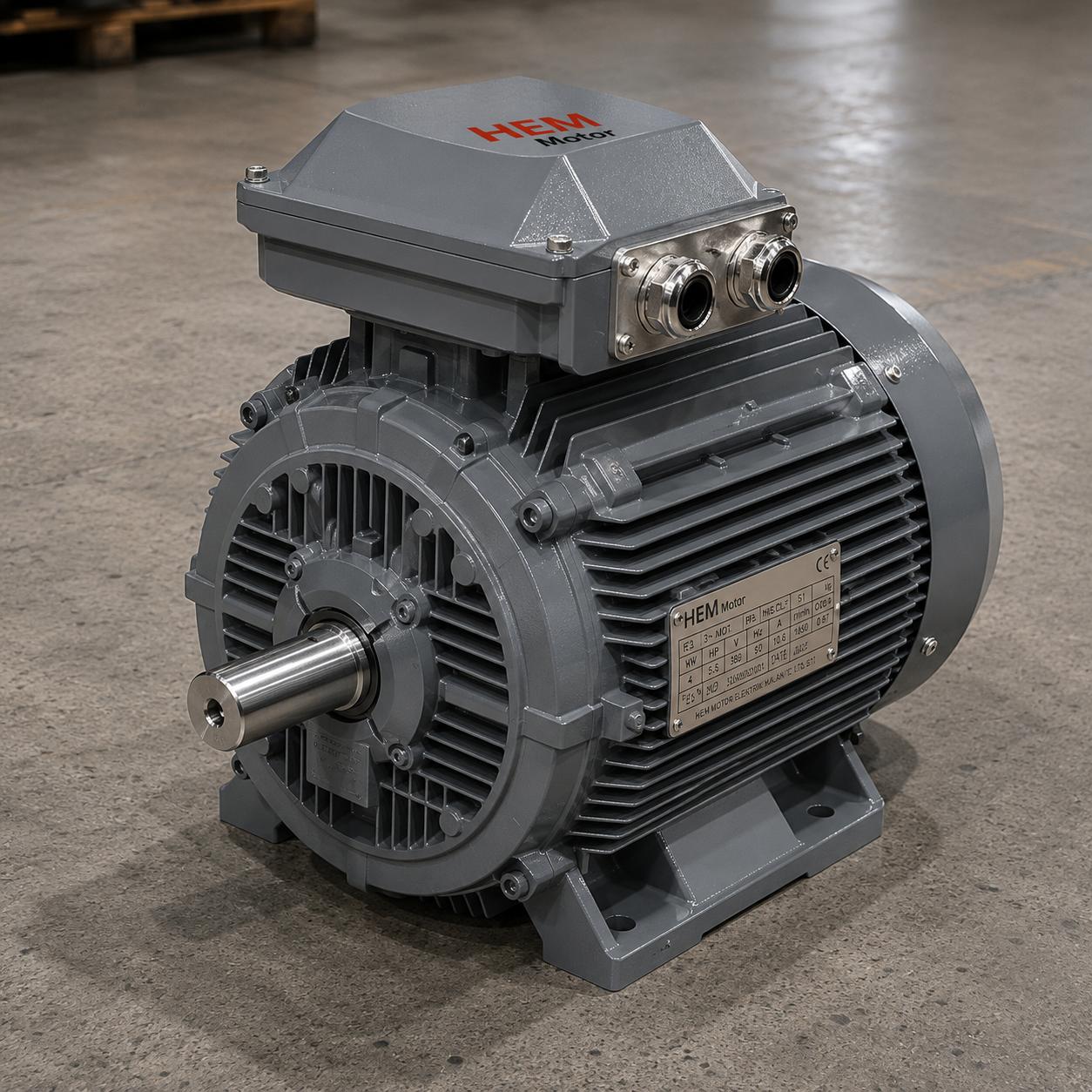

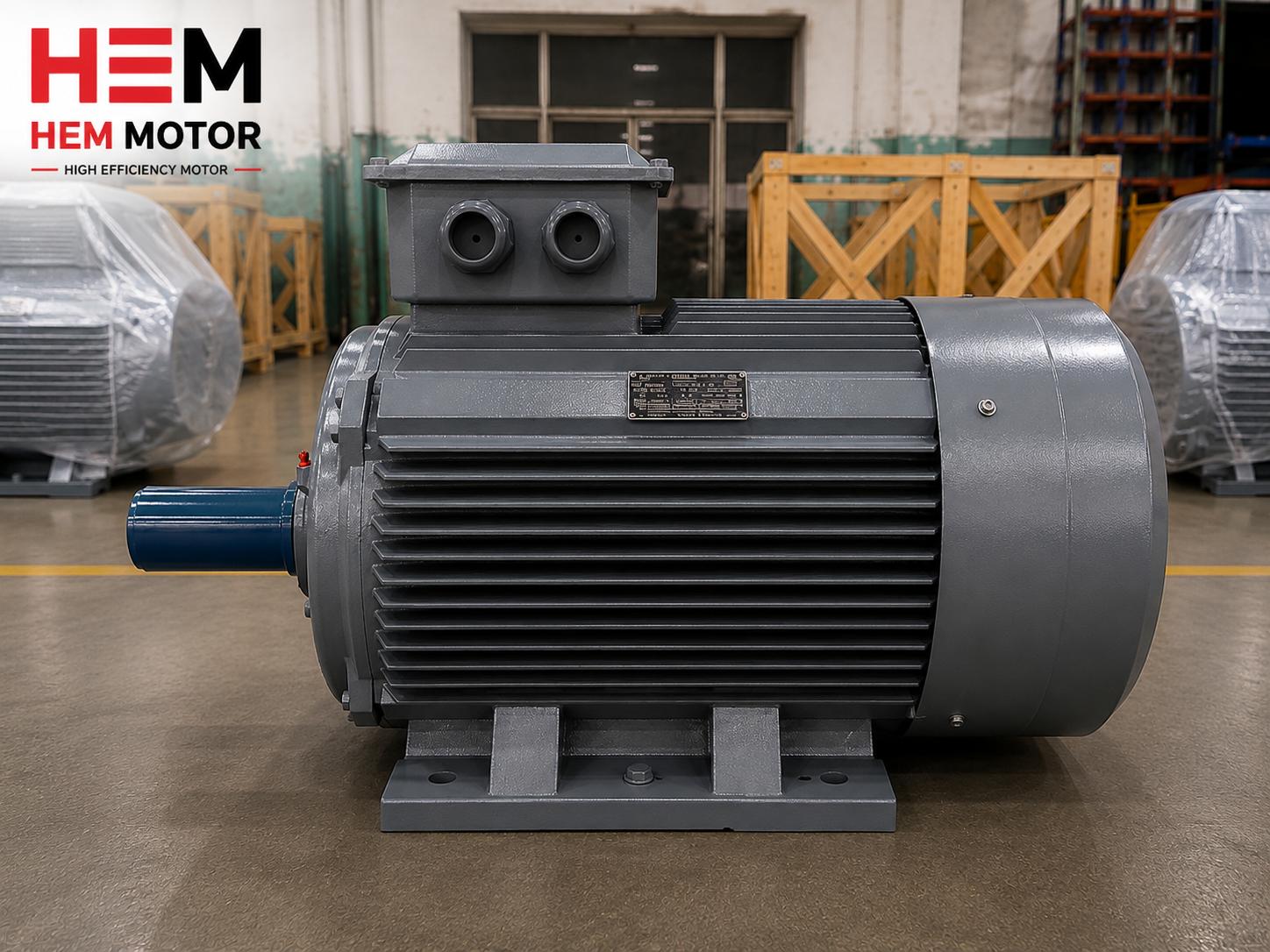
In high-power applications, motor selection demands far more engineering than for small powers. At ratings such as 90 kW and 110 kW the motor is no longer a "shelf product"; it is a critical investment that directly shapes the plant's energy bill, starting infrastructure, cooling and lead time. In this power band, moving to the IE4 (Super Premium) efficiency class means a meaningful energy gain in plants with high annual running hours, because at high power even a small efficiency difference turns into a large absolute kWh saving. In this article we cover the pole/speed options of 90 and 110 kW IE4 motors, typical frame sizes, the efficiency gain, starting and cooling requirements, stock and lead-time management and how to buy correctly, from HEM Motor's perspective.
Why Are 90 and 110 kW a Critical Power Band?
90 and 110 kW are powers frequently met in industrial pumps, fans, compressors, crushers, conveyors and process drives. In this band the motor usually runs all day, often 24 hours continuously. Continuous running multiplies the importance of efficiency: the more efficient the motor, the less power it draws from the grid for the same mechanical work and the less heat it produces as loss. The IE4 class noticeably reduces losses versus IE3; at high power this difference shows up both on the bill and in the motor's running temperature.
Motors at this power are also heavy (hundreds of kilograms), their starting currents are high and they stress the panel/transformer infrastructure. So a 90/110 kW choice does not end with "how many kW"; the right pole count, the right frame size, the right starting method and the right cooling must be planned together. A wrong choice comes back either as needlessly high initial cost or as constant heating, vibration and early failure.
- Continuous load: high annual running hours turn the efficiency difference into absolute saving.
- High starting current: direct-on-line starting can stress the grid; a soft starter or VFD may be needed.
- Heavy frame: handling, mounting and base design gain importance.
- Cooling: heat management and fan/cooling choice are critical in a large frame.
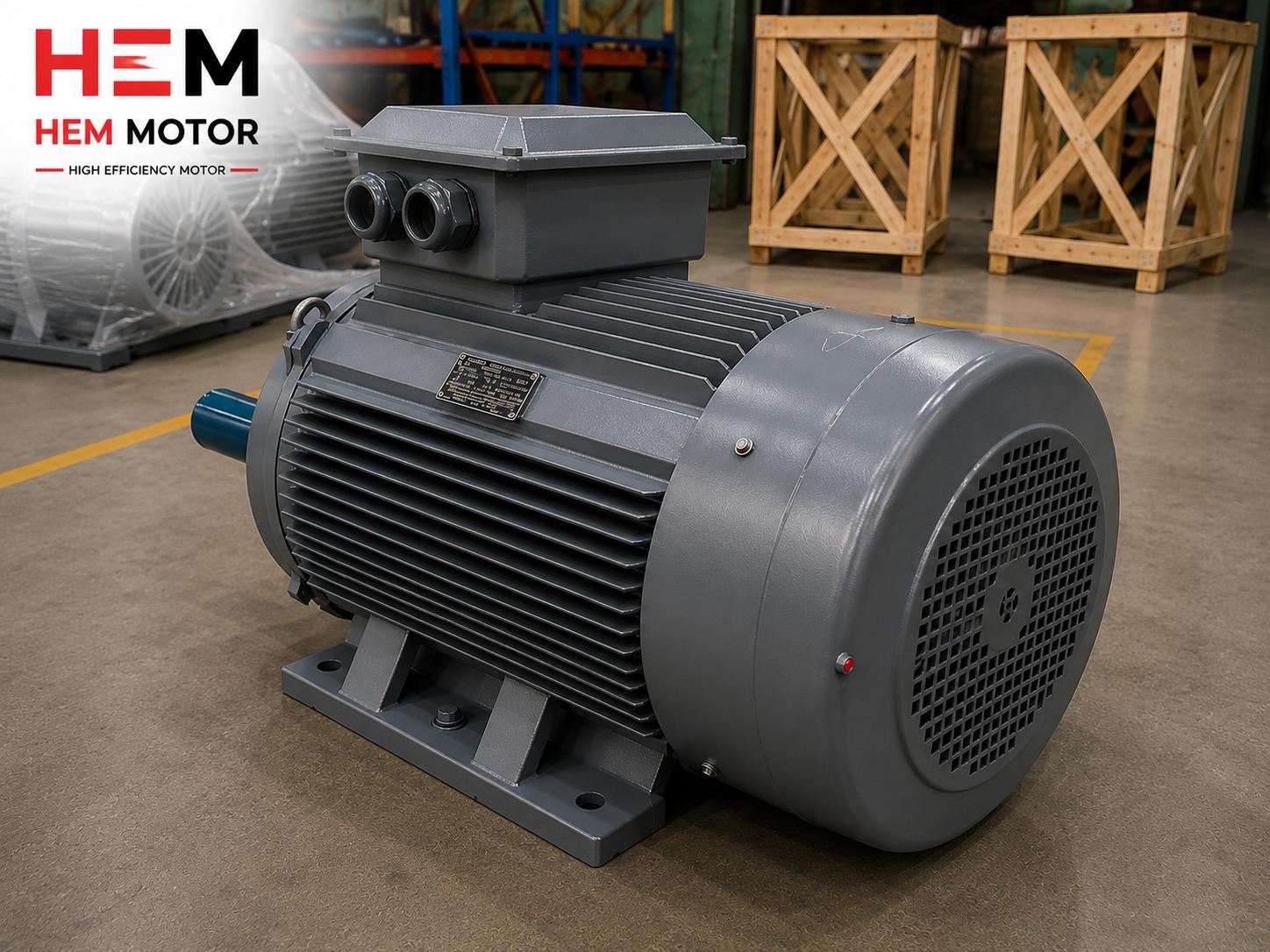
Pole, Speed and Frame Size: 90 and 110 kW IE4
The same power produces different speed and torque at different pole counts. 2-pole gives high speed-low torque, 4-pole is balanced, 6-pole gives low speed-high torque. The speed the application requires directly determines the pole choice. As poles increase, the frame for the same power grows too, because delivering the same power at lower speed demands more torque and therefore a larger magnetic structure.
| Power | Poles | Synchronous Speed | Approx. Load Speed | Typical Frame (IEC) | Rated Torque (approx.) |
|---|---|---|---|---|---|
| 90 kW | 2 | 3000 rpm | ~2975 rpm | 280M | ~289 Nm |
| 90 kW | 4 | 1500 rpm | ~1485 rpm | 280S/M | ~579 Nm |
| 90 kW | 6 | 1000 rpm | ~990 rpm | 315S/M | ~868 Nm |
| 110 kW | 2 | 3000 rpm | ~2975 rpm | 315S | ~353 Nm |
| 110 kW | 4 | 1500 rpm | ~1485 rpm | 315S/M | ~707 Nm |
| 110 kW | 6 | 1000 rpm | ~990 rpm | 315M/L | ~1061 Nm |
The frame sizes in the table are typical and may vary slightly by manufacturer. The key rule is this: at the same power, as poles increase (speed drops) the frame grows and weight and cost rise. So correctly determining the speed the application truly needs is the key to avoiding a needlessly large and expensive motor. To clarify the torque need, our article on torque (Nm) from kW and rpm guides you; for frame-shaft matching see our shaft diameter and frame table (IEC 56-355).
The IE4 Efficiency Gain at High Power
The value of the efficiency class becomes even clearer at high power. In a small motor a one-percent efficiency difference may look trivial; but in the 90-110 kW band with high running hours the same difference means thousands of kWh saved per year. An IE4 motor runs with lower iron, copper and friction loss than IE3, which both lowers the energy bill and lets the motor run cooler and last longer.
| Power (4-pole) | IE3 Typical Eff. | IE4 Typical Eff. | Loss Reduction |
|---|---|---|---|
| 90 kW | ~95.2% | ~96.0% | Significant |
| 110 kW | ~95.4% | ~96.3% | Significant |
The percentage values are approximate and vary by maker and circuit; but the trend is clear: at high power, moving to IE4 usually pays back the investment quickly in a continuously running plant. We detail where losses fall in our article on IE4 motor efficiency losses, and the IE3-IE4 investment comparison in our IE3 vs IE4 investment article.
Starting and Cooling: Two Critical Topics at High Power
When 90-110 kW motors are started direct-on-line they draw a starting current far above the rated current; this can cause a voltage dip on the grid and stress the transformer. So at high power a soft starter, star-delta or variable frequency drive (VFD) is usually preferred. A VFD also adjusts speed to demand, giving extra energy saving in pump and fan applications.
- Direct-on-line: only if grid and transformer suffice; more common on small frames, requires care at this power.
- Star-delta: reduces starting current; suits loads needing low starting torque.
- Soft starter: smooth start and stop; reduces mechanical shock and current surge.
- VFD: full speed control and the highest saving under variable load; mind harmonics and bearing currents.
On the cooling side, a larger frame produces more loss heat. In motors running on a VFD at low speed the shaft fan may not cool enough; then an external forced cooling fan is needed. We cover this in our article on the IE4 external forced cooling fan. In large motors on a VFD, winding insulation and du/dt voltage spikes also matter; see our inverter duty motor and du/dt filter article.
Typical Application Areas of 90 and 110 kW Motors
This power band is used intensively in the heavy drives that form the backbone of industry. Because each application demands a different speed, torque and starting profile, the character of the application must be well understood before choosing the motor:
- Pump systems: 2 or 4 pole is usually preferred in water, wastewater and process pumps. Running on a VFD in variable-flow systems gives serious energy saving, because pump power varies with the cube of speed.
- Fans and blowers: 4 or 6 pole is common in ventilation, flue-gas and process fans. In high-inertia fans the starting current lasts long, so the starting method must be chosen carefully.
- Compressors: screw and piston compressors have continuous high load; the IE4 efficiency gain pays back fastest here.
- Crushers, mills and conveyors: involve high starting torque and shock load; correct pole choice and a robust cast-iron frame matter.
- Extruders and process lines: continuous, steady load; cooling planning becomes critical in hot environments.
Correct application matching is the foundation of a motor running both efficiently and durably. A wrong pole or an undersized frame runs the motor constantly at the limit, causing heating and vibration problems, which means both energy loss and unexpected downtime cost.
Mounting Type, Protection Class and Mechanical Details
In high-power motors mechanical details matter more than in small powers. The mounting type (foot-mounted B3, flange B5, foot-flange B35 or vertical mounting) determines how the motor connects to the machine and must be clear at the ordering stage. The protection class (usually IP55) is chosen for ambient conditions; dusty and wet environments may need higher protection. Insulation class F or H sets the motor's thermal margin. Terminal-box orientation, cable-entry side and cable cross-section must also be planned for the panel side; at this power cable sizes grow and correct lug selection becomes critical.
Because of the heavy frame, lifting lugs, base design and alignment must be handled carefully too. If shaft-coupling alignment is poor, bearing life shortens and vibration rises. Watching radial and axial load limits at this power directly affects bearing life; our article on shaft radial and axial load limit guides you here.
Stock, Lead Time and Supply Management
High-power motors are not always delivered from the shelf like small powers; lead time can vary with the frame, pole and option combination. So clarifying motor delivery time early in project planning is critical. When a motor fails and an urgent replacement is needed, fast delivery from stock is the most valuable advantage in preventing production loss.
For correct supply, clarifying all the motor's rated values up front (power, pole/speed, voltage, mounting type, protection class, options) prevents later mismatches. Performing insulation, rotation-direction and vibration checks at incoming acceptance adds extra assurance at high power; we explain this in our incoming acceptance inspection article. You can find IE4 high-power supply and lead-time planning in our IE4 premium motor supply article.
Total Cost of Ownership and Payback Logic
The real cost of a high-power motor is far more than its purchase price. Most of the money a motor spends over its life comes from the energy bill; the purchase price usually makes up only a small part of the total cost of ownership (TCO). At a power like 90-110 kW running continuously, the motor consumes tens of thousands of kilowatt-hours per year. So a few points of efficiency difference become a large item in the total amount paid over the motor's life.
The extra purchase cost of an IE4 motor is usually covered by energy saving in a short time in a plant with high running hours; everything after that is net gain. To calculate the payback period correctly, the motor's annual running hours, average load and energy unit cost must be evaluated together. In intermittent, low-load operation the payback is longer; even then, IE4 running cooler and lasting longer is an advantage. The right decision should be made with an approach that sees not just the initial investment but the total cost the motor will create over its life.
Storage and Pre-Commissioning Checks
If a high-power motor will not be commissioned immediately on delivery, it must be stored properly. Moisture, condensation and bearings staying still for a long time create extra risk in large motors. In motors that wait long, the insulation resistance (megger) must be measured before commissioning and the winding dried if needed. Before commissioning, rotation direction, vibration and bearing noise should be checked. At high power these checks catch a fault up front, preventing an expensive downtime and ensuring the motor runs safely from day one.
Checklist for the Right 90/110 kW IE4 Purchase
- Determine the application's real speed and choose the pole count accordingly; needlessly low speed enlarges the frame.
- Calculate the annual running hours; if high, the IE4 efficiency gain pays back the investment fast.
- Plan the starting method according to grid and transformer capacity.
- If a VFD will be used, include cooling, du/dt and bearing-current measures from the start.
- Clarify mounting type, voltage and protection class and confirm lead time early.
Frequently Asked Questions
Is it sensible to buy a 110 kW motor instead of 90 kW to leave a reserve margin?
Some reserve margin can be useful, but over-sizing lowers efficiency and raises the initial cost. A motor gives its highest efficiency near rated load; a large motor running continuously at very low load is both expensive and inefficient. The right approach is to measure the real load and choose the right power with a reasonable margin.
Is the difference between IE4 and IE3 really noticeable at high power?
Yes. Although the percentage difference looks small, at high power like 90-110 kW with high running hours the absolute saving (kWh) is large. In a continuously running plant this difference usually covers IE4's extra cost in a short time and then turns into net gain.
Can I use direct-on-line starting at this power?
If your grid and transformer can handle the high starting current it is technically possible; but in most plants a soft starter or VFD is preferred. This both protects the grid and reduces mechanical shock. The right method should be set according to your grid capacity and load type.
Manufacturer Stock and Fast Delivery with HEM Motor
In selecting a 90 or 110 kW IE4 motor, when the right pole, the right frame, the right starting and the right cooling come together, a large gain is achieved on both energy and operation. The HEM Motor engineering team evaluates your application's load profile, speed need and grid conditions together with you and recommends the most suitable high-power motor. To complete your project on time, backed by manufacturer stock and fast delivery, contact us and request a quote.