English
 Türkçe

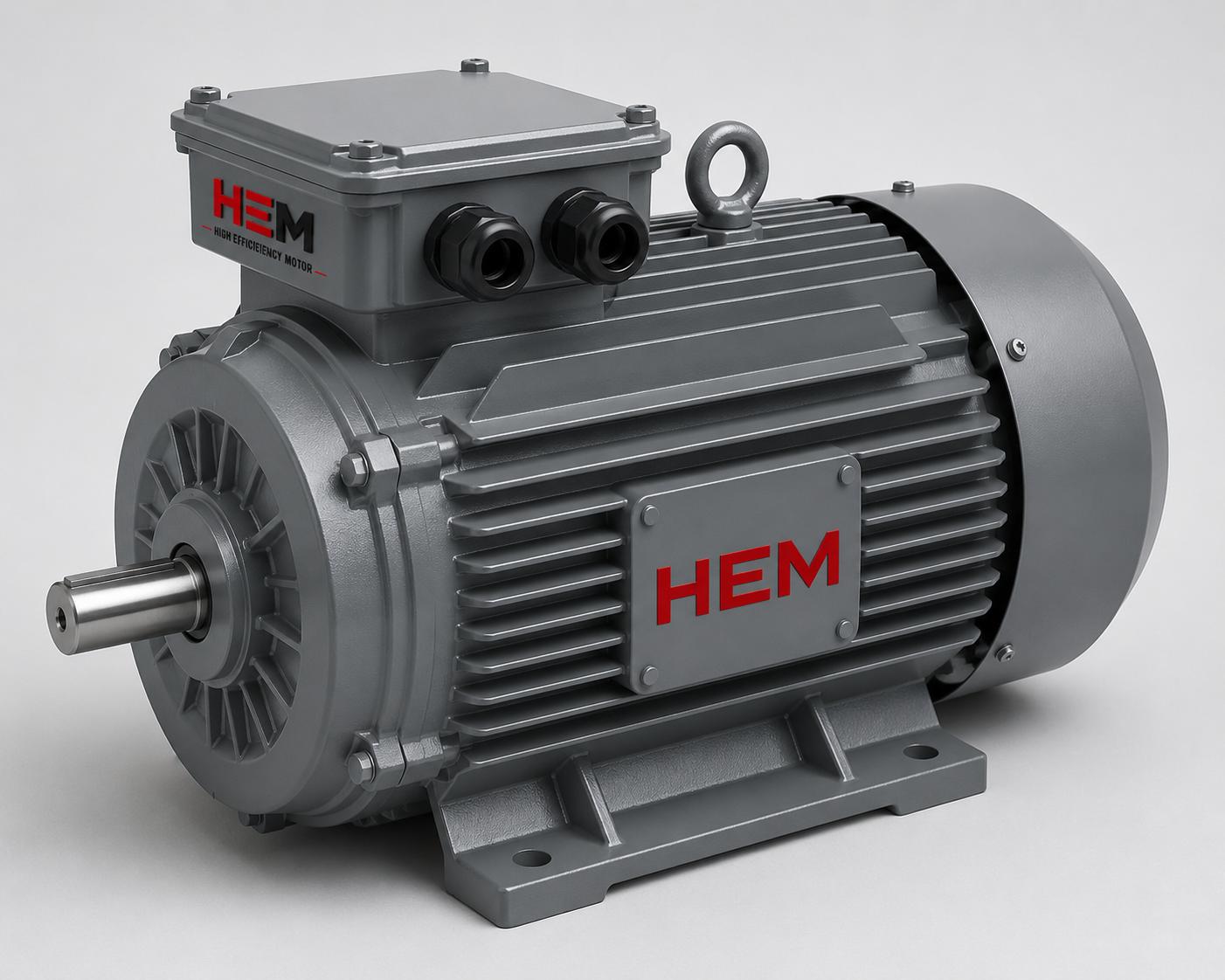

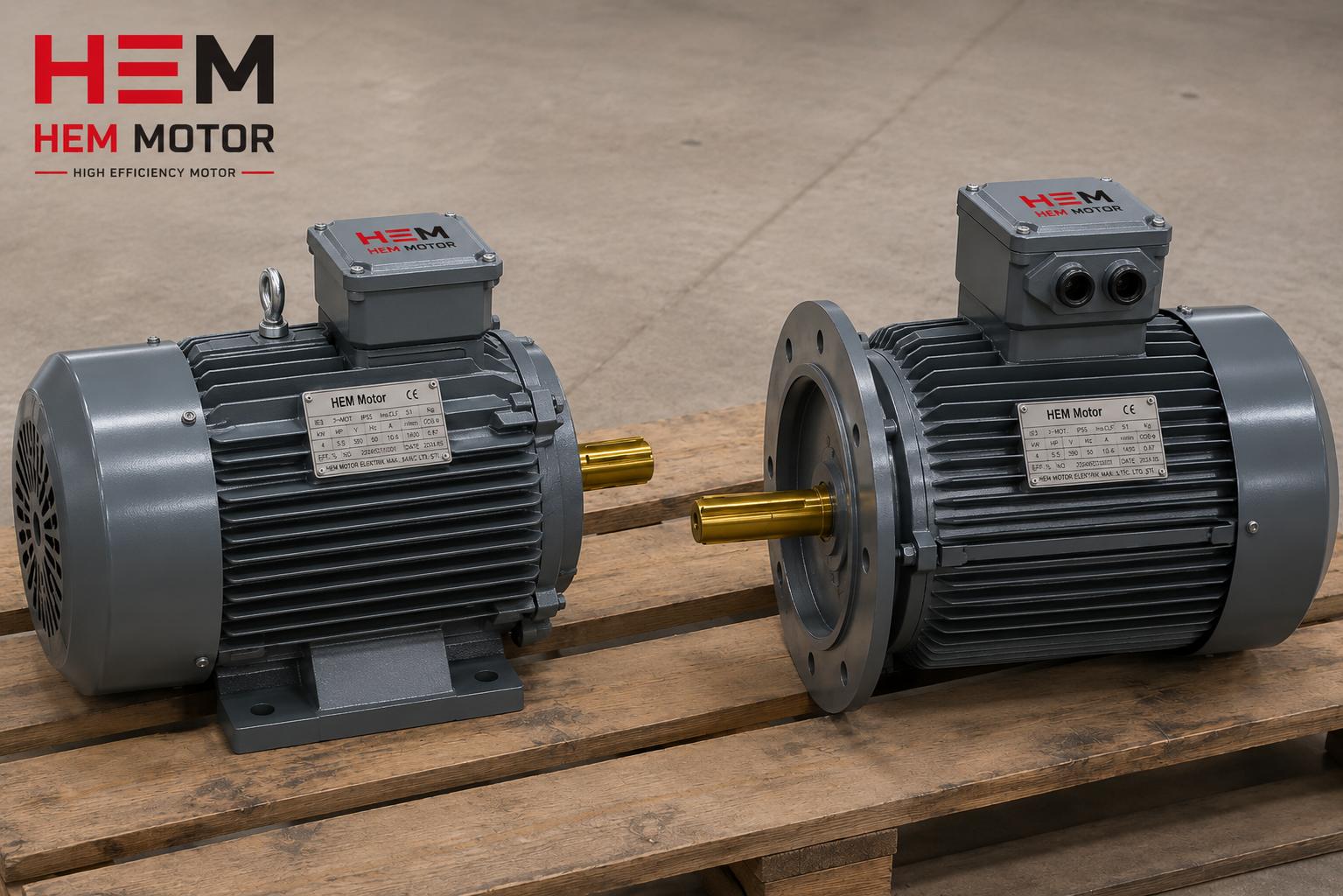
4 kW and 5.5 kW are two of the most sought-after motor powers in industry. This exact power range is used in pumps, fans, compressors, conveyors, hydraulic units and countless general-purpose drives. That is why moving to the IE4 super-premium efficiency class at these two powers is a critical decision for both energy saving and regulatory compliance. But buying the right IE4 motor does not end with the question of "how many kW"; the behaviour of the efficiency-load curve, how efficient the motor stays at part load, the suitability of the 2/4/6-pole speed choice for the application, correct matching of the frame size (100/112/132) and stock availability at these powers must all be evaluated together. In this article we examine 4 kW and 5.5 kW IE4 motors along these axes and explain correct procurement from the HEM Motor stock and supply perspective.
IE4 is the "super-premium" efficiency class in the IEC 60034-30-1 standard; at the same power it markedly reduces losses compared with IE3. However, a single efficiency value on the nameplate does not fully describe the motor's real field behaviour. Most drives rarely run at full load; the real saving is determined by efficiency at the part-load points where the motor operates throughout the day. This is precisely why reading the efficiency-load curve is the key to selecting the right motor.
The Efficiency-Load Curve: Beyond a Single Number
A motor's efficiency is not constant; it varies with load. A typical induction motor's efficiency-load curve peaks at around 75% load; it drops slightly at full load (100%) and falls noticeably at very low loads. The greatest strength of IE4 motors is that they shift this curve upward and maintain high efficiency particularly in the 50-75% part-load region. Since most pump and fan applications operate exactly in this region, the gain delivered by IE4 can be even more meaningful in the field than the catalogue value.
The practical consequence of this behaviour is clear: sizing the motor correctly to the application is as important as choosing the efficiency class. An oversized motor runs continuously at very low load and falls into the weak region of the efficiency curve; in that case the IE4 advantage melts away. For correct sizing, our article on efficiency class and correct sizing is a valuable resource.
4 kW and 5.5 kW IE4: Speed, Pole and Frame
At these two powers the physical size and speed of the motor change with pole count. As the pole count increases, speed decreases, torque rises and frame size grows. The table below summarises the typical pole-speed-frame matching and approximate efficiency magnitudes for 4 kW and 5.5 kW IE4 motors.
| Power | Poles | Synchronous Speed | Typical Rated Speed | Frame | Approx. IE4 Full-Load Efficiency |
|---|---|---|---|---|---|
| 4 kW | 2-pole | 3000 rpm | ~2900 rpm | 100L / 112M | ~89.9% |
| 4 kW | 4-pole | 1500 rpm | ~1450 rpm | 112M | ~90.1% |
| 4 kW | 6-pole | 1000 rpm | ~960 rpm | 132S | ~88.6% |
| 5.5 kW | 2-pole | 3000 rpm | ~2920 rpm | 132S | ~91.0% |
| 5.5 kW | 4-pole | 1500 rpm | ~1455 rpm | 132S | ~91.2% |
| 5.5 kW | 6-pole | 1000 rpm | ~960 rpm | 132M | ~89.8% |
The efficiency values in the table are typical magnitudes and may show small differences by manufacturer/series; the binding value is always the motor's nameplate. As can be seen, the 4-pole (1500 rpm) version is both the most common and generally the highest-efficiency point; that is why it is most often held in stock at this speed.
Which Pole to Choose?
- 2-pole (3000 rpm): Pumps and fans requiring high speed; centrifugal pumps, high-flow fans. Smaller frame, higher noise.
- 4-pole (1500 rpm): The most common, most balanced choice. General-purpose drives, conveyors, medium-speed pumps and fans; the default for most applications.
- 6-pole (1000 rpm): Applications needing high torque, low speed; mixers, heavy conveyors. Larger frame.
Part-Load Efficiency and Real Saving
A motor's real field saving depends less on its nameplate efficiency than on the load profile it runs at. If your motor spends most of the day at 50-75% load, the part-load superiority of IE4 translates directly into bill savings. On a continuously running (S1) 4 kW or 5.5 kW motor, the difference in electricity cost paid over the years by moving from IE3 to IE4 usually more than covers the initial price difference of the motor. To make this calculation concrete, you can review our articles on the payback of replacing an old motor with IE4 and total cost of ownership (TCO).
In pumps and fans driven by a variable frequency drive (VFD) the gain is even greater; at variable flow the motor frequently runs at part load, and the IE4 curve shines here. For the right combination in drive-fed applications, our article on high-efficiency motor + variable frequency drive provides guidance.
In Which Applications Are 4 kW and 5.5 kW Used?
The reason this power band is so common is that many standard machines in industry draw power exactly in this range. The typical applications of 4 kW and 5.5 kW IE4 motors are:
- Centrifugal pumps: Transfer of water, wastewater and process fluid; continuously running applications where energy saving is felt most.
- Fans and exhausters: Ventilation, air handling units (AHU), dust collection; high saving with a VFD at variable flow.
- Conveyors and belts: Continuous or intermittent transport; mostly 4- or 6-pole together with a gearbox.
- Compressors: Screw and piston air compressors; efficiency is critical under continuous load.
- Hydraulic units: Hydraulic pump motor in presses, injection and machine drives.
- Agitators and mixers: Usually 6-pole in processes needing high torque and low speed.
Most of these applications run continuously (S1), so the efficiency difference appears directly in annual energy consumption. To evaluate the IE4 threshold in pumps, fans and compressors, our article on the IE4 threshold in pumps, fans and compressors clarifies which application requires IE4.
Stock and Correct Procurement at These Powers
Because 4 kW and 5.5 kW are the most sought-after powers, they are priority items in IE4 stock. For correct procurement, follow these steps:
- Size the power correctly: Do not choose an oversized motor; prefer the standard power closest to your load.
- Choose the pole by application: Clarify your speed need; in most applications 4-pole is correct.
- Verify frame and mounting type: At the same power, the 100/112/132 frame and B3/B5/B35 mounting difference determines mechanical fit.
- Check drive compatibility: If it will run on a VFD, watch the winding insulation and du/dt protection.
- Clarify stock and lead time: The most sought-after powers can usually be supplied quickly.
If you are making a mechanical replacement at the same power, it is critical that the IEC connection dimensions match; our articles on mechanical compatibility in the IE4 transition and equivalent selection and IEC connection dimensions give the detail.
Regulation and Mandate in the IE4 Transition
The medium-power band such as 4 kW and 5.5 kW is the range most affected by efficiency regulation. European ecodesign rules and the national legislation aligned with them have raised the minimum efficiency class within certain power and application limits; IE3 has become the floor for many general-purpose motors between 0.75 kW and 1000 kW, and a trend toward IE4 has strengthened at certain powers. Therefore, when building a new facility or renewing an existing motor, it is wiser in the long run to choose a class that meets tomorrow's expectation rather than today's minimum. To clarify the decision between IE3 and IE4, our articles on IE3 and IE4 efficiency mandate and staying with IE3 vs moving to IE4 offer a comprehensive framework.
The regulatory mandate should not be the only motivation; the real gain is in the energy bill. A continuously running motor consumes many times its purchase price in electricity over its life. So the slightly higher initial cost of IE4 pays for itself in the short to medium term. To assess which facility should adopt super-premium motors first, our article on which facility should adopt IE4 super-premium first helps with prioritisation.
Where Do the Efficiency Losses Decrease?
There are concrete design improvements behind the IE4 motor's higher efficiency over IE3. In an induction motor, losses fall into four main headings: copper (winding) loss, iron (core) loss, friction and windage loss and load-dependent stray losses. In IE4 motors, more copper means lower-resistance windings; thinner, higher-grade silicon steel means lower iron loss; and an optimised fan design means lower windage loss. The sum of these improvements produces the efficiency that lifts the curve and gives an advantage especially at part load. To see in detail where the losses decrease, you can review our article on efficiency losses in IE4 motors.
A side benefit of these design improvements is quieter, lower-vibration operation. An optimised fan and better balancing often make IE4 motors quieter than standard motors of the same power; this is an extra advantage in facilities where noise matters. We covered the topic in our article on quiet and low-vibration operation in IE4 motors.
Reading the Nameplate
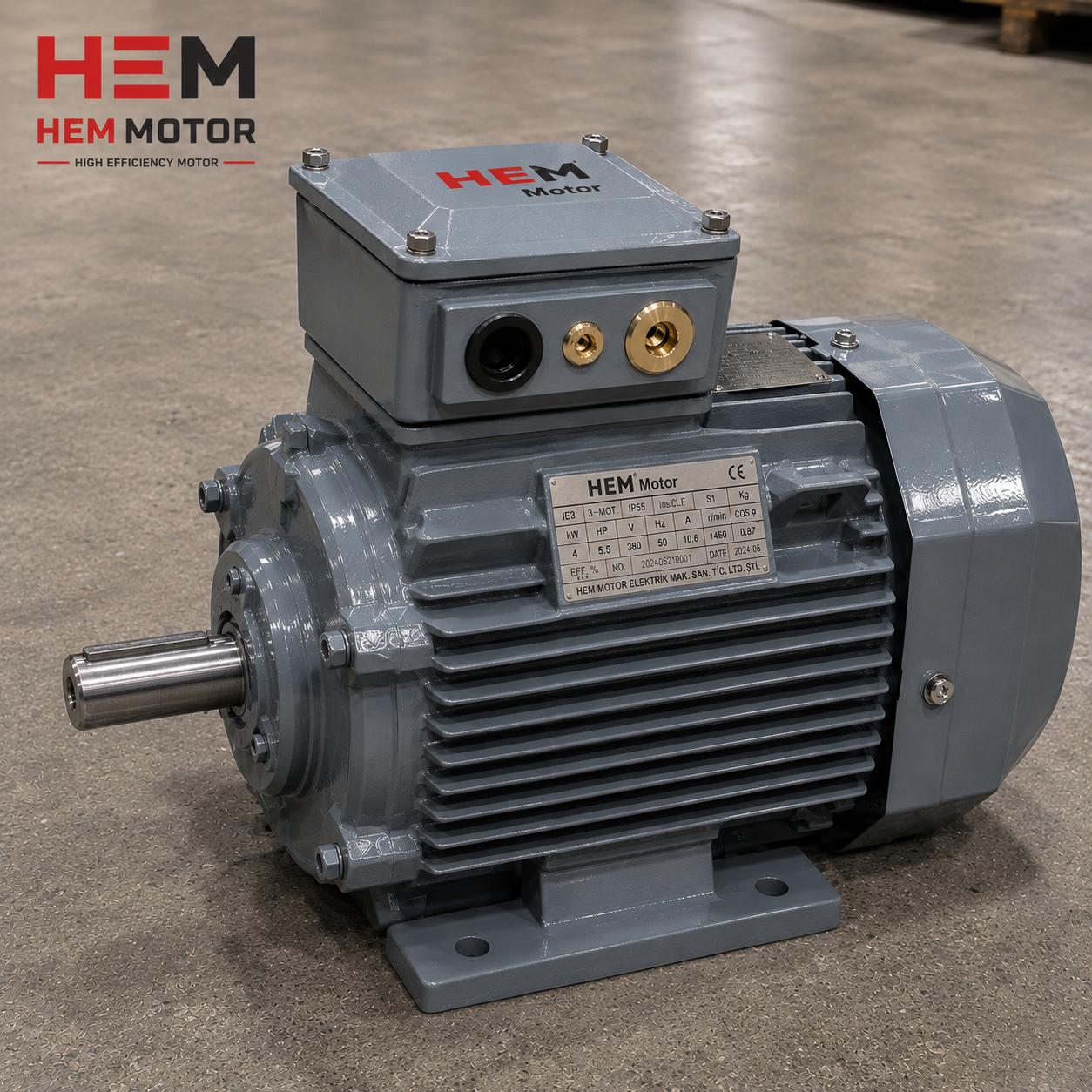
After selecting the right motor, it is good practice to read the nameplate at delivery and compare it with expected values. The plate shows power (kW), speed (rpm), poles, voltage, current, cosφ, efficiency (%) and IE class. To verify the nameplate efficiency with a field measurement, our article on reading efficiency and the IE code on the nameplate offers a practical checklist. This step lets you confirm that you have received a motor of the right class and the right power.
Frequently Asked Questions
How do I decide between 4 kW IE4 and 5.5 kW IE4?
The decision depends on the real power need of your load. Determine the shaft power of your drive and choose the standard power closest to it with a reasonable safety margin. For an application loaded continuously above 90% it is right to step up a power; for one running continuously at low load it is right not to oversize. Over-sizing weakens even the part-load advantage of IE4.
Is 2-pole or 4-pole more efficient?
Generally 4-pole (1500 rpm) versions offer slightly higher efficiency and quieter running at the same power; 2-pole versions provide higher speed and a smaller frame. The choice depends less on efficiency than on the speed the application requires; but where speed is free, 4-pole is often the most balanced choice.
Can IE4 motors at these powers be supplied quickly from stock?
Since 4 kW and 5.5 kW are the most sought-after powers, their 2- and 4-pole versions in particular are held as priority in stock and can usually be delivered quickly. If you share your frame size, mounting type and drive need up front, we clarify the correct configuration in the shortest time.
At HEM Motor we offer 4 kW and 5.5 kW IE4 super-premium motors from wide stock with fast delivery in the most sought-after pole and frame configurations. To assess together your application's load profile, speed need and mounting type and select the right motor, request a quote; we are at your side with manufacturer stock advantage and fast supply.