English
 Türkçe


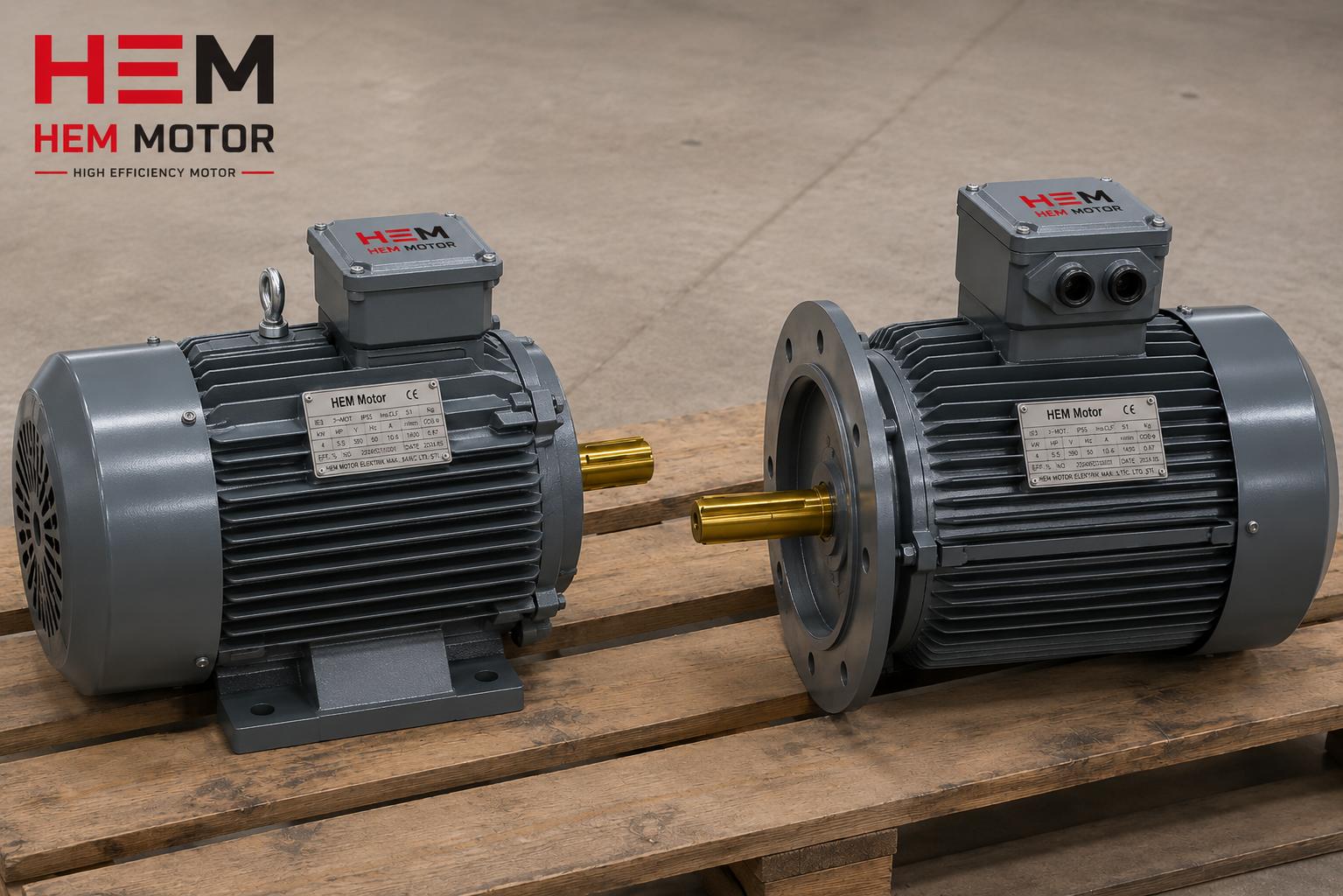

An IE4 class electric motor, thanks to its high efficiency, produces the same output with fewer losses; this means lower winding temperature and longer life. Yet this thermal margin can be quietly consumed by a fault in the supply: phase current unbalance. In a three-phase motor, if the current in one phase is markedly higher than the others, that winding heats disproportionately and the thermal reserve gained from efficiency melts away. Worse, the problem often stays hidden at partial load; because the motor runs below rated power the total current is low and the overload relay does not trip, yet the most loaded phase can still reach a dangerous temperature.
In this article we cover, in practical terms, the source of phase current unbalance in IE4 motors, how voltage unbalance is amplified into current unbalance through the NEMA factor, the relationship between winding heating and derating at partial load, the correct measurement method (clamp meter), the selection of phase protection relay and overload, and why the 2% voltage unbalance limit is critical. The aim is to help you recognise this hidden fault that prematurely ages a high-efficiency IE4 motor and to set up the right protection.
What Is Phase Current Unbalance and Why Does It Occur?
Phase current unbalance is the inequality of the currents in the three phases. In an ideal system all three phases draw the same current. In reality the main causes of unbalance are:
- Voltage unbalance: Inequality of the phase-to-phase voltages. The most common and most important cause.
- Uneven distribution of single-phase loads: Single-phase loads fed from the same transformer concentrated on one phase.
- Loose connections and high contact resistance: Increased resistance in one phase at a terminal, contactor or fuse.
- Winding fault: A turn-to-turn short or connection defect in the motor's own winding.
- Cable size and length differences: Impedance difference between phases, especially on long feeders.
The first of these, voltage unbalance, is the most insidious for the motor because a small voltage difference turns into a much larger unbalance in current.
Effect of Voltage Unbalance on Current: The NEMA Factor
The widely accepted rule in industry is that percentage voltage unbalance is amplified roughly 6 to 10 times into current unbalance. For example, a 2% voltage unbalance can create a current unbalance of the order of 12-20% in the most loaded phase. The reason is that the motor's negative-sequence impedance is very low; a small negative-sequence voltage drives a large negative-sequence current, and that current acts on the rotor like a brake, generating extra heat. NEMA states that the winding temperature rise increases roughly with twice the square of the percentage unbalance; so at 5% voltage unbalance the temperature rise can be of the order of 50%.

Winding Heating and Derating at Partial Load
The most dangerous aspect of phase current unbalance is that it can hide at partial load. If the motor runs at, say, 60% of rated power, the total current is low and the overload relay does not trip. But due to unbalance the most loaded phase may be drawing current well above the average; that phase reaches a temperature that degrades the winding insulation even while the motor appears "lightly loaded". The thermal margin that the IE4 motor gains from its low losses acts as a protective buffer here, but it is not limitless.
In this situation NEMA recommends derating the motor under unbalance. The table below summarises the approximate derating factor to apply versus voltage unbalance and the winding temperature-rise trend.
| Voltage unbalance (%) | Approx. derating factor | Winding temp-rise trend | Status |
|---|---|---|---|
| 0 - 1 | 1.00 | Negligible | Normal |
| 2 | 0.95 | Noticeable rise | Monitor |
| 3 | 0.88 | High | Derating needed |
| 4 | 0.82 | Very high | Action needed |
| 5 | 0.75 | Critical | Do not run |
As the table shows, 5% voltage unbalance means the motor can run at only three quarters of rated power; operating above this threshold rapidly consumes the winding insulation. For this reason many standards and manufacturers recommend the 2% voltage unbalance limit as the safe upper bound for continuous operation.
Correct Measurement: Phase Current Check with a Clamp Meter
The most practical way to detect phase current unbalance is to measure the current of each of the three phases separately with a clamp meter while the motor runs at normal load. The unbalance percentage is found simply: take the average of the three currents, find the greatest deviation from the average, then divide that deviation by the average and convert to a percentage. For example, if the currents are 10, 10.5 and 11.5 A, the average is 10.67 A, the greatest deviation 0.83 A and the unbalance about 7.8%, which is an unacceptable level.
- Measure while the motor is at steady load; sudden load changes give misleading values.
- Measure the phase-to-phase voltages at the same time; this tells whether the current unbalance comes from voltage or from the motor.
- If you swap the supply phases to the motor and measure again, you can see whether the most loaded phase travels with the motor or with the supply. If the high current travels with the phase, the source is in the supply; if it travels with the motor, the source is in the motor.
Protection: Phase Protection Relay and Overload Selection
There are two complementary ways to protect an IE4 motor against phase current unbalance:
- Phase protection (phase-sequence/unbalance) relay: Monitors phase loss, phase-sequence error and voltage unbalance; stops the motor when unbalance exceeds a set threshold (e.g. 5-10%). It is the fastest protection against phase loss (single-phasing).
- Thermal overload relay: Modern overload relays are sensitive to phase unbalance; they detect excess current in a phase and trip. But the overload alone cannot always catch a hidden unbalance at partial load; hence it is recommended together with a phase protection relay.
- Winding temperature sensor (PTC/PT100): The most reliable protection is a thermistor or PT100 that measures winding temperature directly. Whatever the source of unbalance, it protects the motor when the most loaded winding reaches a critical temperature.
The most robust solution is to use all three together: the phase protection relay catches sudden faults, the overload catches excess current, and the winding sensor catches the real temperature. On an expensive IE4 motor in particular, specifying winding temperature protection from the start secures the investment.
Frequently Asked Questions
Why is 2% voltage unbalance taken as the limit?
Because 2% voltage unbalance, through the NEMA factor, turns into roughly 12-20% current unbalance in the most loaded phase and a noticeable winding temperature rise. Continuous operation above this threshold without derating shortens insulation life; that is why most manufacturers recommend 2% as the safe upper bound.
Does a thermal relay protect against phase unbalance on its own?
Partly. Modern overload relays are sensitive to unbalance, but since total current is low at partial load they cannot always catch a hidden unbalance. It is best to use them together with a phase protection relay and, where possible, a winding temperature sensor.
Does the IE4 motor's high efficiency protect against unbalance?
Indirectly, yes. The IE4's low losses mean a lower base winding temperature, which leaves a thermal margin for the extra heating caused by unbalance. But this margin is limited and is no substitute for fixing the unbalance; a persistent unbalance still wears the motor.
In IE4 motors, phase current unbalance is a significant risk that quietly consumes the thermal margin gained from high efficiency and hides at partial load. The right approach is regular clamp-meter measurement, adherence to the 2% voltage unbalance limit, derating where necessary, and the combined use of a phase protection relay with a winding temperature sensor. HEM Motor delivers IE4 motors across a wide power range from stock and helps you define options such as winding temperature protection from the start; we can determine the right motor and protection for your application together and prepare a quotation.
Finding and Eliminating the Source of Unbalance
When phase current unbalance is detected, the source must be found before protecting the motor; setting up protection hides the problem but does not solve it. The first step is to measure the phase-to-phase voltages. If there is a marked difference between the voltages, the problem is on the supply side: uneven distribution of single-phase loads at the transformer or main board, a loose connection in one phase, or high contact resistance are the most likely causes. In this case, distributing single-phase loads evenly across the three phases, tightening terminal and busbar connections and cleaning oxidised contact surfaces usually solves it.
If the voltages are balanced but the currents are not, the problem is most likely inside the motor: a turn-to-turn short in the winding, a connection fault, or high resistance in one phase. To confirm this, swap the supply phases relative to the motor; if the high current travels with the motor, the motor is suspect and an insulation resistance test plus a winding resistance comparison should be carried out. A marked difference between the resistances of the three windings is a clear sign of a winding fault. Such a motor is usually replaced rather than repaired in the field; on a high-efficiency IE4 motor in particular, a winding fault also lowers efficiency, so economical repair is often not feasible.
Difference Between Unbalance at Starting and at Steady Running
Phase current unbalance matters not only in steady running but also at the moment of starting. At start the motor draws several times rated current; in this high-current region even a small unbalance creates a large difference in absolute terms and can reduce starting torque, causing the motor to run up slowly. A slow run-up means a longer starting time, which leads to extra winding heating. So in applications with frequent start-stop or high-inertia loads, phase unbalance is doubly critical; extra heat accumulates at every start and the unbalance persists in steady running. The right approach in these applications is to make a winding temperature sensor mandatory alongside the phase protection relay and, if necessary, to limit the starting current with a soft starter or a drive. On drive operation, supply-side voltage unbalance is largely filtered out because the drive supplies the motor with its own balanced three phases; this is an important reason why drive-fed IE4 applications are more resilient to supply unbalance, but the drive does not solve unbalance arising from the motor's own winding fault.
Cost, Life and Practical Tips
The cost of phase current unbalance often accumulates unnoticed. Insulation life is related exponentially to winding temperature: as a common rule, every 10 degrees of sustained temperature rise roughly halves insulation life. So a continuous voltage unbalance of 3-4%, while looking small on paper, can cut the expected ten-year life of an IE4 motor to a half or even a quarter. The premium paid for a high-efficiency motor is wasted by early failure under such unbalance. Eliminating unbalance is therefore a step that protects not only energy but the motor investment itself. The practical tips can be summarised as: at commissioning, record the three-phase currents for each motor and keep them as a reference; repeat this measurement at periodic maintenance and track the trend; a sudden increase in unbalance is an early warning of a loosening connection or a developing winding fault. Distribute single-phase loads evenly across the three phases at the design stage, choose generous cable sizes on long feeders, and most importantly treat winding temperature protection as standard rather than optional on expensive IE4 motors; this small added cost provides the most reliable protection by stopping the motor at the limit temperature whatever the source of unbalance.
Related reading: thermal relay, contactor and fuse selection, temperature monitoring with PT100 and PTC, voltage tolerance and grid fluctuation, wiring PTC/PT100 thermal protection and motor protection circuit breaker (MPCB) setting.