English
 Türkçe


A large share of early failures in an electric motor stem not from the winding but from the bearing, and a significant portion of these failures are tied to wrong or neglected lubrication. Bearing greasing and lubrication in IE3 motors is not just a maintenance routine; it is a decision that directly determines the motor's life, downtime and annual maintenance cost. Knowing the right grease type, the right interval and the right amount, combined with a planned maintenance programme, largely prevents unexpected stoppages. To source IE3 motors suited to your plant from stock or to find an equivalent for your existing motor, you can contact us and review the product family on our IE3 electric motors page.
Why Does Bearing Lubrication Determine the Motor's Life?
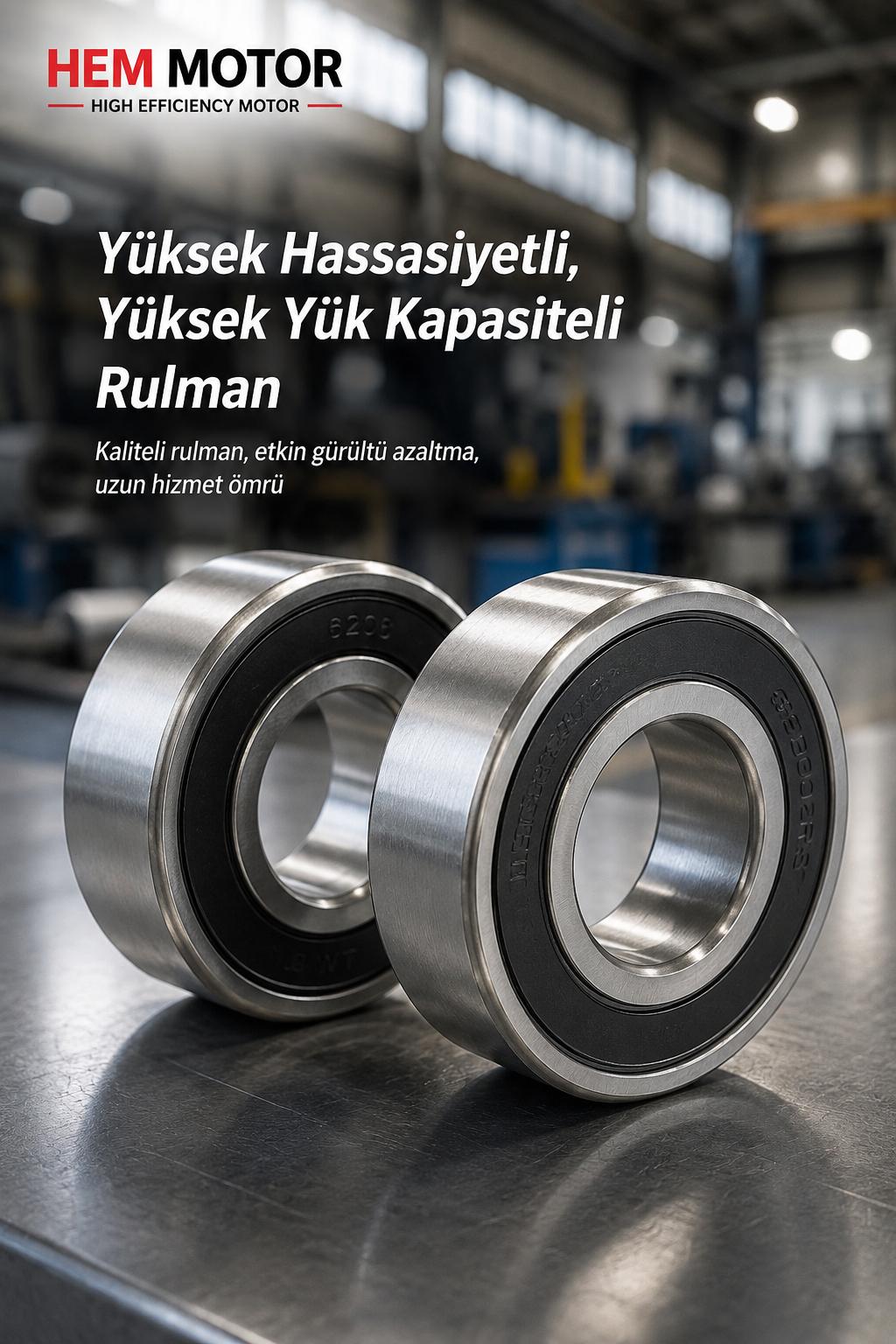
The bearing is the mechanical part that carries the motor's rotating shaft and wears the most. Between the balls and the races sits a thin grease film; this film prevents metal-to-metal contact, reduces friction and heating, and also forms a barrier against moisture and contamination. Grease degrades over time, loses its consistency and loses its protective property. When the film thins, friction rises, the bearing heats up, noise and vibration increase and eventually the bearing seizes. This is why lubrication is the determinant of the motor's mechanical life.
To see the symptoms of bearing-related failures and when intervention is needed in detail, our article on electric motor failures is a complementary resource. We addressed the effect of bearing type selection on life in our content on bearing type and life in asynchronous motors.
The Relationship Between Lubrication, Efficiency and Temperature
In IE3 efficient motors mechanical losses are kept low; a correctly lubricated bearing keeps friction loss at a minimum and preserves the motor's efficiency. If lubrication is faulty or insufficient, friction rises, the motor heats up more, efficiency falls and the winding insulation ages faster. So greasing concerns not only the bearing but, indirectly, the health of the whole motor.
Sealed Bearing or Regreasable Bearing?
There are two basic bearing approaches in IE3 motors. In small and medium frame motors, sealed (closed) bearings are generally used; these are greased at the factory, sealed with a shield and under normal conditions need no regreasing throughout their life. In larger frames, regreasable bearings are preferred; these motors have a grease nipple and are regreased at certain intervals.
Which Is Preferred in Which Case?
The sealed bearing is advantageous where maintenance access is difficult or where staff cannot grease frequently; the maintenance burden is low, but the bearing must be replaced once its life expires. The regreasable bearing is preferred in large motors running continuously heavy, at high speed or high temperature; with planned greasing the bearing life can be extended. Which approach suits you depends on frame size, operating conditions and your maintenance capability. It is useful to assess the effect of frame size on life together with our article on winding and insulation class in IE3 motors.
Choosing Grease Type: Which Grease, Which Condition?
Not every grease suits every motor. Three key parameters stand out in grease selection: consistency (NLGI class), base oil viscosity and operating temperature range. In electric motors, lithium or lithium-complex soap-based greases of NLGI 2 and NLGI 3 consistency are commonly used. High-temperature applications call for greases with a high dropping point, while low temperatures call for softer, lower-viscosity greases.
Why Is It Important Not to Mix Different Greases?
A common serious mistake is adding a grease with a different soap base to the existing grease. When incompatible greases mix, consistency breaks down, the grease becomes fluid or, conversely, hardens and loses its lubricating property. In this case the bearing is actually left unprotected even though it appears full. When regreasing, always use the same type or a grease the manufacturer states to be compatible. Grease type, amount and interval are stated on the nameplate or information plate of most motors; our article on reading the IE3 motor nameplate offers guidance.
Regreasing Interval: Effect of Speed and Temperature
In regreasable bearings the most critical decision is what the regreasing interval will be. This interval is not fixed; it changes with the motor's speed, bearing size, operating temperature and ambient conditions. The general rule is this: the higher the speed, the shorter the regreasing interval. In a 2-pole (3000 rpm) motor the regreasing interval is markedly shorter than in a 4-pole (1500 rpm) motor of the same size.
How Does Operating Temperature Shorten It?
Temperature is one of the strongest factors directly affecting grease life. As a general engineering assumption, once the bearing operating temperature is above a certain threshold, grease life roughly halves for every 15-degree rise. So in a motor running in a hot environment or continuously at full load, the regreasing interval should be more frequent than the standard catalogue value. The interval is also shortened in dusty, humid or high-vibration environments. We detailed the effect of hot and dusty environment conditions on motor selection in our article on motors in hot and dusty environments.
The Relationship Between Speed and Frame Size
In large-frame motors the bearing is also large, so the grease amount given at one time increases, but the regreasing interval is more frequent than in small-frame motors. The correct amount is usually determined by a formula based on bearing diameter and width or by the manufacturer's table. To read the motor's speed and power correctly, our article on what load to run a motor at helps to understand the operating point.
Overgreasing: More Harmful Than Under-Lubrication
A common misconception in many plants is the idea that "the more grease, the better." Yet overgreasing is often more harmful than insufficient greasing. When the bearing cavity fills completely with grease, the balls keep pushing and churning the grease; this churning raises internal friction and temperature. The rising temperature separates the oil from the grease, the grease hardens and the bearing overheats into early failure. Excess grease can also seep into the winding cavity and damage the insulation.
How Is the Right Amount Given?
In regreasing, the correct practice is to give the calculated amount of grease slowly while the motor runs and the drain plug is open. This way the old grease is expelled, the new grease settles into the bearing and excess grease does not accumulate. After greasing, the motor is run for a while to expel the excess. This simple discipline significantly extends bearing life and lowers maintenance cost.
The Way to Cut Maintenance Cost: Planned Lubrication
Tying bearing lubrication to a planned schedule is the most effective measure against unexpected stoppages. For each motor the grease type, amount and interval are recorded; greasing dates are tracked and supported by temperature and vibration measurements. This approach is far more economical than a bearing failure stopping the production line. To build a general maintenance schedule, our article on the electric motor maintenance and periodic check schedule offers a ready framework.
Keeping a spare for critical motors is also a cost-cutting strategy; being able to substitute without stopping production when a motor fails is an integral part of maintenance planning. You can reach all our IE3 topics from the IE3 electric motors category, equivalent products and mounting options from our electric motor mounting types page, and our entire product range from our home page.
The Effect of Season and Environment on Grease Selection
The same motor may show different lubrication needs in a cold store in winter and in a hot production hall in summer. At very low temperatures a stiff grease cannot spread well enough to the bearing at start-up and increases friction in the first moments; at very high temperatures a soft grease flows and leaves the bearing unprotected. So in grease selection the lowest and highest temperatures of the environment in which the motor will run should be assessed together. In applications running across a wide temperature range, special greases with a wide operating range are preferred.
In open fields, outdoor environments or plants where washdown is carried out, greases resistant to water and moisture and protective against wash-out gain importance. In environments requiring hygiene such as food plants, food-grade greases are used. So grease selection relates not only to temperature and speed but directly to the sector the application sits in. To determine the right motor and the right protection class together, our article on IP protection class selection in electric motors gives complementary information.
How Lubrication Mistakes Reflect on Maintenance Cost
The cost of a lubrication-related bearing failure can rarely be measured by the price of a few tubes of grease. The real item to factor in is lost production. The unexpected stoppage of a conveyor, pump or fan motor can halt the entire line; replacing the failed bearing, removing the motor, rebalancing and recommissioning it can take hours. By comparison, planned greasing takes minutes and costs next to nothing. This is why lubrication discipline is one of the highest-return maintenance investments.
A second hidden cost is the damage wrong lubrication does to the winding. The heat radiating from an overheated bearing ages the neighbouring winding insulation and shortens the motor's total life. So a lubrication mistake can put not just the bearing but the whole motor at risk. To see the early failure causes that shorten motor life together, our article on electric motor life and early failure causes offers a holistic view.
Watch Lubrication in Stock Motors
In a motor stored for a long time, the grease settles downward with gravity over time even if unused, and the upper part of the bearing can be left unprotected. So motors kept in stock for a long time should have the shaft turned by hand before commissioning and be regreased if necessary. We addressed the effect of storage conditions on the motor in detail in our article on electric motor storage and long-term standstill. In a newly purchased IE3 motor too, checking the bearing noise and temperature before first commissioning is a simple but effective way to catch early problems.
The Right Grease Equipment and Cleanliness
The grease gun, nipple and their surroundings being clean is as important as the greasing itself. Dust and dirt sticking to the nipple tip are carried into the bearing with the grease and create an abrasive effect. Before greasing, the nipple should be cleaned, and cross-contamination should be watched for in grease guns used for different motors. These small care details extend bearing life and lower maintenance cost. Good maintenance habits are among the most important factors determining a motor's total cost from the moment it is received from stock to the day it is scrapped.
Frequently Asked Questions
How often should I grease my IE3 motor's bearing?
There is no fixed interval; the regreasing interval depends on the motor's speed, bearing size, operating temperature and ambient conditions. In 2-pole high-speed motors the interval is shorter; in hot, dusty or humid environments greasing should be more frequent than the standard value. Take as a basis the interval stated on your motor's information plate or catalogue; if this information is missing, send us the power, speed and operating condition and we will help you determine the right interval.
Can I mix greases of different brands?
If the soap bases are incompatible, mixing causes serious problems; the grease can become fluid or harden and lose its lubricating property. In this case the bearing is left unprotected even though it appears full. Always use the same type of grease or one the manufacturer states to be compatible; if you need to change the grease type, first clean the bearing of the old grease.
Why is overgreasing harmful?
When the bearing cavity fills completely with grease, the balls churn the grease; this churning raises friction and temperature, the grease hardens and the bearing fails early. Excess grease can also seep into the winding and damage the insulation. The correct practice is to give the calculated amount with the drain plug open and wait for the excess to be expelled.
Get a Quote
Would you like support on supplying an IE3 efficient electric motor suited to your plant, an equivalent for your existing motor or your maintenance planning? Send us your power, speed, frame type and application details, and we will quickly offer the most suitable solution. Call now on +90 (532) 345 49 86 or send your quote request via our contact page.