English
 Türkçe



IE4-class 15 kW and 18.5 kW motors are among the most sought-after power ranges in industrial facilities in Turkey. In pump, fan, compressor, conveyor and general process drives, these two power ratings appear constantly. The right purchasing decision, however, does not end with the question of "how many kW"; you need to evaluate the motor's efficiency-load curve, its behaviour at part load, the correct pole (speed) selection and stock availability together. In this article we look practically at the efficiency-load curve of 15 kW and 18.5 kW IE4 motors, the 2/4/6-pole speed selection, how efficiency changes at part load, and why buying correctly from stock matters in the most sought-after powers.
Why Does the IE4 Efficiency Class Matter? Gains in the 15 and 18.5 kW Band
IE4 (Super Premium Efficiency) is the high-efficiency class defined in the IEC 60034-30-1 standard. If a motor runs for long hours per day, the purchase price is a small part of the total cost of ownership (TCO); the real cost is the electricity it consumes over the years. In medium powers like 15-18.5 kW, the few points of efficiency gained by moving from IE3 to IE4 translate into meaningful energy savings at high running hours. We examined the IE3-to-IE4 transition decision together with running hours and depreciation in our article on IE4 vs IE3 transition decision.
To see the real value of the efficiency difference, you have to distinguish field efficiency from nameplate efficiency; a wrongly sized motor will not deliver the expected savings in the field even if its label says IE4. We covered this distinction in our article on nameplate vs field efficiency.
Typical Efficiency Values for 15 kW and 18.5 kW IE4 (4-pole)
| Power | Poles / Speed | Full-load efficiency (IE4, ~) | Typical full-load current tendency |
|---|---|---|---|
| 15 kW | 2-pole / ~2950 rpm | around 92.9% | Low torque, high speed |
| 15 kW | 4-pole / ~1465 rpm | around 93.3% | Most common choice |
| 15 kW | 6-pole / ~975 rpm | around 92.6% | High torque, low speed |
| 18.5 kW | 2-pole / ~2955 rpm | around 93.3% | Low torque, high speed |
| 18.5 kW | 4-pole / ~1470 rpm | around 93.7% | Most common choice |
| 18.5 kW | 6-pole / ~980 rpm | around 93.0% | High torque, low speed |
The efficiency values in the table are approximate references for the IEC 60034-30-1 IE4 class; exact values are stated in the manufacturer's technical catalogue and on the motor nameplate. The general tendency: at the same power, 4-pole usually offers the highest efficiency and the most balanced characteristic.
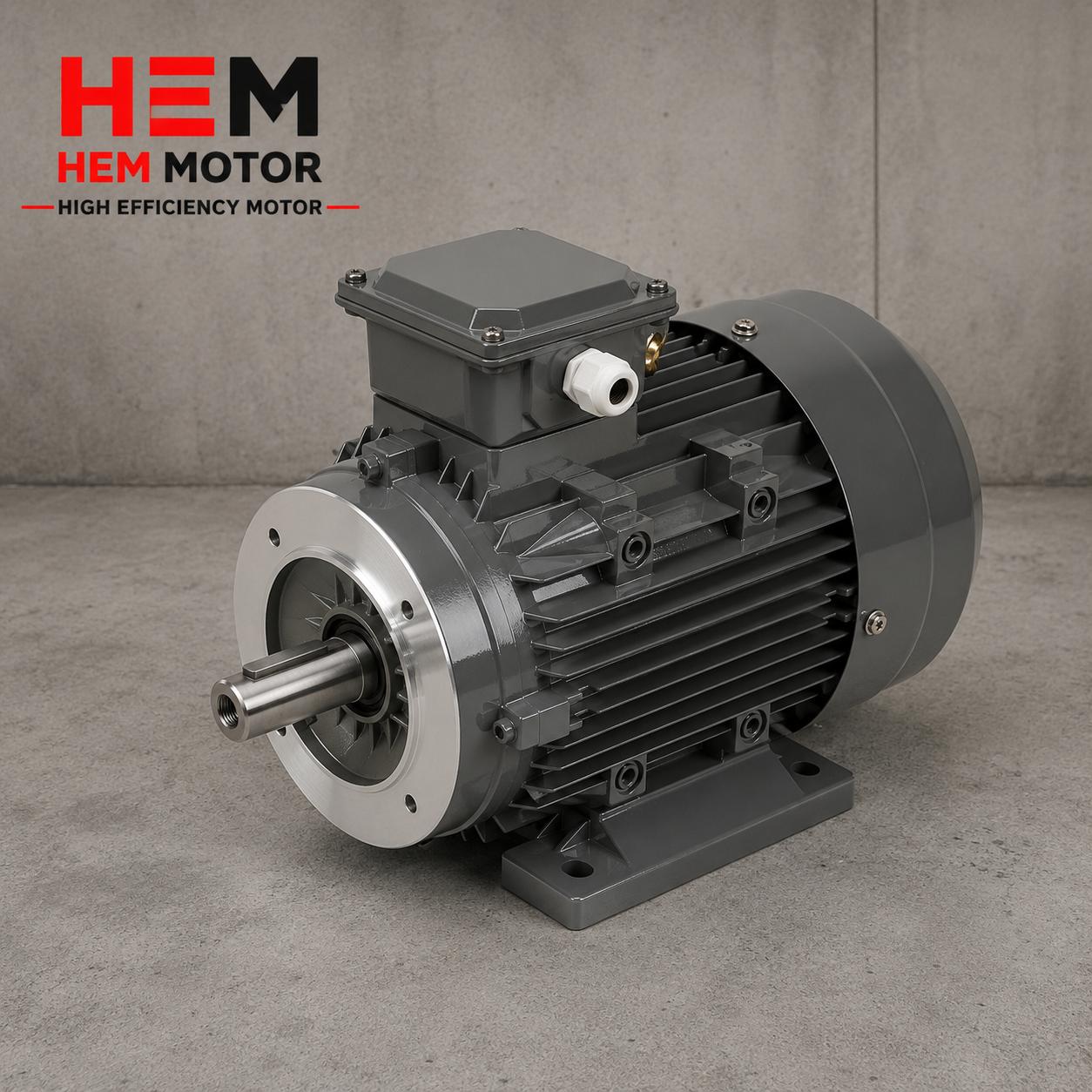
The Efficiency-Load Curve: Why Is Part-Load Efficiency Critical?
The efficiency written on the motor nameplate is the full-load (100%) value. But most motors in the field do not run continuously at full load; pumps, fans and conveyors generally operate in the 50%-85% load band. The efficiency-load curve shows how efficient the motor is at different load ratios. For induction motors the typical characteristic is:
- Efficiency peaks around 75% load.
- It stays fairly flat (high) across the 50%-100% band.
- At very low loads of 25% and below, efficiency drops quickly; because iron losses and friction losses stay constant while useful power decreases.
An important advantage of IE4 motors is that the part-load efficiency curve runs flatter and higher than IE3. So in variable-load applications the gain of IE4 is larger than the full-load difference alone. That said, an over-sized motor running continuously at 30%-40% load loses both efficiency and power factor. That is why correct sizing matters as much as the efficiency class. We covered part/low-load efficiency and correct sizing in depth in our article on part/low-load efficiency and correct sizing.
Typical Efficiency-Load Curve (15 kW IE4, 4-pole, approximate)
| Load ratio | Approx. efficiency | Approx. power factor (cosφ) |
|---|---|---|
| 100% | 93.3% | 0.86 |
| 75% | 93.5% (peak) | 0.83 |
| 50% | 92.5% | 0.76 |
| 25% | 88.0% | 0.58 |
As you can see, efficiency stays high and flat across the 50%-100% band, while at 25% load both efficiency and power factor drop noticeably. So for an application that will run the motor continuously in the 25% load band, a lower power (e.g. 11 kW) may be the more correct choice.
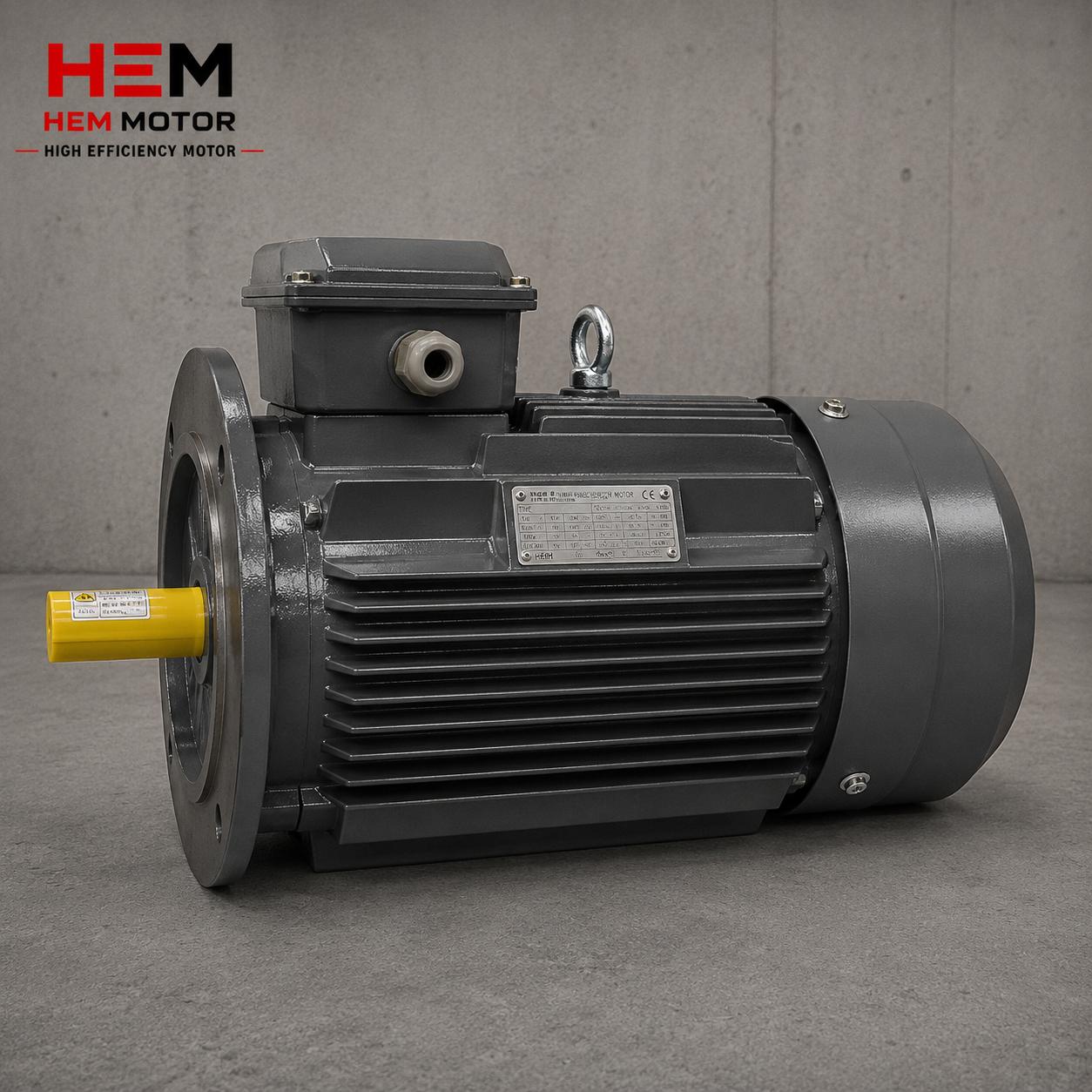
2, 4 and 6-Pole Speed Selection: Which Pole for Which Application?
The motor's synchronous speed is determined by the number of poles and the grid frequency (at 50 Hz: 2-pole ≈ 3000, 4-pole ≈ 1500, 6-pole ≈ 1000 rpm synchronous). Under load the actual speed drops slightly with a small slip. The correct pole choice depends on the speed and torque characteristic the application requires:
- 2-pole (~3000 rpm): High speed, low torque. Centrifugal pumps, high-pressure fans, some compressors. The smallest and lightest motor at the same power.
- 4-pole (~1500 rpm): The most common and most balanced choice. Pumps, fans, conveyors, general drives. Often offers the highest efficiency and is the most abundantly stocked speed.
- 6-pole (~1000 rpm): Low speed, high torque. Applications needing slow but powerful drive; some mixers, heavy conveyors, with a gearbox.
The speed choice also depends on whether it will be direct drive or run through a gearbox/belt-pulley. The wrong pole choice creates either the need for an unnecessarily large gearbox or extra transmission loss in a belt-pulley. We covered efficiency-torque selection in low-speed 6/8-pole motors in our article on low-speed 6/8-pole efficiency-torque selection. For 2-pole high-speed pump-fan selection, our article on 2-pole 3000 rpm pump-fan power selection is useful.
Why Does Stock Matter in the Most Sought-After Powers?
Because 15 kW and 18.5 kW are the most demanded powers in industry, the "needed immediately" situation arises often at the moment of a breakdown or a new installation. Being able to supply quickly from stock in these powers directly reduces the downtime of the production line. Advantages of buying correctly from stock:
- Quick replacement and short downtime in an urgent breakdown,
- Mechanical compatibility thanks to standard frame size (typically around IEC 160L for 15 kW, 160M/180M for 18.5 kW),
- Easy mounting in place of the old motor with standard connection dimensions (foot, flange, shaft),
- Predictable lead time in project planning.
We covered which kW values can be supplied from stock and the stock range in our article on IE4 motor stock range: which kW from stock; and the selection of the lower band 7.5 and 11 kW in our article on 7.5 and 11 kW efficiency-load curve and stock. When replacing an old motor with an equivalent, our article on equivalent selection and connection dimensions guides the connection-dimension compatibility.
Where Do the Efficiency Losses in 15 and 18.5 kW IE4 Motors Come From?
In a motor, the portion not converted to useful work turns into heat. The IE4 class minimises these losses to achieve high efficiency. In the 15-18.5 kW band, the losses consist mainly of four items:
- Copper (winding) losses: The I²R losses from winding resistance. IE4 motors lower this loss by using more and better-quality copper.
- Iron (core) losses: Magnetic hysteresis and eddy-current losses. Using thin, low-loss silicon steel laminations reduces this.
- Friction and windage losses: Bearing friction and fan loss. Reduced with an optimised fan design.
- Stray load losses: Scattered losses that occur under load.
In the transition to IE4, each of these items is improved; the result is a motor that does the same job with less electricity. We examined the detailed breakdown of loss items in our article on IE4 motor efficiency losses: iron, copper, friction.
Running with a VFD: Variable Speed in 15-18.5 kW IE4
In pump and fan applications, instead of running the motor at fixed speed and throttling with a valve/damper, lowering the speed to demand with a variable frequency drive (VFD) provides large energy savings. Under the affinity law, reducing speed by 20% can cut the power requirement by roughly half. This gain is very pronounced in continuously running medium powers like 15 and 18.5 kW. However, two points need attention when running with a VFD: at low speed the motor's own fan may not cool sufficiently (an external forced cooling fan may be needed), and the waveform at the drive output can impose extra thermal load on the motor. We covered pump-fan savings with a VFD under the affinity law in our article on VFD pump-fan energy savings; and the cooling need at low speed in our article on external forced cooling fan.
Checklist for the Right 15 / 18.5 kW IE4 Selection
- What is the real load profile? Continuous or variable, and what is the part-load band?
- Which is the correct pole (2/4/6) for the required speed/torque?
- What is the frame size, connection type (B3 foot / B5-B14-B35 flange) and shaft size of the existing motor?
- How many running hours? High running hours amortise the IE4 efficiency advantage faster.
- Will it run with a VFD? If variable speed is needed, drive compatibility and cooling must be considered.
Frequently Asked Questions
Should I choose 2-pole or 4-pole for 15 kW?
It depends on the speed the application requires. For a centrifugal pump or high-pressure fan that needs high speed, 2-pole (~3000 rpm) is suitable. But for most general drives, conveyors and standard pump-fan applications, 4-pole (~1500 rpm) is both the most common and generally the most efficient and most abundantly stocked choice. Selecting power without clarifying your speed need leads to the wrong result.
Is IE4 really advantageous at part load?
Yes. The efficiency-load curve of IE4 motors is flatter and higher than IE3 across the 50%-100% band. In variable-load applications like pumps and fans, the motor spends most of its time at part load; therefore the real gain of IE4 is larger than the full-load difference alone. But if the motor is over-sized it runs at very low load continuously and loses its advantage.
Does it make sense to choose one power up/down instead of 18.5 kW?
This depends on the real load demand. If your load continuously runs an 18.5 kW motor in the 30%-40% band, a lower power (15 kW or 11 kW) may be more correct for both efficiency and power factor. Conversely, if the load frequently rises above 18.5 kW, choosing one power up is safer for service life than continuously overloading the motor. The right choice must be based on a measured load profile.
Contact Us for Stock and Fast Delivery
At HEM Motor we evaluate the most sought-after 15 kW and 18.5 kW IE4 motors with 2/4/6-pole options and standard IEC frame-connection dimensions. Based on your application's real load profile, speed need and running hours, we can determine the right pole and frame together and turn the part-load efficiency advantage into real savings in the field. To get a quote with manufacturer stock advantage and fast delivery, contact us and let us minimise your downtime in urgent needs.