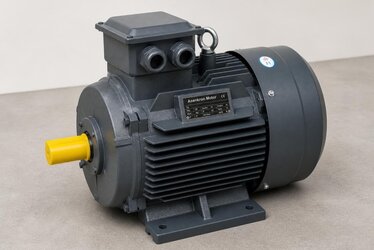
IE4 Super Premium motors carry a high efficiency value on their nameplate; but that value belongs to the condition where the motor runs near full load. In real facilities motors often run below rated power, that is, at part load. Moreover, many motors are selected larger than needed with a "just to be safe" mindset, so they constantly run at a low load ratio. This oversizing quietly eats the efficiency and power factor advantage the IE4 motor offers, because both efficiency and power factor drop noticeably at low load ratio. In this article we cover how the IE4 motor's efficiency curve behaves at part and low load, why oversizing eats the savings, and how to do load assessment and sizing for the right kW selection.

IE4 motor efficiency curve at part and low load and correct sizing

The IE4 Efficiency Curve: Efficiency by Load Ratio

A motor's efficiency is not a fixed number; it is a curve that varies with the load ratio. In IE4 motors, efficiency usually peaks around 75% load and stays relatively high in the 50-100% range. But as the load ratio falls below 50%, efficiency starts to drop; at very low loads (25% and below) this drop becomes pronounced. So the IE4 motor shows its superior efficiency when run in the right load range; at very low load this superiority dissolves. The important thing is to realize that even the seemingly flat region of the efficiency curve has a limit: between 50-100% efficiency is relatively stable, but below this band the curve bends down quickly. So sizing the motor to keep it within this stable band is the precondition for actually getting the efficiency IE4 promises in the field.

This behavior explains why the load ratio is critical in motor selection. The nameplate efficiency of IE4 rests on the assumption that the motor runs near full load. If the motor constantly runs at 30% load, the real field efficiency stays below the nameplate value. The difference between nameplate efficiency and field efficiency emerges exactly at this point.

Power Factor Drops Faster at Low Load

A value that deteriorates faster than efficiency is the power factor (cos phi). In induction motors the power factor drops sharply at low load; the motor still draws magnetizing current while the useful load decreases, so the ratio worsens. A low power factor increases reactive energy draw and the need for correction. An oversized IE4 motor creates a two-way loss with both low efficiency and low power factor. A low power factor causes the facility to draw more apparent power from the grid; this both increases cable and transformer loading and creates the risk of a reactive power penalty. So the cost of oversizing is not limited to the motor's own efficiency; it spreads to the facility's electrical infrastructure. That is why power factor is a part of motor sizing that should not be ignored.

Why Does Oversizing Eat the Savings?

Oversizing means selecting the motor larger than needed: like fitting a 15 kW motor for a 7.5 kW job. On the surface it provides a safety margin, but the cost is high. Since the motor constantly runs at a low load ratio, both efficiency and power factor drop; the premium paid for IE4 dissolves within these losses. Moreover, the large motor is a more expensive, heavier and more space-consuming investment. Oversizing is often not a conscious decision; it arises from a "just in case" mindset or from blindly repeating the previously fitted motor. Yet every oversized motor carries a hidden cost both at the initial investment and every running hour. Because this cost does not appear directly on the bill, it is hard to notice; but accumulated across the facility it corresponds to a serious energy loss.

The irony here: the facility switches to IE4 for energy savings, but because it selects the motor too large, it does not get the expected savings. The right decision is to assess the real load first, then select the kW that suits that load. The motor power calculation is the basis of this sizing. Sometimes the solution is not a higher efficiency class but bringing the existing power down to the right point.

Efficiency and power factor loss at low load ratio in an oversized IE4 motor

How Do You Assess the Real Load?

Correct sizing starts with measuring the real load. The current, power and temperature the motor draws give an idea of the real load ratio. If a motor constantly draws current far below the rated current, it is most likely oversized. An energy efficiency audit and motor inventory is the systematic way to reveal oversized motors in the facility.

When assessing load, the motor's nameplate ratings are the reference. Comparing the rated values on the motor nameplate (kW, current, cos phi, efficiency) with field measurements shows what load ratio the motor actually runs at. This comparison forms the basis for the right kW selection and, where needed, the decision to downsize the motor. Taking multiple measurements under different operating conditions rather than a single one gives a more reliable result, because the load can change during the day. Especially in variable-load applications, seeing both the lowest and highest load points of the motor is important for the right kW and, if needed, a drive decision.

Service Factor and Safety Margin

Avoiding oversizing does not mean running the motor on the edge. The right approach is to leave a reasonable safety margin. The service factor (SF) shows the motor's capacity to withstand short-term overloads and provides this safety margin. Selecting the motor to suit the real load and leaving an extra margin with the service factor is a far more efficient solution than oversizing. The service factor indicates that the motor can run for short periods above a certain ratio of its rated power; this provides a buffer against unexpected load increases. So the ability to draw extra power when needed is preserved without running the motor constantly at low load. This approach keeps efficiency high and manages the safety margin wisely.

Correct Sizing and the Efficiency Band

The goal is to run the motor in the peak region of the efficiency curve, that is, usually around 75% load. At this point both efficiency and power factor are near their best values. When selecting the motor, the continuous load should be made to fall within this band. Load ratio and correct sizing are the key to getting the efficiency IE4 promises on the nameplate in the field too.

In variable-load applications, a single kW point may not be enough. When the load varies over a wide range, running the motor with a frequency drive (VFD) both preserves efficiency at low load and prevents unnecessary energy draw. In variable-torque loads such as pumps and fans, this approach yields large savings. The drive adjusts the motor's speed with the load, eliminating unnecessary power draw during low-load periods; this prevents the loss created by an oversized motor running at constant speed.

Pole and Speed Selection

Sizing covers not only kW but also speed (pole number) selection. The choice of 2, 4 or 6 poles is made according to the speed the application requires. A wrong speed selection can require an unnecessary gearbox or pulley-belt arrangement, lowering system efficiency. Selecting the right kW together with the right speed turns the IE4 motor's efficiency advantage into reality in the field. In some cases, instead of slowing a high-speed motor with a gearbox, selecting a low-speed motor directly increases the total system efficiency; this shows that sizing should be considered not only on the kW axis but also on the speed axis.

How Do Losses Change with Load?

To understand why oversizing lowers efficiency, look at the structure of motor losses. Motor losses split into two main groups: load-independent fixed losses (iron losses, friction-windage) and load-dependent variable losses (copper losses). When a motor runs at low load, the useful output power decreases but the fixed losses stay almost the same. So the ratio of fixed losses to output power grows and efficiency falls.

In an oversized motor this effect is pronounced: the large motor's fixed losses are large, but the useful power drawn at low load is small. As a result, efficiency stays low compared to a correctly sized smaller motor. Knowing where iron, copper and friction losses are reduced in an IE4 motor shows that this advantage emerges only when the motor runs in the right load band.

Cooling and Speed at Low Load

Another aspect of oversizing is the motor's thermal and mechanical behavior. A motor running at low load heats up little; although this seems an advantage, since the motor's fan still spins at full speed, a wasted cooling and friction loss occurs. The effect of cooling and fan design on efficiency explains how these fixed losses pull efficiency down at low load.

There is a detail on the speed side too: in an induction motor the real speed changes with the load through slip. At low load the slip decreases and the motor approaches the rated speed; this can affect the desired output speed in some applications. Correct sizing ensures the motor runs at its design point in terms of both efficiency and the desired speed.

Stay with IE4 or Fix the Size?

The efficiency class decision cannot be thought of separately from correct sizing. If the existing motor is oversized, fixing the kW before moving to a higher efficiency class often delivers faster gains. The decision of whether to move to IE4 or stay with IE3 is made together with power, running hours and payback. A correctly sized IE3 motor can run more efficiently than an oversized IE4 motor. This seems counterintuitive but is logical: the efficiency class alone does not determine the real field efficiency; the load ratio does too. A correctly sized motor, regardless of what its nameplate says, can use less energy than a poorly sized higher-class motor. So before raising the efficiency class, you must always question whether the existing motor is the right size.

So efficiency class and sizing are two decisions that must be handled together. Knowing where efficiency losses are reduced in an IE4 motor makes it easier to understand that this advantage emerges only at the right load ratio. Wrong sizing renders even the best efficiency class ineffective. So the right order is to address the size first, then the efficiency class; this order ensures the investment truly pays off.

The Total Cost of Ownership Window

The motor decision should be made not only on the purchase price but through the total cost of ownership (TCO) window. TCO includes energy and maintenance cost alongside the purchase price. An oversized motor means both a more expensive investment and higher energy cost due to low efficiency; that is, it pulls TCO up two ways. Correct sizing is the basic step that minimizes TCO.

In continuously running applications this effect grows further, because a motor running at low efficiency accumulates the loss every running hour. So correct sizing should be addressed as a priority in high-running-hour applications. In continuously running systems such as pumps, fans and compressors, bringing the motor down to the right kW sometimes delivers a faster and cheaper gain than raising the efficiency class. So the first step in energy efficiency work is often not buying a new motor but assessing the real load ratio of existing motors and identifying the oversized ones. Every new IE4 motor bought without this assessment risks repeating the same loss if it too is selected at the wrong size.

Purchase and Selection Checklist

  • Measure the motor's real load ratio (via current, power, temperature).
  • If current drawn is far below rated current, suspect oversizing.
  • Select the kW that places the motor in the peak region of the efficiency curve (~75% load).
  • Check the power factor; cos phi drops sharply at low load.
  • Provide the safety margin with the service factor instead of oversizing.
  • Preserve efficiency with a frequency drive (VFD) under variable load.
  • Select the right kW together with the right speed (poles).
  • Make the efficiency class decision together with sizing and through the TCO window.

From our range, see the efficient electric motors, IE4 motors and IE3 motors pages, and reach us via the HEM Motor homepage for the right power and efficiency class.

Frequently Asked Questions

Why doesn't an IE4 motor deliver the expected efficiency at low load?

IE4's nameplate efficiency belongs to the condition where the motor runs near full load (usually around 75%). As the load ratio falls below 50%, efficiency drops, and at very low loads this drop is pronounced. So an oversized IE4 motor constantly running at low load runs below its nameplate efficiency in the field.

Why is oversizing harmful?

A motor selected larger than needed constantly runs at a low load ratio; this lowers both efficiency and power factor. The premium paid for IE4 dissolves within these losses, and the large motor is more expensive and takes more space. The safety margin should be provided with the service factor instead of oversizing.

How do I select the right kW?

First measure the real load; compare the current and power the motor draws with the nameplate values. The goal is to run the motor in the peak region of the efficiency curve (~75% load). Under variable load, running with a frequency drive preserves efficiency even at low load.

Get a Quote

Let us size your IE4 motor together with the right kW and speed so it runs in the best region of the efficiency curve. For the right power and efficiency class selection, reach the HEM Motor experts at +90 (532) 345 49 86 or request a quote through our contact page.