English
 Türkçe


In underground mines and long tunnels, ventilation is the foundation not of production but of life safety. The main ventilation fans that force fresh air into the mine or extract foul air, dust and explosive gases are often the most critical and most continuously running equipment in the facility. Selecting the electric motor that drives these fans requires meeting several demanding conditions at once: high airflow, uninterrupted operation (S1), harsh-environment protection and, where required, explosion-proof (exproof/ATEX) construction. In this article we examine mine ventilation fan motor selection from an engineering perspective in terms of axial main-fan drive, high power, continuous duty, starting and redundancy.
Basic Requirements of Mine Ventilation
Underground ventilation serves two basic functions: delivering sufficient oxygen to the mine and removing hazardous components such as methane (CH4), carbon monoxide, diesel exhaust and dust. The main ventilation fan is usually located at the mine mouth and operates in either a forcing or an exhausting arrangement. The airflow of these fans is very high, moving air on the order of cubic meters per second, while the (static) pressure is determined by the length and resistance of the galleries. The motor must meet the fan power at this flow-pressure point with a safe power margin.
What distinguishes motor selection in mining from classic fan motor selection is that the dimensions of continuity, environmental severity and gas risk are far more dominant. For general fan motor selection logic see centrifugal and axial fan motor selection and, for duct-type applications, duct-type axial fan motor selection.
Axial Main Fan and Motor Matching
The most common type in mine main ventilation is the axial fan, because axial fans provide very high airflow at low-to-medium pressure, suiting the typical resistance profile of mine galleries. In some deep or high-resistance mines, centrifugal (radial) fans may be preferred; they produce higher pressure but occupy more space for the same flow.
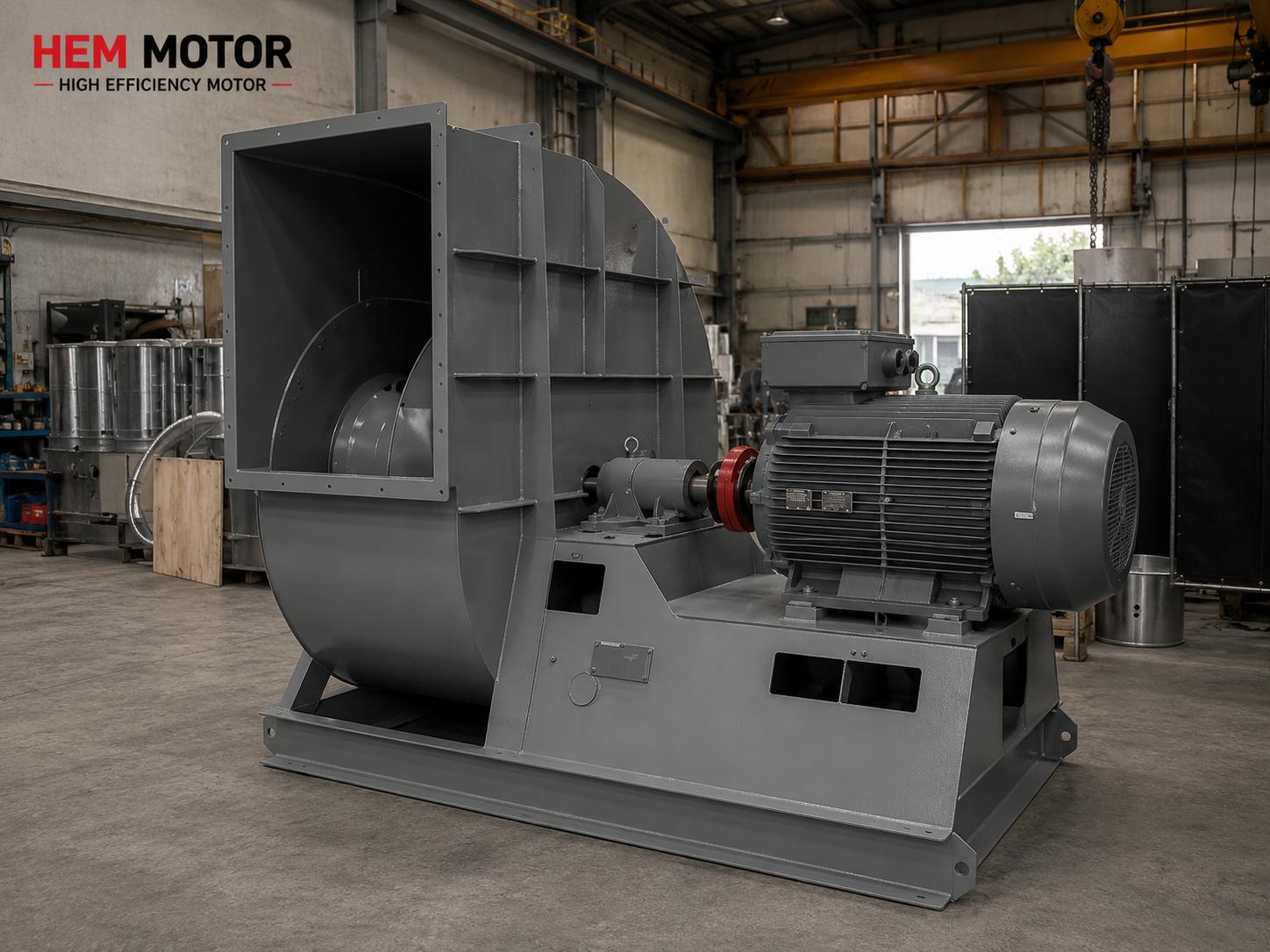
In axial fan drives the motor may be direct-coupled (mounted to the fan hub), belt-driven or geared. Direct drive is the most common solution and requires the motor to be selected with a pole count suited to the fan speed. 4-pole (1500 rpm) and 6-pole (1000 rpm) motors are common in large-diameter axial fans; lower speed is preferred for quieter, smoother running. For speed-torque matching see asynchronous motor speed-torque curve and for pole selection 2/4/6 pole selection.
High Airflow and Power Requirement
Mine main fans require high power; depending on the application size, cast-iron framed motors from 30 kW up to 355 kW are used. Fan power is calculated as the product of flow (Q) and pressure (p) divided by fan efficiency; the motor is selected with a suitable power margin (typically 10-20%) above this. Oversizing should be avoided, because an oversized motor runs at low load with low power factor and efficiency. For correct power calculation see required kW for pump, fan and conveyor and for high-power supply high-power motor supply above 90 kW.
Continuous Operation: S1 Duty
The mine ventilation fan practically never stops; it runs throughout the shift, often 24/7. Therefore the motor must be selected for S1 (continuous) duty. S1 duty means the motor can run indefinitely at rated load until it reaches thermal equilibrium. The industrial motors in our catalog are suitable for S1 continuous operation. For the difference between duty types, our duty type (S1-S6) selection article is explanatory.
Continuous operation also demands care in cooling and insulation. Motors designed with Class F insulation and Class B temperature rise offer longer life. For the relationship between heating and life see temperature rise class (80K). To monitor winding temperature under continuous load, PT100/PTC sensors are recommended; see temperature monitoring with PT100 and PTC.
Explosive Atmosphere: Exproof (ATEX) Requirement
In mines that carry methane (firedamp) risk, above all coal mines, the fan motor must be explosion-proof (exproof / ATEX). The ATEX directive classifies zones where explosive gas or dust may be present and requires equipment of a protection type suitable for those zones (for example flameproof "Ex d"). Coal mines involve Group I (methane/coal dust) equipment; other industrial environments with gas risk fall under Group II.
An important point: in some arrangements the motor located at the mine mouth on the fresh-air side may remain outside the explosive atmosphere; however, in an exhausting arrangement the foul, gas-laden air passes through the fan, so the exproof requirement becomes pronounced. Risk assessment and zone classification must be carried out by competent engineering. On when an exproof motor is required, our articles on when is an exproof (ATEX) motor required and exproof vs standard motor clarify the decision process.
Environmental Protection: IP55 / IP65 and Dust-Moisture
The mine environment is very harsh in terms of dust, moisture and sometimes water ingress. The motor should be at least IP55, and IP65/IP66 at points with heavy dust or washdown. A cast-iron frame is more resistant to mechanical impact and vibration than fabricated steel and is preferred on the mine site. For IP protection selection see IP protection class selection (IP55, IP65, IP66), and for dusty sites dust sealing and IP65/66 protection. In humid environments, a condensation drain hole and, if needed, anti-condensation winding heaters are recommended; see condensation drain hole.
For the general motor protection approach on mine and quarry sites, our stone quarry and mine motor protection article is complementary.
Starting and High Inertia
A large-diameter ventilation fan has a high moment of inertia (GD²), which makes starting take longer and keeps the starting current high for an extended time. While direct-on-line (DOL) starting is possible at small powers, large fans prefer star-delta or a soft starter; very large, high-inertia systems bring slip-ring motors and liquid resistance starters (LRS) into play. The right method must be chosen so the starting current does not stress the grid or generator. To go deeper see star-delta vs softstarter, reducing starting current (LRA) and, for soft starting at high inertia, liquid resistance starter and slip-ring motor.
Using a variable frequency drive (VFD) to vary fan speed and adjust ventilation airflow saves energy; by the affinity law, power drops with the cube when flow is reduced. See VFD with asynchronous motor and VFD savings with the affinity law.
Redundancy and Critical Stock
When the ventilation fan stops, the mine quickly becomes unworkable; therefore, keeping a spare motor for the ventilation motor is vital in mining facilities. Many facilities build the main fan with two motors (one spare) or a redundant two-fan arrangement. For critical spare motor planning see critical spare motor list, and for supply assurance in mining mining motor supply contracts. For mining sector motor requirements, our articles on mine conveyor motors and mine dewatering slurry pump motor cover related applications.
To explore the product family, see our crusher / stone-crushing and mine motors category, for fan motors our pump, fan and blower motors category, and for a general start the electric motors section.
Effect of Forcing and Exhausting Arrangements on the Motor
Mine main ventilation can be set up in two basic arrangements, and this arrangement directly affects motor selection. In the forcing arrangement, the fan pushes fresh air at the mine mouth into the galleries; the motor stays on the fresh-air side and does not directly contact the gas/dust content of the air. In the exhausting arrangement, the fan draws the foul, humid, gas-laden air out of the mine; because this air passes through the fan and, in some layouts, near the motor, the exproof requirement and corrosion risk increase markedly.
In the exhausting arrangement, the humid and corrosive air makes the corrosion protection (cataphoresis coating, extra paint) and sealing of the motor frame important. For corrosion protection see cataphoresis coating and corrosion protection and for open-field use corrosion protection and open-field use. Some facilities use both arrangements together (push-pull); in that case separate motor selections are made for both the forcing and exhausting fans, and the environment each is exposed to is evaluated separately.
Auxiliary (Secondary) Ventilation and Tunnel Fans
In addition to the main ventilation fan, auxiliary (secondary) ventilation fans are used to deliver air to the working faces and blind galleries of the mine. These are usually lower-power, duct-connected axial fans that carry air to the working face through flexible ducting. The motors of these fans also run continuously and must be exproof in zones with gas risk. In tunnel and metro projects, high-temperature-resistant jet fan motors are involved; a fire scenario requires motors that can run at high temperature for a defined period (class F300/F400). On this topic our tunnel, metro and highway jet fan motors article offers detail. For flue gas and high-temperature aspiration see our ID fan (aspirator) motor selection article.
Speed, Pole Selection and the Noise Balance
Large-diameter axial ventilation fans usually run more efficiently and more quietly at low speed. Therefore, instead of 4-pole (1500 rpm), 6-pole (1000 rpm) or, where needed, 8-pole (750 rpm) motors may be preferred. Low speed provides the same airflow with a larger-diameter fan; this lowers the blade tip speed and reduces aerodynamic noise. In the mine environment, noise is an important criterion for both occupational health and communication. For low-speed, high-pole motor selection see 6 and 8 pole low-speed motor selection and for noise management noise and vibration: low-sound motor selection.
Varying fan speed with a VFD allows scaling ventilation to the mine's need and saving energy. Lowering fan speed during off-shift or low-production periods reduces power consumption by the cube, per the affinity law. If the motor's own cooling is insufficient during continuous operation at low speed, external forced cooling may be needed; see external forced cooling fan (VFD low speed).
Vibration, Balance and Mechanical Strength
In a ventilation fan motor running continuously at high power, vibration is a critical indicator for both fan and motor life. An unbalanced fan blade or bearing wear increases vibration, shortening bearing life and potentially leading to fatigue cracks in the frame. Therefore the motor's balance quality and vibration level should be within the ISO 10816/20816 acceptance values. For vibration and balance, our vibration and balance (ISO 10816/20816) article provides criteria. The high rigidity of a cast-iron frame offers an advantage over fabricated steel under impact and vibration; see impact strength and rigidity in cast-iron frames. Bearing greasing and a maintenance schedule should also not be neglected for long life; see bearing greasing (grease type, NLGI, interval).
Frequently Asked Questions
Must a mine ventilation fan motor be exproof?
This depends on the gas/dust risk in the mine and the classification of the zone where the motor is located. Exproof (ATEX) is mandatory in coal mines carrying methane (firedamp) risk and for fans within an explosive atmosphere. In some arrangements where the motor stays on the fresh-air side, outside the explosive zone, a standard motor may suffice; the decision must be made through competent risk assessment.
Which duty type should be selected for a mine fan motor?
Since the main ventilation fan runs continuously 24/7, S1 (continuous) duty should be selected. Class F insulation and low temperature rise are important for long life.
Is a spare motor essential for the ventilation motor?
Yes. A ventilation stoppage makes working in the mine impossible and dangerous. A spare motor or a redundant fan arrangement is critical to minimize downtime.
Get a Quote
We support you in selecting a motor that meets the high airflow, continuous S1 operation and site-appropriate protection class for your mine and tunnel ventilation fan. For spare motor planning and fast supply, request a quote on +90 (532) 345 49 86 or via our contact page.
Mine Ventilation Fan Motor Selection Checklist
- Determine fan type (axial/centrifugal), airflow (m³/s) and static pressure values.
- Calculate fan power and select motor kW with a power margin (avoid oversizing).
- Choose speed/pole based on the fan operating point and noise target.
- Specify S1 continuous duty, Class F insulation and low temperature rise.
- Select IP55/IP65 protection and a cast-iron frame to suit the environment.
- If there is gas/dust risk, have the exproof (ATEX) zone classification confirmed.
- Plan a starting method suited to high inertia (star-delta, softstarter, LRS).
- Define the spare motor and critical stock strategy in advance.