English
 Türkçe


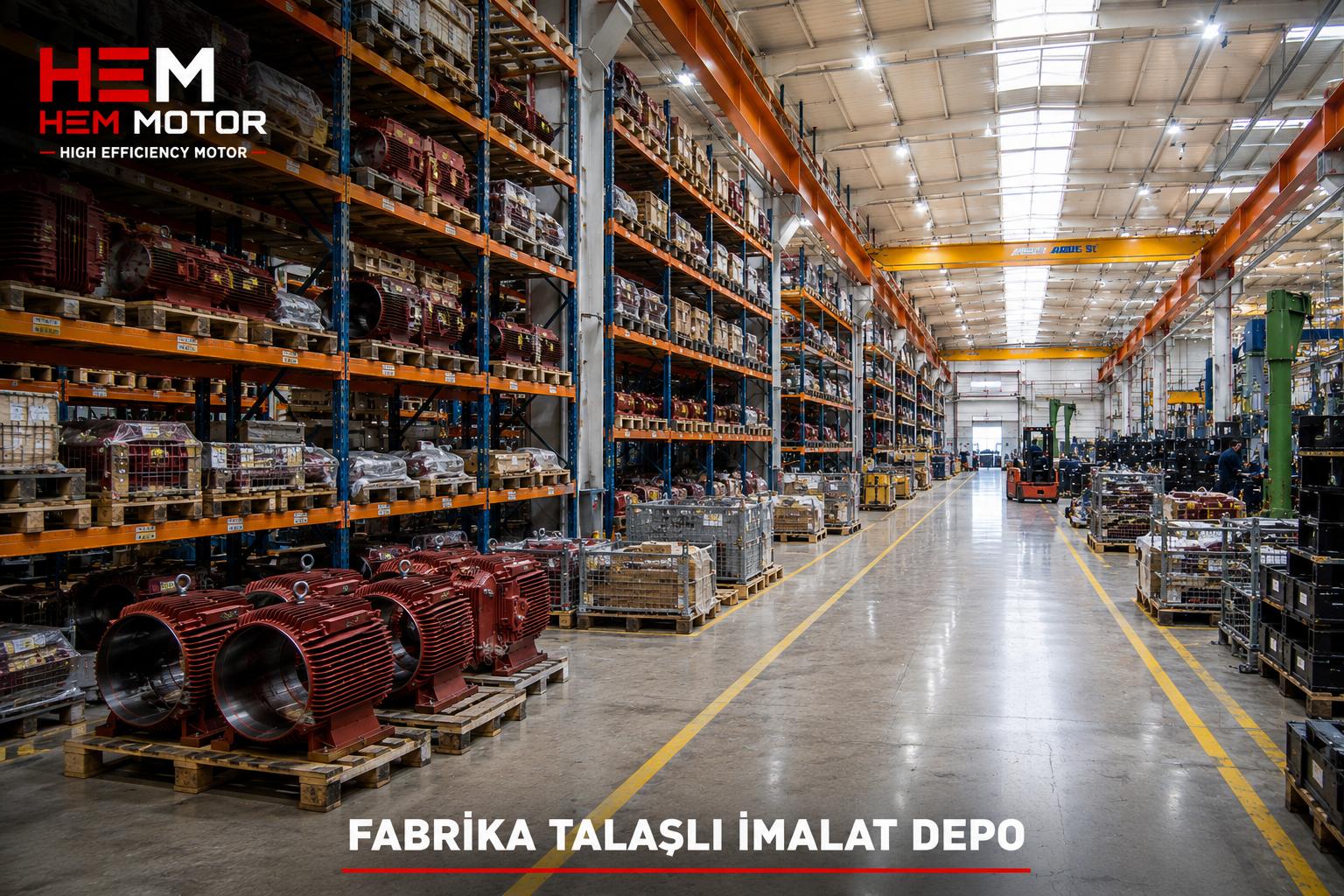

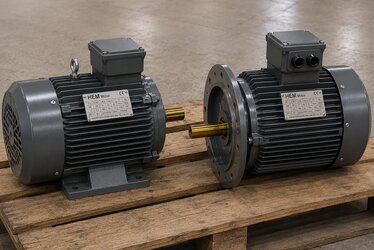
The most expensive form of a motor appears not on its price tag, but at the moment it fails and has no spare. At midnight a line stops, the shift supervisor reaches for the phone and calls every supplier in town one by one; that scramble is the late bill for a stock plan not made months earlier. In industrial plants, a critical spare-motor list is not a luxury but the basic insurance of production continuity. In this article we address item by item which powers should be kept on the shelf, how that decision is made, and how to store a spare motor so it runs with first-day performance.
The right way to begin is to shake off a common mistake: the backup decision is made not per motor, but on the role the motor's driven equipment plays in production. Of two motors of the same power, one may turn a critical conveyor while the other drives a secondary ventilation fan. Both can break; but when one stops the whole line stops, and when the other stops nobody notices. The heart of the stock plan lies in this distinction.
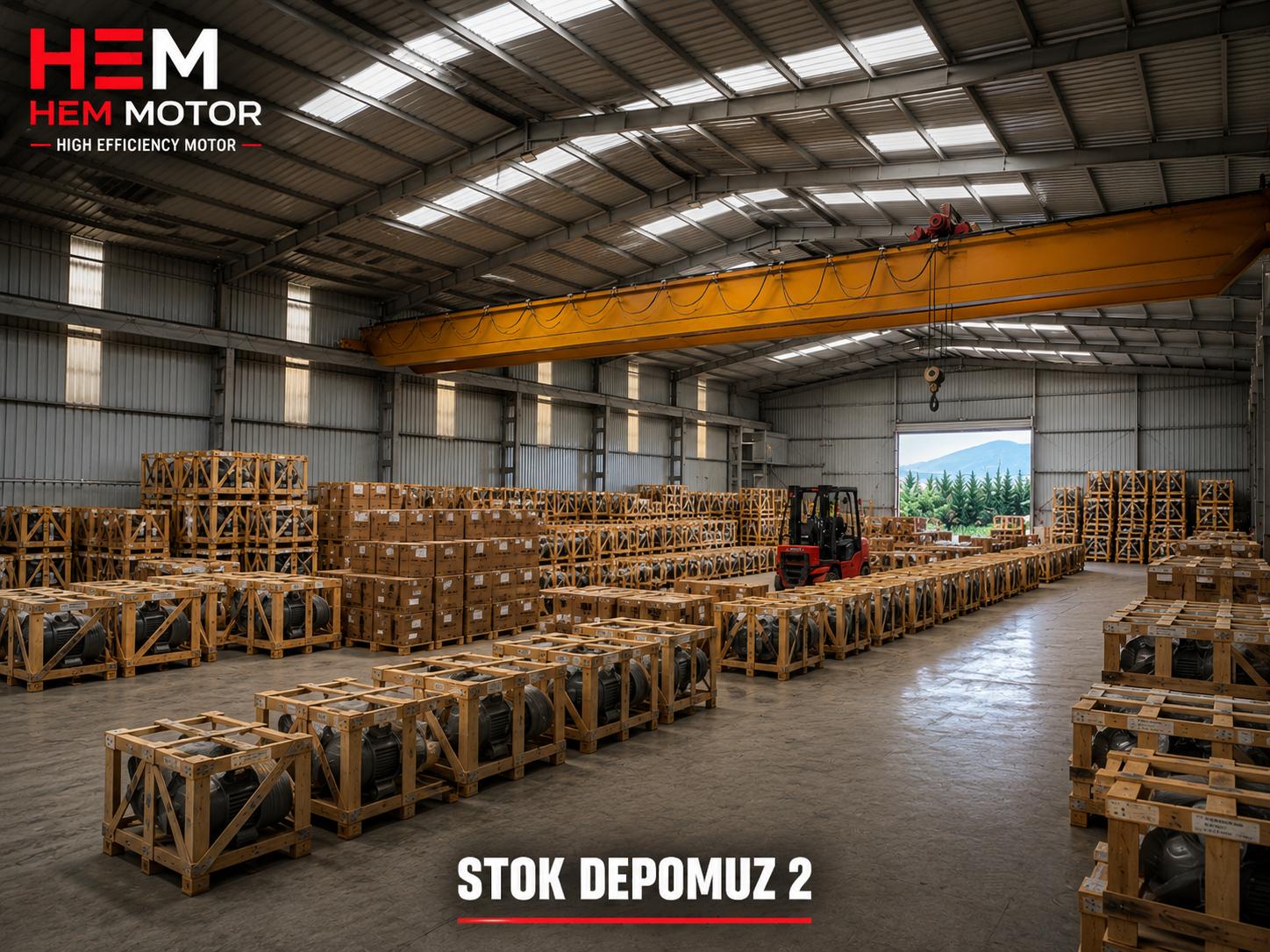
The Most Expensive Motor Is the One With No Spare
A motor's purchase price is known and written into the budget. But that motor failing unexpectedly with no replacement to put in its place is the heaviest line item, one that appears nowhere in the budget. When the lost revenue from stopped production, penalty-clause delivery contracts, wasted work-in-progress, and overtime costs come together, the shelf cost of a spare motor looks laughably small.
Another hidden cost of the midnight motor search is panic buying. The motor found in an emergency is often not at exactly the required power-speed value; a wrong motor bought on the logic of "it'll do for now" runs inefficiently and fails again quickly. A stock planned in advance, by contrast, makes the right motor ready at the right moment. We address in detail how the difference between fast supply from domestic stock and import lead times affects a plant in our comparison imported motor or domestic from stock.
The Backup Decision Is Made on Criticality
To decide which motor's spare waits on the shelf, you must look not at every motor but at the process each motor feeds. This assessment is usually made with four questions:
- What stops when it stops? If this motor fails, does only one machine stop, or the entire production line?
- Is there an alternative? Can production be temporarily shifted to another line or motor?
- What is the lead time? Is this power-speed combination quickly found on the market, or niche with a long lead time?
- What is the cost of downtime? What does one hour of unplanned downtime cost the plant per hour?
When the answers to these four questions come together, the motors naturally split into three groups. The first group consists of motors that lock the whole line when they stop, have no alternative, and have long lead times; their spare must wait on the shelf without exception. The second group consists of critical but standard motors that can be quickly found on the market; for these an agreement with a reliable supplier often replaces physical stock. The third group consists of secondary motors whose stopping does not affect production; keeping a spare for these means unnecessary tied-up capital.
How to Build a Criticality Matrix
In practice, it helps to position every motor on two axes: on the horizontal axis the probability of failure (age, running hours, ambient conditions), on the vertical axis the impact of stopping (production loss, customer penalty, safety risk). Motors that fall in the top-right corner of this matrix, those with both high failure probability and large impact when stopped, are written into the first rows of the spare list. This method ensures a limited stock budget is spent where it matters most.
Which Power-Speed Combinations Should Go on the Shelf?
A frequent mistake when preparing a spare list is trying to stock an exact copy of every motor. A smart stock plan focuses on critical power-speed bands rather than individual models. In most plants motors cluster within certain power ranges; these clustering points are natural candidates for backup.
- Most repeated powers: A power-speed value used in several places in the plant can protect multiple points with a single spare.
- Critical single motors: Special motors that feed a process alone and have no twin must be backed up even if they do not repeat.
- Standard frame sizes: Motors of the same mounting size provide stock flexibility because they can be used at different points with minor adaptation.
- Special types with long lead times: Brake motors, special-flange or special voltage/frequency motors are not quickly found on the market and are backed up as a priority.
The aim here is to protect the greatest number of critical points with the fewest possible spares. Standardisation is the key to this goal: when a plant can reduce its motor fleet to a small number of standard power-speed-frame combinations, both the spare count drops and each spare covers more points.
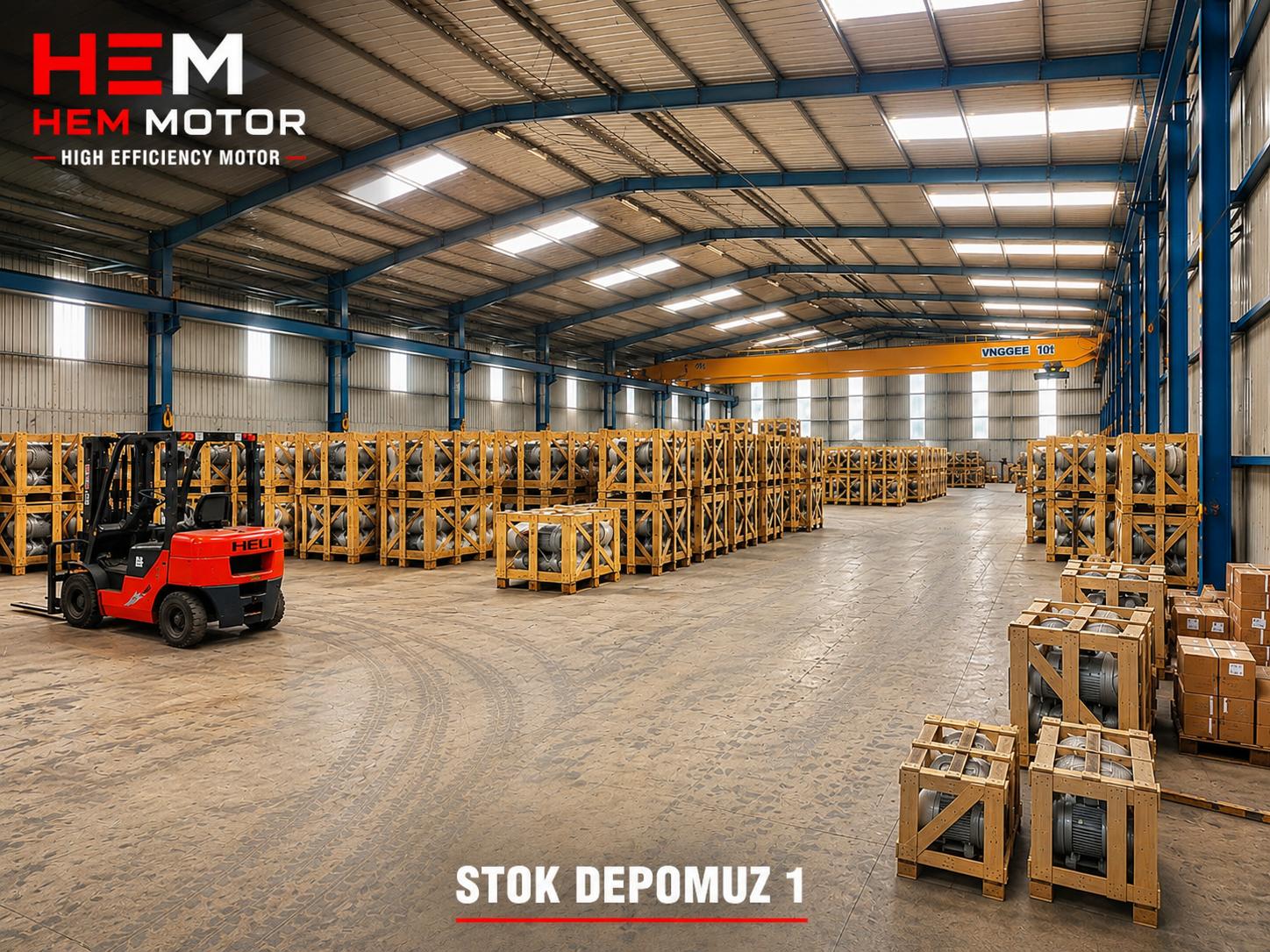
Storing a Spare Motor at First-Day Performance
A motor placed on the shelf and left to its own devices will, over time, fail to deliver its first-day performance when commissioned. The three greatest enemies of a waiting motor are moisture, immobility, and dust. If a spare that is not stored correctly does not run when pulled out at the moment of failure, the entire purpose of the stock plan is wasted.
- Dry, temperature-stable environment: Moisture degrades winding insulation and bearing lubrication; the store must be dry and away from temperature swings.
- Periodic shaft rotation: In a motor left immobile for long, bearing grease pools at one point and a seating mark forms in the bearing race; turning it a few revolutions monthly prevents this.
- Insulation resistance measurement: Measuring winding insulation resistance before commissioning shows whether moisture has penetrated the winding.
- Anti-condensation heater: Where possible, connecting an anti-condensation heater inside the motor prevents moisture from accumulating within.
- Labelling and records: Every spare motor should be labelled with its power, speed, frame and which equipment it protects, so it can be found within seconds at the moment of failure.
This simple maintenance discipline ensures that the spare motor is not "dead stock" but genuinely ready-to-use insurance. As a plant grows, this discipline turns into a system that manages the entire motor fleet; our article on motor fleet management at three-shift plants details this system for plants with high running hours.
Putting the Stock Plan Into Practice
Once a critical spare-motor list is prepared, it must be updated as a living document. When new lines are installed, old motors renewed, or production priorities change, the list changes too. A correctly structured spare stock turns unplanned downtime into a plan and buries the midnight motor-search scramble in the past. To keep the critical powers you need ready on the shelf and to receive a fast quote, you can review our broad-stock motor and gearbox supply network.
Frequently Asked Questions
Do I need to keep a spare of every motor in stock?
No. The backup decision is made not per motor, but on the production criticality of the equipment the motor drives. Motors that lock the whole line when stopped, have no alternative, and have long lead times should have a spare on the shelf; keeping stock for secondary motors is unnecessary tied-up capital.
Does a motor waiting in stock deteriorate over time?
If stored incorrectly, yes. Moisture degrades winding insulation and bearing lubrication, and immobility creates a seating mark in the bearing. Storing it in a dry environment, turning the shaft a few times a month, and measuring insulation resistance before commissioning keep the spare motor at first-day performance.
Is a supplier agreement enough instead of physical stock?
For critical but standard motors that can be found quickly on the market, a fast-supply agreement from domestic stock with a reliable supplier often replaces physical stock. But for niche motors with long lead times that lock the whole line when stopped, holding a physical spare is essential.