English
 Türkçe


Summary (TL;DR)
- In a permanent delta connection each winding is exposed to the line-to-line voltage; a 230/400 V motor runs in delta on a 230 V supply.
- For a 400/690 V motor, delta is correct only on a 400 V supply, while star is for a 690 V supply.
- In direct-on-line (DOL) starting, delta delivers full torque and full current; star-delta starting runs star at start-up.
- The bridge position on the 6-terminal block decides the connection type; a wrong bridge burns the motor.
- Matching winding voltage to the supply correctly is essential; HEM Motor ships correctly connected motors from stock.
How an asynchronous motor is wired to the panel directly determines how much torque it produces, how much current it draws from the grid at start-up, and what voltage the windings are exposed to. The permanent delta connection is the most frequently chosen and most frequently confused wiring scheme in the field. At the purchasing and commissioning stage, the question "Should I run this motor in delta or in star?" is a decision point that often ends with a burned motor or with a motor that never delivers its rated power. This article explains, from the viewpoint of a motor manufacturer and supplier, what permanent delta connection means, the winding voltage and current under single-voltage direct-on-line (DOL) starting, the torque-current behaviour versus star, the bridging logic on the 6-terminal block, and how to choose the correct connection.
What Is a Permanent Delta (Δ) Connection?
The stator of a three-phase asynchronous motor consists of three phase windings. You can connect these three windings in two fundamental ways: star (Y) and delta (Δ). A permanent delta connection means the motor stays in the delta configuration for its entire run; that is, the windings are in delta both at start-up and in steady-state. This is different from star-delta starting, where the motor is temporarily run in star at start-up and then switched to delta.
In delta the ends of the three windings are joined to form a triangle, and the two ends of each winding fall on two different phases of the supply. The critical consequence is this: in delta each winding is exposed to the line-to-line voltage of the supply. For example, on a 400 V three-phase supply, a delta-connected motor has 400 V across every winding. In star, each winding sees the line voltage divided by √3 (about 230 V on a 400 V supply), because the windings join at a common neutral point.
Winding Voltage: The Two Faces of the Nameplate
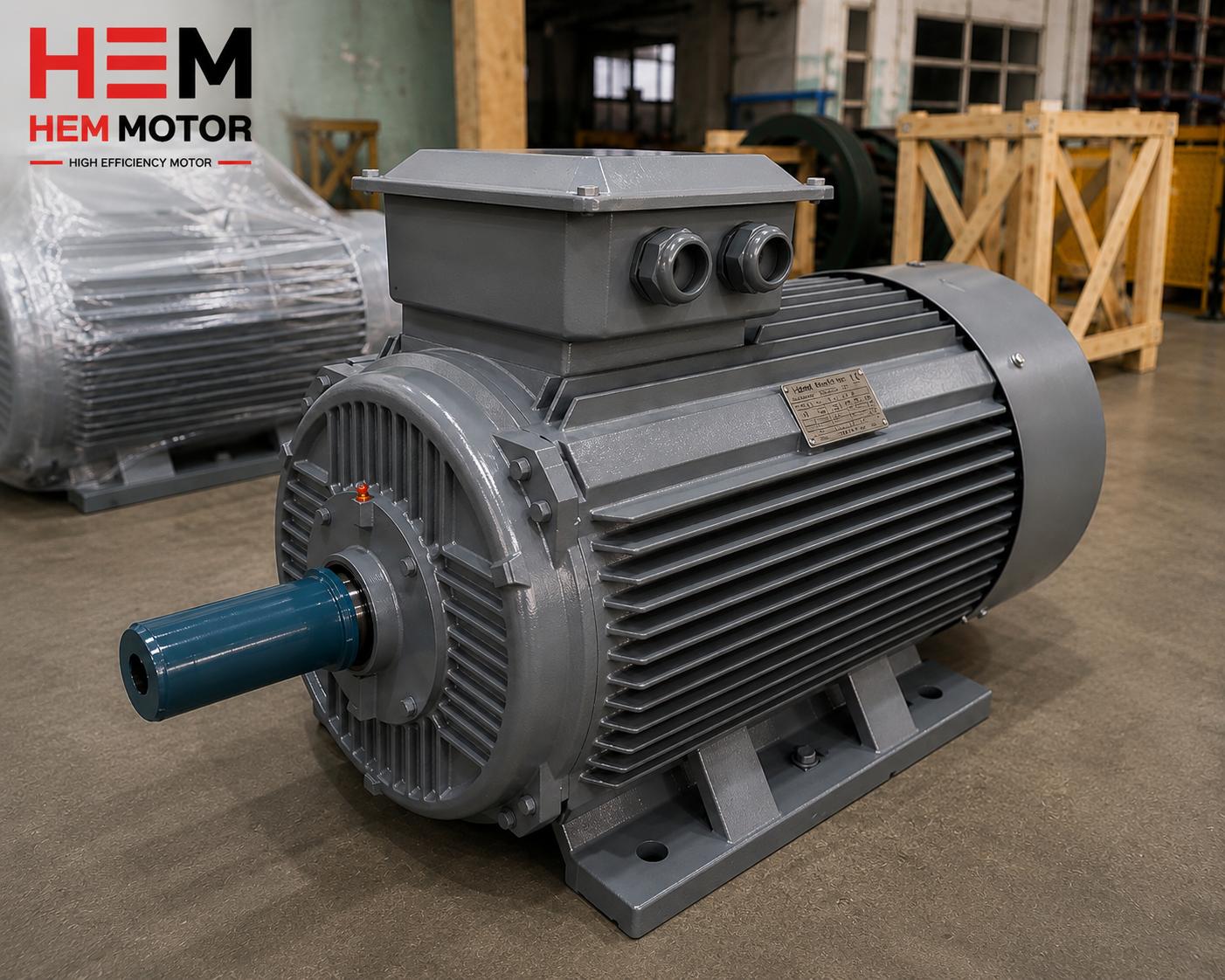
On the nameplate of asynchronous motors you usually see two voltages and two connection symbols, for example 230/400 V or 400/690 V. The logic is this: the lower voltage corresponds to delta and the higher voltage to star. The winding itself is designed for a specific (winding rated) voltage, and you select the connection type so that the voltage the winding sees stays the same.
- 230/400 V motor: runs in delta on a 230 V line-voltage supply, and in star on a 400 V line-voltage supply. On the common 400 V three-phase grid this motor is wired in star.
- 400/690 V motor: runs in delta on a 400 V supply, and in star on a 690 V supply. So on the standard 400 V grid this motor is wired in delta (permanent delta).
This is the classic case of permanent delta running: when you connect a 400/690 V motor to a 400 V supply it runs in delta and delivers its full power. The winding voltage always stays at the value it was designed for (400 V in this example). If you mistakenly wire this motor in star on 400 V, each winding sees only ~230 V and the motor stays well below its power, producing low torque in an incorrect operating regime.
Current and Torque in Direct-On-Line (DOL) Starting
Direct-on-line (DOL) starting means switching the motor in at full supply voltage, without any voltage-reducing device. In a permanent delta connection under DOL, the motor is in the configuration that can produce its full rated torque and rated current. The price for this is the high inrush current at the moment of start-up.
An asynchronous motor draws an inrush current of roughly 5 to 8 times its rated current during DOL starting. Because delta is the full-voltage/full-current regime, the starting torque is also high; this suits applications that require loaded starting such as conveyors, crushers and compressors. The table below summarises the comparative behaviour of delta and star connections on the same supply.
| Property | Delta (Δ) Connection | Star (Y) Connection |
|---|---|---|
| Voltage across winding | Equal to line voltage (e.g. 400 V) | Line voltage / √3 (e.g. ~230 V) |
| Line current (same motor) | High (full current) | About 1/3 of delta |
| Starting/running torque | Full torque (100%) | About 1/3 of delta |
| Typical use | Continuous running, loaded DOL start | Start step of star-delta; or high-voltage winding |
| Fit on a 400 V supply | 400/690 V rated motor | 230/400 V rated motor |
Do Not Confuse It with Star-Delta Starting
Star-delta starting serves a completely different purpose from permanent delta: reducing the inrush current. The motor is run in star at start-up (windings see lower voltage, current and torque drop to about one third of delta), and as the motor speeds up the contactors switch it to delta where it runs at full torque. This method can only be applied if the motor is suited to delta operation on the 400 V supply, that is, if it is rated 400/690 V. Trying to star-delta start a 230/400 V motor on a 400 V supply is wrong, because that motor is already designed to run in star at 400 V, and switching to delta over-volts and burns the windings.
Bridging Logic on the 6-Terminal Block
Standard three-phase motors have six terminals in the terminal box: U1, V1, W1 (winding starts) and U2, V2, W2 (winding ends). At the factory these six terminals are usually arranged in two offset rows. The connection type is set by three bridges (links) placed between these terminals.
- Delta connection: the end of each winding is bridged to the start of the next: U1-W2, V1-U2, W1-V2 are joined. The supply is connected to U1, V1, W1. On the terminal layout this is done with vertical bridges.
- Star connection: the three winding ends (U2, V2, W2) are bridged together (common neutral point); the supply again comes to U1, V1, W1. On the block this is bridging the lower row with a single link.
Setting the bridge position wrong means running a motor that should be in permanent delta in star (under-powered), or the reverse, forcing a 230/400 V motor into delta on 400 V and burning the winding. That is why, before commissioning, you must verify the voltage/connection symbol on the nameplate, the supply line and the bridge position together.
Choosing the Correct Connection: Practical Steps
- Determine the line voltage of your supply (typically 400 V in Turkiye).
- Read the dual voltage on the motor nameplate (is it 230/400 V or 400/690 V?).
- Choose the connection where the supply voltage equals the delta value on the label: 400/690 V motor + 400 V supply = permanent delta.
- If there is loaded and frequent starting, consider star-delta or a soft starter to reduce inrush (only on a delta-capable motor).
- Set the bridges per the table/label, and check insulation and rotation direction before commissioning.
At HEM Motor we ship motors from stock in IE3 and IE4 efficiency classes, in a range from 0.55 kW to 355 kW, with the correct voltage/connection structure and with nameplates and terminal bridges checked. Our technical team guides you to the right selection of winding voltage, pole count and mounting type for your project.
Torque-Current Behaviour of Delta and Its Effect on Efficiency
In a permanent delta connection the torque-speed curve of the motor is realised exactly at the voltage the winding was designed for. This means both the starting torque and the breakdown (pull-out) torque are obtained at the nameplate values. A delta-connected motor runs at its design slip at rated load and reaches peak efficiency near the operating load. A correct winding voltage keeps the magnetic flux (B) at its design value; if the flux stays too low the motor cannot produce its torque, and if the flux is too high (wrong delta) the iron saturates, current spikes and heating rises quickly.
A practical observation: the same motor frame, when wound for dual voltage, can run both as delta and star, but in both regimes the voltage the winding sees is the same. So whether a 400/690 V motor runs in delta at 400 V or in star at 690 V, the winding sees 400 V in either case and produces the same power and the same torque. The connection type does not change the power; what determines the power is the winding running at its correct voltage. The connection choice only determines which supply you make the motor compatible with.
- Constant power: in the correct connection (the winding sees its design voltage) the motor delivers its rated power; being delta or star does not change the power, only the supply compatibility.
- Efficiency: when the winding sees the right voltage, the IE3/IE4 efficiency values are realised as declared on the label; a wrong connection lowers efficiency and heats the motor.
- Heating: in a wrong delta (a 230/400 V motor in delta at 400 V) the winding overheats from excess current; even the margin provided by the insulation class (F/H) cannot save this situation.
When Is Permanent Delta Preferred?
Permanent delta operation is preferred in applications where the motor must produce full torque from the first instant. If the delta voltage on the motor label equals the supply voltage, the panel designer can run the motor directly in delta DOL without an additional starting step. The following situations point to permanent delta operation:
- When the motor label is 400/690 V and the supply is 400 V (the most common case in Turkiye) — the motor is already wired to run in delta.
- When full starting torque is needed for loaded-start applications such as conveyors, crushers, compressors and mixers.
- In small and medium powers where the inrush current does not stress the grid and simple, reliable DOL control is wanted.
- When a soft starter or a frequency inverter will be used; these devices are usually connected to a delta-wired (full torque at single voltage) motor.
In high powers, if the inrush current stresses the grid, star-delta starting or a soft starter takes over instead of permanent delta; but for these methods to be applicable the motor must again be delta-capable at 400 V (rated 400/690 V). Therefore the correct motor selection, from the very beginning, determines which starting strategy you can use.
Frequently Asked Questions
How should I connect a 400/690 V motor on a 400 V supply?
A 400/690 V motor is wired in permanent delta on the standard 400 V three-phase supply. In this connection each winding sees 400 V and the motor delivers its full power and torque. If you wire the same motor in star on 400 V, the winding sees only ~230 V and the motor runs well below its power, incorrectly.
Does a permanent delta connection increase the starting current?
Direct-on-line (DOL) starting in permanent delta makes the motor draw its full current; the inrush at start-up is roughly 5-8 times the rated current. If you want to lower this current, star-delta starting or a soft starter is used, but only on delta-capable motors.
What happens if I wire a 230/400 V motor in delta?
If you wire a 230/400 V motor in delta on a 400 V supply, each winding sees far more than its design voltage; due to excess current and overheating the winding burns out quickly. This motor must be wired in star on a 400 V supply; delta is valid only for a 230 V line supply.
The Right Motor, the Right Connection
Permanent delta is a safe operating mode in which the motor delivers full performance when the correctly rated motor is connected to the correct supply. The key is to match the winding voltage with the supply line and the terminal bridges. For an asynchronous motor with the voltage, connection, pole count and frame structure you need, HEM Motor offers fast supply from stock with manufacturer assurance. Contact our technical team to determine the most suitable motor for your project and request a quote.
Related guides: star and delta bridging at 230/400V and correct voltage selection, dual-voltage motor 230/400 and 400/690 V terminal wiring, IE3 motor star/delta winding connection, terminal, tightening torque and correct cable cross-section and rated and starting torque at DOL.