English
 Türkçe

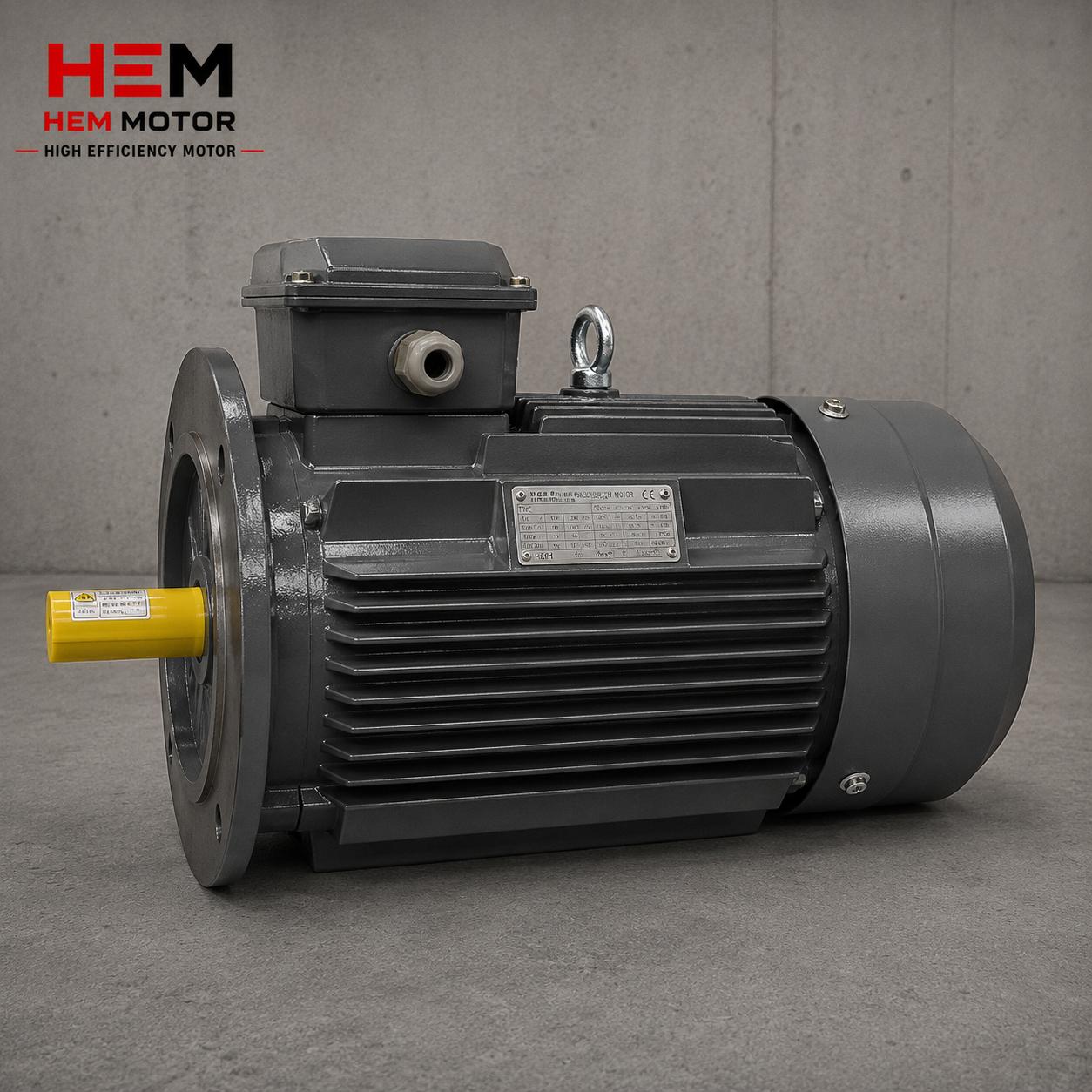

When buying an electric motor, most plants look at power (kW) first; yet what actually turns the machine is not power but torque (rated torque, Nm). Two motors with the same kW rating may come in different frame sizes and with very different torque densities. This is exactly where IE5 synchronous reluctance (SynRM) motors stand out: alongside their top efficiency class, they can deliver higher torque density in the same IEC frame than an asynchronous counterpart. In this article we look, from a purchasing perspective, at the concepts of rated torque and torque density, why an IE5 SynRM motor can produce more torque in the same frame, how the same job can be done with a smaller frame, and what that gain means in terms of drive dependency, space and weight.
What Is Rated Torque (Nm) and Why Is It More Decisive Than Power?
Rated torque is the turning force the motor produces at its shaft at rated power and rated speed. The basic relationship is simple: Torque (Nm) = 9550 × Power (kW) / Speed (rpm). This formula shows that the same power produces very different torque at different speeds. For example, a 7.5 kW motor at 2 poles (about 3000 rpm) produces roughly 24 Nm, the same 7.5 kW at 4 poles (1500 rpm) about 48 Nm, and at 6 poles (1000 rpm) about 72 Nm. In other words, if your machine needs high force at low speed, you must look at the real torque requirement, not the kW figure.
What moves a conveyor, turns a mixer or feeds a press is torque. Power is torque multiplied by speed; so the same power means higher torque as speed drops. Getting the rated torque calculation and the kW-speed-torque relationship right is therefore the foundation of correct motor selection. Our article on rated torque calculation in IE3 motors: finding torque from kW and speed helps you build the same logic for IE5.
Torque Density: Getting More Nm From the Same Frame
Torque density is the ratio of the torque a motor produces to its frame volume or weight; in practice it answers the question "how many Nm can I get from the same IEC frame size?" Two motors can share the same 132 frame, yet one may produce significantly more torque than the other. This is the most concrete purchasing advantage of IE5 synchronous reluctance motors: the high torque density that comes with high efficiency often means more work in the same frame, or the same work in a smaller frame.
The reason lies in the rotor design. In an asynchronous motor, current is induced in the rotor and turns into heat, creating rotor losses. In a synchronous reluctance rotor there are no windings or magnets; the rotor turns at synchronous speed along the paths the magnetic flux prefers (the reluctance difference). Largely eliminating rotor losses means the heat budget in the same frame is used more efficiently, so higher continuous torque can be drawn from the same size. You can find the basics of SynRM technology in our article on IE5 and synchronous reluctance motors: the efficiency class of the future? and the full difference versus asynchronous in IE4 asynchronous vs synchronous reluctance.
The Supply and Cost Side of a Magnet-Free Rotor
The absence of permanent magnets in a synchronous reluctance rotor means both independence from rare-earth price swings and more predictable supply. Permanent magnet (PM) motors can push torque density even higher; but SynRM offers a balanced middle ground, exceeding asynchronous torque density without magnet cost or supply risk. We cover the difference between the two technologies in IE5 synchronous reluctance vs permanent magnet (PM) motor difference and the advantage of the magnet-free rotor in magnet-free rotor: supply and cost advantage.
Torque Comparison in the Same IEC Frame: Asynchronous vs IE5 SynRM
In practice the buyer's question is this: "In the same 160 frame, how much more torque do I get versus asynchronous, or can I find the same torque in a smaller frame (132)?" The answer varies with application and speed, but thanks to SynRM's lower rotor losses and better thermal balance, a one-frame-size reduction is often possible at many power-speed points. That translates directly into space and weight savings in the mechanical design.
The critical point here is that IEC connection dimensions (foot holes, shaft diameter, flange) stay standard; so while using the torque density gain, you must also verify mechanical compatibility with the machine. We detail frame-power matching and choosing the right size in IE5 synchronous reluctance motor frame-power table (IEC), and mechanical replacement compatibility in mechanical compatibility when switching to an IE4 motor. To understand the speed-torque curve and breakdown torque on the asynchronous side, the asynchronous motor speed-torque curve and breakdown torque is a good reference.
Same Power in a Smaller Frame: Space and Weight Savings
A frame size reduction affects not only the motor's own weight but also the mounting base, coupling, pulley and even shipping logistics. Especially in plants with many motors, the effect of a smaller frame on total weight and layout can be significant. We cover handling and lifting of heavy-frame motors in lifting eyebolt, weight and safe handling in electric motors, and the weight table of cast iron frames by IEC size in cast iron motor frame sizes (IEC 56-355): weight and handling.
Drive Dependency: In SynRM, Torque and Efficiency Come With the Drive
A critical feature of IE5 synchronous reluctance motors is that they cannot be connected directly to the grid (DOL); because of the synchronous rotor structure, they always run with a variable frequency drive (VFD). This means the torque density gain requires cost and engineering on the panel side; the drive should be thought of as part of the motor. We cover why it does not run without a drive and how to choose the package in why an IE5 synchronous reluctance motor cannot run without a drive.
The advantages the drive brings are not limited to torque density: with correct parameterization and autotune, the motor offers high efficiency and stable torque across a wide speed range. You can find commissioning and parameterization details in drive parameterization in IE5 synchronous reluctance motors, and the effect of the rated current and power factor difference on panel selection in rated current and power factor in IE5 synchronous reluctance motors. If you are curious about torque response under sudden load changes, torque response under sudden load change guides you.
What Torque Density Means at Partial Load
Many industrial applications rarely run at full load; loads such as pumps, fans and compressors vary through the day. The partial-load efficiency advantage of SynRM motors, combined with the torque density advantage, allows both running with a smaller motor and preserving efficiency at variable load. We discuss this in the efficiency curve of IE5 synchronous reluctance motors: why superior at partial load? and how oversizing eats savings in partial and low-load efficiency in IE4 motors.
Thermal Behavior: The Factor That Limits Torque Density
The ultimate limit on how much torque you can draw from the same frame is heat. Although low rotor losses give SynRM an advantage, when using high torque density in continuous duty you must pay attention to the motor's cooling conditions and operating environment. Especially in applications demanding continuous high torque at low speed, external forced cooling may be needed. We cover thermal behavior in thermal behavior and cooling in IE5 synchronous reluctance motors and the external fan solution for continuous torque at low speed in external forced cooling fan in IE4 motors.
If you want to evaluate the long-term economics of the efficiency class fully, our articles on total cost of ownership (TCO) comparison of IE5, IE4 and IE3 and IE5 vs IE4: does the efficiency difference justify the investment? support your decision. You can reach our full motor range from our homepage.
Frequently Asked Questions
Does an IE5 SynRM motor really deliver more torque than asynchronous in the same frame?
At most power-speed points, yes. Because rotor losses are largely eliminated in a synchronous reluctance rotor, the heat budget in the same IEC frame is used more efficiently; this allows higher continuous torque from the same size, or the same torque in a smaller frame. The exact gain varies with application, speed and cooling conditions, so we recommend clarifying your real torque requirement and speed before selection.
Is a drive required to use the torque density advantage?
Yes. Because of their synchronous rotor structure, IE5 synchronous reluctance motors cannot be connected directly to the grid; they always run with a variable frequency drive (VFD). The torque density and efficiency gain are achieved together with a correctly sized and parameterized drive, so the motor and drive must be planned as a single package.
If I move to a smaller frame, will it fit the machine mechanically?
A frame reduction may change shaft diameter, foot hole spacing and flange dimensions; so before using the torque gain you must compare IEC connection dimensions with the existing machine. In many cases compatibility can be achieved with a coupling or adapter plate; our team helps you determine the right frame and connection based on your existing motor nameplate.
Get a Quote
Share your application's real torque requirement and speed with us; let us evaluate together whether you aim for more torque in the same frame or the same job in a smaller frame. For an IE5 synchronous reluctance motor and a suitable drive package, call us at +90 (532) 345 49 86 or send your request via our contact page. Sharing your existing motor nameplate speeds up the correct torque density match.
Purchasing and Selection Checklist
- Clarify your machine's real torque requirement (Nm) and operating speed; start with torque, not kW.
- Define your goal: more torque in the same frame, or the same job in a smaller frame?
- Compare IEC connection dimensions (shaft diameter, foot holes, flange) with the existing machine.
- Plan the drive (VFD) sizing and panel space from the start; SynRM does not run without a drive.
- Map the operating load profile (full load / partial load); evaluate the SynRM advantage at partial load.
- Check cooling conditions and the need for continuous torque at low speed; plan an external fan if required.
- Assess space and weight savings in terms of mounting base, coupling and shipping.
- Provide the existing motor's complete nameplate values before requesting a quote.