English
 Türkçe



When you read an efficiency value such as "IE3 93.0%" or "IE4 95.4%" on the nameplate of a high-efficiency motor, exactly what that figure means and how binding it is a critical matter most buyers overlook. The value on the nameplate is the declared (nominal) efficiency; however, every motor comes off the production line with small variations, and standards accept a tolerance band to recognise this variation. That is, the guaranteed minimum efficiency of a motor may in reality be somewhat lower than the nominal value on the nameplate, and this fully complies with the standards. In this article we cover, in engineering terms but with the clarity a buyer needs, the guaranteed minimum efficiency of a high-efficiency motor, the IEC 60034-2-1 measurement method, the IEC 60034-30-1 classification, the difference between the nameplate nominal efficiency and the guaranteed minimum, the tolerance rule (15% of the losses) and how binding the declared efficiency is.
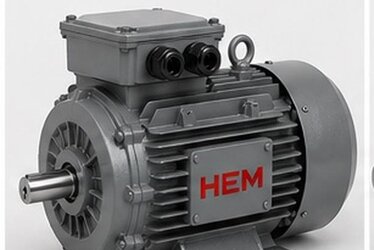
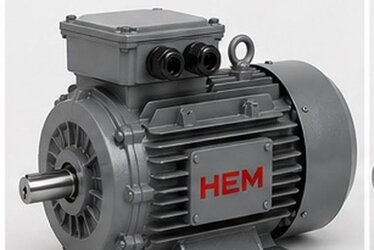
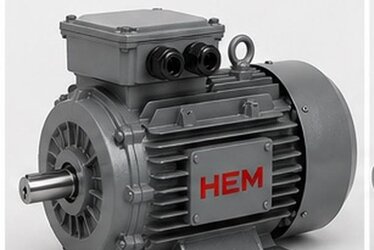
At HEM Motor, while delivering high-efficiency motors from stock, we see that buyers often look only at the nameplate figure when comparing different brands or different quotations. For a correct comparison you need to know how efficiency is defined and with what tolerance it is guaranteed.
The Difference Between Declared (Nominal) Efficiency and Guaranteed Minimum Efficiency
The efficiency on the nameplate is the nominal efficiency declared as a result of the motor's design and type tests. However, in series production every motor does not come out exactly the same; due to material, winding and manufacturing tolerances the real efficiency may be slightly below or above the declared value. Standards accept this fact and define a tolerance. According to IEC 60034-1, the permitted tolerance for efficiency is calculated not directly on the efficiency percentage but on the total losses.
The rule is this: for motors up to 150 kW the permitted tolerance is -15% of the total losses (-10% above 150 kW). That is, the loss accepted to meet the declared efficiency can be up to 15% less than the real loss; this allows the real (guaranteed minimum) efficiency to be somewhat lower than the nominal value. We also addressed this logic from a nameplate-reading point of view in our article on reading the nameplate efficiency value and IE code.
The Numerical Meaning of the Tolerance Band
Let us explain with an example why the tolerance is calculated on the losses. Efficiency is the ratio of output power to input power; loss is the difference between input and output. In a high-efficiency motor the loss is small, so a 15% tolerance on the loss reflects as only a small drop in the efficiency percentage. The table below conceptually shows how the declared efficiency and the tolerance band reflect onto efficiency.
| Declared (Nominal) Efficiency | Approx. Loss Share | Guaranteed Minimum After Tolerance (conceptual) |
|---|---|---|
| 90.0% | High loss | Noticeable drop margin from nominal |
| 93.0% | Medium loss | Medium drop margin from nominal |
| 95.0% | Low loss | Small drop margin from nominal |
| 96.5% | Very low loss | Very close to nominal |
The critical message: as the efficiency class rises (as the loss falls), the reflection of the tolerance band onto efficiency also shrinks. That is, in high classes such as IE4/IE5 the guaranteed minimum efficiency is much closer to nominal; in low classes the tolerance margin is felt as a wider efficiency spread. We examined where efficiency losses occur in our article on efficiency losses in an IE4 motor.
IEC 60034-2-1: How Is Efficiency Measured?
Stating a motor's efficiency as a single correct number depends on the measurement method used. IEC 60034-2-1 is the standard that defines the measurement methods for motor efficiency. This standard sets out how losses are to be determined (direct measurement, indirect method, calculation of additional losses, etc.). What matters is that, when comparing two motors, you use the efficiency value measured by the same method for both; efficiencies obtained by different methods cannot be compared directly. We explained the IEC 60034-2-1 test method and the documentation of the nameplate efficiency in detail in our article on efficiency measurement test IEC 60034-2-1.
IEC 60034-30-1: Efficiency Classes (IE Code)
IEC 60034-30-1 is the standard that defines the efficiency classes of motors (IE1, IE2, IE3, IE4, IE5). For each power and pole number, the minimum nominal efficiency values required by these classes are tabulated. For a motor to be "IE3" or "IE4", its declared nominal efficiency must be equal to or above the threshold value the relevant class sets for that power/pole. That is, the IE class is defined on the nominal efficiency; the tolerance band manages the series-production deviation of this nominal value. We addressed which class is required at which power in our article on efficiency class mandate and power-efficiency table, and the class mandate dates in our article on IE3 and IE4 efficiency mandate.
How Binding Is the Declared Efficiency?
The declared nominal efficiency is the value the manufacturer guarantees; however, the real efficiency of a single motor may come out slightly below nominal within the permitted tolerance band, and this is not contrary to the standard. What is binding is that the motor meets the nominal efficiency within the tolerance band. For this reason, when comparing two quotations:
- Look not only at the nominal percentage on the nameplate but at which IE class the motor belongs to.
- Ask by which measurement method (IEC 60034-2-1) the efficiency value was declared.
- Compare motors of the same power, pole and speed; efficiency naturally changes with a different pole number.
- Also consider the part-load efficiency; the real application rarely runs at full load.
Part Load and Correct Comparison
The nominal efficiency on the nameplate is the value at full load (100%). Yet many applications run the motor at part load. The real advantage of high-efficiency motors often appears at part load; this is why oversizing can reduce the expected saving. We examined part- and low-load efficiency and correct sizing in our article on part- and low-load efficiency. We addressed the superiority of IE5 synchronous reluctance motors at part load in our article on IE5 efficiency curve and part load. For the real consumption calculation when replacing an old motor with a new one, our article on replacing with IE4 and payback provides guidance.
Verifying Efficiency in the Field and the Effect of Rewinding
The nominal efficiency on the nameplate is determined under calibrated laboratory conditions. It is hard to measure with the same accuracy in the field; because the real mains voltage fluctuates, the load may not be exactly nominal and the instruments are not laboratory grade. For this reason it is normal to see a small deviation from nominal in a field measurement, and on its own it does not show that the motor is defective. You need to know these limits when verifying the nameplate value with a field measurement; we addressed this in our article on nameplate efficiency and field verification.
Another critical point: rewinding a burnt motor often causes efficiency loss. If the original wire cross-section, slot fill and winding geometry are not fully preserved during rewinding, the motor can no longer meet the efficiency on its nameplate; that is, the real efficiency of a rewound motor can drop below the nominal value on the nameplate. For this reason the rewinding decision on a high-efficiency motor must be made carefully. We examined the rewind-versus-new-purchase comparison in our articles on motor rewind or new purchase and rewind efficiency loss.
Efficiency Is at the Centre of Total Cost of Ownership
The purchase price of a motor is often small next to the energy it consumes over its life. On a continuously running motor, a few points of efficiency difference turn into a significant energy difference over the years. This is exactly why the guaranteed minimum efficiency and the correct class selection are not just a technical detail but directly a matter of operating cost. We addressed the gain in a high-efficiency motor plus gearbox combination in our article on gain in a gearbox combination. The decision between staying with IE3 and moving to IE4 when selecting the correct class is also related to cost; we examined this in our article on staying with IE3 or moving to IE4.
Frequently Asked Questions
Is the efficiency value on the nameplate met exactly by every motor?
The value on the nameplate is the declared nominal efficiency. In series production the real efficiency of a single motor may come out slightly below nominal within the tolerance band permitted by IEC 60034-1 (-15% of losses for ≤150 kW); this complies with the standard. What is binding is that the motor meets the nominal efficiency within this tolerance. So seeing a small deviation in a single measurement does not mean the motor is defective.
What should I pay attention to when comparing the efficiency of two motors?
Make sure both motors are in the same IE class, of the same power, pole and speed, and that their efficiencies are declared by the same measurement method (IEC 60034-2-1). Looking only at the nameplate percentage can be misleading; a different method or a different pole number makes the comparison meaningless. Also evaluate the efficiency behaviour at your application's operating load (full or part).
Why is the tolerance calculated on the losses instead of on the efficiency percentage?
Because the real physical quantity is the loss; efficiency is a ratio derived from the loss. Defining the tolerance on the loss provides consistent fairness for both low- and high-efficiency motors. Since the loss is small in a high-efficiency motor, the 15% tolerance on the loss reflects as a small drop in efficiency; in a low-efficiency motor the same ratio reflects more widely onto efficiency.
Efficiency Traps When Comparing Quotations
When comparing quotations from different suppliers, looking only at the efficiency percentage on the nameplate is often misleading. Two figures that look the same may rest on different bases. The main traps to watch for in a correct comparison are:
- Different measurement method: Efficiency can be measured by different sub-methods of IEC 60034-2-1. The efficiency of the same motor comes out with small differences depending on how additional losses are calculated. If two quotations use different methods, the figures cannot be compared directly.
- Different pole and speed: The efficiency of 2-pole and 4-pole motors is naturally different. Comparing motors of the same power but different speed gives a wrong result.
- Nominal or guaranteed minimum: One quotation may state the nominal efficiency, another the value after tolerance. Which value is given must be clarified.
- Part-load behaviour: Even if two motors have the same efficiency at full load, their behaviour at part load can differ; in the real application this difference is decisive.
All these traps stem from the illusion of seeing efficiency as just a single number. In reality efficiency is a quantity that gains meaning in the context of the measurement method, load point and IE class. A correct quotation comparison therefore requires questioning the definitions behind the figures. Efficiency definitions can also differ between NEMA and IEC standards; we addressed this difference when replacing a motor on an imported machine in our article on NEMA and IEC motor matching.
The Relationship Between Warranty, Service Life and Efficiency
The declared efficiency is also related to the motor's warranty coverage. A motor meeting its nominal efficiency within the tolerance band is the basic performance the manufacturer guarantees. But the warranty is not limited to efficiency alone; service life, expected operating time and warranty coverage are also part of the purchase decision. A high-efficiency motor, when correctly selected, offers both low energy consumption and a long, reliable service life. We examined service life, warranty period and the cost meaning for the buyer in our article on service life and warranty period.
So that you can select your high-efficiency motors together with the correct IE class, efficiency declared by the correct measurement method and a load point suited to your application, HEM Motor offers fast supply from stock. For a correct efficiency comparison and the class selection most suited to your application, get in touch with us and let our team prepare a quotation with the right solution.