English
 Türkçe


When an electric motor burns out or its winding fails, a classic question lands in front of the business: is it more sensible to rewind the motor or to buy a new one? At first glance this looks like a simple sum: "which is cheaper?" If the quote from the rewinding workshop is lower than the price of a new motor, the decision seems made. Yet this decision cannot be made by looking at the invoice alone; because the hidden costs are often more decisive than the visible price.
The efficiency loss that appears after rewinding, the absence of warranty, the delivery time and the motor's frame size are four critical axes that can change the decision completely. In this article we compare motor rewinding cost with buying a new motor across these axes and set out, with a practical summary, which decision is more correct in which situation.
Our aim is not to disparage one side; in some cases rewinding really is the best solution, and in others a new motor is far more profitable in the long run. What matters is making the decision with the right criteria.

What Does the Rewinding Cost Really Include?
The quote from the rewinding workshop usually includes only the rewinding labour and the copper cost. But when calculating the real cost, there are other items that should be added to this figure:
- Removal and transport: Dismounting the motor, carrying it to the workshop and bringing it back.
- Workshop waiting time: The line standing still while the rewind is done, or being managed with a spare.
- Reassembly: Refitting the rewound motor and recommissioning it.
- Possible repeat failure: If the rewind quality is low, the risk of burning out again soon and the cost it would cause a second time.
When all these items are added, the rewinding cost that looks "cheap" at first glance can approach the price of a new motor, and even exceed it for some small powers. So when deciding, one must look not only at the workshop quote but at the total cost of ownership. Even if rewinding looks economical on paper, the gap can close quickly once the hidden items are added.
Post-Rewind Efficiency Loss: The Invisible Bill
A motor's most critical property is its efficiency; because efficiency reflects directly onto the electricity bill. A new motor leaving the factory is produced in a defined efficiency class (such as IE2, IE3). But when a motor is rewound, this efficiency often cannot be preserved.
The main causes of efficiency loss are:
- Changes in winding geometry: The original winding is made with a calculated optimum wire cross-section and turn count; in workshop rewinding these values may not be fully preserved.
- Stripping the winding at high temperature: To remove the old winding the stator is often baked; excessive heat can degrade the magnetic properties of the core lamination.
- Copper fill ratio: If the amount of copper in the slots decreases, resistance rises and heating and losses increase.
- Air gap and balance: Small tolerance shifts during the removal and refit operations can also cause additional losses.
As a result, a rewound motor may consume more electricity doing the same work. On a continuously running motor, this difference creates an electricity-bill gap over the years that far exceeds the rewinding cost. For details on the importance of high-efficiency motors, you can review our what is IE3 efficiency class article. Efficiency loss is like a bill that is invisible at the initial investment but recurs every month.
The Absence of Warranty and the Risk Axis
One of the biggest advantages of a new motor is the manufacturer's warranty. The warranty is not just a document; it is a commitment that the motor will operate under defined conditions. With a rewound motor, the situation is different:
- The rewind warranty is limited: The workshop usually gives only a short-term warranty on the rewinding labour; problems originating from the core lamination, rotor or bearings may fall outside the scope.
- There is no performance warranty: A commitment that the rewound motor's efficiency and temperature values will hold to the nameplate values is often absent.
- Risk in critical applications: On a motor on which production fully depends, an unwarranted rewind carries serious risk.
For this reason, choosing a new motor for critical motors whose stopping would completely lock up production is often the more sensible choice in terms of the assurance the warranty brings. The warranty should be thought of as an insurance that protects the business in the event of an unexpected second failure.
Delivery Time: How Long Can the Line Stay Down?
One of the axes most often overlooked yet most decisive when deciding is the delivery time. The time balance of the two options is as follows:
- Rewinding time: Depending on the motor's power and the workshop's workload, it can stretch from a few days to a week. During this time the line is down or managed with a spare.
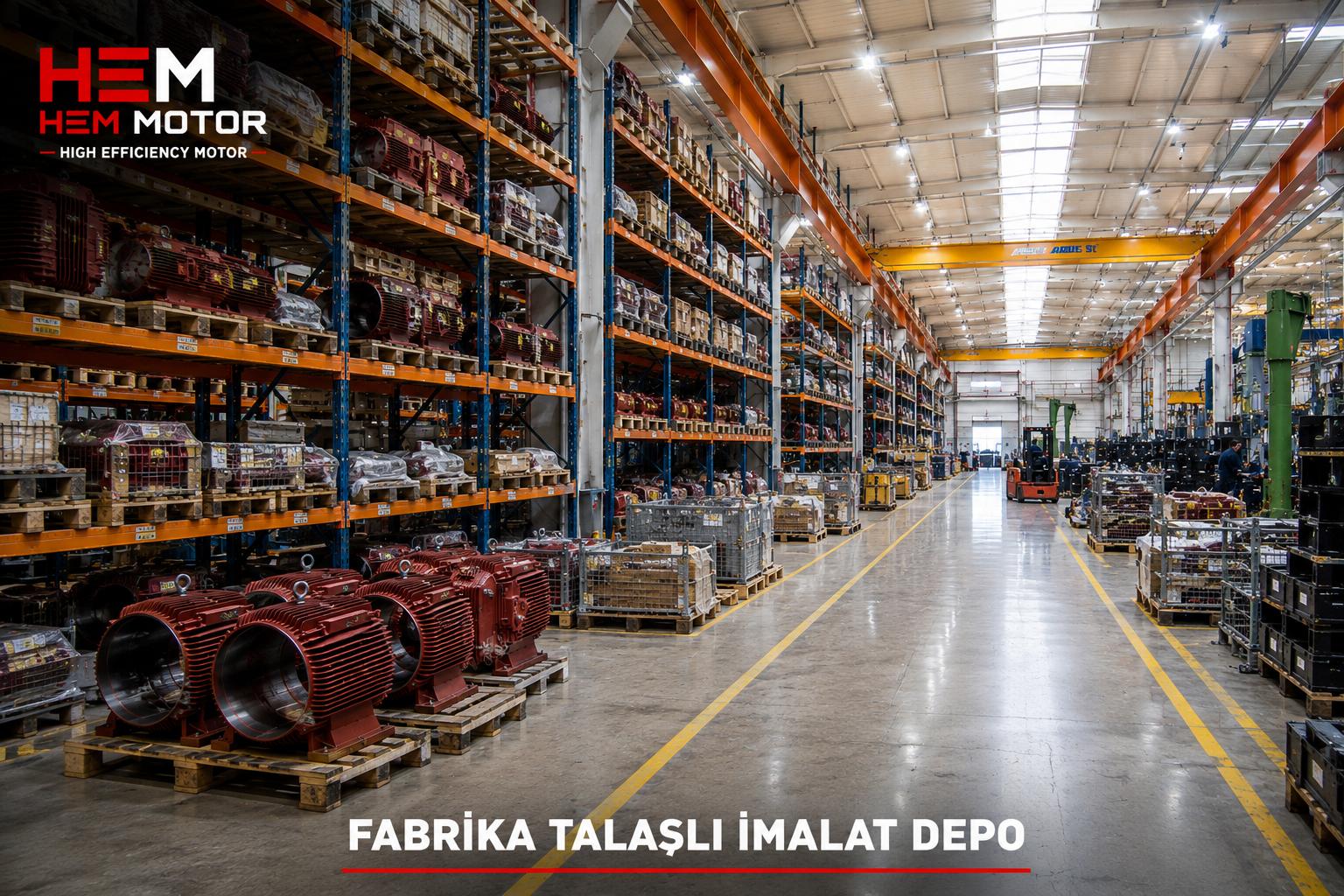
- New motor from stock: If the needed power and speed are in stock, a new motor can be delivered the same day or in a very short time.
If the motor is a standard power-speed combination waiting ready in stock, new-motor delivery can be far faster than rewinding. In this case, the line running sooner more than makes up for the price difference. The stock advantage becomes decisive here. On urgent delivery, our emergency motor supply page helps. If the cost of each hour of line downtime is high, delivery time can be the heaviest factor in the decision.
How Does Frame Size Change the Decision?
The motor's frame size affects the decision balance quietly but powerfully. On small-frame motors (for example 80-132 frame) the new-motor price is relatively low; so rewinding at these powers is often illogical, because the rewinding cost comes very close to the new motor.
By contrast, on large-frame, high-power motors (for example 200 frame and above) the picture changes:
- Small powers (low frame): Since the new motor is cheap, rewinding is not economical; a new motor is more sensible.
- Large powers (high frame): Since the new motor may be expensive and the delivery time long, a quality rewind can be economically meaningful.
- Special/old-type motors: On special motors whose equivalent is not easily found, rewinding may be the only way to solve the supply problem.
To select the right motor by frame size and mounting type, the motor frame size table is a useful starting point. Since the frame value also determines mechanical compatibility, preserving this value when choosing a new motor is important for ease of mounting.
Practical Decision Summary
When we bring all the axes together, the decision settles into this simple framework:
- Choose a new motor: If the motor is small/medium power, runs on a critical line, preserving the efficiency class matters, a warranty is needed, and it waits ready in stock.
- Consider rewinding: If the motor is very high power, its equivalent is not easily found, the line can stay down for a while, and a reliable workshop commits to a quality rewind.
When deciding, one must look not only at the workshop quote but together at the long-term bill of efficiency loss, the value of the warranty, the cost of delivery time and the economics of frame size. For most businesses the safest approach is, before deciding, to get a quote for a new motor from stock and genuinely compare it with the rewinding cost. For current price and stock information, you can request a quote from our electric motor prices page and comfortably compare whether a new motor really is more advantageous.
Total Cost of Ownership and the Long-Term View
To give a sound answer to "rewind or buy new," one must carry the perspective beyond the first invoice. The right measure is the total cost the motor will create over its lifetime: the purchase or rewinding price, energy consumption, maintenance expenses and the downtime loss a possible second failure would bring. When this equation is set up, the new motor that looks expensive at first glance often turns out to be more economical.
On a continuously running motor, the energy cost rises many times over the purchase price across the years. So even a few points of efficiency difference soon wipes out the visible saving of rewinding in facilities with high running hours. New high-efficiency motors offer longer life thanks to both a lower electricity bill and a lower operating temperature.
- Initial investment: Rewinding usually looks lower, but the gap closes with the hidden items.
- Energy cost: A new high-efficiency motor pulls ahead as running hours increase.
- Maintenance and reliability: A new motor is under warranty and the risk of an unexpected second failure is low.
- Downtime risk: An unwarranted rewind burning out again on a critical line costs far more than the motor price.
Practical Scenarios: Which Decision in Which Situation?
To set theoretical comparisons onto the real field, it helps to look at a few typical scenarios. The same failure can lead to a completely different decision depending on the motor's power, its role on the line and the facility's operating regime.
- Scenario 1 — Small-power pump motor: A motor driving a critical, continuously running 4 kW circulation pump has burned out. Here the new motor is relatively cheap, quickly available from stock, and the efficiency class is preserved. The clear decision: a new motor.
- Scenario 2 — High-power special fan motor: A 160 kW fan motor with a special shaft size whose equivalent is not easily found. Supplying a new motor may take long and cost much. If the line can be managed with a spare for a few days, a quality rewind at a reliable workshop is economically meaningful.
- Scenario 3 — Medium-power conveyor motor, critical line: A 30 kW conveyor motor on which production fully depends. Here delivery time and warranty become decisive; a new motor ready in stock stands out for both speed and assurance.
- Scenario 4 — Low-running-hours spare motor: A seasonal motor that runs only a few weeks a year. Since the energy cost is low here, a quality rewind can be a reasonable option in terms of total cost.
These scenarios show there is no single right answer such as "always rewind" or "always buy new." The right decision emerges by weighing the motor's power, its criticality on the line, its running hours and stock status together.
Frequently Asked Questions
Is a rewound motor as efficient as a new one?
In most cases, no. During the rewinding process, baking the core lamination, possible changes in wire cross-section and turn count, and the reduction in copper fill ratio can lower the motor's efficiency below the nameplate value. Although this loss is not the same on every motor, on continuously running motors it can create, over the years, an electricity-bill gap that exceeds the rewinding cost. In applications where efficiency is critical, a new high-efficiency motor is usually more advantageous.
From which power does rewinding start to make sense?
Although there is no precise boundary, the general rule is that at small powers (low frame sizes) the new motor is economical, while at large powers a quality rewind becomes meaningful. On small motors, since the rewinding cost comes very close to the new motor, rewinding is often illogical. On high-power, expensive motors with long delivery times, a reliable rewind can be considered economically. For a clear decision, the motor's frame size, power-speed data and stock status should be evaluated together.
In an urgent failure, does rewinding or a new motor offer the faster solution?
If the needed power and speed are ready in stock, a new motor is almost always the faster solution; same-day or very short delivery is possible. Rewinding, depending on the workshop's workload, can take from a few days to a week, and the line is down during this time. If the line's downtime cost is high, a new motor delivered from stock is usually both the faster and overall the more economical solution.