English
 Türkçe

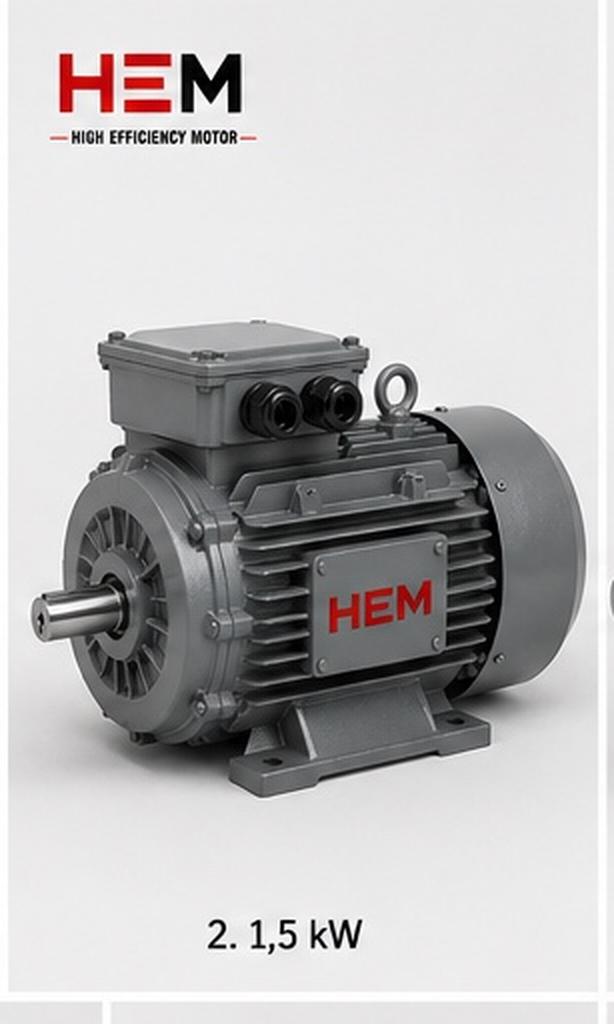

In small workshops, agricultural irrigation points and many domestic applications where a three-phase grid is not available, the power source is single phase. The single-phase motors used at these points work structurally differently from their three-phase counterparts and have a natural limit in terms of efficiency. Moreover, most single-phase motors fall outside the scope of the MEPS and Ecodesign regulations that govern efficiency requirements. This does not mean "efficiency does not matter"; on the contrary, serious energy saving is possible even at small power with the right motor selection. This article covers high-efficiency single-phase motors, the capacitor start and run methods (CSCR, PSC), the reason for the efficiency limit in single phase, why they are outside MEPS scope, the saving potential at small power, the comparison with three phase and the correct single-phase motor selection, all from a purchasing-decision perspective.
How Does a Single-Phase Motor Work? The Role of the Capacitor
In a three-phase motor, the time-shifted sequence of the three phases naturally produces a rotating magnetic field, and the rotor follows this field and turns. In single phase there is only one phase; a single winding produces a field that does not rotate but pulsates (oscillates). This pulsating field alone cannot create a starting torque to turn the rotor. This is why single-phase motors use a second auxiliary winding and a capacitor. The capacitor shifts the current in the auxiliary winding in phase relative to the main winding; this phase difference creates the rotating-field-like effect needed for starting, and the motor starts.
The way the capacitor is used inside the motor determines the motor's type and performance. The main single-phase motor types are named according to how the capacitor is kept in circuit. This choice directly affects both the starting torque and the running efficiency. Below we cover the two most common types and their differences.
CSCR and PSC: Two Basic Single-Phase Motor Types
In a PSC (Permanent Split Capacitor) motor a single run capacitor stays in circuit both at start and in continuous running. This structure is simple, quiet and long-lasting; but the starting torque is low. PSC is ideal for applications such as fans and pumps where a low starting torque is enough, and its running efficiency is relatively high. In a CSCR (Capacitor Start Capacitor Run) motor there are two capacitors: a high-capacity start capacitor that comes in at start and a run capacitor that stays in circuit continuously. The start capacitor provides high starting torque and is switched out by a centrifugal switch once the motor speeds up; the run capacitor maintains efficient continuous running.
| Property | PSC (Permanent Capacitor) | CSCR (Start+Run) |
|---|---|---|
| Number of capacitors | 1 (run) | 2 (start + run) |
| Starting torque | Low | High |
| Running efficiency | Relatively high | High |
| Centrifugal switch | None | Yes (for start capacitor) |
| Typical application | Fan, small pump | Compressor, loaded start |
| Structural complexity | Simple | More complex |
Why Is Efficiency Limited in Single Phase?
The efficiency of single-phase motors is structurally lower than that of three-phase motors of the same power, and there are several main reasons. First, the auxiliary winding and capacitor system itself creates extra loss. Second, the magnetic field formed in single-phase supply does not rotate as smoothly as in three phase; this causes extra losses in the rotor and more heating. Third, the power factor (cosφ) in single-phase motors is usually lower. When all these reasons combine, single-phase motors run a few points lower in efficiency than their three-phase counterparts.
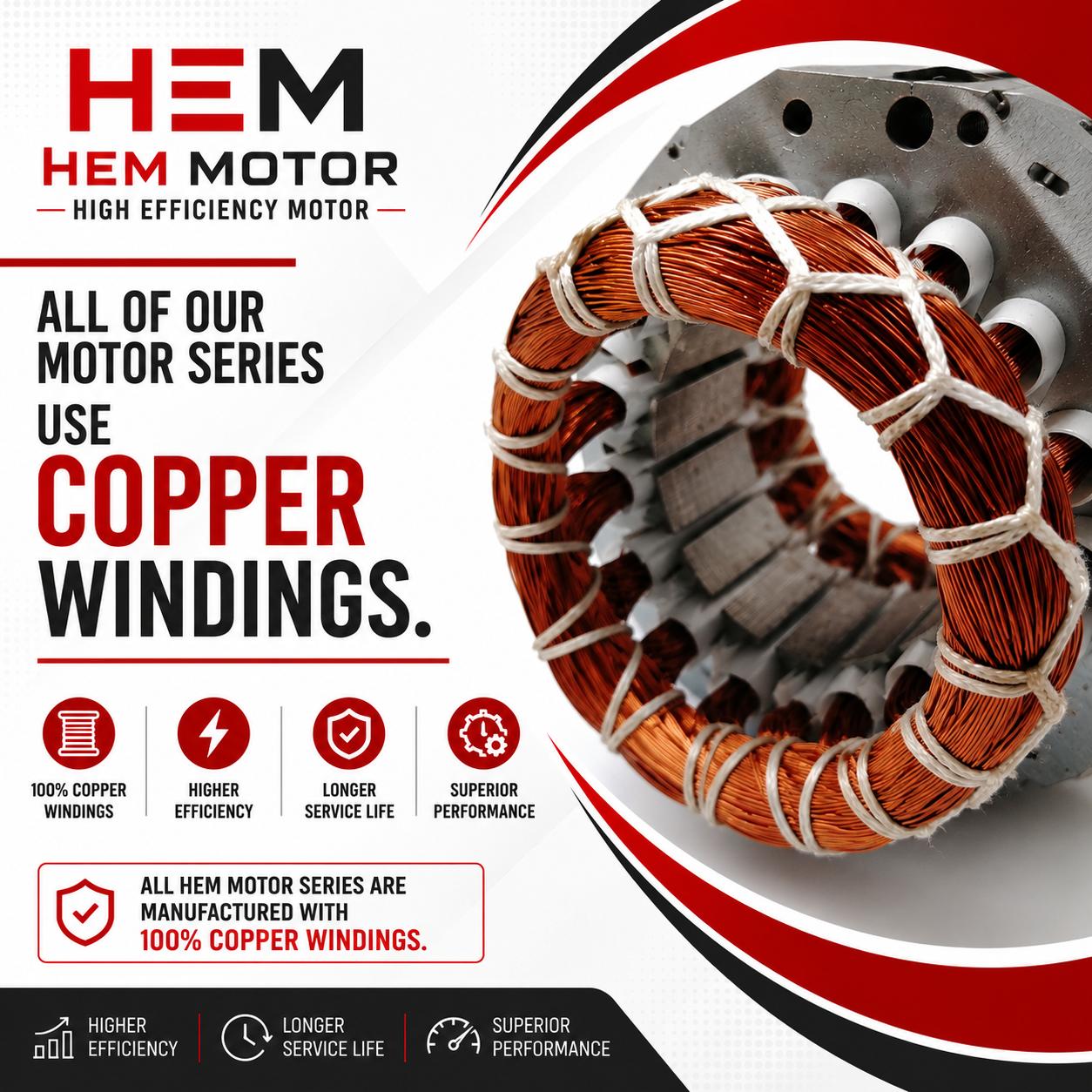
This natural limit does not mean efficiency is unimportant in single-phase motors. On the contrary, even within the same single-phase technology, a well-designed motor using quality laminations and copper winding can be markedly more efficient than a cheap, low-quality one. We covered the efficiency difference between copper and aluminium winding in our article on copper versus aluminium winding; the same principle applies to single-phase motors too. Attempts to run a three-phase motor on single phase are often inefficient and problematic; we explained this in our article on running a three-phase motor on 220V single phase.
Why They Fall Outside MEPS and Ecodesign Scope
The European Union Ecodesign regulation and the parallel MEPS (Minimum Energy Performance Standards) requirements mandate minimum efficiency classes (such as IE3, IE4) for three-phase asynchronous motors in a certain power range. But these regulations largely leave single-phase motors outside scope or subject them to much looser conditions. So a single-phase motor is not expected to carry a mandatory efficiency-class label such as IE2/IE3; these motors are not required by regulation to meet a particular efficiency class.
The practical consequence of this is: in the single-phase motor market, efficiency can vary greatly from seller to seller and product to product. Because the regulation sets no floor, the buyer must question efficiency themselves. A low-priced single-phase motor can run with higher losses and add far more to the electricity bill over the years than its cheapness saved. To read the rated values on the motor nameplate and any efficiency information, our article on reading the motor nameplate guides interpreting kW, speed and cosφ values.
Saving Potential at Small Power
Single-phase motors are usually used at small powers (from a few hundred watts to a few kW). Although it may look like "small power, small saving," these motors often run for long hours, even continuously. A continuously running fan, circulation pump or refrigeration compressor consumes thousands of hours of energy a year. In that case even a few points of difference in efficiency creates a meaningful saving in annual consumption and the bill. So efficiency at small power is an item that should not be overlooked.
- In continuously running applications a small efficiency difference turns into a large annual saving.
- Quality laminations and copper winding raise efficiency even in a single-phase motor.
- The right motor type (PSC/CSCR) avoids unnecessary capacitors and loss.
- Correct power selection prevents the inefficiency caused by oversizing.
Comparison with Three Phase and Correct Selection
Where possible, a three-phase motor is always more advantageous with its higher efficiency, smoother torque and better power factor. So if there is a three-phase supply on site, or it can be provided at reasonable cost, a three-phase motor should be preferred. A single-phase motor is a sensible solution only where a three-phase supply is not available or cannot be brought in. In that case too, selecting the most efficient single-phase motor of the right type and right power matters for both performance and operating cost.
- Supply type: is there three phase or not? If there is, prefer three phase.
- Application: is low starting torque needed (PSC) or high (CSCR)?
- Running time: continuous or intermittent? If continuous, efficiency stands out.
- Power: correct sizing, avoiding an oversized motor.
- Quality: lamination and winding quality determine efficiency and life.
Capacitor Maintenance and Fault Signs
The most frequently failing component of single-phase motors is the capacitor. A capacitor can lose its capacity over time, swell or fail completely. When the run capacitor weakens the motor runs under strain, heats up and loses efficiency; when the start capacitor fails the motor cannot start, only hums and draws excess current. In that case, if the motor's thermal protection does not trip, the winding can burn. So in single-phase motors it is important that the capacitor is of the correct value (in microfarads and voltage) and is checked periodically. When replacing a capacitor, one of the value stated on the motor nameplate or in the catalogue must always be used.
Another critical component is the centrifugal switch in CSCR motors. This switch disconnects the start capacitor when the motor speeds up. If the switch sticks closed the start capacitor stays in circuit continuously and overheats and fails; if it stays open the motor cannot start. The clean and correct operation of this mechanical switch is essential for the reliability of a CSCR motor. In general, we compiled the mistakes made when buying a motor and the principles of correct selection in our article on mistakes made when buying an electric motor; these principles apply to single-phase motor selection too.
Rewind a Single-Phase Motor or Buy a New One?
Because single-phase motors are small-power and relatively low-cost, in the event of a failure rewinding can often be more expensive, or at least less sensible, than buying a new one. The rewind of a small single-phase motor requires a labour-heavy cost, and efficiency after rewinding usually drops somewhat. So at small power, if the rewind cost approaches the cost of a new motor, buying a new and efficient motor is both more economical and safer. We covered this decision in detail, in terms of rewind cost and efficiency loss, in our article on rewind a motor or buy a new one.
When buying a new motor, the right type and right power selection should also be reviewed at the same time. Taking into account the possibility that the old motor was wrongly sized, selecting according to the real load requirement prevents unnecessary energy consumption. An oversized single-phase motor creates unnecessary cost both in the initial investment and in operation; a motor that fits the need exactly is both efficient and economical. So every failure should also be seen as an opportunity to move to the right motor.
Frequently Asked Questions
Why is a single-phase motor's efficiency lower than three phase?
In single phase the magnetic field does not rotate as smoothly as in three phase; in addition the auxiliary winding and capacitor system create extra loss, and the power factor is usually lower. These structural reasons make a single-phase motor of the same power run a few points lower in efficiency than its three-phase counterpart. This is a natural limit of the technology; but within the same class a quality motor is always more efficient.
Is there a mandatory MEPS efficiency class for single-phase motors?
In most cases no. Ecodesign and MEPS regulations mainly cover three-phase asynchronous motors of a certain power; single-phase motors are largely outside scope or subject to much looser conditions. So it is important for the buyer to question efficiency themselves and request the nameplate and technical information for single-phase motors.
Should I choose PSC or CSCR?
This depends on the starting-torque need of your application. In applications where low starting torque is enough, such as fans and small pumps, PSC is simpler, quieter and more efficient. In compressors or applications that start under load, high starting torque is needed, so CSCR is suitable. The wrong type choice leads either to insufficient starting or to unnecessary complexity; the application profile is decisive.
For your applications where a three-phase supply is not available, we can define the most suitable solution of the right type (PSC/CSCR), the right power and a high-efficiency single-phase motor according to your application's starting-torque and running profile. As HEM Motor, with broad stock and fast delivery, contact us to guide you to a single-phase motor suited to your need; sharing your supply type and application details to get a quote is enough.