English
 Türkçe



Buying a high-efficiency motor is only one part of energy saving. Whatever voltage the motor is supplied with in the field, its real efficiency is shaped by that voltage. Most plants assume the efficiency value on the motor's nameplate is a fixed fact; yet when the supply voltage deviates from the rated value, the motor's loss rises and the nameplate efficiency cannot be achieved in the field. At over-voltage iron loss rises, at under-voltage copper loss rises; voltage unbalance worsens both at once. So, to obtain the saving expected from a high-efficiency motor, supplying the motor at the right voltage is at least as important as selecting the motor. In this article we cover the effect of supply voltage on efficiency under load, how loss rises at over- and under-voltage, the consequences of voltage unbalance, the role of the voltage optimization transformer and how to save by preserving efficiency at the right voltage, from HEM Motor's perspective.
How Does Supply Voltage Affect Efficiency?
The loss of an induction motor consists of two main components: load-independent iron (magnetic) loss and load-dependent copper (I²R) loss. The supply voltage directly changes the balance of these two losses. When voltage rises, the motor's magnetic circuit saturates more, which raises iron loss and the magnetizing current. When voltage drops, the motor draws more current to deliver the same mechanical power, which raises copper loss and heats the motor.
So every motor has an "optimum voltage" region where loss is minimum, and this region is usually near the rated voltage. As you move away from the rated voltage, in whichever direction, efficiency falls. An interesting point is this: it is assumed that lowering voltage always saves energy, but this is only true if the motor is lightly loaded and supplied with over-voltage. In a loaded motor, lowering the voltage more than necessary has the opposite effect by raising copper loss.
- Iron loss: rises with voltage; dominant at high voltage and low load.
- Copper loss: rises with current (load); dominant at low voltage and high load.
- Optimum voltage: the point where the sum of the two losses is lowest; usually near the rated value.
Loss Increase at Over- and Under-Voltage
The table below shows conceptually the typical effect of deviation from rated voltage on motor efficiency and losses. The values vary with motor design and load condition; but the trend is similar in every motor.
| Supply Voltage | Iron Loss | Copper Loss (under load) | Temperature | Result |
|---|---|---|---|---|
| 110% (over) | High | Slightly low | Rises (saturation) | Efficiency falls |
| 100% (rated) | Balanced | Balanced | Normal | Highest efficiency |
| 90% (low) | Slightly low | High | Rises (current) | Efficiency falls |
As seen, both over- and under-voltage lower efficiency, but by different mechanisms. Over-voltage saturates the motor magnetically and produces unnecessary iron loss and heat; this is especially pronounced in lightly loaded motors. Under-voltage strains a loaded motor, raises current, heats the winding and shortens insulation life. Moreover, under-voltage also reduces starting torque, creating starting problems on heavy loads. We cover grid fluctuation and voltage tolerance in our article on voltage tolerance and grid fluctuation in IE3 motors.
Voltage Unbalance: The Silent Efficiency Killer
In a three-phase motor, the voltage between phases being unequal, that is, voltage unbalance, is far more harmful to efficiency than the average voltage deviating. Even a small unbalance leads to a large current unbalance in the winding, because the effect of unbalance grows multiplied through the negative-sequence component. This causes one phase to heat far more than the others, extra loss and a shortened motor life.
| Voltage Unbalance | Approx. Current Unbalance | Extra Heating / Loss | Recommended Action |
|---|---|---|---|
| 1% | ~6-10% | Low | Can be monitored |
| 2% | ~12-20% | Significant | Derating may be needed |
| 3.5%+ | 25%+ | High | Should not run / must be corrected |
So voltage unbalance can silently destroy the saving of a high-efficiency motor. We detail derating with the NEMA curve and unbalance protection in our article on derating under voltage unbalance in induction motors. Correcting unbalance can often be even higher priority than optimizing the voltage level.
How Do You Measure Supply Voltage and Unbalance?
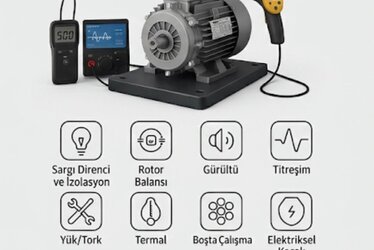
Before deciding on voltage optimization, measuring the current situation correctly is essential. A single instantaneous reading is not enough, because grid voltage varies through the day and across the days of the week. The soundest approach is to record voltage, current, power factor and harmonics at the motor supply point for at least a few days with an energy analyzer. These records show whether the voltage is really continuously high or rises only at certain hours.
Voltage unbalance is calculated as the ratio of the largest deviation of the three-phase voltages from the average to the average. If this value is below 1% it is considered safe for the motor; when it exceeds 2%, derating comes onto the agenda. Recording the moments when the motor runs at different load levels during measurement is valuable for seeing the voltage-load relationship. We cover the method of comparing the measured efficiency value with the nameplate in our article on nameplate efficiency value and field verification.
Real Plant Scenarios
To make the logic of voltage optimization concrete, let us look at a few typical scenarios. The right decision differs in each scenario, which shows why a measurement-based approach is essential:
- Continuously high voltage, lightly loaded motors: if the grid supplies 415-420 V and the motors mostly run at low load, lowering the voltage to the optimum level reduces iron loss and saves. This is the scenario where voltage optimization fits best.
- At rated voltage, fully loaded motors: if the voltage is already optimum and the motors are at full load, lowering the voltage harms by raising copper loss. Optimization is unnecessary in this scenario.
- Unbalanced grid: if the phase-to-phase voltage unbalance is high, the unbalance must be removed first; this is higher priority and more effective than optimizing the level.
- Fluctuating voltage: if the voltage varies over a wide range through the day, automatic voltage regulation may be more suitable than a fixed transformer.
As seen, voltage optimization is not a solution that "benefits every plant"; applied correctly it is a valuable saving tool, applied wrongly it is a mistake that lowers efficiency.
The Relationship Between Voltage, Power Factor and Reactive Penalty
The supply voltage affects not only efficiency but also the power factor and therefore the reactive energy penalty. Over-voltage raises the motor's magnetizing current, which increases reactive power consumption and lowers the power factor. A low power factor both raises distribution losses and can show up on the bill as a reactive energy charge. So keeping the voltage at the optimum level indirectly improves the power factor and reduces the risk of a reactive penalty.
We cover power factor and the reactive penalty in high-efficiency motors in detail in our article on power factor and reactive penalty in high-efficiency motors. Voltage optimization, when evaluated together with compensation, improves the plant's electrical efficiency holistically.
What Is a Voltage Optimization Transformer?
In many plants the grid voltage is above the rated value; for example, while the motor is designed for 400 V the grid continuously supplies 410-420 V. This continuous over-voltage produces unnecessary iron loss and heat in lightly loaded motors. A voltage optimization transformer (or voltage optimization system) reduces this loss by lowering the voltage entering the plant to the level at which the motors run optimally.
This system is meaningful especially in plants with many motors and lighting where the grid voltage is continuously high. But it is not an automatic solution for every plant: if the voltage is already optimum or the motors run at full load, lowering the voltage can harm rather than help. So the decision on voltage optimization must always be made with a measurement and analysis. We cover the effect of rated voltage and frequency differences in our article on motor rated voltage and the 50/60 Hz difference.
Voltage and Frequency Together: The V/f Balance
To do voltage optimization correctly, it is important to know that voltage must be considered together with frequency. In a motor supplied directly from the grid, the frequency is fixed (50 Hz) and only the voltage changes. But in a motor running on a variable frequency drive (VFD), the drive adjusts voltage and frequency together (the V/f ratio). In this case the magnetic flux is set by the voltage/frequency ratio; as long as this ratio is kept constant, the motor runs with the correct flux and efficiently.
In a motor running on a VFD there is no need to optimize the voltage separately, because the drive already applies the correct voltage at every speed. Voltage optimization is mainly meaningful for fixed-speed motors supplied directly from the grid. Making this distinction correctly is the basis for determining which method suits which plant. We cover the effect of running below 50 Hz on torque and cooling in our article on running below 50 Hz and the V/f curve.
Measuring and Documenting the Saving
After voltage optimization or unbalance correction is done, measuring and documenting the saving achieved is important. Comparing energy consumption before and after the intervention under the same load conditions reveals the real gain. This measurement both shows that the investment is paid back and is used for documentation in energy management systems (for example ISO 50001). Saying merely "we lowered the voltage" is not enough; numerically verifying the gain reveals the true value of the work done.
We explain the method of measuring and documenting annual energy saving in detail in our article on measuring and documenting annual saving in high-efficiency motors. Correct measurement turns energy saving into a concrete and sustainable gain.
Preserving Efficiency at the Right Voltage and Saving
To obtain the saving expected from a high-efficiency motor, attention to supply conditions matters as much as the purchase. The right approach includes these steps: first measure the existing supply voltage and its unbalance, then determine the motors' load profile, then correct the voltage level and unbalance if needed. These steps turn the efficiency promised on the nameplate into reality in the field.
- Measure the supply voltage and the unbalance between phases; unbalance should be below 1%.
- If the grid voltage is continuously high and the motors are lightly loaded, evaluate voltage optimization.
- Do not lower the voltage more than necessary; in a loaded motor this raises copper loss.
- Monitor the winding temperature; unexpected heating can be a sign of a voltage problem.
- Solve the voltage problem before replacing the motor; otherwise the new motor cannot deliver the same efficiency either.
For a general framework that addresses energy saving step by step, our article on the 10-point electric motor energy saving checklist and, for the nameplate vs field efficiency difference, our nameplate vs field efficiency difference article are good starting points.
Frequently Asked Questions
Does lowering voltage always save energy?
No. This is a common misconception. Lowering voltage saves energy only if the motor is lightly loaded and supplied with over-voltage, because in that case unnecessary iron loss falls. But in a loaded motor, lowering the voltage more than necessary makes the motor draw more current and raises copper loss, having the opposite effect. The right decision should be based on measurement.
Why can't I get the nameplate efficiency value in the field?
The nameplate efficiency is the value measured at the motor's rated voltage, rated load and balanced supply conditions. In the field, if the voltage deviates from the rated value, if there is unbalance or if the motor runs far below rated load, the real efficiency is lower than the nameplate. So correcting the supply conditions is the way to turn the nameplate efficiency into reality in the field.
Why is voltage unbalance so harmful?
Because a small voltage unbalance turns into a much larger current unbalance in the winding and causes one phase to overheat. This means both extra loss and a shortened insulation life. At 3.5% and above unbalance the motor should not run and the source must be corrected; this, besides preserving efficiency, also protects the motor from failure.
Manufacturer Stock and Fast Delivery with HEM Motor
Turning the saving a high-efficiency motor promises into reality in the field depends on running the motor at the right voltage with a balanced supply. The HEM Motor engineering team guides you from selecting a motor in the right efficiency class to evaluating supply conditions and recommends the most suitable solution for your application. To secure your energy saving by supplying high-efficiency motors with manufacturer stock and fast delivery, contact us and request a quote.