English
 Türkçe



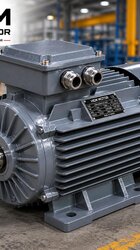
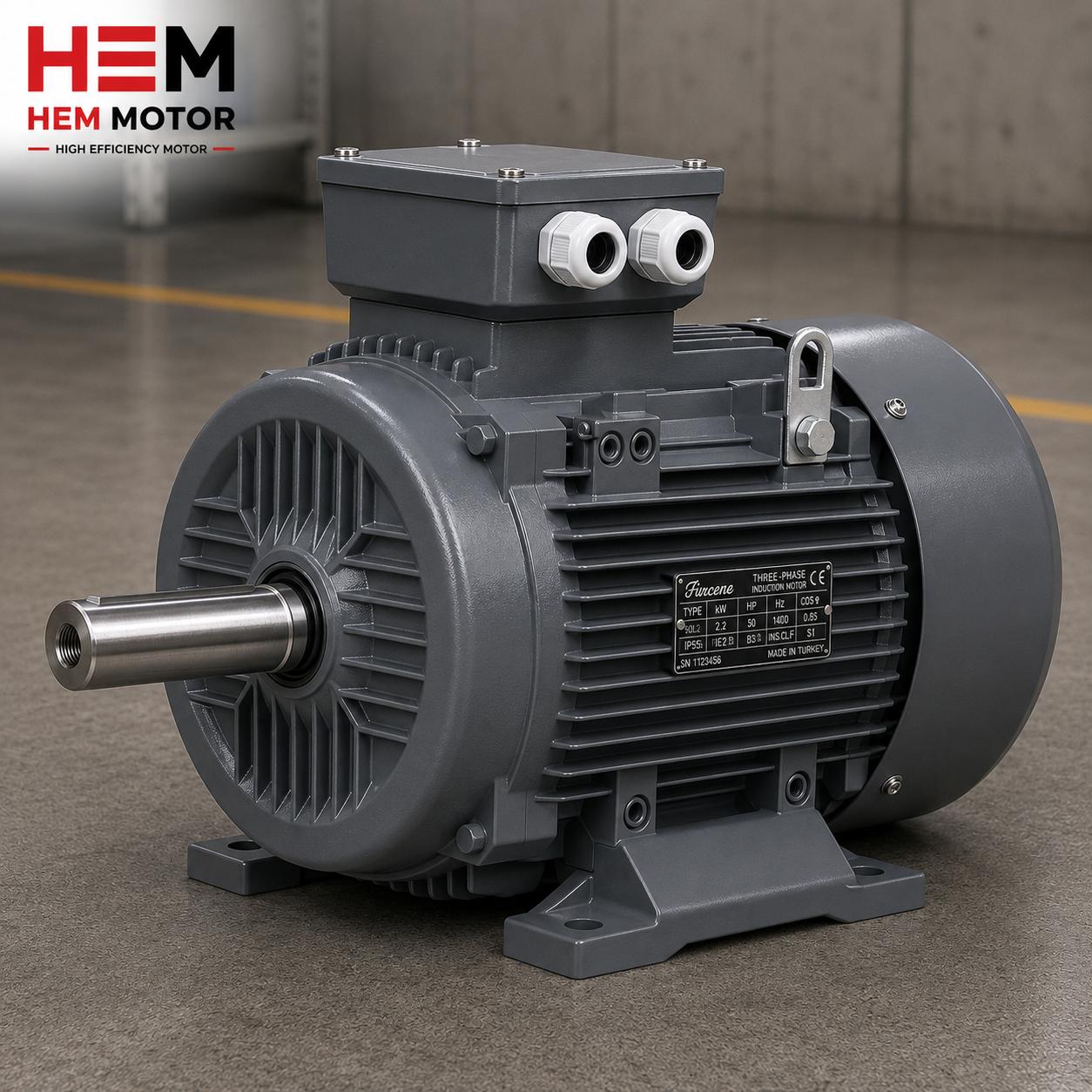

When exporting a machine or plant, the electric motor on it must suit the grid frequency and voltage of the country it is going to. While Turkey and most of Europe use a 50 Hz grid, North America, part of Saudi Arabia, and some Latin American and Asian countries use a 60 Hz grid. When the same motor is run at 60 Hz instead of 50 Hz, its speed, power and efficiency behaviour change; in addition, the target market often wants a different efficiency standard such as NEMA premium rather than the IEC efficiency class. So 60 Hz export with a high-efficiency motor is not just a voltage matter but a multi-dimensional decision involving speed, power, efficiency class and documentation. At HEM Motor, supplying the motor suited to the target market's frequency, voltage and efficiency standard, with the right frame and documentation, is the key to delivery without field incompatibility in your export projects. This article covers the speed-power-efficiency change in the transition from 50 Hz to 60 Hz, the IEC IE class to NEMA premium match, voltage options (230/460/575V), frame compatibility and efficiency class documentation, all focused on the purchasing decision.
How Do Speed, Power and Efficiency Change from 50 Hz to 60 Hz?
The synchronous speed of an asynchronous motor depends on frequency and pole number. When the frequency rises from 50 Hz to 60 Hz, the synchronous speed of a motor with the same pole number increases by about 20 percent. For example, a 4 pole motor turns at about 1500 rpm synchronous speed at 50 Hz and rises to about 1800 rpm at 60 Hz. This speed increase also changes the power demand of the load connected to the motor (especially pumps and fans), because in centrifugal loads power rises with the cube of speed. So a motor selected for 50 Hz draws more power when driving the same pump at 60 Hz. For this reason, the motor and load must be re-evaluated together in a 60 Hz application.
Voltage is also part of this equation. The motor's magnetic flux depends on the voltage/frequency ratio (V/f). If the voltage is raised proportionally as the frequency rises to 60 Hz (for example 460V/60Hz instead of 400V/50Hz), the flux stays constant and the motor keeps its rated power and torque. If only the frequency is raised without raising the voltage, the flux drops and torque decreases. So in 60 Hz markets motors are usually defined together with higher voltages such as 460V or 575V. Our article on the motor rated voltage and 50/60 Hz difference, which covers this in more detail, forms the basis of this topic.
Efficiency behaviour also changes with frequency. If a motor is optimised for 50 Hz, its magnetic and electrical losses differ at 60 Hz; usually iron losses rise somewhat at higher frequency, while more power is produced at the same torque as the speed increases. For this reason a truly high-efficiency 60 Hz motor is not obtained simply by changing the label of a 50 Hz motor; the motor must be correctly designed for the 60 Hz operating point and documented to meet its efficiency class at that frequency. This distinction matters in export, because the target market demands the efficiency class under the 60 Hz condition.
In practice this also means the motor can be defined as dual-frequency (50/60 Hz). Many quality motors carry both 50 Hz and 60 Hz values on their nameplate; a separate speed, power, current and efficiency value is given for each frequency. This way the same motor can be sent to different markets, as long as its voltage also suits that market's grid. For the exporter, this dual-frequency definition is an important advantage that simplifies stock management.
Speed and Power Change: Practical Table
The table below summarises the typical synchronous speed and behaviour change of the same motor at 50 Hz and 60 Hz. These values are synchronous speed; the actual speed is slightly below this by the amount of slip.
| Poles | Synchronous Speed 50 Hz | Synchronous Speed 60 Hz | Typical Voltage 60 Hz |
|---|---|---|---|
| 2 pole | 3000 rpm | 3600 rpm | 460V / 575V |
| 4 pole | 1500 rpm | 1800 rpm | 460V / 575V |
| 6 pole | 1000 rpm | 1200 rpm | 460V / 575V |
| 8 pole | 750 rpm | 900 rpm | 460V / 575V |
In terms of voltage, the most common values in 60 Hz markets are 230V at small powers, 460V at medium-large powers and 575V in some industrial applications (notably Canada). The right voltage is selected according to the grid of the plant the motor is going to and must be clearly specified at the ordering stage. The wrong voltage causes the motor either to run weakly or to draw excessive current.
IEC IE Class to NEMA Premium Match
The most frequently confused topic in export is that the efficiency standard differs. The IEC world defines efficiency classes as IE2, IE3, IE4, IE5; North America uses the NEMA standard and names efficiency levels as "Energy Efficient", "Premium Efficient" (NEMA Premium). Although the two systems are not based on exactly the same test conditions, in practice there are close matches. The table below shows the approximate equivalents.
| IEC Class | Approximate NEMA Equivalent | Position |
|---|---|---|
| IE2 | NEMA Energy Efficient | Older/lower level |
| IE3 | NEMA Premium | Mandatory baseline in most markets |
| IE4 | NEMA Super Premium (and above) | Advanced efficiency |
| IE5 | No full NEMA match yet | Ultra efficiency |
So a European customer asks for "IE3" while a North American customer asks for the same level as "NEMA Premium"; the two indicate roughly the same efficiency target. We covered the frame and matching differences between the IEC and NEMA worlds in our NEMA and IEC motor matching article, and the efficiency class mandate in our IE3 efficiency class mandate article.
Frame and Connection Compatibility: Mechanical Details in Export
Beyond efficiency and frequency, mechanical compatibility is also critical in an export motor. The IEC world defines frame sizes on a millimetre basis (for example 132M, 160L), while NEMA uses inch-based frames (for example 213T, 256T). If a machine is designed to a NEMA frame, the motor to be sent must match the foot hole spacing, shaft diameter and flange dimensions of that frame. So in an export motor not only the electrical but also the mechanical connection dimensions must be selected for the target market. We detailed IEC frame and shaft dimensions in our shaft diameter and frame table (IEC 56-355) article.
- Frame standard: IEC (mm) or NEMA (inch)? Determined by the target machine.
- Mounting type: Foot (B3), flange (B5/B35) mounting compatibility.
- Shaft end: Diameter and key size must fit the coupling or pulley.
- Terminal and cable entry: The target market's cable and gland standard (metric/NPT).
The multi-mount option makes it easier to serve different markets with a single stock code; we covered this topic in our multi-mount (B3/B5/B35) universal frame article.
Efficiency Class Documentation and the Right Order
In export markets the efficiency class is often a legal requirement; the efficiency value and class on the motor's nameplate must be stated correctly and in the target standard. A motor going to North America is expected to show the NEMA nominal efficiency value, and one going to Europe the IEC IE class. Correct reading and field verification of the nameplate is important to avoid problems at customs and commissioning; we explained this in our reading the efficiency value and IE code on the nameplate article.
For a correct export order, the following information must be clarified together: the target market's frequency (50/60 Hz), voltage (230/460/575V), required efficiency standard (IEC IE class or NEMA Premium), frame standard (IEC/NEMA), mounting type and shaft dimensions. When these six items are correctly determined, the motor fits the destination plant both electrically and mechanically and passes customs smoothly in terms of documentation. You can evaluate where losses are reduced in an efficient motor and the real saving together with our loss mapping and efficiency budget article.
A common mistake in export is to focus only on electrical compatibility and leave documentation to the end. Yet in many markets a motor can only clear customs with a valid efficiency certificate and the right label; a motor that is missing documentation or documented to the wrong standard can be held at the port of arrival and cause a serious delay in the project. So documentation should be planned at the start of the ordering process, not at the end. Printing the nameplate to the target standard, showing the efficiency value correctly and preparing the necessary conformity documents together with the motor is the foundation of a smooth export.
Another practical point is the cooling and noise behaviour of the 60 Hz motor. Because the speed rises about 20 percent, the motor's fan also turns faster; this usually provides better cooling but can slightly raise the noise level. This should be considered in applications with a strict noise limit. In most industrial export applications this difference is negligible, but in places requiring quietness such as building mechanical services it is right to evaluate it before ordering.
Frequently Asked Questions
Can I run a 50 Hz motor on a 60 Hz grid?
It runs, but it is not correct. A motor designed for 50 Hz turns about 20 percent faster at 60 Hz; if the voltage is not raised proportionally, torque and power drop, and if it is raised the motor is suitable but its nameplate values still do not reflect 60 Hz. On loads such as pumps and fans, the speed increase can seriously raise the power demand and overload the motor. In export, the best approach is to define the motor for 60 Hz and the right voltage from the start.
Are an IE3 motor and NEMA Premium the same thing?
Not exactly the same, but very close in practice. The two standards are based on different test methods, but their efficiency targets are close and in most power-speed combinations IE3 and NEMA Premium show a similar efficiency level. In export it is essential to clarify which standard the customer wants and to document the motor to that standard; we supply the motor in the standard the target market requires.
Which voltage should I choose for a 60 Hz market?
It depends on the grid of the target plant. As a general rule, 230V is common at small powers and 460V at medium-large powers; some markets such as Canada use 575V. The voltage must be chosen in harmony with the frequency so the motor correctly keeps its rated torque and efficiency. The best approach is to learn the exact grid voltage of the plant the motor is going to and define the motor accordingly.
At HEM Motor, for your export projects we supply high-efficiency motors suited to the target market's frequency (50/60 Hz), voltage (230/460/575V) and efficiency standard (IEC IE class or NEMA Premium), with the right frame and mounting compatibility and correct documentation. Share the grid and standard information of the market your motor is going to; request a quote for the right motor configuration that will pass customs and commissioning smoothly for export, and take advantage of fast delivery from stock.