English
 Türkçe

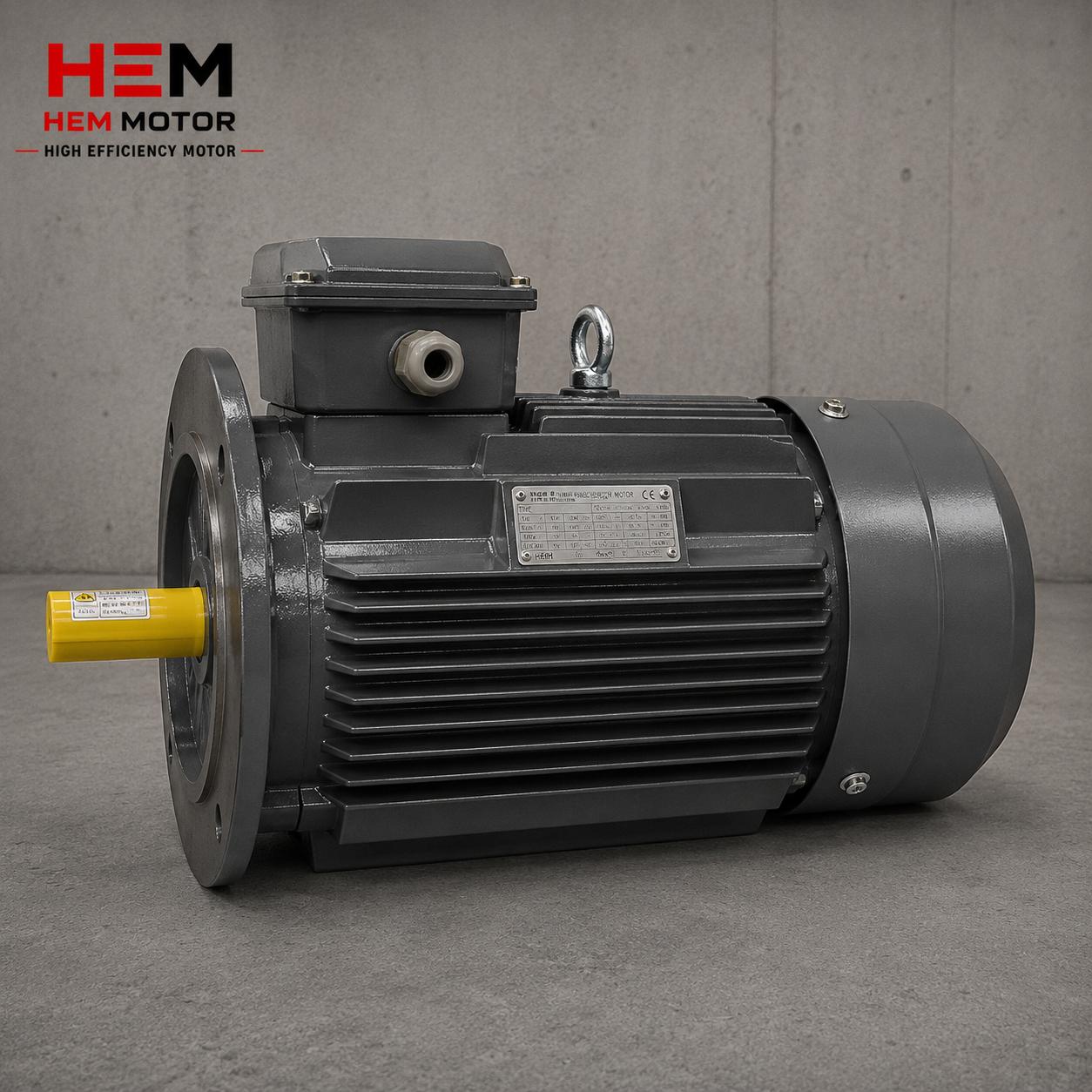

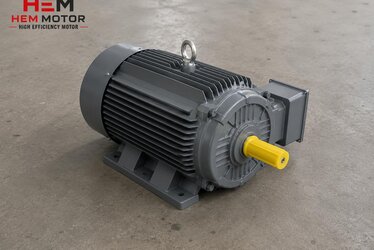
55 kW is one of the most sought-after medium-to-large power steps in Turkish industry for pump, fan, compressor and conveyor applications. Although it looks like a single power value, a 55 kW motor turns into a completely different machine depending on how many poles it is chosen with: a 2-pole (about 3000 rpm) 55 kW motor and a 4-pole (about 1500 rpm) 55 kW motor produce the same power yet come in a different frame size, different torque and are right for different applications. In this article we treat 55 kW as a single power; we explain how the speed difference between 2 and 4 poles determines the application, which frame size (250 or 280) it corresponds to, why the starting method becomes important, and how to choose the correct power-speed combination from a stock-and-supply perspective. As HEM Motor, we supply IE3 and IE4 motors from 0.25 kW to 355 kW with a cast iron frame, IP55 protection and class F insulation, so clarifying the correct speed and frame at a high-demand power like 55 kW is a core area of our expertise.
Pole and Speed Selection in a 55 kW Motor
The speed of an asynchronous motor is determined by the pole count and the grid frequency. On a 50 Hz grid a 2-pole motor produces a synchronous 3000 rpm and a 4-pole motor a synchronous 1500 rpm; the actual speed is slightly below these values due to slip (about 2950 and 1480 rpm). At a power like 55 kW, the choice between 2 and 4 poles depends directly on what the application requires.
2-Pole (3000 rpm): High-Speed Applications
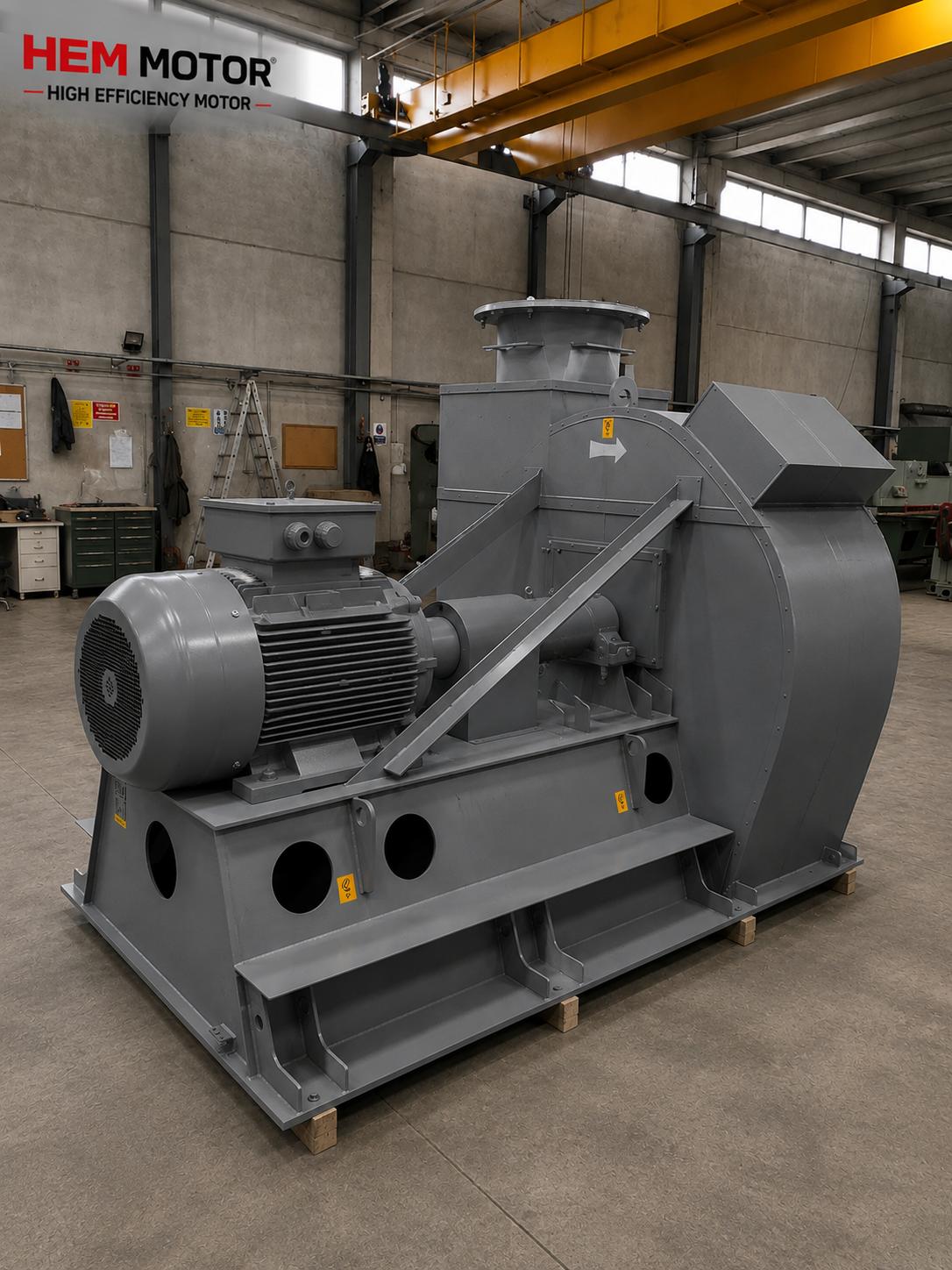
A 2-pole 55 kW motor is preferred for centrifugal pumps requiring high speed, high-pressure fans and especially screw compressors. High speed means lower torque at the same power, so 2-pole motors have a smaller, more compact structure. In applications running continuously at high speed, such as compressors, 2 poles offer both space and cost advantages.
4-Pole (1500 rpm): Torque and Versatility
A 4-pole 55 kW motor produces roughly twice the torque of a 2-pole one at the same power, which makes it the most common choice in conveyor, crusher, mixer and general industrial drives. 1500 rpm is also the most suitable speed for a gearbox input and offers balanced, quiet operation in most pump-fan applications. We covered the effect of pole count on the application in general in our article on asynchronous motor pole selection: 2, 4, 6 poles; and you can find the efficiency comparison in our article on efficiency and pole count in asynchronous motors.
Frame Size: 250 or 280?
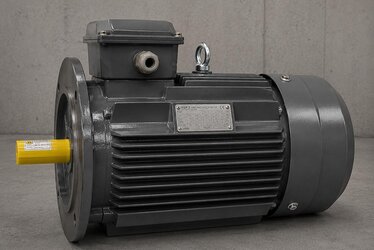
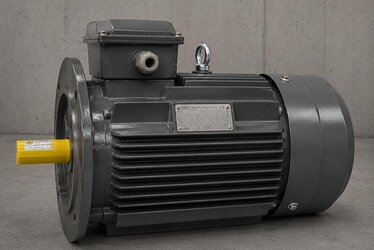
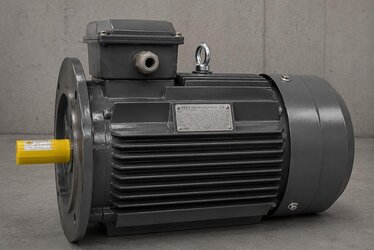
At 55 kW the frame size is closely related to the speed selection. According to the IEC standard, 55 kW generally corresponds to the 250 or 280 frame range; the 2-pole version is mostly in a more compact frame, while the 4-pole version may be in one frame size larger. The frame size determines not only the physical dimension of the motor, but also the shaft diameter, foot holes and flange connection.
Why Is Frame Size Important?
When replacing an existing motor or fitting a motor to a new machine, the frame size is decisive for an exact fit. The wrong frame size means foot holes that do not align, a shaft diameter incompatible with the coupling, or a flange that does not seat. Therefore, when ordering 55 kW you must specify not only the power but also the frame size and mounting type clearly. We detailed the matching of frame size and power in cast iron frame motors in our article on frame size and power matching in cast iron frame motors.
Mounting Type: B3, B5 and B35
55 kW motors are generally supplied in foot-mounted (B3), large-flange (B5) or combined (B35) mounting types. A motor to be connected directly to a pump by a flange is chosen as B5 or B35, while a motor to be seated on a base and driven by a coupling is chosen as B3. Choosing the wrong mounting type is one of the most common compatibility problems in the field, so the connection method of the application should be clarified from the start.
55 kW Selection by Application
The correct speed and frame of a 55 kW motor vary according to the machine to be driven. Below we offer a practical view for the four most common applications.
Pump and Fan
Centrifugal pumps and fans are variable-torque loads; their power varies with the cube of speed. 2 poles (3000 rpm) are preferred for pumps requiring high pressure, while 4 poles (1500 rpm) are preferred for more balanced and quiet applications. We covered the logic of calculating the required power for a pump in our article on motor power calculation: required kW for pump, fan and conveyor.
Compressor
Screw compressors run continuously and at high load, so 55 kW compressor motors are generally designed as 2-pole and for continuous duty (S1). Here it is critical that the motor runs continuously at full load without overheating, that is, correct insulation and cooling. We examined compressor motor selection under continuous load in our article on compressed air and screw compressor motors: power and speed selection under continuous load.
Conveyor
Conveyor belt systems are constant-torque loads and usually run with a gearbox, so a 4-pole (1500 rpm) 55 kW motor is the most common choice. High starting torque and continuous heavy duty are decisive in this application. We covered durability and torque selection in conveyor drive motors in our article on cast iron heavy-duty conveyor drive motor.
Starting: Why Is It Important at 55 kW?
55 kW is a power zone where direct-on-line starting (DOL) is restricted on most grids. When a motor of this power is started directly, it draws a starting current reaching 6-8 times the rated current, which causes both a voltage drop on the grid and a mechanical shock. Therefore, at 55 kW the starting method is an inseparable part of motor selection.
Star-Delta and Soft Starter
The two most common solutions at 55 kW are star-delta and a soft starter. Star-delta is an economical method that reduces the starting current to about one third; however, a current surge may occur at the moment of transition. A soft starter makes the start gradual and controlled, reducing both the current and the mechanical shock. We covered the comparison of starting methods in our article on starting AC asynchronous motors: star-delta or soft starter.
Caution When Running on a Generator
In generator-powered environments such as construction sites or backup supply, the starting current of a 55 kW motor directly affects generator sizing. With an undersized generator the motor struggles and the start may fail. We detailed generator-motor matching in our article on how many kVA generator carries how many kW of motor.
Stock and Supply: The Right Power-Speed
Because 55 kW is a high-demand power, it is very important that the version in the correct speed and frame can be supplied quickly from stock. A motor with the wrong speed will not fit the application, no matter how high its quality in the field; therefore the power-speed combination must be clarified at the supply stage.
55 kW as a Critical Spare
On continuously running critical lines such as pumps, fans or compressors, a 55 kW motor failure can directly cause a production stoppage. Therefore many facilities keep a spare motor in the power and speed they use most. We covered which powers should be kept in stock in our article on critical spare motor list for facilities. And we compared the speed-pole selection in the 45, 55 and 75 kW range in our article on 45, 55 and 75 kW motor selection.
Correct Sizing and Power Margin
When choosing 55 kW, the proportion at which the motor will run under load also matters. Running a motor continuously at very low load lowers efficiency and power factor; running it at very high load creates heating and life risk. We detailed the right power margin in our article on at what load should a motor run: efficiency and correct sizing. We covered lead time and shipping planning in high-power supply in our article on high-power motor supply above 90 kW; 55 kW is a step close to this logistics logic.
- First determine the application: pump, fan, compressor, conveyor or general drive?
- Choose the speed: 2 poles (3000 rpm) for high speed, 4 poles (1500 rpm) for torque and versatility.
- Clarify the frame size: 55 kW generally corresponds to the 250 or 280 frame.
- Specify the mounting type: B3 (foot), B5 (flange) or B35 (combined).
- Plan the starting method: star-delta or soft starter.
- If running on a generator, account for the starting current and generator power.
- For a critical line, keep a 55 kW spare motor in stock in the correct speed and frame.
Frequently Asked Questions
Should I choose 2 poles or 4 poles in a 55 kW motor?
It depends on the application. 2 poles (3000 rpm) are preferred in centrifugal pumps requiring high speed, high-pressure fans and especially screw compressors. In conveyors, crushers, mixers and general industrial drives running with a gearbox, 4 poles (1500 rpm) are far more common, because they produce roughly twice the torque at the same power and suit a gearbox input.
Which frame size does a 55 kW motor correspond to?
According to the IEC standard, 55 kW generally corresponds to the 250 or 280 frame range. The 2-pole version is mostly in a more compact frame, while the 4-pole version may be in one frame size larger. If you are replacing an existing motor, always verify the frame size, shaft diameter and mounting type from the nameplate for an exact fit.
Can I start a 55 kW motor direct-on-line?
On most grids direct-on-line starting (DOL) is restricted at a power like 55 kW, because the starting current rises to 6-8 times the rated current and causes a voltage drop and mechanical shock on the grid. Therefore star-delta or a soft starter is generally used on 55 kW motors. The starting method should be planned together with motor selection.
Get a Quote
If you want to clarify the correct speed, frame and mounting type for your 55 kW motor need, share the machine you will drive (pump, fan, compressor, conveyor), the starting method you plan to use and, if any, the nameplate details of the existing motor with us. Our expert team will clarify the 2 or 4 poles, frame and stock status best suited to your application together. You can call us at +90 (532) 345 49 86 or send your request via our contact page. You can review the power and speed options in our power and speed options category, and explore our product range on the products page and our home page (HEM Motor).