English
 Türkçe



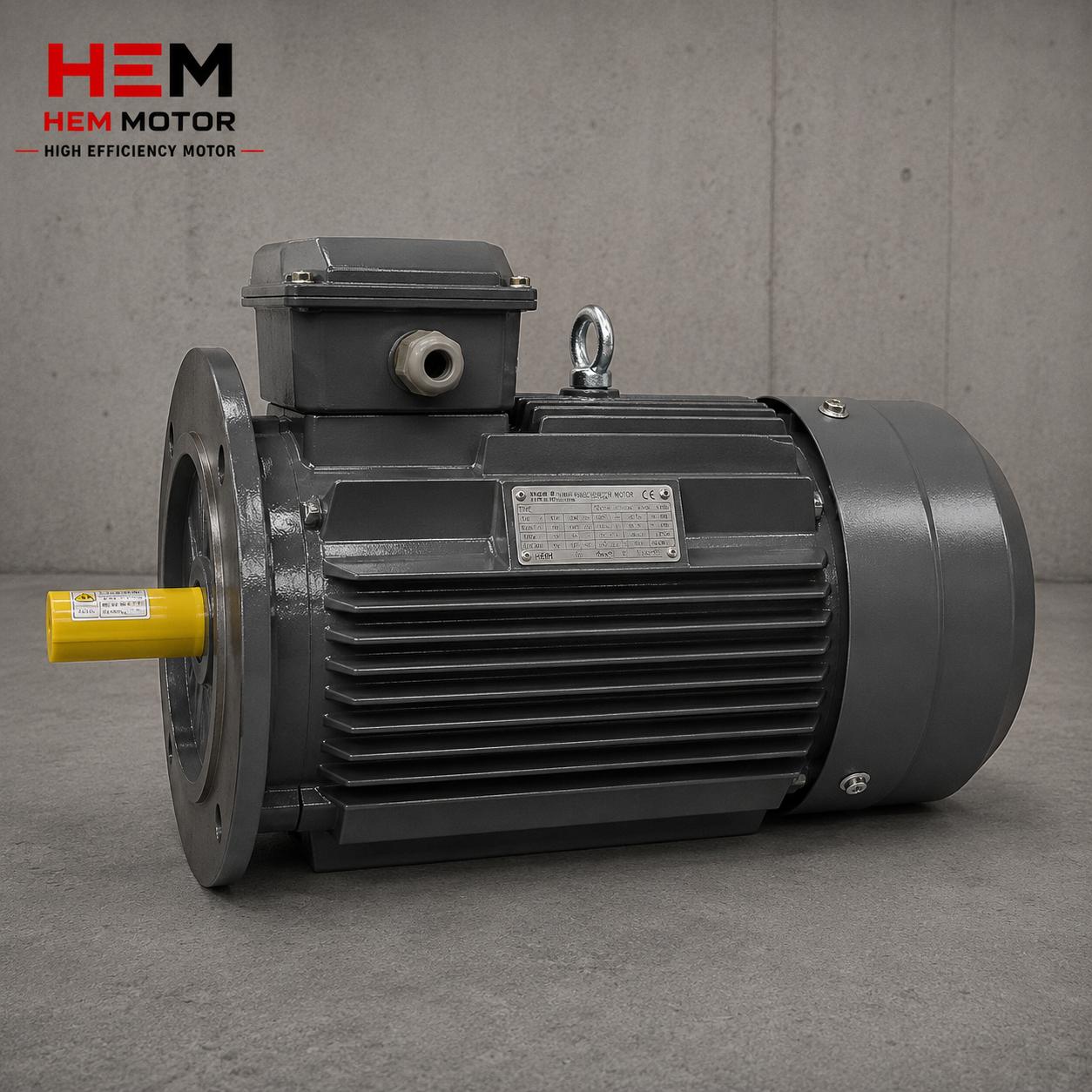

Screw compressors are among the hardest-working and most energy-hungry machines in any facility; in most plants they run continuously for the greater part of the day. For this reason, choosing the wrong power rating, the wrong speed or an inadequate duty type when buying a compressor motor both increases energy costs and leads to premature motor failure. This guide has been prepared for purchasing officers and technical teams who are renewing the motor on a piston or screw compressor or planning a new compressor project. To quickly source a stock motor suited to your existing compressor, you can reach us through our contact page.
What Sets a Compressor Motor Apart from Other Industrial Motors?
A compressor motor runs continuously and almost never idles, turning at a point close to full load. While a conveyor motor stops during the day, a screw compressor motor runs uninterrupted for hours. This makes it essential to select a motor with a continuous-duty (S1) rating that runs thermally comfortable and highly efficient. We explained the impact of duty type on selection in detail in our article on duty type (S1-S6) selection.
The second distinguishing point is speed. The majority of screw compressors turn at high speed, and the motor is most often chosen as 2-pole, that is, with a 3000 rpm rated speed. In directly coupled systems, the motor shaft drives the screw block directly, so speed, frame and shaft compatibility must match exactly. A replacement motor with the wrong speed changes the air flow rate and pressure of the compressor.
Continuous S1 Load and Cooling
The greatest enemy of a motor running under continuous load is heat. Compressor rooms are usually hot, because both the motor and the compression process generate heat. As the ambient temperature rises, the power the motor can deliver falls (derating). For this reason, ambient temperature and ventilation must be taken into account when selecting a compressor motor. We covered the power reduction calculation at high ambient temperatures in our article on hot environment and derating.
Class F or H insulation noticeably extends the life of compressor motors that run continuously hot. In addition, keeping the motor's cooling fan and fins clean, and maintaining a compressor room free of accumulated dust and oil vapour, is critical for the motor to reach its expected service life. Cast-iron framed motors offer a more stable mechanical structure than aluminium in the hot and vibration-prone compressor environment.
Screw or Piston? The Difference from the Motor's Perspective
Piston compressors create a pulsating (impulse) load profile because of the back-and-forth motion of the pistons; this means vibration and variable torque on the motor. Screw compressors, on the other hand, draw a smoother, continuous torque. For this reason, the motor on a piston compressor is usually belt-and-pulley driven, and the flywheel/pulley inertia smooths out the load; on a screw compressor, directly coupled operation is common. We compared the motor matching of the two systems in our compressor motor renewal guide.
Power and Speed Selection: The Right kW and 2 Poles
The basic rule in selecting compressor motor power is to choose the motor in line with the power specified by the compressor manufacturer. Oversizing the motor does not bring energy savings; on the contrary, the motor runs at low load, and power factor and efficiency fall. Undersizing it keeps the motor continuously overloaded and leads it to premature failure due to overheating. Our article on motor load ratio and correct sizing guides correct sizing.
In screw compressors, the rated speed is most often chosen as 3000 rpm (2-pole); in some high-power or low-pressure applications, 1500 rpm (4-pole) may be preferred. Because the correct speed directly affects the compressor's air flow rate, the pole count and rated speed of the existing motor must be preserved exactly when buying a replacement motor. We explained the pole and speed logic in our article on 2, 4, 6 pole selection.
Mechanical Compatibility in Directly Coupled Operation
In directly coupled systems, joining the motor shaft to the screw block with a coupling requires that the shaft diameter, key and flange compatibility match exactly. A wrong shaft diameter or flange type makes the coupled connection impossible. For this reason, in a replacement motor order, the frame type, shaft diameter and mounting type (usually B3 foot-mounted or B35 foot-flange) must be the same as the existing motor. You can find the details of mechanical matching in our article on shaft diameter and key dimensions.
Efficiency: IE3 and IE4 Compressor Motors
Because compressor motors run continuously, the efficiency class is directly reflected in operating costs. The annual energy cost of a compressor motor is often far above its purchase price. For this reason, in compressor applications, IE4 super premium motors and high-efficiency motors are the options that pay back the investment fastest. From a regulatory standpoint as well, IE3 is mandatory for DOL motors above 0.75 kW, and IE4 is mandatory at certain power levels. We examined the IE4 threshold in pumps, fans and compressors in our article on the IE4 threshold.
On the supply side, the compressor is the breathing pipe of a facility; its stoppage affects all production. For this reason, fast delivery from stock in the most commonly used compressor motor power ratings is of great importance. You can work with the HEM Motor team to plan your facility's compressor motor needs and check stock availability.
Power Factor and Reactive Load
Continuously running compressor motors directly affect a facility's reactive energy balance. A motor running at low load or with a low power factor draws extra reactive power from the grid, which increases the risk of a reactive penalty. High-efficiency motors generally have a better power factor; this provides gains in both active energy and reactive load. We covered the relationship between power factor and reactive penalty in our article on power factor (cos φ) and reactive penalty.
Sizing the compressor at the correct power is the first condition for keeping the power factor at a good point. Oversizing the motor means continuous low-load operation, which lowers both efficiency and power factor. For this reason, staying faithful to the power recommended by the compressor manufacturer is the most correct approach in terms of both the energy bill and the reactive balance. We can evaluate these points together when drawing up a motor inventory for your compressor room.
Winding Temperature Monitoring and Protection
Another drawback of oversizing the compressor motor is the starting current; a large motor draws higher current at start-up, and this creates problems especially in facilities fed by a generator. For this reason, selecting the compressor motor at as accurate a power as possible is the healthiest approach in terms of both energy and the electrical installation. A correctly sized motor relieves both the grid and the protection equipment, and provides a trouble-free start during commissioning.
Because compressor motors run continuously and hot, monitoring the winding temperature is a critical layer of protection in high-power motors. A PTC thermistor or PT100 sensor embedded in the winding stops the motor when the winding temperature rises to a dangerous level, preventing it from burning out. This protection prevents premature failure in compressor motors operating under continuous load. We explained temperature monitoring methods in our article on protection with PT100 and PTC thermistors.
Alongside temperature monitoring, the correct selection of thermal relay and fuse is also a fundamental requirement in protecting the compressor motor. Planning this protection equipment together with the motor prevents surprises during commissioning; we addressed the topic in our article on protection: thermal, relay and fuse selection.
Nameplate Information When Ordering a Replacement Motor
The most common mistake when renewing an existing compressor motor is reading the nameplate information incompletely or transferring it incorrectly. For a correct replacement, the power (kW), rated speed (rpm), voltage, connection (star/delta), frame type, mounting type and shaft diameter on the motor nameplate must be conveyed in full. If this information does not match exactly, the incoming motor may not fit the compressor or may produce the wrong flow rate. We explained nameplate reading and what is essential when ordering in our article on exact matching with nameplate information.
When replacing an old or different-brand compressor motor with its equivalent, the IEC connection dimensions are decisive; a motor with the same frame and flange dimensions fits exactly without any brand difference. We detailed equivalent motor selection in our article on replacing an old-brand motor exactly. By conveying these details correctly, you can quickly source the motor that fits your compressor on the first try.
Stock, Lead Time and Emergency Replacement
The compressor is the compressed-air backbone of a facility; its stoppage suddenly affects the pneumatic systems, presses and automation on the production line. For this reason, when a compressor motor fails, the most critical question is "how soon will a new motor arrive". Fast delivery from stock in the most commonly used compressor motor power ratings reduces an unplanned stoppage from hours to a short interruption. We covered the difference in lead time between delivery from stock and a production order in our article on delivery from stock or production order.
The most reliable way to reduce the need for emergency replacement is to record the power-speed-mounting information of the critical motors in the compressor room in advance and keep a spare in the most critical power rating. This way, instead of waiting for hours during a failure, the ready motor is installed within minutes. We can build this redundancy plan together according to your facility's compressor fleet.
Commissioning in a Directly Coupled System
When commissioning a new or replacement compressor motor, the direction of rotation is especially critical in screw compressors; the wrong direction of rotation can damage the compressor. For this reason, after the motor is connected, the phase sequence and direction of rotation must be checked before the first start. We explained the topic of direction of rotation and phase sequence in our article on direction of rotation and phase sequence.
During commissioning, coupling alignment, lubrication and an initial load check must also be carried out. A correct commissioning is the first step toward the compressor motor reaching its expected service life; you can find the first-start checklist in our article on the commissioning and first-start checklist.
Ambient Temperature and Cooling Details
Compressor rooms are usually among the hottest and most poorly ventilated parts of a facility, because both the motor and the compression process generate heat. This hot environment reduces the power the motor can deliver and raises the winding temperature. For this reason, ambient temperature and the ventilation of the room must always be taken into account when selecting a compressor motor. In a poorly ventilated compressor room, even a motor correctly selected according to the catalogue can overheat.
A practical measure is to set up a ventilation arrangement that provides fresh air intake into the compressor room and exhausts the hot air. In addition, keeping the motor's cooling fins and fan cover clean prevents the oil vapour and dust sticking to the fins from impeding cooling. We covered the effect of cooling methods on efficiency in our article on IC411 and IC416 cooling methods.
Maintenance, Bearings and Long Service Life
In continuously running compressor motors, the bearing is one of the most fatigued parts. Regular greasing and correct lubrication noticeably extend bearing life and prevent an unplanned stoppage. Bearing maintenance is especially important in 2-pole compressor motors that turn continuously at high speed, because high speed increases the load on the bearing. We explained the periodic maintenance schedule in our article on the maintenance and periodic inspection schedule.
Besides maintenance, vibration monitoring is also an effective way to catch early signs of failure; increasing vibration is often the first sign of bearing wear. By planning your compressor motor's maintenance interval according to operating hours and ambient conditions, you both extend its service life and minimise unexpected stoppages. In 2-pole motors turning at high speed, a balanced rotor and quality bearings reduce both vibration and noise, providing a more comfortable working environment in the compressor room. These details directly affect the total cost of ownership of a continuously running compressor motor, because the lowest lifetime cost comes from the combination of the right selection and the right maintenance.
Frequently Asked Questions
How many poles and what speed should a screw compressor motor be?
The majority of screw compressors run with a 2-pole motor rated at 3000 rpm. In some high-power or low-pressure applications, 4 poles (1500 rpm) may be preferred. When buying a replacement motor, it is essential to preserve the existing motor's pole count and rated speed exactly; otherwise the compressor's air flow rate and pressure change.
Does buying an oversized compressor motor save energy?
No. An oversized motor runs at low load; power factor and efficiency fall, and the risk of a reactive penalty increases. The correct approach is to select a motor that suits the power specified by the compressor manufacturer, is suitable for continuous operation (S1) and is in a high efficiency class. Correct sizing pays off in terms of both energy and service life.
Is a piston compressor motor the same as a screw compressor motor?
Although the rated values are similar, the load profiles differ. A piston compressor creates a pulsating (impulse) load and is usually belt-and-pulley driven; a screw compressor draws smooth torque and mostly operates directly coupled. When selecting a replacement motor, the drive type, shaft and flange compatibility must be checked exactly.
Get a Quote
Contact us to supply a motor in the correct power, speed and efficiency class for your piston or screw compressor. Share your existing motor nameplate or the compressor brand-model information; we will quickly quote an exactly compatible replacement motor along with its stock status. Phone: +90 (532) 345 49 86 or you can get in touch with us through our contact page.