English
 Türkçe

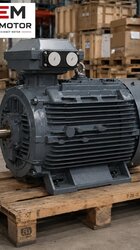
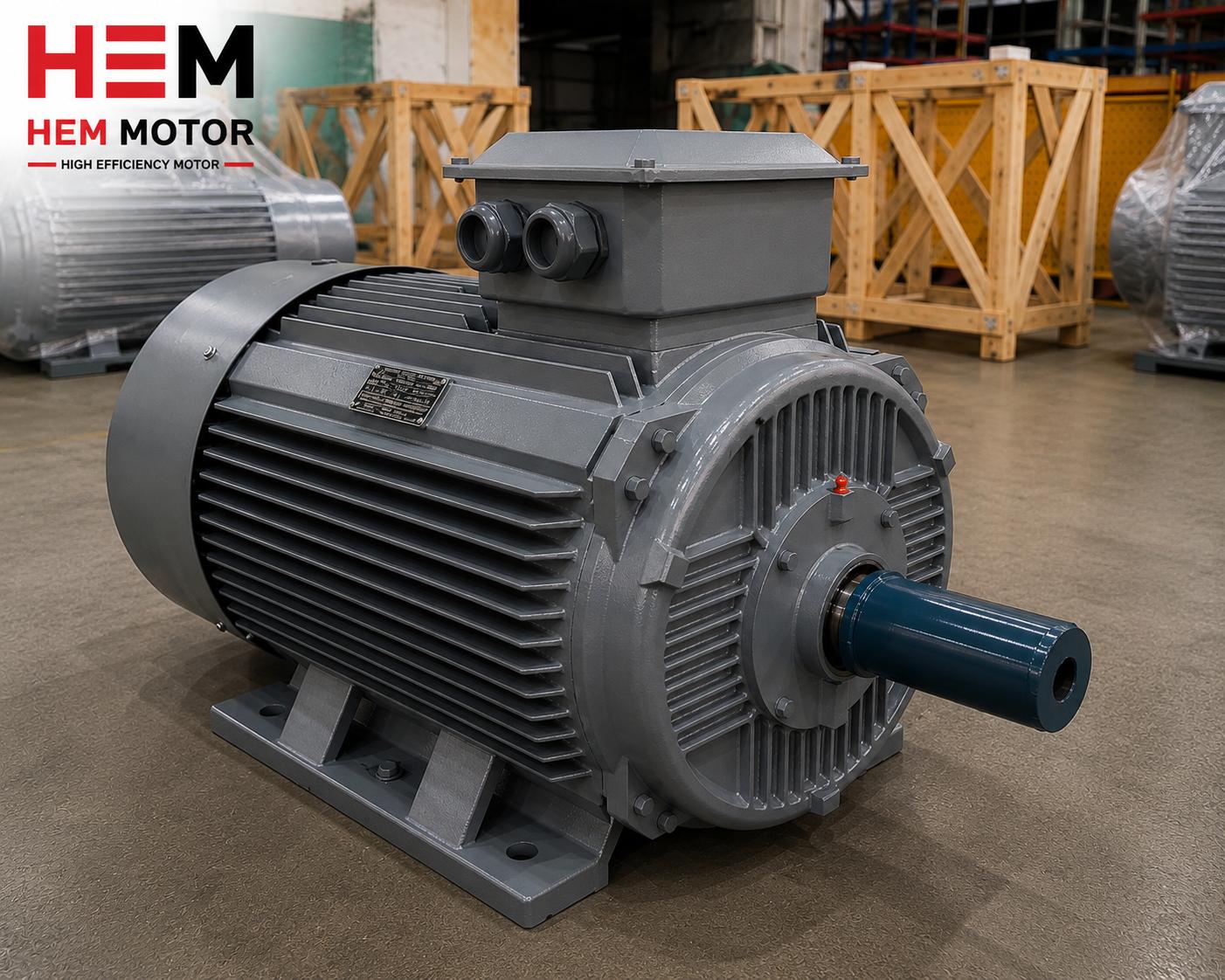

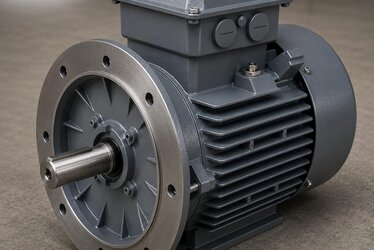
90 kW and 110 kW are two common steps in the large-power class in industry. These powers appear in heavy applications such as large pumps, industrial fans and aspirators, compressors, conveyor drives, crushing-and-screening plants and process machines. In this power range the motor is no longer a small component but a critical asset of the plant; its failure means long downtime and high cost. Moreover, at these powers the efficiency class is legally mandated at IE3 (Premium) and above; the sale of low-efficiency motors is not permitted. This article covers the pole-speed options of 90 kW and 110 kW IE3 motors, their typical frame sizes (around 280/315), large-power starting and cooling, the meaning of the IE3 mandate, and the stock/lead-time supply process. Our aim is to help you make a correct, fast and trouble-free purchase at this level.
90 kW and 110 kW IE3: Pole and Speed Options
At these powers too, speed is set by the pole count. The most common options are 2, 4 and 6 poles; 8 poles are also available depending on the application. The speed choice directly determines the torque requirement and the speed of the driven machine:
- 2-pole (~3000 rpm): High-speed large pump, blower and compressor drives.
- 4-pole (~1500 rpm): The most common large-power choice; fans, pumps, conveyors and general process.
- 6-pole (~1000 rpm): Crushers, mills and heavy drives requiring high torque.
At the same power, as pole count rises (speed falls) torque increases and the frame usually grows. So a 90 kW 6-pole is a larger and heavier motor than a 90 kW 2-pole. You can find the effect of pole choice on the application in our 2, 4, 6 pole - which for which job article, and the speed-slip relationship in our slip and actual speed article.
| Power | Poles | Synchronous speed | Typical frame (IEC) |
|---|---|---|---|
| 90 kW | 2 | 3000 rpm | around 280M |
| 90 kW | 4 | 1500 rpm | 280S/280M |
| 90 kW | 6 | 1000 rpm | around 315 |
| 110 kW | 2 | 3000 rpm | around 280/315 |
| 110 kW | 4 | 1500 rpm | around 315S |
| 110 kW | 6 | 1000 rpm | around 315M |
The frame values in the table show the typical trend; there may be small differences by manufacturer series. In replacement (motor change) purchases, it is essential to verify frame, shaft diameter and mounting dimensions exactly. Our shaft diameter and frame table article helps with this compatibility check.
Frame Size: Around 280 and 315
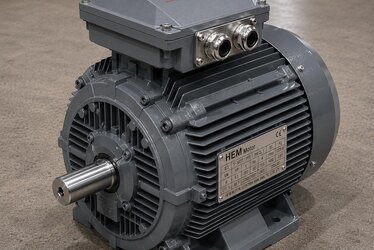
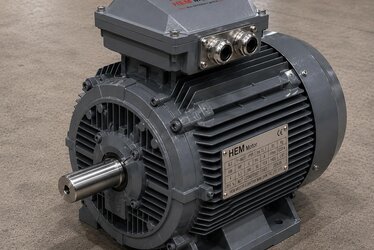
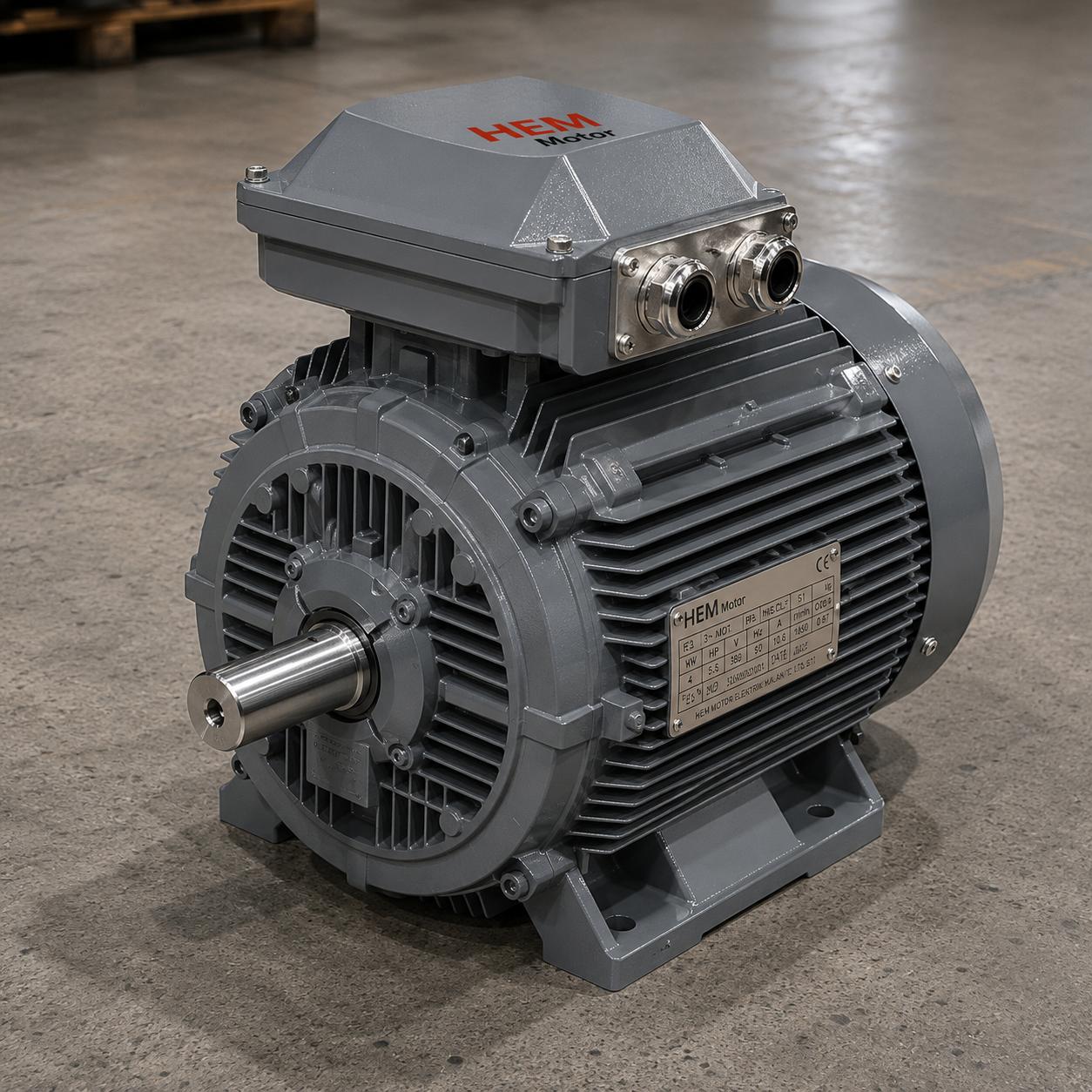
90 kW and 110 kW motors usually sit in 280 and 315 IEC frames. That means considerable weight and volume; the motors are mostly produced with cast-iron bodies, lifting eyebolts and robust bearings. Frame size determines shaft diameter, foot/flange dimensions, terminal box position and total weight. For this reason, transport, crane lifting and mounting planning carry particular importance at these powers.
- Frame 280: Most poles of 90 kW and part of 110 kW; shaft diameter around 75 mm.
- Frame 315: Most of 110 kW and 90 kW 6-pole; shaft diameter around 80 mm.
- The cast-iron body provides rigidity and impact resistance at large power.
We covered the weight and handling of large motors in our lifting eyebolt, weight and safe handling article, and the advantage of the cast-iron body in our cast-iron motor frame sizes article.
IE3 Mandatory Efficiency Class
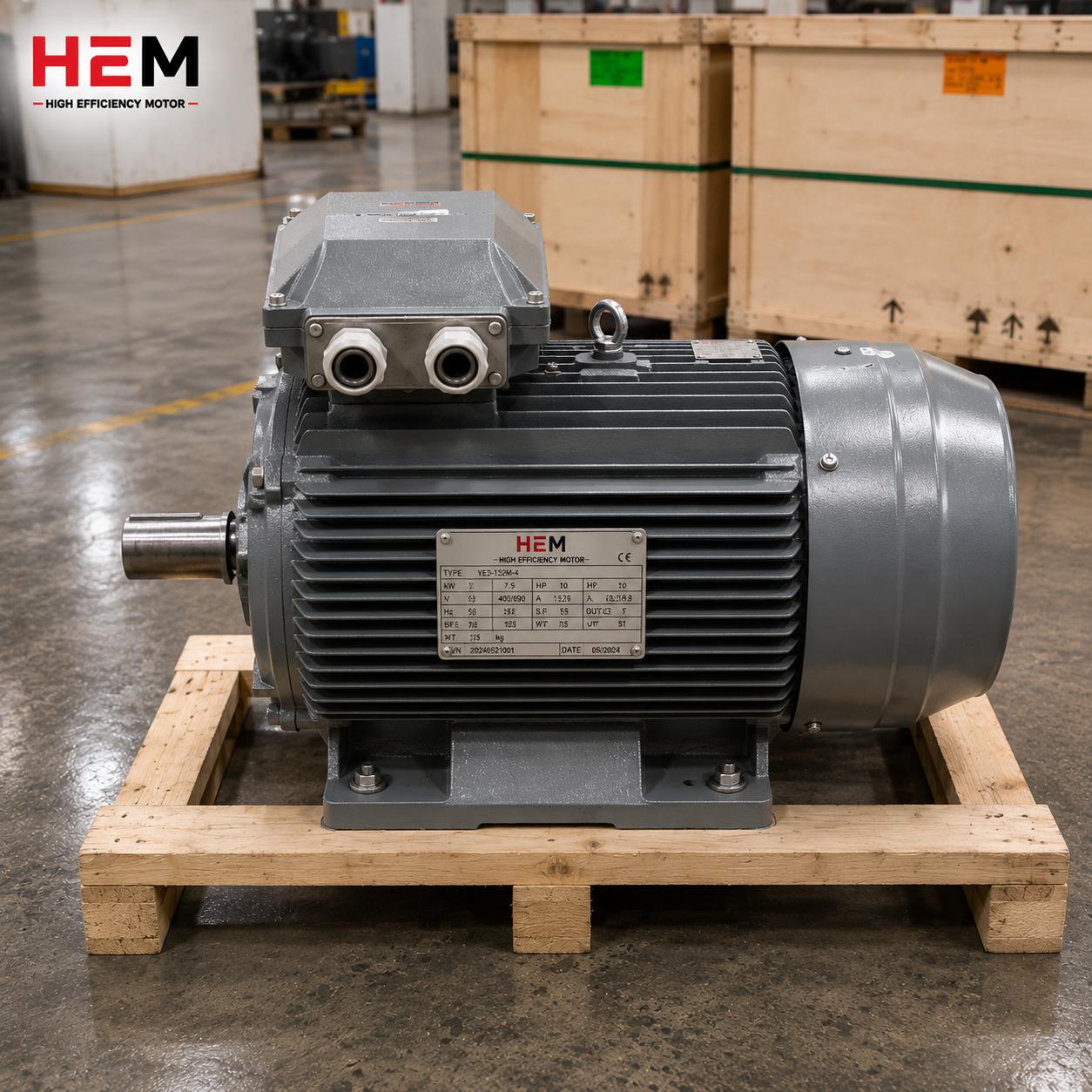
At 90 kW and 110 kW, the IE3 (Premium efficiency) class is legally mandatory. The reason is simple: at these powers motors usually run for long hours, even continuously, and their energy consumption is high. Even a small improvement in efficiency class turns into a large saving on the annual energy bill. An IE3 motor does the same job with fewer losses; this both lowers operating cost and ensures legal compliance.
You can find at which powers the IE3 mandate applies in our IE3 efficiency class mandate article, and how to read efficiency and ratings from the nameplate in our reading the IE3 motor nameplate article. At large power, efficiency is at the center of the purchasing decision because it directly affects the payback period.
| Topic | 90 kW | 110 kW |
|---|---|---|
| Efficiency class | IE3 mandatory | IE3 mandatory |
| Typical rated current (400V, approx.) | ~160 A | ~195 A |
| Typical starting | Star-delta / soft starter | Soft starter / VFD |
| Cooling | IC411 (own fan) | IC411, forced if needed |
Large-Power Starting and Cooling
At these powers, direct-on-line (DOL) starting is unsuitable on most grids, because the starting current is very high and causes a voltage dip on the grid. So for 90-110 kW motors, star-delta, a soft starter or a variable frequency drive (VFD) is preferred for starting. The starting method is chosen according to the load's moment of inertia, the start frequency and the grid capacity.
- Star-delta: Classic, economical; reduces starting current to about a third but also lowers torque.
- Soft starter: Smooth, controlled start; reduces mechanical shock and current surge.
- VFD: Full control + speed adjustment during operation; also provides energy savings.
For a comparison of starting methods, our star-delta or soft starter article, and for soft-starter sizing, our soft-starter compatibility article provide guidance. On the cooling side, because large motors produce high loss heat, adequate ventilation is essential; in VFD applications running continuously at low speed, a forced (external) cooling fan may be needed. You can find cable, fuse and contactor selection by rated current in our rated current and protection devices article.
Stock and Lead Time: The Supply Process
Supply of large-power motors is managed differently from small powers. The most-requested combinations (especially 90 and 110 kW 4-pole) are usually kept in stock; this substantially shortens downtime in emergency failure replacements. For more specialized pole, mounting or optioned motors, lead time comes into play. Correct supply planning also includes keeping a spare motor in critical plants.
- Most stocked: 90 kW and 110 kW 4-pole, IE3, cast-iron body.
- A spare motor (critical stock) in a critical plant reduces downtime risk.
- In replacement purchases, power, pole, frame and mounting must be verified from the existing nameplate.
You can find the most-requested power-speed combinations in our IE3 stock guide article, and the neighboring large powers (45/55 kW) in our 45 and 55 kW IE3 motor article; these levels allow comparison when the requirement is borderline. When the calculated power lands between two standard steps, it is usually safer to move up to the next step than to load a motor at its limit; a motor running continuously near 100% of its rating leaves no margin for voltage dips, ambient heat or load peaks, whereas a slightly larger motor runs cooler and lasts longer.
Protection and Monitoring at Large Power
On large and expensive motors such as 90-110 kW, protection is not an optional luxury but a mandatory investment. A failure risks long downtime of both the motor itself and the process it is connected to. So large-power motors are given multi-layered protection:
- Winding temperature protection (PTC/PT100): Monitors winding temperature and stops the motor on overheating.
- Motor protection circuit breaker (MPCB) / thermal relay: Protects against overcurrent and phase loss.
- Phase loss/unbalance protection: Prevents winding burnout during single-phasing.
- Bearing temperature monitoring: Catches bearing failure early on large motors.
You can find the correct installation of winding temperature protection in our PTC/PT100 wiring article, and motor protection circuit breaker setting in our MPCB selection and setting article. We covered the burnout risk and protection of phase loss in detail in our phase loss article. At large power, the absence of these protections can turn a small saving into a very large loss.
Mounting, Foundation and Vibration
Motors at these powers are heavy and produce high torque; they therefore need a solid foundation and correct anchoring. A weak or loose mounting magnifies vibration, disturbs alignment and fatigues the bearings of both the motor and the driven machine. The foundation must be designed to carry the motor's weight and dynamic forces; anchor bolts must be tightened to the correct torque. Coupling alignment in the motor-machine connection is also critical at large power; even a small misalignment causes high vibration and premature bearing damage.
You can find bolt, nut and foundation mounting in our foundation mounting and anchor torque article, and coupling selection and shaft alignment in our coupling selection and shaft alignment article. For vibration acceptance limits, our ISO 10816/20816 vibration and balance article can be taken as a reference.
Typical Applications and Total Cost
90 kW and 110 kW motors sit at the heavy-working heart of industry. Typical fields of application are:
- Large centrifugal and submersible pumps; water treatment and pumping stations.
- Industrial fans, aspirators and flue-gas exhaust systems.
- Screw and piston compressors; compressed-air plants.
- Crusher, mill and crushing-screening plant main drives.
- Long belt conveyors and heavy process machines.
- Mill and fan drives in cement, mining and aggregate plants.
- Main drive motors in the plastics, paper and textile industries.
Even though the power looks the same in every application, the speed, mounting, starting and protection needs change; the key to a correct purchase is clarifying these parameters per application. At these powers the purchasing decision must be made not on the initial price alone but on total cost of ownership. On a continuously running 90-110 kW motor, energy consumption reaches an expense far above the purchase price over its life; so IE3 (or even higher where suitable) efficiency, correct sizing and reliable supply must be assessed together. We addressed the large-power economics of whether to rewind or buy new in our rewind or buy new article. It is also useful to assess savings under continuous load in pumps, fans and compressors together with our fan motor selection article.
Frequently Asked Questions
Which frame is used for 90 kW and 110 kW motors?
Usually 280 and 315 IEC frames; 90 kW is mostly around 280 and 110 kW mostly around 315. As pole count rises the frame grows. In a replacement purchase, the existing motor's frame, shaft diameter and mounting dimensions must be verified exactly.
Is IE3 mandatory at these powers?
Yes, at 90 kW and 110 kW the IE3 (Premium efficiency) class is legally mandatory. Because of the long running hours at these powers, efficiency makes a large difference in energy cost, so IE3 is required both legally and economically.
How is a 90-110 kW motor started?
Direct-on-line starting is usually unsuitable; star-delta, a soft starter or a variable frequency drive (VFD) is preferred. The method is chosen according to the load inertia, start frequency and grid capacity. A VFD also provides speed adjustment during operation and energy savings.
You can source a 90 kW or 110 kW IE3 motor according to your pole/speed, frame, mounting and starting needs from the manufacturer with stock availability and fast delivery. Share your application's power, speed and mounting details or your existing motor's nameplate; we will determine the most suitable large-power motor together and prepare a tailored quotation along with the stock/lead-time status.