English
 Türkçe

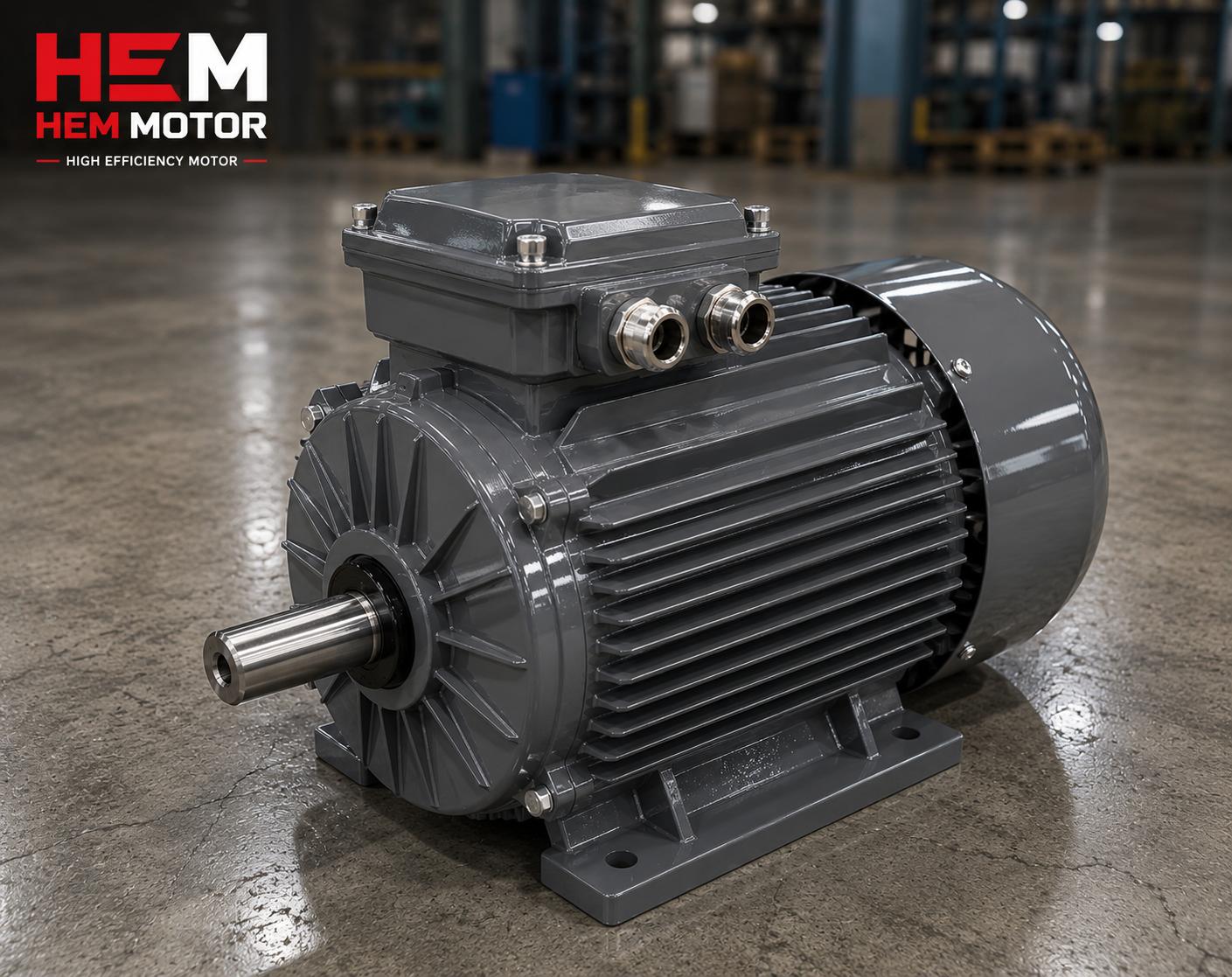

A vertical hollow shaft (VHS) motor is a special class of machine used to drive deep-well turbine pumps and vertical line-shaft assemblies, and it follows design rules completely different from those of an ordinary horizontal foot-mounted motor. In these motors the main shaft is hollow; the pump's long head shaft passes through this bore and the pump bowl assembly is suspended by an adjusting nut at the top of the motor. This means the motor does not merely rotate the load: it carries the entire rotating weight of the pump plus the hydraulic force that pushes the water column upward, namely the axial thrust load. For this reason, the bearing system, the non-reverse ratchet and the mounting tolerances are at least as decisive as power and speed when selecting a VHS motor. A wrongly chosen thrust bearing is the source of the most expensive downtime in a well, because pulling the motor, lifting the pump together with hundreds of meters of column out of the borehole and lowering it back is an operation that takes days. This guide covers axial thrust load, upper angular-contact / spherical thrust bearing selection, the non-reverse ratchet, pump-shaft suspension and outdoor (IP) conditions in deep-well pump motors, walking you step by step toward getting the right motor to site the first time.
What Is a VHS Motor and Why Is It Different from a Standard Motor?
A VHS motor is a vertically mounted, top-flanged (usually P-base) induction motor with a hollow main shaft. Because the pump head shaft runs through the motor, the machine is fitted with a thrust bearing that absorbs the weight of the rotating assembly and the downward hydraulic thrust generated by the pumped water column. In a standard horizontal motor the load is largely radial and classic ball bearings suffice; in a VHS motor the dominant load is axial, so a high-capacity angular-contact or tapered/spherical roller thrust bearing is placed at the top. This difference directly determines motor life and vibration-free pump operation. VHS motors are also offered in two families, solid shaft and hollow shaft; deep-well turbine pumps almost always use the hollow shaft, because the head shaft must be adjustable for axial clearance via the top adjusting nut.
- Hollow shaft: the pump head shaft passes through the motor center; impeller clearances are set by the top adjusting nut.
- Upper thrust bearing: downward hydraulic thrust and rotating weight are carried here; the lower end holds only a radial guide bearing.
- Non-reverse ratchet: prevents the water column from reverse-rotating the motor when the pump stops.
- Top flange (P-base): the motor sits directly on the pump head; no separate coupling is required and the head shaft connects to the motor shaft with a threaded nut.
- WP-I / TEFC options: weather-protected or totally enclosed fan-cooled frames are used outdoors.
Axial Thrust Load: The Real Force the Motor Carries
In a deep-well turbine pump each stage adds pressure to the water column. As total head rises, the downward axial force on the impellers rises with it. This force is proportional to the number of stages, impeller diameter and head. In practice the thrust load is estimated from the pump manufacturer's "thrust factor" (in kg or N per meter of head) plus the weight of the shaft assembly itself. For example, in a high-head, multi-stage well pump the thrust load can reach the order of tons. The motor's thrust bearing must carry this combined load for an acceptable L10 life (in pumping, a typical target is one year of continuous duty, roughly 8,760 hours or more).
A critical point here is the momentary up-thrust phenomenon. When the motor first starts, before the pump has lifted the water column, the impeller can briefly create an upward push instead of the steady downward thrust. This momentary up-thrust stresses a bearing group otherwise designed for the downward direction; that is why most VHS motors use a bearing arrangement able to restrain both directions. In a correct selection, the maximum down-thrust and the momentary up-thrust values quoted by the pump maker are considered separately.

VHS Motor Thrust Bearing and Load Table (Typical Ranges)
| Motor Frame / Power Class | Typical Upper Bearing | Load Direction | Typical Axial Thrust Capacity | Non-Reverse Ratchet |
|---|---|---|---|---|
| Small power (1.5-7.5 kW) | Angular-contact ball (single/duplex) | Down-thrust | Low-medium thrust | Optional |
| Medium power (11-37 kW) | Double-row angular contact | Down + momentary up | Medium thrust | Recommended |
| High power (45-160 kW) | Tapered / spherical roller thrust | High down-thrust | High thrust | Standard |
| Very high power (200 kW+) | Bi-directional thrust bearing set (oil bath) | High + momentary up-thrust | Very high thrust | Mandatory (heavy duty) |
Note: the values above show the design approach; for an actual selection the pump maker's thrust curve and the motor maker's bearing catalog are evaluated together. A wrong bearing choice is the most common cause of early failure in the well, and the downtime cost can far exceed the price of the motor itself.
Selecting the Upper Angular-Contact / Spherical Thrust Bearing
The heart of a VHS motor is the upper bearing group. Single-direction angular-contact ball bearings handle the downward thrust; for heavier loads, tapered or spherical roller thrust bearings are used. To carry bi-directional load, angular-contact bearings are paired back-to-back. Four points are critical:
- Load direction: thrust is downward in normal operation, but brief up-thrust can occur at start and stop. The bearing group must restrain both directions.
- L10 life: in continuously running well pumps the bearing-life target is high; a low-life choice means frequent failures and high downtime cost.
- Lubrication: oil-lubricated thrust bearings are preferred at high power, grease at low power. Oil level and type must be checked before commissioning.
- Cooling: the upper bearing heats up under high thrust; large motors use oil circulation or extra cooling fins for the bearing.
To go deeper on bearings and lubrication, see our bearing greasing and NLGI grade guide and our asynchronous motor bearing type and life article. On machining and seating tolerances of the bearing housing, our end-shield machining article is complementary.
Why Is a Non-Reverse Ratchet Essential?
When the pump stops, the water column in the column pipe flows back and tries to spin the pump impellers in reverse. If the motor is restarted during this event, a forward command meets a reverse-spinning shaft; this can snap the shaft and severely damage the coupling and impellers. The high reverse speed can even loosen the shaft nut and drop the pump to the bottom of the well. The non-reverse ratchet is a pawl/ball mechanism at the top of the motor that allows rotation in one direction only. When the column drains back, the shaft cannot reverse, protecting both motor and pump.
- A non-reverse ratchet is mandatory in high-head (long-column) wells.
- The mechanism should be considered together with soft starting via star-delta or a soft starter.
- During maintenance the wear of the ratchet pawl is checked periodically; a worn pawl cannot do its job.
- Used together with a check valve, the column backflow is limited and the load on the mechanism is reduced.
Pump-Shaft Suspension and the Top Adjusting Nut
At the top of a VHS motor, on the crown of the hollow shaft, sits an adjusting nut. After the pump head shaft is fed through the motor, this nut pulls it upward, lifting the impellers slightly off the bowl bodies and setting the correct axial (lateral) clearance. If this adjustment is wrong:
- Too low: impellers rub the bowls, flow drops, overheating and wear follow, motor current rises.
- Too high: upper clearance grows, efficiency drops, thrust distribution is upset, the pump becomes more prone to cavitation.
In a correct installation the manufacturer's "lift" value (usually a few mm) is converted into nut turns and set. Typically each full turn of the nut gives a defined millimeter of lift, so the thread pitch must be known and the lift expressed in turns and notches. Because this also changes the load reaching the thrust bearing, the procedure must be followed exactly during commissioning. After adjustment the nut is fixed with a locking pin or set screw. For moisture/bearing checks before commissioning and storage, our storage and long-term standstill guide is helpful.
IP Protection and Outdoor Conditions
A deep-well pump is usually installed in open terrain, on a well head over the borehole. The motor sits on top, in the open air. Therefore the IP rating, the top-cover design and resistance to weather matter. In the open, rain, dust, sun and temperature swings act directly on the motor; condensation leads to moisture buildup in the winding.
| Environment | Recommended Protection | Extra Measure |
|---|---|---|
| Open well head (rain/dust) | IP55 and above | Top air-inlet cover, drain hole |
| Agricultural irrigation / greenhouse | IP55 | Anti-condensation heater |
| Saline / corrosive region | IP55 + special paint | Corrosion-resistant coating, stainless washers |
| Continuous irrigation season | IP55, F/H insulation | Thermal protection (PTC/PT100) |
For continuous irrigation, our irrigation and agricultural pump motors article and our deep-well pump motor selection guide are complementary resources. If submersible solutions are being weighed instead of line-shaft for sewage and drainage, see our submersible drainage and sewage pump motor article.
Speed, Power and Cooling: Matching the Drive Characteristic
Deep-well turbine pumps usually run at 2-pole (about 2950 rpm) or 4-pole (about 1450 rpm) speed. For applications needing high head, the higher-speed 2-pole motor is preferred; however, higher speed increases thrust load and wear. For power selection, the shaft power at the pump's worst operating point (maximum flow) is taken as the basis and a suitable safety margin is left; otherwise the motor is continuously overloaded. For cooling, VHS motors usually have a fan arrangement that draws air from the top and cools the frame; outdoors, the top cover must be protected against dust and leaf ingress.
- High head + low flow: 2-pole, higher thrust-capacity bearing.
- Medium head + high flow: 4-pole, balanced thrust, lower wear.
- Continuous irrigation: F or H insulation class, with a wide temperature margin.
Correct VHS Motor Selection: A Checklist
- Obtain the pump maker's thrust value (kg/N), momentary up-thrust and number of stages.
- Compute total axial load = down-thrust + shaft assembly weight.
- Select the upper bearing group to carry this load at the target L10 life.
- Decide the non-reverse ratchet as standard/mandatory based on column height.
- Match the P-base flange dimension and hollow-shaft bore to the pump head shaft.
- Choose speed (usually 2/4 pole) per the pump characteristic.
- Set IP rating, insulation class and thermal protection to suit the site.
- Note the adjusting-nut pitch and lift value for commissioning.
Frequently Asked Questions
Why is the thrust bearing so critical in a VHS motor?
Because in a vertical pump the motor carries the entire upward hydraulic force on the water and the weight of the rotating shaft assembly. Since this load is predominantly axial (downward), a wrongly sized thrust bearing is the most common cause of early failure in the well. Choosing the correct-capacity angular-contact or tapered roller thrust bearing directly determines motor life. Moreover, since pulling the motor out of the well takes days and is costly, getting the bearing right from the start is the most economical decision.
Does every VHS motor need a non-reverse ratchet?
In long-column, high-head wells it absolutely must have one. When the pump stops the returning water column spins the shaft in reverse; if the motor restarts during this, the shaft can snap or the nut can loosen and drop the pump. The non-reverse ratchet locks the shaft in one direction and removes this risk. In low-column, small-power applications it may be optional, but it is recommended to stay on the safe side.
How is the hollow-shaft bore selected?
The hollow shaft must have a bore large enough for the pump head shaft to pass freely and for the adjusting nut to seat on top. This bore is matched to the pump maker's shaft assembly. An incompatible bore makes assembly impossible, so the pump head-shaft dimension must always be given to the motor maker before ordering. The top flange type (P-base size) must also be confirmed to seat on the pump head.
Get the right VHS motor to site in one go. Let us evaluate the thrust load, bearing group, non-reverse ratchet and flange dimension of your vertical hollow-shaft deep-well pump motor together with your pump data, and offer the best fit with manufacturer stock and fast delivery. Contact HEM Motor to request a quote and confirm technical suitability for your project.