English
 Türkçe

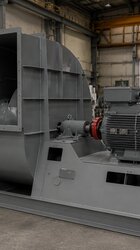

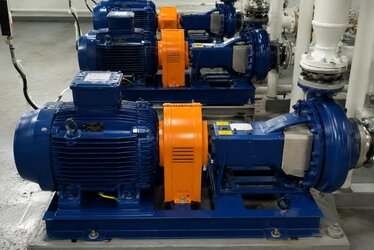
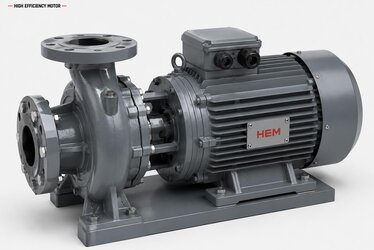
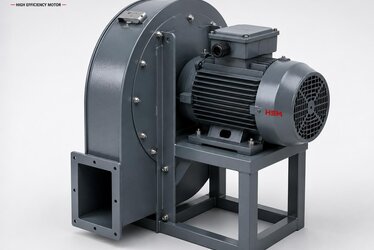
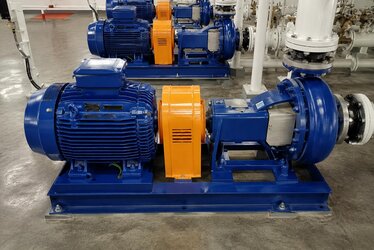
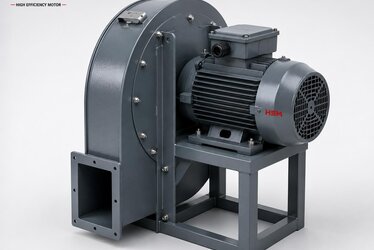
When buying a pump or fan motor, the catalogue figures most people check are power and speed; yet in a large-impeller fan the real cause of a burnt winding or a protection relay that keeps tripping is very often the moment of inertia. Inertia is the resistance a rotating mass shows to a change in speed, and the sum of all rotating parts – fan blades, pump impeller, sheave, coupling – directly sets the motor’s run-up time, how long the starting current stays high, and therefore how hot the windings get. In centrifugal fans and large radial blowers in particular, the load inertia can reach tens of times the motor’s own rotor inertia. In this article we explain the concept of GD² (WR²), the run-up time calculation, inertia-driven heating, the correct choice of starting method, and the limit on starts per hour with concrete tables – so that when you select a fan or pump motor from HEM Motor stock you build a drive that does not burn out and lasts.
What Is the Moment of Inertia (GD² / WR² / J)?
The moment of inertia expresses how a body’s mass is distributed about its axis of rotation. In industry three related notations are used:
- J (kg·m²): the SI moment of inertia, the standard notation in modern motor catalogues.
- GD² (kg·m²): "gravity × diameter squared", common in older European catalogues. The relation GD² = 4 × J holds.
- WR² (lb·ft²): the Anglo-Saxon notation, weight × radius squared, seen in pump-fan export documents.
What matters when selecting a fan motor is the total inertia seen at the motor shaft: the rotor’s own inertia plus the load inertia referred to the shaft. In belt-and-sheave drives the load inertia is reflected to the motor shaft by the square of the speed ratio. A slow-turning large fan impeller therefore appears smaller once referred to the fast motor shaft, but its absolute value is still large.
Why Does Run-Up Take Longer in a Large-Impeller Fan?
Run-up time follows from the relation between the accelerating torque the motor produces and the total inertia. In simplified form:
trun-up ≈ (Jtotal × ωrated) / Maccelerating
As Jtotal grows and the accelerating torque (motor torque minus load counter-torque) shrinks, the time gets longer. In centrifugal fans the load torque rises with the square of speed, so the counter-torque is low early in the run-up, but because inertia is large the motor draws 5–7 times rated current for a long time. The table below compares typical fan/pump starting scenarios.
| Application | Load/rotor inertia ratio | Typical run-up time | Starting current (x In) | Risk |
|---|---|---|---|---|
| Small pump impeller | 0.5 - 2 | 0.5 - 2 s | 5 - 6 | Low |
| Medium centrifugal fan | 5 - 15 | 3 - 8 s | 6 - 7 | Medium |
| Large radial blower | 20 - 40 | 10 - 25 s | 6 - 7 | High (winding heating) |
| Very large stack/forced-draft fan | 40 - 80+ | 25 - 60 s | 6 - 8 | Very high (tE exceedance) |
As run-up lengthens, the heat dissipated in the winding grows roughly as current squared × time. So for run-ups beyond 25 seconds a standard motor’s thermal limit (locked-rotor withstand time, tE) is stressed and the winding insulation is damaged.
Inertia-Driven Heating and the tE Problem
A motor is designed to run continuously at rated power, while the start is a transient overload regime. Under high inertia the motor draws a near-locked-rotor current for a long time, so the rotor cage and winding overhangs heat up quickly in particular. The manufacturer states the maximum permissible external inertia (Jext-max) and the permitted starts per hour in the catalogue. Exceed it and the thermal class (F/H) and locked-rotor withstand time fall short. We detailed how inertia, starting current and thermal issues link together in our article on starting time and inertia moment matching.
What Happens When the External Inertia Limit Is Exceeded?
- Run-up lengthens and thermal stress cracks the rotor bars.
- The thermal relay or motor protection breaker trips before the start finishes; the plant cannot come online.
- With frequent starts the accumulated heat cannot cool before the next start; cumulative overheating burns the winding.
- Bearings and coupling wear early from the repeated shock of high accelerating torque.
Which Starting Method? DOL, Star-Delta, Soft Starter, VFD
High inertia directly affects the choice of starting method. The goal is to limit the starting current while preserving accelerating torque and keeping the time acceptable.
| Method | Starting current | Starting torque | Suitability for high inertia |
|---|---|---|---|
| DOL (Direct) | 6-7 In | Full torque | Fine for low inertia, strains grid at high inertia |
| Star-delta | ~2-2.5 In | ~33% torque | Time stretches badly at high inertia, may stall |
| Soft starter | Adjustable (3-4) | Ramp-controlled | Very suitable for medium-high inertia |
| VFD (Frequency drive) | ~1-1.5 In | Full/controlled | Safe even at the hardest inertia, time controlled |
In a large-impeller centrifugal fan, star-delta starting drops the torque in the star position so inertia cannot be overcome; the motor stalls at half speed and can produce a large current surge during the transition to delta. For these applications the star-delta versus soft starter comparison and soft starter compatibility must be weighed carefully. For the toughest, very large stack fans a VFD both softens the start and provides flow control; our VFD with asynchronous motor article is a guide here. For strategies to reduce starting current (LRA), see reducing starting current LRA.
Starts-per-Hour Limit and Frequent Stop-Start
Under high inertia every start leaves significant heat in the winding. Manufacturers therefore state the permitted starts per hour (Z). As inertia grows this number falls. The table below shows a typical starts-per-hour limit by inertia ratio.
| Load/rotor inertia ratio | Typical run-up time | Recommended max starts/hour |
|---|---|---|
| ≤ 2 | < 2 s | 30 - 60 |
| 2 - 10 | 2 - 6 s | 10 - 20 |
| 10 - 30 | 6 - 20 s | 3 - 8 |
| > 30 | > 20 s | 1 - 3 (VFD recommended) |
On fan/pump lines that need frequent stop-start, continuous speed control with a VFD both removes the starts-per-hour limit and saves energy. For the thermal effect of frequent starting, see our article on starts per hour limit and heating.
Correct Fan/Pump Motor Selection Steps
- Obtain the GD² or J value of the fan/pump impeller from the maker; include sheave and coupling.
- In belt-sheave drives refer the load inertia to the motor shaft by the square of the speed ratio.
- Compare against the motor catalogue Jext-max and the starting torque curve (Ma, Mk).
- Calculate the run-up time; ensure it stays below the tE / thermal limit.
- Choose the starting method by inertia and starts-per-hour (DOL / soft / VFD).
How Do You Find the GD² / J Value in Practice?
The hardest part of the inertia calculation is gathering the right input data. The fan or pump maker states the impeller’s GD² or J in the technical document; if not, it is estimated from the impeller material, diameter and mass. In radial centrifugal fans most of the mass is concentrated at the outer diameter, so the inertia is much higher than a solid disc of the same weight. You must include not only the impeller but the sheave on the shaft, the coupling, any flywheel and the transmission elements. In belt-sheave drive, when referring the load-side inertia to the motor shaft you multiply by the square of the speed ratio; this referral shrinks the inertia if the motor speed is higher than the load speed, and enlarges it otherwise.
- Fan impeller: the largest inertia source; outer-diameter weight is decisive.
- Sheave and coupling: often neglected, but large sheaves add notable inertia.
- Shaft and rotor: the motor’s own rotor inertia is taken from the catalogue.
- Transmission ratio: the square of the speed ratio is used for referral.
It is important to evaluate run-up time and inertia matching together with the starting torque curve. The difference between the motor’s starting torque curve (Ma, Mk, Ms) and the load’s counter-torque curve gives the accelerating torque available at each speed; this difference must stay positive at all times, otherwise the motor stalls at that speed. For torque-class (Design N/H) selection, see our article on asynchronous motor torque class Design N-H starting.
The Difference Between Pump and Fan Inertia
Pump and fan behave very differently in terms of inertia. In a centrifugal pump the liquid is dense but the impeller is usually small and the inertia is low; moreover the pump is often started with the valve closed or partly open, which lowers the starting torque. A fan, working with air, achieves flow by enlarging its diameter; a large diameter means large inertia. So a fan motor of a given power experiences a far tougher start regime than a pump motor of the same power.
| Feature | Centrifugal pump | Centrifugal/radial fan |
|---|---|---|
| Impeller diameter | Small-medium | Large |
| Inertia level | Low-medium | High-very high |
| Starting torque | Lowerable with valve | Lowerable with damper |
| Typical run-up time | Short | Long |
| Starting risk | Low | High |
Starting a fan with the damper closed can shorten the run-up by lowering the air counter-torque; but the inertia does not change, so at very high inertia this alone is not enough. For pump motor selection, our deep well pump motor selection guide and 10 questions when buying a fire pump motor articles offer a practical framework. For the efficiency threshold in pump-fan-compressor applications, review our pump-fan-compressor IE4 threshold reference.
Run-Up Time Calculation: A Step-by-Step Approach
A practical run-up time estimate follows these steps. First the total inertia (rotor + referred load) is determined. Then the motor’s average accelerating torque is found from the average difference between the starting torque curve and the load curve. Multiplying the rated angular speed (ω) by the total inertia and dividing by the average accelerating torque gives the approximate run-up time. This time must be shorter than the maximum permitted start time in the catalogue (usually limited by tE). If it is longer, there are three options: move to a larger power/frame motor, choose a higher-starting-torque (Design H) type, or use a VFD for controlled acceleration.
- Sum the total inertia (rotor + referred load).
- Find the average accelerating torque from the torque curves.
- Calculate the run-up time and compare with tE / permitted time.
- If exceeded, enlarge the frame, choose Design H or use a VFD.
Field Practice: Detecting and Solving the Inertia Problem
To tell in the field whether a fan or pump motor is suffering an inertia-driven problem, you look for specific signs. The most typical symptom is that the protection (thermal relay or motor protection breaker) trips before the start finishes every time the motor is energised. A second sign is the motor heating abnormally and the frame temperature rising to a level too hot to touch; this is the mark of heat accumulating in the winding because of a long run-up. A third symptom is the voltage at the panel inlet dropping severely at the moment of start and affecting other devices; this is a result of the prolonged high starting current. When these signs appear, the solution is to change the starting regime or replace the motor with a type suited to the inertia.
| Symptom | Likely cause | Solution |
|---|---|---|
| Protection trips at start | Long run-up, high inertia | Soft starter / VFD, raise trip class |
| Motor overheats | Frequent or long start | Reduce starts, run continuously with VFD |
| Voltage dip at start | High starting current | Limit current with a soft starter |
| Motor stalls at half speed | Insufficient torque in star | VFD or Design H motor |
The inertia problem is often the result not of the motor but of a wrongly chosen starting method; with the right start solution the same motor can run trouble-free. Still, at very high inertia, moving the motor to a larger power or a higher-starting-torque type provides a permanent solution. These principles also apply to cold storage, blower and continuously running fan-compressor applications; our article on cold storage fan-compressor motors offers a field perspective.
Frequently Asked Questions
What is the relation between GD² and J?
GD² = 4 × J holds; both are given in kg·m². Old European catalogues use GD², modern IEC catalogues use J. Not mixing them up matters to avoid a factor-of-four error in the run-up calculation.
Is star-delta enough for my large fan, or do I need a soft starter?
In large centrifugal fans where the load/rotor inertia ratio exceeds 10, the low star-position torque cannot overcome the inertia; the motor stalls at half speed and a large current surge appears at the transition to delta. A soft starter or VFD that ramps torque under control is safer.
Does inertia affect the motor’s rated power?
Inertia does not directly set the continuous power; it sets the starting regime and the frequent-start capacity. At very high inertia, even if rated power is adequate, you may need to choose one frame larger or a higher starting-torque type (Design H).
Fast Fan and Pump Motor Supply from Stock
For your large-impeller fan, blower and pump applications we deliver fast, from manufacturer stock, motors matched in inertia and starting method at the correct frame and speed. Share your impeller GD² value and your starting scenario; let the HEM Motor engineering team identify the right motor and starting solution and prepare a tailored quote. Contact us for a drive that does not burn out and lasts.