English
 Türkçe


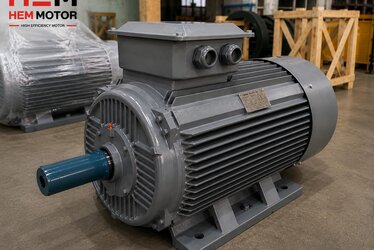
When selecting an asynchronous motor, most people look only at its power and speed; yet how often the motor stops and starts is a criterion at least as decisive as power. At every start the motor draws several times its rated current (typically 5-8 times), and this high starting current heats the winding in a very short time. If the number of starts per hour exceeds the motor's limit, accumulated heat burns the winding insulation and the motor fails early, even with no mechanical problem on the load side. In this article we examine in detail the starts-per-hour limit of an asynchronous motor, the heating mechanism in frequent stop-start duty, and the correct motor selection that prevents this early failure.
Conveyors, cranes, pumps, compressors and especially all applications that switch in and out continuously by process requirement face this problem. You will see a value such as "30 starts/hour" in a motor catalogue; this figure is not arbitrary, and when exceeded the motor's life shortens dramatically. With the right duty type, inertia, thermal protection and a suitable starting method, it is possible to operate safely within this limit.
Why Is the Starting Current So High?
When the asynchronous motor is at standstill the rotor is also stationary, and at this instant the rotor's relative speed with respect to the stator is at maximum (slip = 1). In this state the motor behaves like the short-circuited secondary winding of a transformer and draws very high current from the line. As the motor accelerates, slip decreases and current falls toward its rated value. But during those first few seconds of starting, the high current through the winding suddenly increases the losses converted to heat in the winding copper (I²R losses).
Because this heat is proportional to the square of the current, a starting current 6 times the rated value produces roughly 36 times more instantaneous heat than rated operation. This heat may not be dangerous in a single start; but in successive starts made without a chance to cool, heat accumulates. This is the essence of the starts-per-hour limit.
The Heating Mechanism in Frequent Stop-Start
To understand a motor's thermal behaviour, two things must be considered together: heat generation and heat dissipation. While the motor runs, losses generate heat; at the same time the housing, fins and fan dissipate this heat to the surroundings. In a continuously running motor (S1 duty) these two reach equilibrium and the temperature stabilises.
But if the motor stops frequently, the internal cooling fan also stops at the moment it stops. In many asynchronous motors the fan is attached to the shaft end, so cooling almost ceases when the motor stops. That is, the motor has the weakest cooling precisely at the moment of starting when the most heat is generated. If the heat produced at each start cannot be fully dissipated before the next start arrives, the winding temperature rises step by step and eventually exceeds the temperature allowed by the insulation class (e.g. class F). From this point the insulation ages rapidly and winding burnout becomes inevitable.
The Role of Load Inertia (GD²)
The most important factor determining how long a start will last, and therefore how much heat it will produce, is the load's inertia (GD² or J). A heavy flywheel, a large fan impeller, or a loaded conveyor requires the motor to stay at high current for a long time to reach rated speed. The higher the inertia, the longer the start time, the more heat per start, and the lower the allowable number of starts per hour. That is why in motor selection not only power but also the inertia of the driven load must be known.
Duty Types: Why Are S4 and S5 Important?
International standards define motor operating regimes with duty types (S1-S10). The most critical for frequent stop-start applications are:
- S1 (Continuous duty): The motor runs continuously and the temperature reaches equilibrium. Not suitable for frequent starting.
- S3 (Intermittent periodic duty): There are running and stopping periods, but the thermal effect of starting current is not decisive.
- S4 (Intermittent periodic duty with starting): The duty definition explicitly includes the thermal effect of starting. Starts per hour and inertia are the core parameters of this duty type.
- S5 (Intermittent duty with starting and electrical braking): In addition to S4, it includes the thermal effect of electrical braking. Defined for applications that frequently stop, start and brake.
For a frequently started application, it is essential to select the motor according to the right duty type (S4 or S5) and the accompanying starts per hour. A motor may carry a label such as "S4 40%, 90 starts/hour"; this information indicates that the motor will operate safely in that regime.
Ways to Prevent Early Failure
To protect the motor in a frequent stop-start regime, several complementary measures are applied together:
- Correct duty type selection: The motor must be selected in class S4/S5 according to the real starts and inertia.
- Winding thermal protection: PTC thermistors embedded in the winding stop the motor when the temperature limit is exceeded, preventing burnout.
- Soft starting or VFD: Methods that limit starting current significantly reduce heat per start.
- External cooling: On frequently stopping motors, using an independently driven (forced) cooling fan instead of a shaft-mounted fan keeps cooling going.
- High efficiency: A low-loss motor heats up less and stays safer in the same regime.
One of the most effective ways to limit starting current is to use a frequency drive. A VFD-driven asynchronous motor ramps in under control; this eliminates both the high starting current and the associated sudden heating. Moreover, choosing a low-loss IE4 high-efficiency electric motor widens the thermal margin in a frequent-start regime. For winding protection, the right insulation and bearing selection is also decisive for long life.
Selecting the Right Motor with Stock and Engineering
In frequent stop-start applications, the logic of "let's buy a slightly bigger motor" is often wrong; the solution lies in the right duty type and thermal design before power. By evaluating your application's starts per hour, load inertia and braking need, we can together select, from our broad stock, motors suited to S4/S5 duty type, thermally protected, and ready for frequency-drive operation if needed. To prevent your motor from burning out early, share your application regime with us. You can explore our product range and more technical content on our homepage.
The Effect of the Starting Method on Heating
One of the most important factors determining the starts-per-hour limit is how the motor is started. Direct-on-line starting switches the motor in at full voltage and draws the highest starting current; this produces the most heat per start. This method is simple and cheap, but in frequent-start applications it is the most demanding thermally.
Star-delta starting begins the start at reduced voltage and lowers the current somewhat; but because of current pulses at the transition moment and limited torque reduction, it is not always sufficient for very high-inertia loads. A soft starter keeps the starting current under control by gradually raising the voltage and reduces mechanical strain. The most flexible solution is the frequency drive: the drive accelerates the motor on the desired ramp with limited current, so the heat per start drops dramatically and the starts-per-hour capacity increases noticeably.
The choice of method directly affects not only starting comfort but also the thermal life of the motor. In a frequent stop-start application, choosing the right starting method is often a smarter solution than buying a motor one frame larger, because the source of the problem is not power but the rate at which heat accumulates.
Counting Starts Correctly in Practice
Determining an application's real starts per hour is often more complex than it seems, because starts do not always occur at regular intervals. By process requirement they sometimes cluster back to back and at other times become sparse. The moment that thermally strains the motor is the dense window where starts pile up. For this reason, the question "how many times per hour does it start" is not enough; how many starts occur consecutively in the busiest hour must also be known. For example, a motor that starts rarely on average across the day but cuts in dozens of times in succession at the beginning of a shift must be selected according to this peak intensity, not the average.
For a correct evaluation, the duration of each start matters as much as the number of starts. A short start under light load produces little heat, while a long start with a high-inertia load imposes far more thermal load. Therefore the starts-per-hour limit and the start duration must be considered together. Modern frequency drives and intelligent motor protection relays record the real number of starts and the winding temperature, providing valuable data for this analysis; this makes it concretely visible how close the motor is to its limit.
Another frequently overlooked point is braking and reversing events. In applications such as conveyors or cranes, the motor draws high current not only at starting but also during braking and direction changes. These events must also be included in the thermal budget. In a frequent stop-start system, each stop usually leads to a subsequent start; thus the frequency of stops is a direct indicator of the start load. This holistic view reveals the regime in which the motor really operates and makes the correct duty type selection possible.
Motor Life and Operating Cost
The thermal accumulation caused by frequent starting is not only a risk of sudden burnout; it is also a slow ageing process. The winding insulation becomes a little more brittle with every overheating cycle, and this quietly shortens the motor's expected life. The relationship between insulation life and operating temperature is exponential; even a relatively small rise in temperature can considerably reduce insulation life. That is why a motor selected with the right duty type and sufficient thermal margin, even if it costs slightly more in the initial investment, provides a clear saving in total operating cost.
The bill for an early failure is often far larger than the cost of the motor itself. The unexpected burnout of a critical motor on a production line halts the line during the rewinding or replacement period, leading to production loss, delivery delays and unplanned maintenance cost. Preventing this chain of costs with a correctly selected motor is the most sensible economic decision.
The main economic factors to consider in frequent-start applications are:
- Insulation life: As thermal accumulation decreases, winding life lengthens and replacement frequency drops.
- Unplanned downtime cost: On critical motors, a failure is far more expensive as lost production.
- Spare motor planning: A correctly stocked spare quickly brings the line back up at the moment of failure.
- Energy efficiency: A low-loss motor both heats up less and saves energy throughout the year.
- Ease of maintenance: Re-greasing and thermal monitoring make maintenance cost predictable.
When all of these factors are evaluated together, motor selection in a frequent stop-start application is not merely a purchasing decision but a long-term investment in efficiency and reliability. A system built with the right duty type, the right thermal protection and the right starting method both extends motor life and lowers the operation's total cost of ownership. When you share your application's real start profile, we can together determine, from our broad stock, the thermally safe motor best suited to this regime.
The Role of Cooling and Thermal Design
The motor's survival under frequent starting depends on how quickly it can dissipate the heat it produces. In a standard asynchronous motor, the cooling fan is attached to the shaft, so cooling weakens at low speed or at standstill. This is a critical limitation especially for motors that run for long periods at low speed or stop frequently. To overcome this problem, independently driven (forced) cooling fans are used; these fans provide continuous cooling regardless of the motor's speed and make it possible for the motor to withstand more starts in the same frame.
Another dimension of thermal design is the insulation class. An insulation class that withstands a higher temperature widens the thermal margin and makes the motor more tolerant of short-term heat pulses. However, raising the insulation class alone is not a solution; the right duty type, the right starting method and effective cooling must be considered together. In a frequent-start application, the harmonised selection of these three elements can extend the motor's expected life by years.
Frequently Asked Questions
Why did my motor burn out even though there was no problem on the load side?
The most common reason is that the number of starts per hour exceeded the motor's limit. The high current drawn at each start heats the winding; when starts are too frequent the heat accumulates without being dissipated, and the winding insulation exceeds the allowed temperature and burns. Even if the load is mechanically fine, this thermal accumulation finishes the motor. The solution is to select a motor of the right duty type (S4/S5) and to limit the starting current.
How many starts per hour are safe?
There is no single general number; this value depends on the motor's power, duty type, cooling and especially the load inertia. The "starts/hour" value is stated on the motor nameplate or catalogue. This number decreases for high-inertia loads and increases for low-inertia loads. To determine the right limit, the application's real starts and load inertia must be known.
Does a soft starter or VFD solve the starts-per-hour problem?
Largely yes. A soft starter and especially a frequency drive (VFD) significantly reduce the heat produced per start by limiting the starting current. This allows the motor to make more starts safely in the same time. Even so, in applications with very high inertia and extremely frequent starting, selecting a motor of the right duty type and thermal protection should not be neglected.