English
 Türkçe


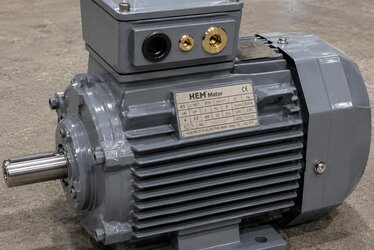
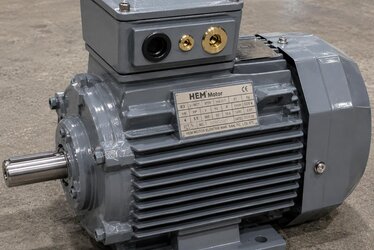
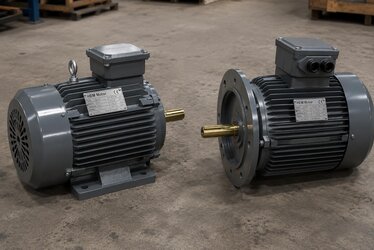
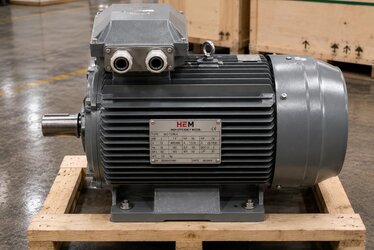
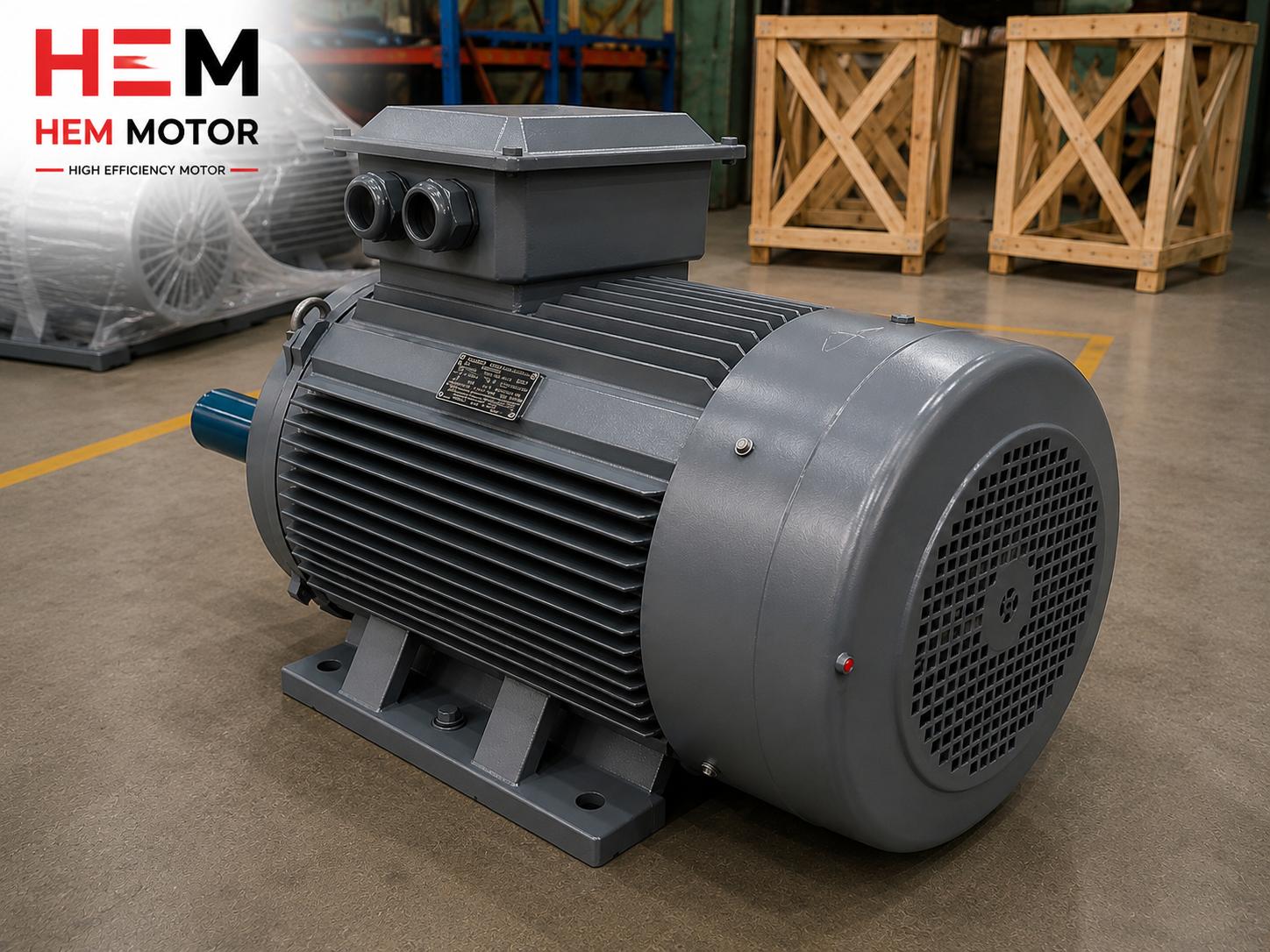
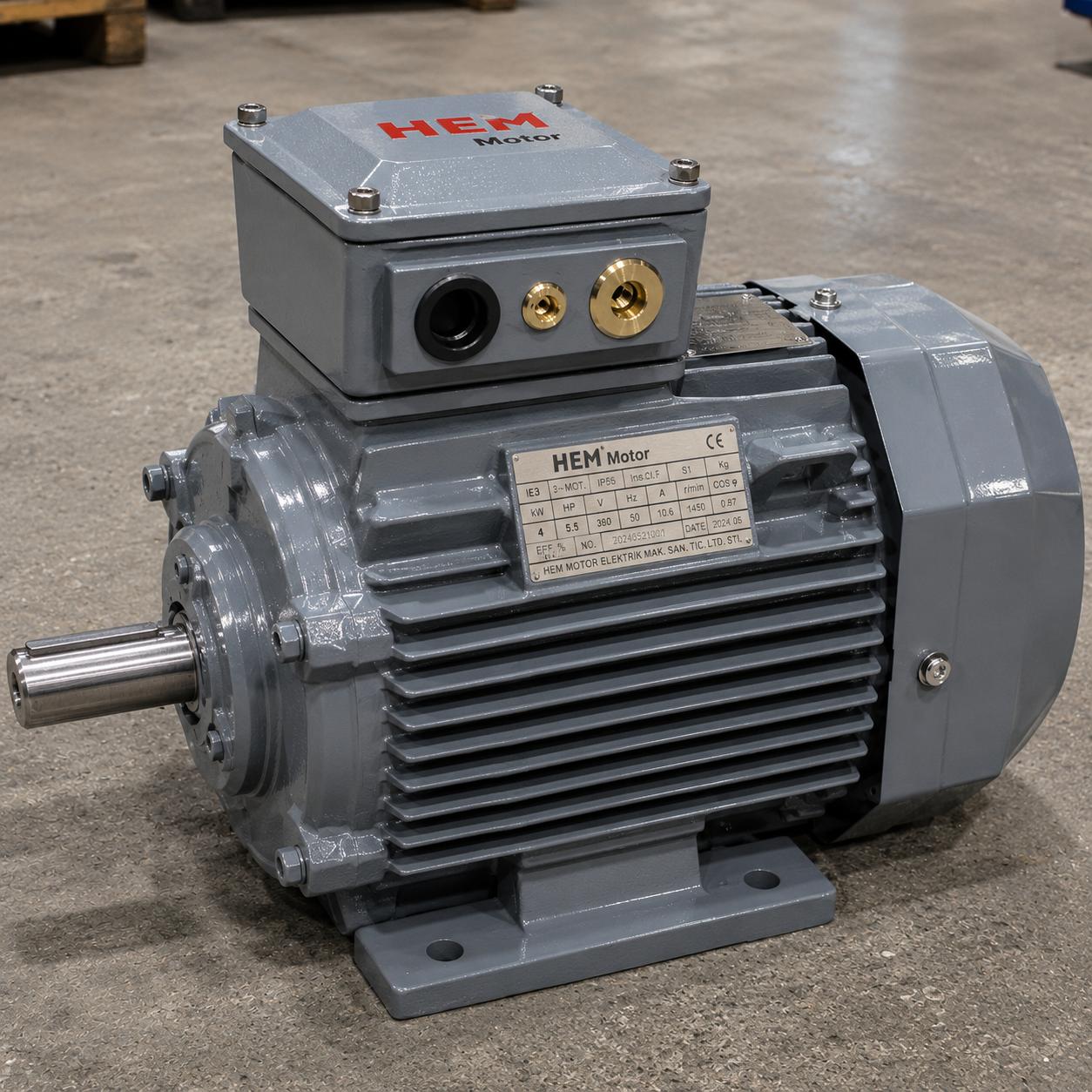
In heavy belt-and-pulley drives, the radial load reaching the drive end (DE) of the shaft can push a standard deep-groove ball bearing beyond its rating. In large fans, crushers, rolling mills and grinding applications, the pulley tension that loads the shaft is continuous and carries vibration. This is exactly where a cylindrical roller bearing of the NU type, fitted to the drive end of a cast iron motor, delivers a much higher radial load capacity than a ball bearing and markedly improves bearing life and operating reliability. The cast iron frame, with its rigid structure that limits housing deformation under high load, is a natural match for this bearing type. This article covers how the NU bearing works, how it differs from a ball bearing, its lubrication, its load curve, which bearing is correct for which application and what to watch when ordering, all from a purchasing-decision perspective.
Why a Cylindrical Roller Bearing of the NU Type?
In a deep-groove ball bearing, load is transferred through a small point contact between ball and raceway. In a cylindrical roller bearing, load is carried by a line contact running along the roller. Because the contact area is larger, a bearing of the same bore carries far higher radial load with lower surface pressure. Lower surface pressure delays material fatigue and extends bearing life. In practice, for the same frame size, the dynamic radial load rating of an NU bearing is roughly 1.5 to 2.5 times that of an equivalent ball bearing. In heavy belt drives this difference can move bearing life from hours into the thousands of hours.
Another key feature of the NU type is that its inner ring can slide freely in the axial direction. An NU bearing cannot carry axial load; it carries radial load only. For this reason the NU bearing is placed at the drive end (DE), while the deep-groove ball bearing that locates the shaft axially sits at the non-drive end (NDE). When the shaft expands thermally, the NU bearing slides freely, avoiding binding and added bearing stress. This "one located, one free bearing" arrangement is a classic engineering solution to absorb heat-related elongation in long-frame, high-power motors.
Among roller bearings, the NU type is the most common option that allows axial freedom thanks to its rib (shoulder) arrangement on both rings. Variants such as NJ and NUP are used where a degree of axial guidance is required; but for a standard electric motor DE bearing the classic choice is the NU type. So when "cylindrical roller bearing option" is mentioned in practice, it usually means NU.
Ball Bearing versus NU Bearing
The table below summarises the core properties of the two bearing types in the same application. Values are relative comparisons for a typical IEC frame range; exact figures come from the C (dynamic) and C0 (static) load data in the bearing manufacturer's catalogue. In design, the L10 life calculation uses these values and the real radial force.
| Property | Deep-Groove Ball (6xxx) | Cylindrical Roller (NU) |
|---|---|---|
| Contact geometry | Point contact | Line contact |
| Radial load capacity | Standard (reference) | About 1.5–2.5x higher |
| Axial load | Carries (both ways) | None (slides free) |
| Belt-drive suitability | Light/medium load | Heavy radial load |
| Typical motor position | NDE (located bearing) | DE (floating bearing) |
| Shock load behaviour | Moderate | Good (wide load spread) |
| Lubrication sensitivity | Moderate | High (regular grease) |
| Friction/speed limit | Suits high speed | Care at very high speed |
The Load Curve: Pulley Diameter and Belt Tension
The radial force on the shaft depends on the transmitted power and the pulley diameter. Transmitted torque equals pulley radius times belt pull, so as the pulley diameter shrinks, higher belt tension is needed to transmit the same torque, which raises the radial load at the shaft end. As a general rule, small pulley = high radial load = need for an NU bearing. For the right selection, pulley diameter, belt type (V-belt, poly-V, synchronous), pre-tension factor and the shaft-end distance are evaluated together. The further the pulley sits from the shaft shoulder, the longer the moment arm and the greater the bending moment at the bearing; so the pulley is mounted as close to the shaft shoulder as possible.
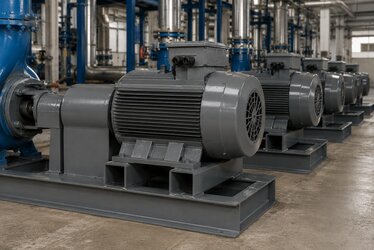
- Large industrial fans: Continuous high radial load and vibration; an NU bearing at the DE is recommended. Induced and forced-draught fans fall in this class.
- Crushers: Impact and variable load; line contact spreads the shock over a wider area and reduces fatigue.
- Rolling mill and grinder drives: High torque, heavy pulleys and high pre-tension; the NU bearing often becomes standard.
- Stone-crushing, cement and mining plants: Dusty, heavily loaded environment; the cast iron frame + NU bearing combination is the safe solution.
- Pump and direct-coupled drives: Radial load is low; a ball bearing is sufficient and an NU is unnecessary.
The cast iron frame supports bearing performance in these heavy applications by keeping the housing rigid; it holds the bearing-seat fit tolerance better than an aluminium frame. For frame material selection, our comparison cast iron versus aluminium frame helps the purchasing decision. For shaft-side load limits, see shaft radial and axial load limit in detail. For quality marks that affect bearing and housing life in cast iron motors, our article on bearing and housing life in cast iron motors is a useful guide.
Lubrication: the NU Bearing's Sensitive Point
Because of its line contact and high load, a cylindrical roller bearing is more lubrication-sensitive than a ball bearing. Insufficient or wrong grease fails to keep the oil film between roller and raceway and leads to early wear and micro-welding (smearing). Heavy-duty NU bearings usually use a regreasable design, grease inlet and outlet nipples, and grease of the correct NLGI consistency. At high speed and temperature the grease interval shortens; a practical assumption is that grease life roughly halves for every 15 °C rise in temperature. So in heavy applications the maintenance schedule must be set by the bearing type.
| Parameter | Recommendation / Note |
|---|---|
| Grease type | Lithium complex, extreme-pressure (EP) additive |
| NLGI consistency | Typically NLGI 2 or 3 |
| Lubrication design | Regreasable, with nipple (heavy load) |
| Grease interval | Shortens with speed and temperature; track by schedule |
| Initial lubrication | Factory fill; confirm at commissioning |
| Over-greasing risk | Temperature rise; follow maker's quantity |
For grease selection and intervals we recommend our guide on bearing greasing, grease type and NLGI interval. For motors stored long term, see storage, moisture and bearings for bearing protection. On regularly greased heavy bearings, the correct nipple orientation and grease drain path ensure that excess grease is pushed outward rather than into the winding; this detail should be discussed at the order stage.
Vibration, Alignment and Operating Details
The high load capacity of the NU bearing does not mean it forgives poor alignment or excessive belt tension. Belt pre-tension must stay within the manufacturer's recommended range; too much tension shortens bearing life, while a loose belt causes slip and heating. Pulley-to-pulley parallelism and shaft alignment directly affect the vibration level. Vibration measurement before commissioning and during periodic checks is the most reliable indicator of early bearing failure. The high mass and damping ability of the cast iron frame help keep vibration low in these applications.
- Keep belt pre-tension within the maker's range; avoid over-tensioning.
- Seat pulleys as close to the shaft shoulder as possible to shorten the moment arm.
- Monitor bearing condition with periodic vibration and temperature readings.
- Shorten the grease interval according to operating temperature and speed.
- Do not force the roller during removal/fitting; use a proper puller.
Correct Bearing Selection and Ordering
The NU bearing option is a factory choice and must be specified when ordering the motor. Standard motors come with ball bearings at both DE and NDE. When the NU option is selected for heavy belt drive, the DE becomes a cylindrical roller bearing while the NDE stays a ball bearing. Selection requires the application radial load, pulley diameter, belt type, speed and target bearing life. With this data the right bearing type and, if needed, a regreasable design are defined.
- Drive type: belt-and-pulley or direct coupling?
- Pulley diameter and belt pre-tension (these set the radial load).
- Speed and operating temperature (affect grease interval).
- Regreasable design and nipple requirement.
- Target bearing life (L10 hours) and vibration level.
- Mounting position and environment (dust, moisture, temperature).
The L10 Life Concept and Its Cost Impact
The most important engineering indicator in bearing selection is L10 life. L10 is the operating hours that 90 percent of a bearing group running under the same conditions will reach, while 10 percent will fall below it. This value depends on the ratio between the bearing's dynamic load rating (C) and the real radial force in the application, and that ratio maps to life through a cubic curve. So when the radial load doubles, the expected life can drop by roughly a factor of eight. This is exactly where the high C value of the NU bearing becomes decisive: in the same application it offers a far longer L10 life than a ball bearing and reduces the risk of unplanned downtime.
In heavy industry a bearing failure means not only the bearing cost but also lost production, labour and spare-part logistics. Therefore the right bearing selection is not a cost line but an operating-safety investment. The extra cost of the NU option is often covered by preventing even a single unplanned stop in a heavy belt drive. Seen through a total-cost-of-ownership lens, the right bearing configuration is the most economical choice in the long run. This approach also helps avoid common mistakes in motor selection; our article on mistakes when buying an electric motor is also useful here.
Mounting, Removal and Field Practice
One advantage of the cylindrical roller bearing is the ease of removal and fitting. In the NU type the inner and outer rings are separable; the inner ring can be mounted on the shaft and the outer ring in the housing separately. This makes maintenance and bearing replacement practical on heavy motors. However, during assembly the inner ring is usually fitted by an interference (heated) fit; using an induction heater instead of a flame ensures controlled, even heating of the ring. Forcing it on cold can leave permanent damage on the ring and the roller surface.
If a bearing change is done in the field, confirming the correct bearing number is critical; the wrong bore upsets the shaft fit. On the subject of bearing replacement and correct number selection, explained through an IE3 frame, our article on bearing replacement, removal-fitting and correct number selection is, in principle, a useful guide for cast iron motors too. After replacement, vibration and temperature checks must always be carried out.
Frequently Asked Questions
Can an NU bearing be fitted to any motor?
The NU cylindrical roller bearing is usually offered from a certain frame size and as a factory option. At small powers the application radial load is low, so a ball bearing is sufficient. The need is determined by pulley diameter and belt tension; we recommend confirming suitability before ordering. On very high-speed small motors an NU bearing may not bring an advantage.
Is the NU bearing enough on its own, or is a second bearing needed?
Because the NU bearing carries no axial load, it cannot locate the shaft. Therefore there is always a ball bearing at the NDE that fixes the axial load and the shaft. Together they carry the high radial load and allow thermal expansion through free sliding. This arrangement keeps the motor running both safely and for a long life.
Can I convert a ball-bearing motor to an NU bearing later?
If the housing dimensions and shaft bore are suitable it is technically possible, but ordering it as a factory option is far safer and more economical. Later conversion requires housing machining and correct tolerances; the wrong tolerance shortens bearing life. For a planned application, sourcing an NU-option motor from the start is the soundest route.
For your heavy belt-driven fan, crusher, rolling mill and grinding applications, we can define the right configuration of a cast iron motor with the NU cylindrical roller bearing option at the DE. As HEM Motor, with broad stock and fast delivery, contact us to guide you to a motor with the correct bearing configuration; sharing your application details to get a quote is enough.