English
 Türkçe



The frame of an electric motor is not merely a shell wrapping the windings and rotor; it is a load-bearing engineering component that directly governs rigidity, vibration behaviour, heat dissipation, resistance to mechanical impact and field service life. When it comes to frame material in industrial motors, two main cast iron families dominate: grey cast iron (EN-GJL, lamellar graphite cast iron) and spheroidal / nodular cast iron (EN-GJS, nodular graphite cast iron). Both are iron-carbon castings, but the shape of the graphite within the material (lamellar versus spherical) fundamentally changes the mechanical properties. In this article we compare grey cast iron and ductile (nodular) iron in terms of tensile strength, vibration damping, weight, impact resistance and cost-performance, and explain which frame suits which application from the HEM Motor stock and supply perspective.
Most standard IEC motors use a grey cast iron frame, and there are solid engineering reasons for this. However, in certain special applications involving heavy impact, high torque shock, large power and dynamic load, a nodular (ductile) iron frame is preferred for the extra strength it offers. The right choice depends far less on "which is more expensive" than on "what the application demands of the frame."
What Is Grey Cast Iron (EN-GJL)?
Grey cast iron is cast iron in which most of the carbon exists as lamellar (flake) graphite. In standards, the EN-GJL-200 and EN-GJL-250 grades are typically used for motor frames; the number indicates approximate tensile strength in MPa. The lamellar graphite structure gives the material two highly valuable properties: excellent vibration damping and very good castability. Because the tips of the lamellar graphite act like internal micro-crack initiators, grey iron has limited tensile strength and ductility (elongation); the material is relatively brittle. In return, its ability to internally damp vibration energy is outstanding which is an extremely desirable property for a rotating machine such as a motor.
The advantages of grey cast iron in a motor frame can be listed clearly:
- Superior vibration damping: Lamellar graphite dampens mechanically and magnetically induced vibration, reducing noise and resonance and contributing to quiet running.
- Good thermal conduction: The graphite network spreads heat into the frame and cooling fins, lowering winding temperature.
- Excellent castability: Thin-walled, complex rib geometries are cast easily, enabling rigid yet light designs.
- Low cost and wide stock: It is the most common solution for standard IEC motor frames, offering the most balanced supply and price-performance.
- Dimensional stability: When machined, bearing seats and flange faces are held to high precision.
What Is Spheroidal / Nodular Iron (EN-GJS)?
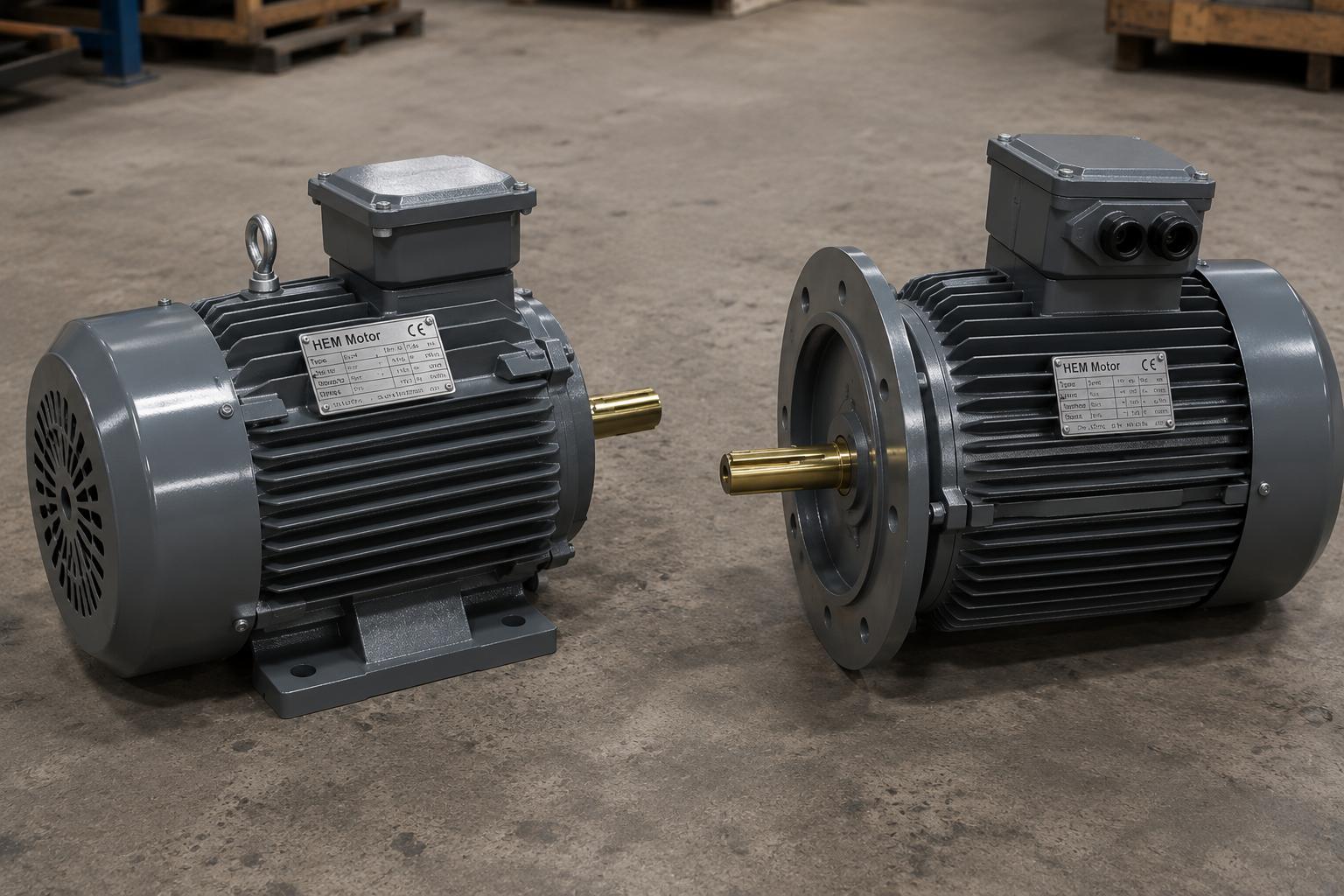
Ductile iron is produced when the graphite in cast iron forms spheroidal (nodular) shapes instead of flakes. This spherical structure removes the internal crack initiators created by lamellar tips, so the material gains both much higher tensile strength and significant ductility (elongation at break). Common grades are EN-GJS-400-15 and EN-GJS-500-7; the first number is tensile strength (MPa) and the second is percentage elongation. Ductile iron is markedly tougher (impact-resistant) and stronger than grey iron, and far safer against cracking under heavy impact and high dynamic stress.
There is a price for this: ductile iron has lower vibration damping than grey iron, and material/production cost is generally higher. Therefore a ductile frame makes sense not in every motor, but in special applications where the frame is genuinely mechanically stressed: large-power motors, heavy industrial impact, cranes and hoisting, crushers/stone crushing, and rolling mills where high torque shock is present.
EN-GJL vs EN-GJS Comparison Table
The table below summarises typical mechanical properties of cast iron grades commonly used in motor frames. The values are typical magnitudes based on material standards; the final choice should be made according to the application load.
| Property | Grey Cast Iron (EN-GJL-250) | Ductile / Nodular (EN-GJS-500-7) |
|---|---|---|
| Graphite structure | Lamellar (flake) | Spheroidal (nodular) |
| Tensile strength (Rm) | ~250 MPa | ~500 MPa |
| Elongation at break (A) | < 1% (brittle) | ~7% (ductile) |
| Impact / toughness | Low | High |
| Vibration damping | Very high | Medium |
| Thermal conduction | Very good | Good |
| Density | ~7.2 g/cm³ | ~7.1 g/cm³ |
| Typical use | Standard IEC motor frame | Heavy impact, high power, hoisting |
| Cost | Low-medium | Medium-high |
Tensile Strength and Ductility
As the table shows, the most pronounced difference is in strength and ductility. Grey iron offers about 250 MPa tensile strength and near-zero elongation, while ductile iron has twice the tensile strength and visible elongation. In practice this means a ductile frame can carry the load by deforming somewhat rather than cracking under sudden impact or excessive torque, whereas grey iron tends to fracture in a brittle manner once its limit is exceeded. However, under normal industrial operating conditions grey iron frames work far below these limits and serve trouble-free for decades.
Vibration Damping and Quiet Operation
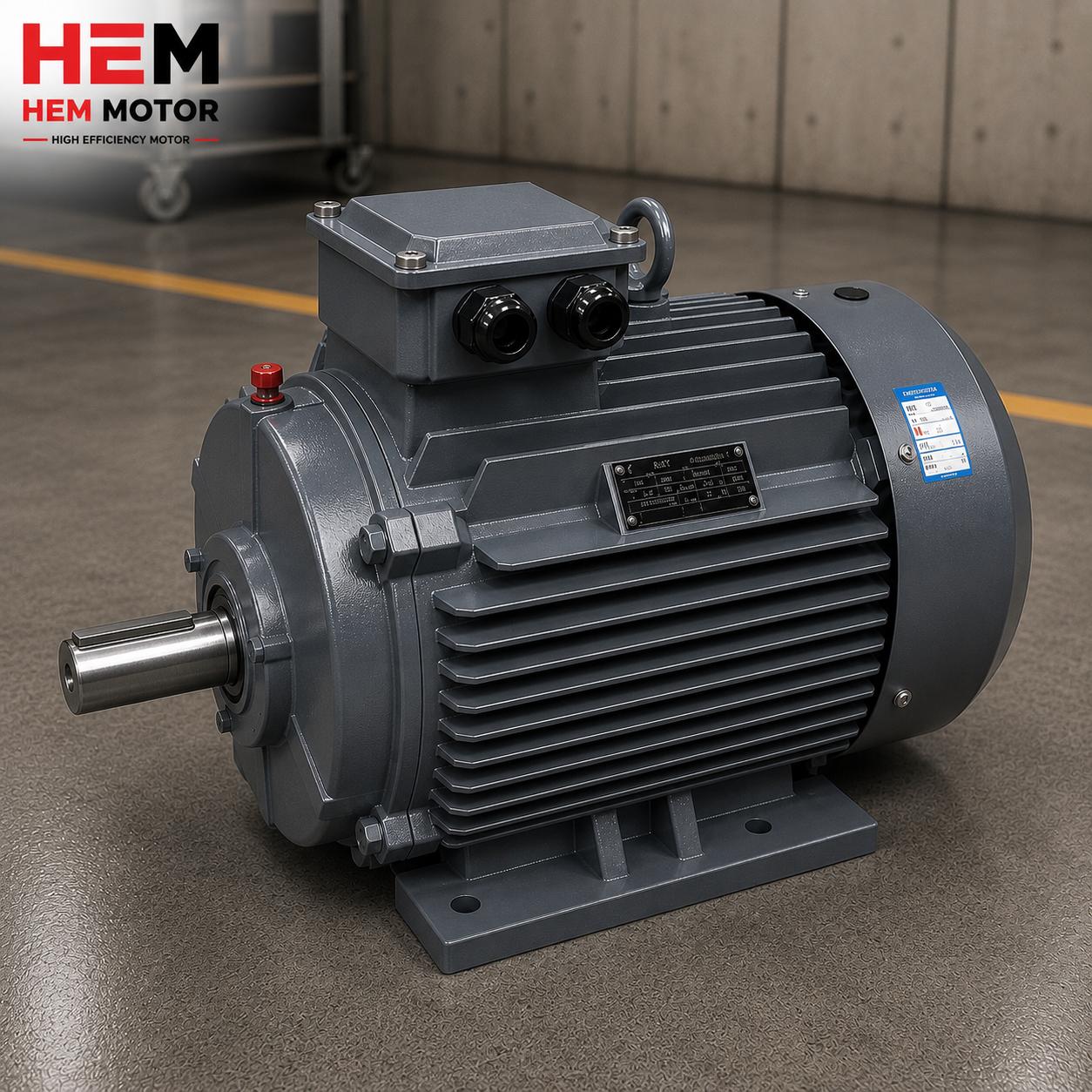
An interesting balance point emerges here: although ductile iron is stronger, grey cast iron is superior in vibration damping. In a motor, a rotating machine, damping magnetic hum, bearing vibration and imbalance-induced vibration reduces noise and fatigue. For this reason, in standard, medium-power motors expected to run quietly, a grey cast iron frame is often the smartest choice. Our articles on low-noise motor selection and ISO 10816/20816 vibration acceptance values complement this decision.
Which Frame for Which Application?
The right frame choice is determined by the mechanical stress the application imposes on the frame:
- Choose grey cast iron (EN-GJL): Standard pumps, fans, compressors, conveyors; medium-power general-purpose drives; where quiet running and good heat dissipation are priorities. The vast majority of IEC stock motors fall in this class.
- Consider ductile / nodular (EN-GJS): Heavy-impact drives, stone crushing/crushers, cranes and hoisting, rolling mills, large-power and high-torque-shock applications; places where the frame is genuinely mechanically stressed.
- Corrosion and environmental conditions are a separate decision; both castings are protected with suitable paint/coating. Our article on corrosion protection in open field provides guidance here.
To complete the frame material choice correctly, matching frame size to power is also critical. You can review our frame size and power matching and IEC 56-355 frame sizes and weight guides, and for the aluminium comparison see our cast iron vs aluminium frame article. We also covered the source of frame rigidity, rib design, in our rib design article.
Weight, Heat Dissipation and Mechanical Behaviour
Although weight in a motor frame is often thought of as a disadvantage, the mass of a cast frame is in fact an asset. High mass gives the frame thermal mass; it smooths temperature swings under sudden load changes and protects the winding. The same mass, as mechanical inertia, also lowers vibration amplitude. For this reason lightweight aluminium-framed motors are, in some applications, not quieter and cooler but the opposite: more vibration-prone and hotter. Grey cast iron has effectively become the standard at medium and large power because it offers a balanced combination of mass, damping and thermal conduction.
In terms of heat dissipation, the lamellar graphite network of grey iron conducts heat slightly better than the spherical graphite of ductile iron. In practice the difference between the two materials is secondary to the cooling-fin (rib) geometry and fan capacity in the motor design; but in applications where vibration and heat are both critical, this dual advantage of grey iron can be decisive. In mechanical behaviour, ductile iron stands out with its fatigue strength and tolerance to notch sensitivity under repeated dynamic load, which makes it safe for vibration-heavy heavy-duty drives. Hence in large-power, impact-prone, continuously heavy-loaded drives the frame choice should consider fatigue life, not just static strength.
Casting Quality: More Important Than the Grade
A frequently overlooked truth must be emphasised here: as much as the grade of the frame material, the quality of the casting is decisive. A poor casting containing porosity, cold shuts or sand inclusions is weak regardless of its grade. A good cast frame must be homogeneous, porosity-free, correctly heat-treated and precisely machined. The axial alignment of the bearing bores, the squareness and flatness of the flange face, and the flatness of the foot base reveal the frame's true quality. Deviations on these surfaces lead to premature bearing wear, misalignment, vibration and ultimately a shortened motor life. HEM Motor watches for these quality marks in the motors it supplies, because even the highest-grade material loses value with a poor casting. Our article on bearing and bearing seat life details the quality marks to look for when buying.
The Cost-Performance Balance
Ductile iron is not always "better"; the correct approach is to select according to the application's need. On a standard pump or fan drive, the extra cost paid for a ductile frame is not justified; grey iron offers both adequate strength and superior vibration damping at low cost. By contrast, on a heavy-impact crusher a grey iron frame carries cracking risk while ductile iron more than repays its extra cost in life and reliability. The decision should follow the logic of "the most suitable material for the application," not "the most expensive material." In terms of total cost of ownership, the right frame choice lowers failure, downtime and replacement costs and usually more than compensates for the initial material difference.
In summary, grey cast iron (EN-GJL) is the right, balanced and economical choice for the vast majority of standard industrial motors; ductile iron (EN-GJS) provides mechanical safety in special, large-power applications where the frame is exposed to heavy impact and high torque shock. When choosing between them, the motor power, pole count, drive type and impact profile encountered should be evaluated together, with application-specific engineering support where needed.
Frequently Asked Questions
Is a grey cast iron frame sufficient for my standard motor?
Yes. For general-purpose drives such as pumps, fans, compressors and conveyors, a grey cast iron (EN-GJL) frame is more than sufficient and also offers advantages in vibration damping and heat dissipation. A ductile frame is needed only in special applications where the frame is exposed to heavy impact or high torque shock.
Is a ductile frame motor heavier?
In terms of density the two castings are almost equal; thanks to its higher strength ductile iron can carry the same load with thinner walls, so some designs can even be lighter. In practice the weight difference usually comes from frame geometry and power class, not the material.
Can a cracked grey iron frame be repaired?
Crack repair on cast frames is difficult and generally not recommended; the correct solution is to select the right frame for the application from the start. If there is heavy impact risk, moving to a ductile frame is far more economical than later crack/repair costs.
At HEM Motor we offer both standard grey cast iron IEC motors from wide stock with fast delivery, and the right frame solutions for heavy-duty applications. To assess together the stress your application imposes on the frame and select the correct material and frame size, request a quote; we are at your side with manufacturer stock advantage and fast delivery.