English
 Türkçe

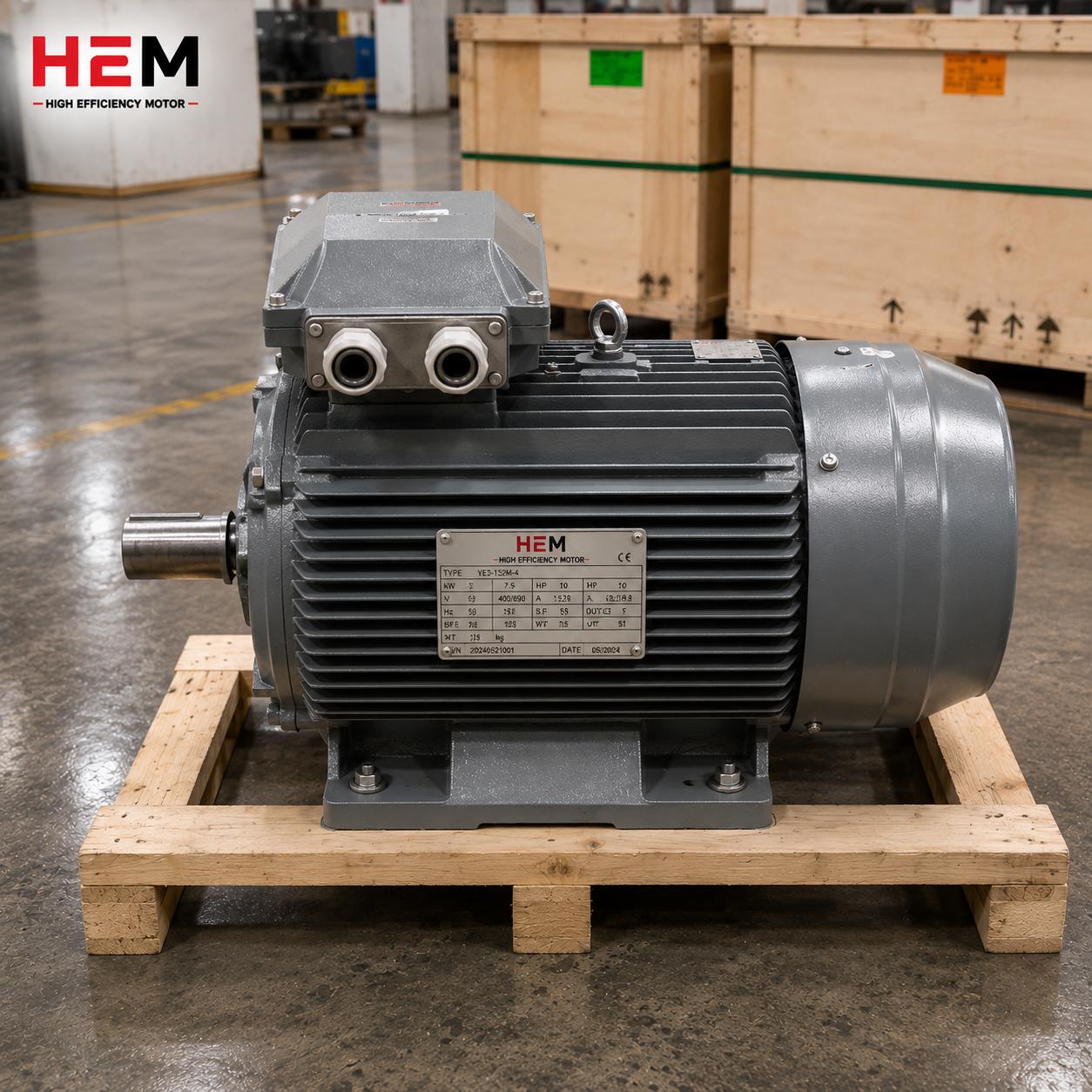

In heavy-industry applications where high power and high torque density are demanded together, the ability to reject the losses a motor generates is often the factor that limits the entire design. Standard finned, fan-cooled (IC411) construction runs out of capacity beyond a certain power density: the frame grows, weight climbs and winding temperatures rise to dangerous levels. This is exactly where a water-cooled jacket in a cast-iron-framed motor earns its place. A liquid flowing through cooling channels cast into the body removes losses directly from beside the windings and core, allowing far higher continuous output from a much more compact frame. In this article we cover, end to end, the thermal-management logic of water-cooled cast-iron motors, the IC71W/IC81W codes, the numbers behind the temperature drop, where they make a real difference and how to choose correctly, with HEM Motor's engineering approach.
What Is a Water Jacket and Why Does It Suit Cast Iron?
A water jacket is a sealed channel system placed between the outer wall of the motor frame and the stator pack that carries the windings; a cooling fluid (water, water-glycol or process water) circulates through it. Because water's heat-carrying capacity is tens of times higher than air, the same loss can be removed from a far smaller surface at the same temperature difference. This gives the design engineer two options: either draw far more power from the same frame, or fit the same power into a much smaller, cooler frame.
This system is especially meaningful in a cast-iron (ductile/grey iron) frame because of the nature of casting. The casting process can form the cooling channels integrally inside the body using cores, in helical or axial complex geometries; in a welded steel frame such complex internal geometry is neither economical nor safe in terms of sealing. Cast iron also brings high rigidity, vibration damping and high thermal mass, so it can mechanically carry the dense output that water cooling enables. The high thermal conductivity of the casting also improves heat transfer between channel wall and winding; the material is not just a carrier but part of the heat path.
- Compact frame: a motor one or two frame sizes smaller for the same power; fits tight machine cabinets, robot joints and ship engine rooms.
- High power density: more continuous kW per unit volume; torque density rises and the same drive becomes lighter.
- Low surface temperature: the outer body can stay cool enough to touch; fin clogging in dusty/oily environments disappears entirely.
- Quiet operation: the cooling fan shrinks or is removed entirely, lowering fan noise and fan loss, which is an indirect efficiency gain.
- Lower ambient heat load: because the motor gives its loss to water rather than room air, the air-conditioning load of an enclosed space drops.
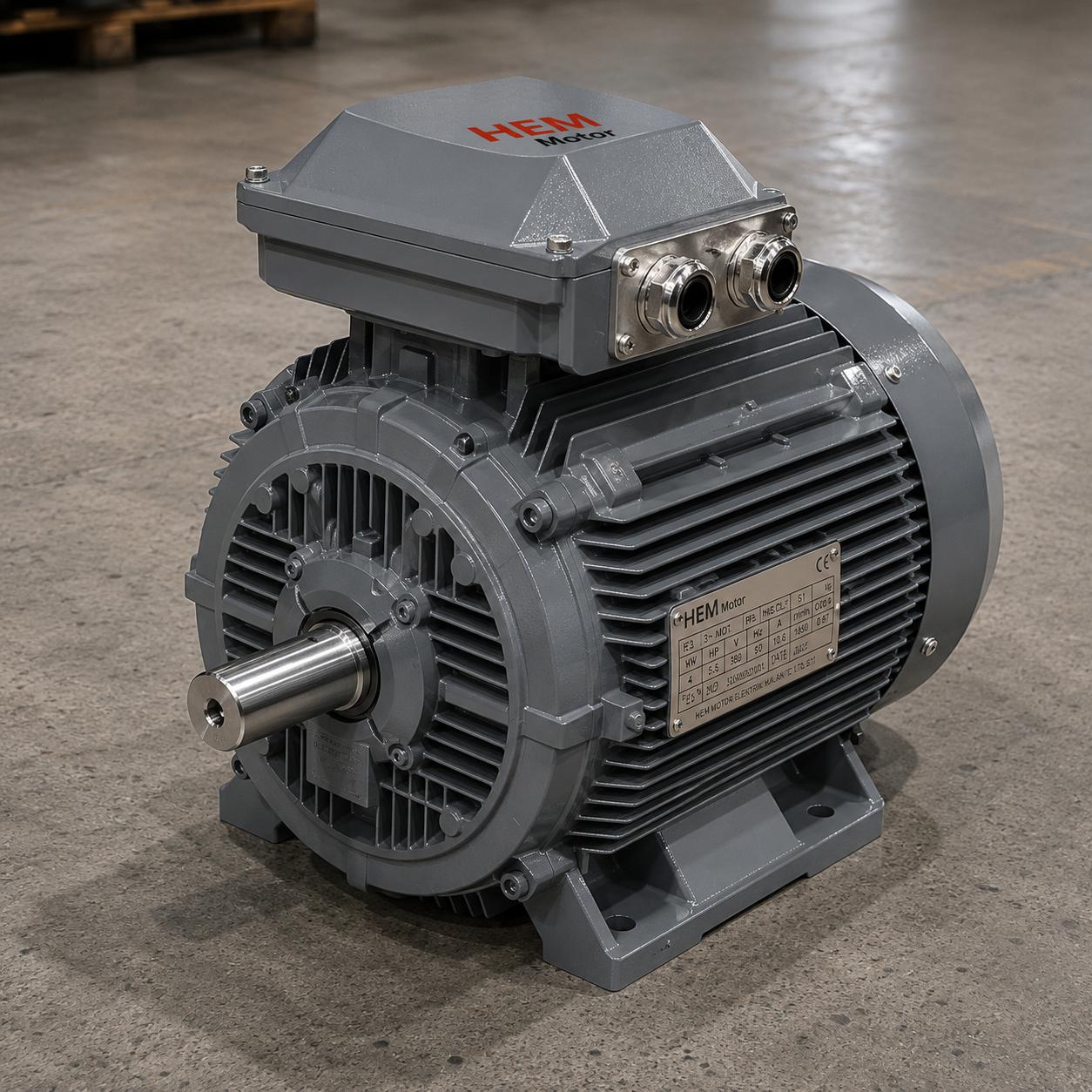
IC Cooling Codes: IC71W, IC81W vs IC411
IEC 60034-6 defines motor cooling methods with "IC" (International Cooling) codes. Water-jacketed motors generally fall into IC71W and IC81W, where the "W" denotes water cooling and the digits describe the layout of the cooling circuit and the way the coolant is moved. Standard surface-cooled motors carry the IC411 code. Choosing the right code directly determines how well the project fits its water infrastructure and ambient conditions.
| IC Code | Cooling Principle | Typical Surface Temp. | Power Density | Typical Use |
|---|---|---|---|---|
| IC411 | Frame surface + shaft fan (air) | High (hot fins) | Reference (1.0x) | General industry |
| IC416 | External forced fan (air) | Medium-High | ~1.1x | Low speed / VFD |
| IC71W | Closed loop, water in jacket | Low | ~1.4-1.6x | Marine, compact drive |
| IC81W | Internal air + water/air exchanger | Low | ~1.3-1.5x | Dusty/dirty, sealed motor |
In IC71W the cooling fluid circulates directly through the frame jacket and rejects the loss; the motor interior is sealed and exchanges no air with the outside. In IC81W the internal air is cooled by water in an internal water/air heat exchanger, so ambient air never enters the motor. This protects the windings and bearings in very dirty, dusty or chemical-vapour environments. Which code to pick depends on available cooling-water quality, ambient contamination and the required protection level (IP55/IP65). If a clean water circuit and the smallest frame are wanted, IC71W makes sense; if the environment is harsh and winding protection is the priority, IC81W does.
Temperature Drop and Thermal Management: The Numbers
The most tangible gain from water cooling is the drop in winding temperature. Insulation life falls exponentially with temperature: for every 8-10 °C of reduction, insulation life roughly doubles (the Arrhenius rule). This means a water-cooled motor not only delivers more power but also runs far longer and more reliably. The table below shows the typical winding temperature rise of different cooling methods at the same loss level.
| Cooling | Winding Temp. Rise (ΔT) | Thermal Margin | Continuous Overload Tolerance |
|---|---|---|---|
| IC411 (air) | ~80 K (class F limit) | Narrow | Low |
| IC81W (water/air) | ~55-60 K | Wide | Medium-High |
| IC71W (water jacket) | ~40-50 K | Very wide | High |
As the table shows, water cooling keeps the winding well away from the insulation-class limit. This wide thermal margin lets the motor absorb short overloads without trouble, removes the need for derating in hot environments and extends insulation life. Successful thermal management depends on getting three parameters right:
- Inlet water temperature: usually designed for 25-35 °C; the lower it is, the more power can safely be drawn. Cold water means free extra capacity.
- Flow rate: proportional to power; the l/min figure on the maker's curve must always be met. Insufficient flow causes local overheating and vapour locks in the channel.
- Water quality: scale and corrosion gradually narrow and clog channels, so a closed loop with a corrosion inhibitor or stainless/aluminium channels is preferred.
Condensation, Glycol and Water-Circuit Design
An overlooked issue in water-cooled motors is condensation. If the cooling water is below the ambient dew point, condensation (sweating) can form inside and outside the body. In that case either the inlet temperature is kept above the dew point or drainage and moisture protection are planned inside the motor. In plants with a freezing risk, a water-glycol mixture is used instead of water; as the glycol ratio rises the heat-carrying capacity drops slightly, so the flow rate must be recalculated accordingly.
In water-circuit design, a closed-loop plate exchanger plus pump and expansion tank is a standard combination. An open circuit (for example direct well or process water) looks cheap but carries a high risk of corrosion and scale; for long life, a closed loop with inhibited water is almost always the better choice. Adding a flow switch, temperature sensor and pressure gauge to the circuit protects the motor safely in the event of water loss or clogging.
Which Applications Call for a Water-Cooled Cast-Iron Motor?
A water jacket is not required for every motor; it carries extra cost and a water-infrastructure need. But in certain applications it is almost mandatory and pays back quickly:
Plastic Extruders and Recycling Lines
In an extruder the motor runs continuously at high load, often inside a hot, tight cabinet. The ambient air is already warm, so air cooling falls short and the motor trips on thermal overload. A water jacket keeps the motor cool and shrinks the frame for easier integration. We also cover continuous process loading in our article on the IE4 motor for plastic extruders and process lines.
Mills, Crushers and Cement Applications
In dust-heavy environments IC411 fins clog quickly and cooling collapses; the motor looks intact yet overheats and burns out. The sealed IC81W construction keeps dust completely away from the motor while water removes the heat safely. Frame material is critical here too, so we recommend our article on motor insulation class and cast-iron frame in hot, dusty environments.
Marine (Ship Propulsion and Auxiliaries)
On ships the engine room is hot and cramped, and a cooling-water (seawater / freshwater) circuit is already present. A water-cooled motor uses this ready infrastructure, saves space with its small frame and reduces engine-room heat load with its low surface temperature. Cast-iron corrosion protection matters here too; see paint and cataphoresis coating on cast-iron motors.
When matching frame size to power, our article on frame size and power matching in cast-iron motors and, for general cooling methods, electric motor cooling methods IC411 and IC416 are good starting points. For continuous torque at low speed and forced cooling, our article on the IE4 external forced cooling fan is complementary.
Economic Comparison of Water vs Air Cooling
The initial investment of a water-cooled motor is higher than an equivalent-power standard air-cooled motor, and it requires a water-circuit infrastructure such as a pump, exchanger and piping. So the decision should look not only at the motor price but at the total system and operating picture. In many projects the gains of water cooling more than cover the extra cost: the smaller frame simplifies machine design and eases handling, the low operating temperature extends insulation and bearing life, the air-conditioning load drops in enclosed spaces and efficiency rises slightly because fan loss falls. Especially in plants running 24 hours continuously, located in hot environments and constrained for space, these gains pay back the investment quickly.
Conversely, if the environment is cool and clean, the load intermittent and space is not tight, a standard air-cooled motor is a more economical and simpler-to-maintain solution. The right decision depends on under what conditions, for how long and at what load the motor runs. Sharing the application profile with an engineer is the safest way to avoid unnecessary cost. A wrong cooling choice either makes the motor needlessly expensive or comes back as constant faults and downtime; the right choice delivers long-term gains on both energy and maintenance.
Commissioning and Operation Considerations
During the first commissioning of a water-cooled motor, the water circuit must be carefully bled, the flow and pressure verified at the maker's values, and the correct wiring of temperature sensors and the flow switch to the panel tested. In operation, the difference between inlet and outlet water temperature is monitored periodically; if this difference grows larger than expected, the flow may have dropped or a channel may be partly clogged. In annual maintenance the water filter is cleaned, the corrosion-inhibitor level is checked and the water is renewed if needed. These simple routines keep a water-cooled motor in trouble-free service for many years. Bearing and grease maintenance should follow the standard schedule, and vibration and noise should be checked regularly.
Selection Checklist for the Right Water-Cooled Motor
- Clarify the continuous power and overload profile; water cooling's real gain appears under sustained high load.
- Determine the available cooling-water source, inlet temperature, flow rate and quality; cold, plentiful water means higher power.
- Choose IC71W (clean, compact) or IC81W (dirty/dusty, sealed) according to ambient contamination.
- Select channel material to suit water quality; hard water demands a stainless/inhibited closed loop.
- Plan inlet temperature and glycol ratio against condensation and freezing risk.
- Install temperature protection (PT100/thermistor) and a flow switch against water loss.
Frequently Asked Questions
Does a water-cooled motor burn out immediately if water is lost?
No, but it must not be left unprotected. When water stops, the motor's high thermal mass buffers briefly; during that window winding temperature protection (PT100/thermistor) and a flow switch should safely stop the motor. A properly installed protection chain detects water loss before it becomes damage and protects the motor.
Should I choose IC71W or IC81W?
If the environment is clean and the most compact frame is wanted, IC71W is suitable; fluid circulates directly through the jacket. If the environment is very dusty, dirty or corrosive, IC81W is preferred; ambient air never enters the motor and an internal exchanger cools the internal air with water, fully protecting the windings.
Is a water-cooled cast-iron motor hard to maintain?
Maintenance focuses on keeping channels clean and corrosion-free. A closed loop, inhibited water and regular filter checks prevent channel clogging. Mechanically, bearing and lubrication care is the same as standard motors; water cooling adds no major extra burden.
Manufacturer Stock and Fast Delivery with HEM Motor
For projects demanding high power density, a compact frame and low operating temperature, a water-cooled cast-iron jacketed motor delivers a large gain with the right IC code and the right water infrastructure. The HEM Motor engineering team evaluates your application's load profile and cooling-water conditions together with you and recommends the most suitable frame size and cooling solution. To bring your project to life without delay, backed by manufacturer stock and fast delivery, contact us and request a quote.