English
 Türkçe


In large-frame cast iron motors, bearing lubrication is one of the decisive factors for motor life. In IEC frames of 160 and above, particularly sizes 180, 200, 225, 250, 280, 315 and larger, the bearings operate at high rotational speed, under heavy mechanical load and in continuous duty. Under these conditions, lubricated-for-life (sealed) bearings are not sufficient; fresh grease must be injected at regular intervals. This is exactly where the grease nipple and re-greasable bearing option comes into play. In this article we cover in detail why a grease nipple is necessary in large-frame cast iron motors, the lubrication interval in hours, the grease type and quantity, the grease drain system, the difference between sealed and re-greasable bearings, and the correct ordering option. The goal is to choose the right bearing and lubrication option at the purchasing stage so that your motor runs trouble-free for decades.
What Is a Grease Nipple and Why Is It Needed on Large Frames?
A grease nipple is a fitting placed on the motor end shield that allows fresh grease to be injected into the bearing with a grease gun. On small-frame motors (IEC 56–132), bearings are usually factory lubricated for life and sealed; the bearing life of these motors is close to the expected total service life of the motor. However, the situation is different in large-frame cast iron motors. The grease inside large bearings oxidizes over time under high speed and temperature, the base oil evaporates, the consistency increases and the lubricating ability decreases. If fresh grease cannot be injected, the dried grease leads to metal-to-metal contact of the bearing balls; this means wear, temperature rise and premature bearing failure.
There are several fundamental reasons why a grease nipple is required on large frames:
- The bearing is large: Large bearings such as 6312, 6314, 6316, 6318 hold a large grease volume that must be renewed regularly.
- The operating temperature is high: Bearing temperatures of large motors can reach 70–90 °C, which shortens grease life.
- Continuous (S1) duty: Total operating hours accumulate quickly in heavy-duty motors running around the clock.
- Maintenance economy: Replacing the bearing of a large motor is far more expensive than periodic re-greasing.
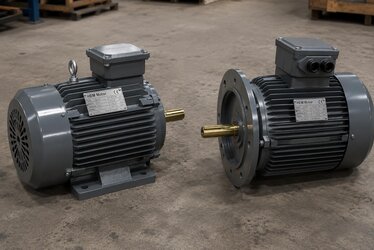
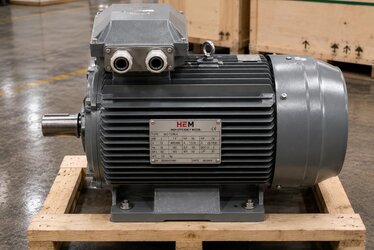
The cast iron frame is the choice of heavy industry because it dissipates heat well and has high mechanical rigidity. In purchasing these motors, the bearing and lubrication option is as critical as the frame-to-power match.

Lubrication Interval: Practical Values in Hours
The re-greasing interval depends on the bearing type, speed, motor frame size, bearing temperature and the quality of the grease used. The general rule is: the higher the speed and the larger the bearing, the shorter the re-greasing interval. On 2-pole (about 3000 rpm) large-frame motors the interval is noticeably shorter than on 4-pole (1500 rpm) motors. The table below gives approximate re-greasing intervals in hours with a typical lithium complex grease. These values are indicative; the exact value is stated on the motor nameplate and the bearing plate.
| Frame | Typical Bearing | 2-Pole (≈3000 rpm) | 4-Pole (≈1500 rpm) | 6-Pole (≈1000 rpm) |
|---|---|---|---|---|
| 160 | 6309 / 6209 | ≈ 3500 h | ≈ 7000 h | ≈ 9000 h |
| 180 | 6310 / 6210 | ≈ 3000 h | ≈ 6500 h | ≈ 8500 h |
| 200 | 6312 / 6212 | ≈ 2500 h | ≈ 5500 h | ≈ 7500 h |
| 225 | 6313 / 6213 | ≈ 2200 h | ≈ 5000 h | ≈ 7000 h |
| 250 | 6314 / 6214 | ≈ 2000 h | ≈ 4500 h | ≈ 6500 h |
| 280 | 6316 / 6216 | ≈ 1800 h | ≈ 4000 h | ≈ 6000 h |
| 315 | 6318 / 6218 | ≈ 1500 h | ≈ 3500 h | ≈ 5500 h |
In practice many plants also apply a calendar-based schedule: re-greasing once a year for single-shift motors and every 3–4 months for three-shift motors. In high ambient temperature (above 40 °C) or dusty environments these intervals should be shortened by up to half. Keep in mind that every 15 °C temperature rise roughly halves grease life.
Grease Type and Quantity
Standard electric motors generally use lithium or lithium complex soap-based, high-temperature resistant greases in the NLGI 2 and NLGI 3 consistency classes. NLGI 3 is preferred for high-speed (2-pole) motors, while NLGI 2 is preferred for lower-speed, high-load motors. Greases with a dropping point above 180 °C are suitable for large frames. Never mix greases with different soap bases (for example lithium with polyurea); incompatible greases cause loss of consistency and lubrication breakdown.
The amount of grease to be injected at each interval is calculated by a simple formula based on the bearing outer diameter and width. A practical approach is to provide the grease quantity in grams as a table:
| Bearing | Re-greasing Quantity (approx.) |
|---|---|
| 6309 | ≈ 13 g |
| 6312 | ≈ 18 g |
| 6314 | ≈ 23 g |
| 6316 | ≈ 27 g |
| 6318 | ≈ 34 g |
Over-greasing can be more harmful than under-greasing. Excess grease is trapped inside the bearing, heats up from friction and raises the bearing temperature. Therefore the grease quantity must be respected and grease should be injected slowly while the motor is running.
Grease Drain System: Discharging Old Grease
On re-greasable large motors, simply injecting grease is not enough; the old, fatigued grease must also be discharged. For this purpose there is a grease drain plug at the bottom of the end shield. The correct procedure is: open the drain plug before greasing, inject fresh grease while the motor is running, and let the excess old grease exit through the drain hole. After running for a while (15–30 minutes) close the drain plug again. This method prevents grease accumulation in the bearing cavity and over-greasing.
- Continuous greasing with the drain plug closed causes grease to escape into the winding or out of the bearing.
- An automatic grease relief device (W-arrangement) is standard on some large motors; it discharges excess grease automatically.
- The colour and consistency of the old grease should be monitored; excessively darkened grease or grease containing metal particles indicates bearing wear.
Sealed (For-Life) Bearing or Re-greasable Bearing?
You must decide between these two options when purchasing a motor. Both have advantages and limits:
| Feature | Sealed (2Z/2RS) For-Life Bearing | Open + Grease Nipple (Re-greasable) |
|---|---|---|
| Typical frame | 56–132 (small-medium) | 160 and above (large) |
| Maintenance | Maintenance-free, no greasing | Periodic greasing required |
| Bearing life | Limited by grease life | Very long with renewed grease |
| Initial cost | Low | Slightly higher (nipple + drain) |
| Continuous heavy duty | Limited suitability | Ideal |
| Lubrication without disassembly | Not possible | Possible |
General rule: sealed for-life bearings up to frame 132, re-greasable bearings + grease nipple for frame 160 and above. For continuous, high-load, high-speed or harsh-environment applications, the re-greasable option should be preferred whether the frame is large or not.
The Correct Ordering Option
When ordering a large-frame cast iron motor, clearly specifying the following lubrication and bearing options is critical for the right purchase:
- Clearly state that a grease nipple and re-greasable bearing are required.
- Grease drain plug / automatic grease relief device option.
- Request for special high-dropping-point grease for high-temperature applications.
- Insulated bearing requirement (especially if it will run with a drive, against bearing currents).
- PT100 sensor option for bearing temperature monitoring.
Since these options are difficult to add later, they must be determined at the ordering stage. To select the correct bearing, it is enough to share the load profile, speed, ambient temperature and duty cycle of the motor.
The Relationship Between Bearing Temperature, Speed and Grease Life
The two most important variables that determine grease life in large-frame cast iron motors are bearing temperature and speed. These two factors directly influence each other: as speed increases, friction in the bearing and therefore the bearing temperature rises, and as temperature rises the base oil of the grease evaporates faster and the lubricating film thins. A common field mistake is to set the greasing interval based only on operating hours; yet the same motor has very different grease life at 20 °C ambient versus 45 °C ambient. As a practical rule, the greasing interval should be halved for every 15 °C rise above 70 °C bearing temperature. For this reason, monitoring bearing temperature with a PT100 sensor on large-frame motors helps both to set up the greasing schedule correctly and to prevent premature failure. Where continuous monitoring is not possible, the trend can also be tracked by periodically measuring the bearing zone temperature with a non-contact infrared thermometer.
To make the effect of speed concrete: a 2-pole motor requires roughly twice as frequent greasing as its 4-pole equivalent. On 6- and 8-pole low-speed motors the greasing interval is considerably longer; on these motors the main risk is separation of the grease and settling at the bottom during long idle periods. Therefore, even low-speed motors should be greased at least once a year, and a short greasing should be applied before commissioning even if the motor has stood idle for a long time. This rule is especially important in seasonally operated plants (for example irrigation, harvesting, winter heating); running a motor directly at high load after a long idle period can strain the dry bearing and cause premature damage.
The healthiest approach for correctly managing grease consumption and interval is for plants to keep a lubrication log. For each motor, the date, the amount of grease injected, the bearing temperature and observations are recorded. In this way the real behaviour of each motor is learned over time and the greasing schedule is fine-tuned according to field data. This discipline is one of the most effective methods for preventing unexpected bearing failures in large-frame motors. Combined with vibration analysis, early signs of bearing degradation can be caught weeks in advance and the bearing can be replaced during a planned shutdown.
Grease Nipple Types and Practical Application Tips
The most common grease nipple type on electric motors is the conical-head (hydraulic) nipple, compatible with a standard grease gun tip. Some motors use a flat-head or angled nipple so that the grease gun can reach the nipple in the mounting position. On vertically mounted (V1/V3) motors, the position of the nipple and drain plug may differ from horizontal mounting, so it is important to state the mounting position at the ordering stage. A poorly positioned nipple causes the maintenance team to skip or struggle with greasing, which is an invisible risk that shortens bearing life. The following practical tips are useful for correct greasing in the field:
- Clean the nipple and its surroundings with a cloth before greasing; if dust and dirt enter the bearing together with the injected grease, they accelerate wear.
- If possible, grease while the motor is running and warm; warm grease is more fluid and spreads better into the bearing.
- Use the grease gun slowly and in a controlled manner; sudden high pressure can strain the bearing seal or the end shield.
- Always check compatibility before using a different brand or base of grease; if unsure, completely clean out the old grease and fill with new grease.
- On motors with an automatic grease relief device (single-point lubricator), also track the cartridge replacement schedule and replace empty cartridges on time.
The right nipple type and accessible positioning make periodic maintenance easier and speed up the maintenance team's work. These small details make a big difference while the motor runs for decades. In short, the grease nipple is not just an accessory but a central element of the maintenance strategy of a large-frame motor.
Frequently Asked Questions
How do I determine the greasing interval on a large-frame cast iron motor?
The interval is stated on the motor nameplate or bearing plate. If not stated, an approximate value is taken from the table above according to the frame, speed and bearing type. High temperature and dust shorten the interval. If in doubt, ask the manufacturer for the exact greasing schedule for your motor's bearing type.
Can I convert a sealed-bearing motor to a re-greasable one later?
It is difficult in practice. If the end shield has no grease channel and nipple seat, conversion is not economical. The best approach, if continuous heavy duty is expected, is to order the motor with the re-greasable bearing option from the start.
Is over-greasing harmful?
Yes. Excess grease is trapped in the bearing, heats up from friction and raises the bearing temperature, causing the grease to deteriorate faster. Injecting the correct amount while the motor is running and the drain plug is open is the safest method.
Related Articles
- Electric motor bearing greasing: grease type, NLGI and interval
- Cast iron motor bearing and bearing life
- Cast iron motor frame IEC 56–355 weight and handling
- Cast iron motor end shield machining and bearing fit
- Electric motor shaft radial/axial load and bearing limit
Request a Quote for Manufacturer Stock and Fast Delivery
To source your large-frame cast iron motor with the right bearing and lubrication option, from manufacturer stock and with fast delivery, get in touch with us. Share the load profile, speed and ambient conditions of your application; let the HEM Motor expert team prepare a quote including the most suitable grease nipple, re-greasable bearing and drain options for you. The right lubrication option extends your motor's life and lowers your total cost of ownership.