English
 Türkçe

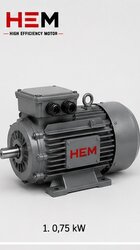

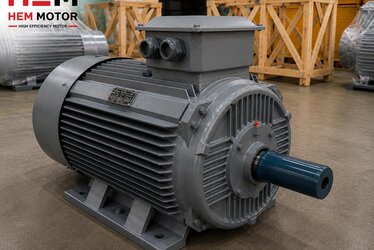
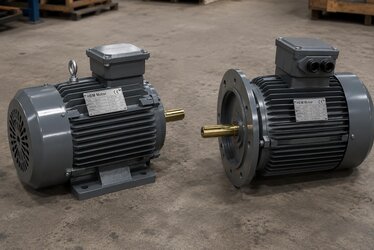
Crane, chain hoist and lifting (hoist) systems push an electric motor into one of the harshest operating regimes in industry. The load is taken from zero to full torque in seconds, the motor starts and stops hundreds or even thousands of times a day, and every stop sends an impact reaction into the housing the moment the brake grips. A standard motor selected for continuous duty (S1) overheats quickly under these conditions, fatigues its bearings and can develop faults reaching as far as housing cracks. A cast iron framed lifting motor, correctly sized for S4 intermittent duty and equipped with a brake, is designed precisely for this impact-loaded, high-starts-per-hour, high-inertia load profile. In this article we cover the role of the cast iron frame in lifting, why the S4 duty type is critical, how brake torque is selected, how to size power correctly under impact and shock loads, and what to watch during commissioning. Our aim is to base the purchasing decision not only on the power of the load to be lifted but on a holistic approach that weighs thermal load, inertia and brake torque together.
The Three Core Challenges a Lifting Application Imposes on the Motor
Three core mechanical and thermal challenges separate a lifting motor from an ordinary drive motor. Without understanding them correctly, neither power nor brake torque can be selected properly.
- High, repeated starting current: Every lift is a new start. At the start moment the motor draws current up to 5-7 times its rated value; the heat this current generates accumulates far more than in continuous running.
- Impact and shock load: Gripping the load, tensioning slack rope (snatch) and brake engagements reflect into the motor as sudden torque peaks. These peaks can be well above the average torque.
- High inertia: The hook, rope, drum and load together form a high inertia. Accelerating and stopping this mass strains both the motor and the brake.
These three challenges feed each other: high inertia lengthens the start, the longer start raises heat, the rising temperature fatigues the insulation. For this reason lifting motor selection is not a "power calculation" but a "thermal cycle and mechanical strength" calculation.
Why a Cast Iron Frame? Rigidity and Impact Resistance in Lifting
In a lifting application the motor is not just a power-producing component but also a mechanical carrier for the gearbox, brake and sheave assembly. Every lift and lower cycle applies bending, torsional and vibration loads to the housing. The cast iron (grey cast iron, GG/EN-GJL) frame offers far higher elastic modulus and mass damping than aluminium; it absorbs vibration, suppresses resonance and withstands the impact reaction of every brake engagement without turning it into structural damage.
- High rigidity: Shaft and bearing alignment is preserved even under heavy load, reducing coupling stress.
- Vibration damping: Cast iron has high internal friction; noise and resonance drop under impact loads.
- Thermal mass: Thick cast walls temporarily absorb the heat of frequent starts/stops, softening sudden temperature peaks.
- Mechanical strength: The repeated shock the brake transfers to the housing produces a lower fatigue-crack risk in a cast frame.
- Environmental resistance: In open-field, dusty foundry and humid harbour environments, a cast iron frame with suitable coating gives long life.
To explore in more detail why frame rigidity is a selection criterion under impact and heavy load, see our article on impact resistance and rigidity in cast iron frames. For continuous heavy-duty drive, our cast iron heavy-duty conveyor drive motor content is also useful. If you want to weigh cast iron versus aluminium frame in terms of environmental conditions, our cast iron or aluminium frame content helps you decide.
S4 Intermittent Duty: Starts per Hour and Inertia
The most important duty type defining lifting motors is S4: "intermittent periodic duty with starting losses". Unlike S1 continuous duty, S4 includes the high current at the start (acceleration) moment and the heat it generates in the duty definition. In a crane every lift is a new start; therefore the number of starts per hour (c/h) and the cyclic duration factor (CDF) are the foundation of correct motor selection. Unlike S3 duty, S4 explicitly includes starting losses; for this reason motors labelled S4, not S3, should be sought for lifting.
The following parameters are critical in S4:
- Starts per hour (c/h): Number of starts per hour. High c/h brings starting losses to the fore.
- Load inertia factor (FI): Ratio of the driven load inertia to the motor rotor inertia. High inertia lengthens the start and raises heat.
- CDF (%ED): Percentage of a cycle the motor spends under load (e.g. 25%, 40%, 60%).
- Cycle time: Total duration of one duty period. The standard usually references 10 minutes.
| CDF (%ED) | Max. starts (c/h) | Typical lifting application | Power correction trend |
|---|---|---|---|
| 15% | 60-90 | Maintenance crane, low usage | May be sized close to rated power |
| 25% | 90-150 | Workshop bridge crane | One power step up advised |
| 40% | 150-300 | Production line lifting | Exceed S1 power |
| 60% | 300-600 | Intensive process, continuous handling | Clear power increase + forced cooling |
On the heating limit and correct power selection in intermittent duty, our S1-S6 duty type selection and S7-S8-S9 braked and variable load articles complete the picture. On the IE3 side, you will find the heating limit in frequent start-stop in our IE3 S3/S4 intermittent duty content.
Braked Motor: Brake Torque Selection and Safety
In a lifting application the brake is not a comfort feature but a life-and-property safety component. The spring-applied (fail-safe) DC or AC brake, which prevents the load from free-falling when power is cut, connects directly to the motor shaft. Brake torque is selected according to the static holding moment of the load and the dynamic stopping requirement. In high-safety lifting where a single brake is insufficient, a dual (redundant) brake arrangement is also evaluated.
- Static holding: Brake torque is typically chosen as at least 1.5-2 times the moment the suspended load creates at the motor shaft.
- Dynamic stopping: Inertia and speed are taken into account to stop a moving load within a safe distance.
- Brake type: A spring-applied disc brake is closed when de-energised; this is mandatory in lifting.
- Air gap and wear: As the brake lining wears the air gap grows; periodic adjustment is essential.
- Manual release: A manual release lever must be present to lower the load in a controlled way during a power failure.
For braked motor supply and crane/conveyor applications see our IE4 braked motor for conveyor and crane, and for accessory options our IE3 brake, encoder and forced-fan options articles. For electrical braking methods for fast and safe stopping, see DC and dynamic braking in asynchronous motors.
Impact/Shock Load and High Inertia: Correct Power Selection
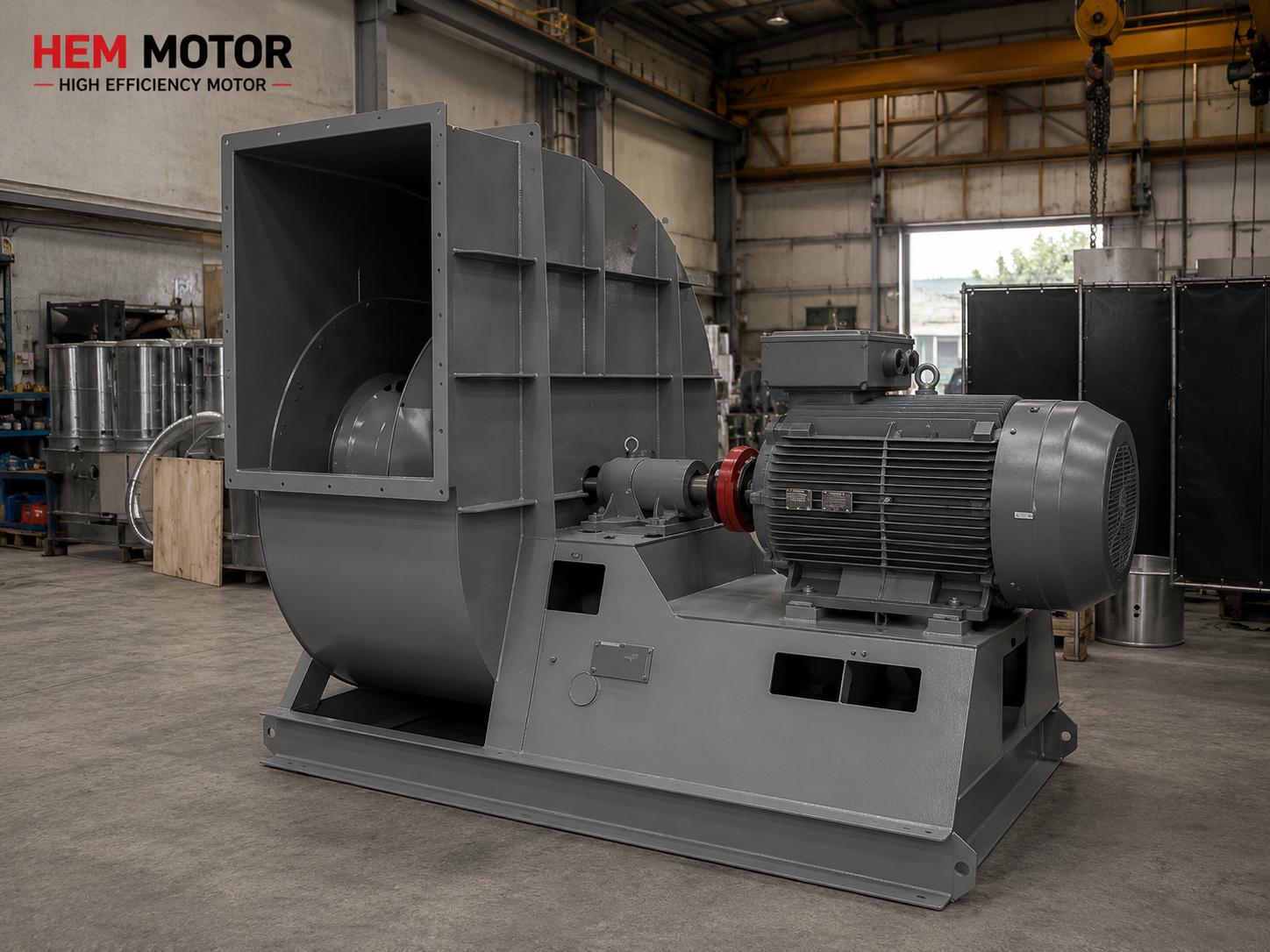
The most common mistake in lifting motor selection is sizing the motor only to the power of the load to be lifted. The deciding factors are actually the trio of thermal load (heat of frequent starts), starting torque (setting the load in motion) and inertia (accelerating the load). A hook/rope/load assembly with high inertia causes the motor to draw high current for a long time at start and to overheat. For this reason, even for the same lifting power, a larger motor may be needed as the number of starts rises.
The path to correct selection:
- Calculate the static lifting power of the load (mass, speed, mechanism efficiency).
- Apply a thermal power-increase factor based on CDF and c/h.
- Compare load inertia with rotor inertia and verify the start time.
- Add a forced (external) cooling fan at high starts per hour.
- If starting torque demand is high, support with a high-starting-torque design/drive.
- Do not exceed the maximum permitted inertia per start (from the manufacturer table).
| Load profile | Inertia trend | Starting torque demand | Recommended measure |
|---|---|---|---|
| Light hook, low load | Low | Medium | Standard braked motor |
| Bridge crane, medium load | Medium | High | Upper power step + brake |
| Heavy handling, shock load | High | Very high | Cast iron + forced fan + drive |
| Skip/hoist, mining type | Very high | Extreme | Heavy-duty, high-torque design |
For high starting torque and braked operation in mining and heavy-duty lifting, our mine shaft hoist and skip winch motor selection article deepens the topic. For crane lifting and pre-installation checks see our crane and chain hoist lifting motor supply content. To calculate rated torque from kW and speed, our rated torque calculation article is a practical reference.
Lifting with a Drive (VFD): Soft Start and Precise Positioning
In modern lifting systems the motor is increasingly used together with a variable frequency drive (VFD). The drive lowers the thermal load by limiting starting current, provides soft start and stop, positions the load precisely and, where needed, recovers energy through regenerative braking. However, in drive operation forced external cooling is often required at low speed because the motor's own fan cannot cool sufficiently.
- Soft start: Starting current is limited, grid surges and mechanical shock are reduced.
- Precise positioning: With encoder feedback the load is positioned to the millimetre.
- Torque at low speed: A forced fan is needed against cooling loss at constant torque.
- Regenerative braking: Energy generated during lowering can be fed to the grid or dissipated in a resistor.
The external cooling solution for continuous torque at low speed is in our IE4 motor external forced cooling fan article; recovering the energy generated during lowering is explained in our regenerative energy recovery content.
What to Watch During Commissioning and Maintenance
Even a correctly selected lifting motor fails quickly with wrong installation and maintenance. During commissioning and periodic maintenance the following points are critical:
- Measure the brake air gap and set it to the manufacturer value; monitor the wear margin.
- Check shaft-coupling alignment; misalignment shortens bearing life.
- Verify the lifting eyebolt and motor weight and plan safe handling.
- Bring terminal connection tightening torques to the manufacturer value; vibration causes loosening.
- Regularly clean forced-fan and filter dirt; blocked cooling leads to overheating.
For safe crane lifting, eyebolt and weight, our motor lifting eyebolt, weight and safe handling article; for terminal tightening torques, our cable connection and lug selection content offers a practical checklist.
Frequently Asked Questions
Which duty type (S code) should a lifting motor use?
Most crane and hoist applications fall under the S4 intermittent periodic duty type, because every lift is a new start and starting losses make up a significant part of the thermal load. Correct power cannot be selected without determining the starts per hour (c/h) and cyclic duration factor (CDF). For very irregular and variable loads, S7-S8-S9 can also be evaluated.
How large should the brake torque be?
Brake torque is typically chosen as at least 1.5-2 times the static moment the suspended load creates at the motor shaft; dynamic holding capable of stopping a moving load within a safe distance must also be provided. A spring-applied (fail-safe, closed when de-energised) brake is mandatory in lifting; the load must not free-fall when power is cut.
Why is a cast iron frame preferred?
The cast iron frame absorbs the impact reaction of every brake engagement and the load vibration without turning them into structural damage. Its high rigidity preserves shaft-bearing alignment, its high internal damping suppresses resonance, and the thermal mass of the thick walls softens temperature peaks during frequent start-stop. For this reason cast iron is standard in heavy, impact-loaded lifting.
Is a drive (VFD) mandatory on a lifting motor?
It is not mandatory but offers strong advantages: soft start lowers the thermal load, provides precise positioning and recovers energy through regenerative braking. In drive operation a forced external cooling fan is often needed because the motor's own fan is insufficient at low speed.
Lifting Motor Supply with HEM Motor
For your crane, chain hoist and hoist applications we supply cast iron framed motors suitable for S4 duty, braked and with forced cooling where needed, with fast delivery from the manufacturer. Share your CDF, starts-per-hour, load inertia and brake torque requirements; let us determine together the most accurate lifting motor for your application. With the right duty type, the right brake torque and the right power selection, secure both safety and motor life. Contact us for stock status and fast delivery, and request a quote tailored to your project.