English
 Türkçe

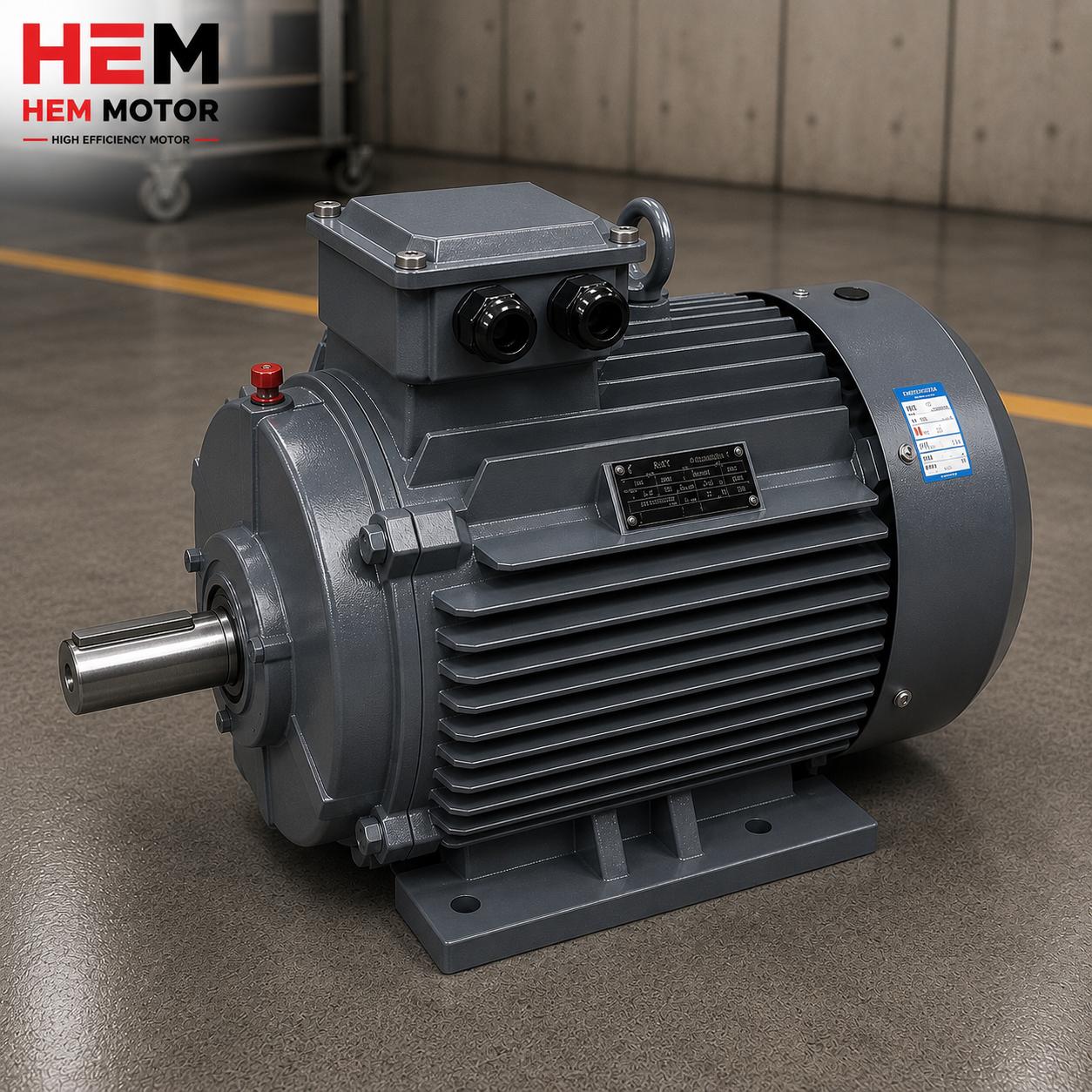

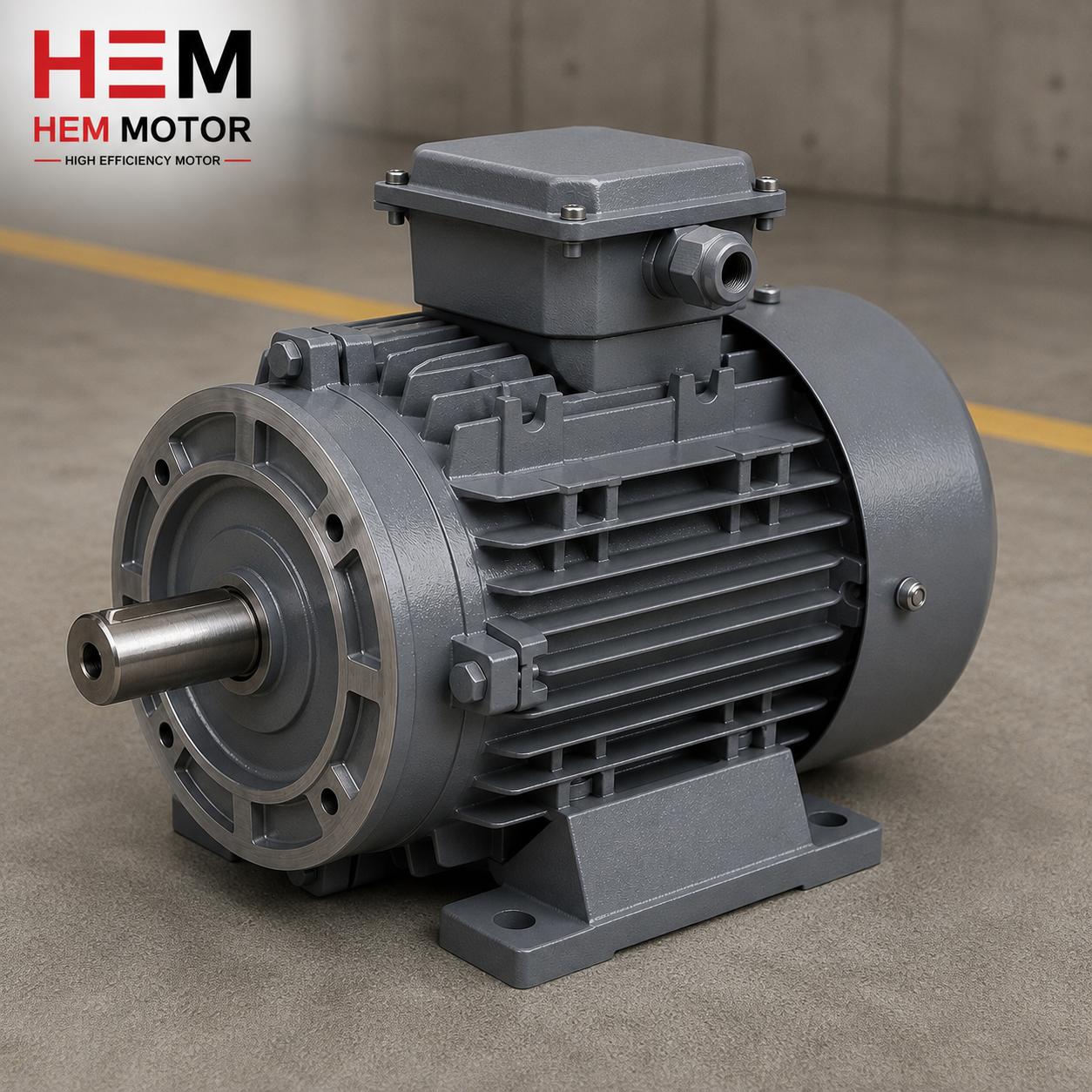
45 kW and 55 kW motors sit in industry's most in-demand medium-to-high power class. Frequently found in pumps, fans, compressors, conveyors, crushers and line drives, these ratings fall under the IE3 efficiency mandate, so they are now supplied as standard in the IE3 premium-efficiency class. Because this power range is both widely used and expected on short notice, the trio of correct pole-speed, correct frame and delivery from stock is at the center of the purchasing decision. At HEM Motor, this article covers the 2/4/6-pole speed options of 45 and 55 kW IE3 motors, typical frame sizes (around 225/250/280), what the IE3 mandate means, mounting compatibility and a practical roadmap for correct procurement. The goal is to help you procure these high-demand ratings correctly and quickly the first time.
Where Are 45 and 55 kW Used?
This power class is the backbone of mid-scale industry. Centrifugal pumps, large fans and exhausters, screw compressors, belt and chain conveyors, granulator and mill drives, extruder and press applications all run on these ratings. Because they run continuously and at high load, the efficiency class directly affects energy cost, which shows why IE3 and, where possible, a higher class matter. At this power the rated current is on the order of tens of amperes, so cable cross-section, protection device and starting method must be planned together with the selection.
- 2 pole (~3000 rpm): High-speed pump, fan and compressor.
- 4 pole (~1500 rpm): The most common choice; general drive, pump, conveyor.
- 6 pole (~1000 rpm): Low-speed, high-torque; mixer, mill, some fans.
The IE3 Mandate: Why Did Premium Efficiency Become Standard?
IE3 denotes the "premium efficiency" class according to the IEC 60034-30-1 standard. It has been made mandatory by regulation for three-phase induction motors in certain power ranges to be in the IE3 class; 45 and 55 kW are right in the middle of this mandate and among the most commonly used ratings. An IE3 motor reduces its losses compared to a lower-efficiency motor, heats up less, and provides clear savings on the energy bill in a plant running thousands of hours a year. So in new installations and motor replacements, IE3 is no longer a preference but a standard.
- IE3 means lower loss, less heating and longer insulation life.
- On a continuously running motor, the efficiency difference quickly outweighs the purchase cost.
- When used with a VFD, the savings increase further.
- An IE3 motor is largely compatible mechanically and in mounting with previous classes.
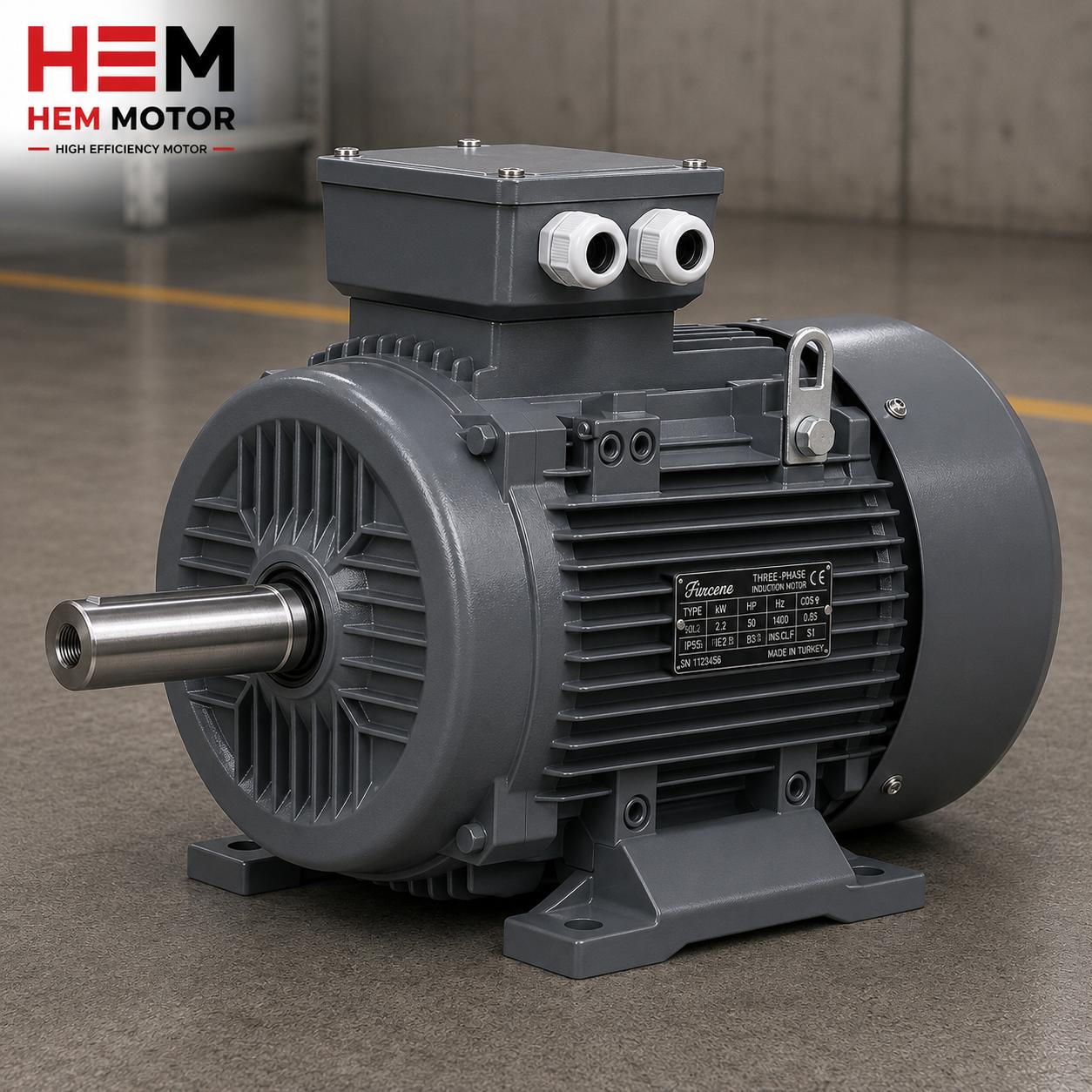
45/55 kW Power-Pole-Speed-Frame Map
At this power the frame size varies with power and pole count. In general, 45 and 55 kW motors concentrate around the 225, 250 and 280 frames; as the pole count rises (speed drops), the frame grows for the same power because torque increases. The table below summarizes typical approximate matches; exact frames and dimensions are confirmed by the production series.
| Power | Pole | Synchronous Speed | Typical Frame (IEC) | Typical Application |
|---|---|---|---|---|
| 45 kW | 2 | 3000 rpm | 225 | High-speed pump/compressor |
| 45 kW | 4 | 1500 rpm | 225 | General drive, conveyor |
| 45 kW | 6 | 1000 rpm | 250 / 280 | Low speed, high torque |
| 55 kW | 2 | 3000 rpm | 250 | Large fan/compressor |
| 55 kW | 4 | 1500 rpm | 250 | Pump, press, general drive |
| 55 kW | 6 | 1000 rpm | 280 | Mixer, mill |
Speed is selected according to the speed the application requires. It is possible to get the same power at different speeds, but torque and frame change; so the frame should not be finalized before the speed need of the driven machine is clarified.
Starting: The Right Start Method at 45/55 kW
45 and 55 kW are above a threshold where direct-on-line (DOL) starting can strain the grid; at this power the starting current reaches 6-7 times the rated current and can cause voltage dips, mechanical shock and coupling stress. So a suitable starting method must be chosen according to the plant infrastructure and the application. The options are:
- Star-delta: The economical classic method; reduces the starting current to about one third, but there is a current surge at the transition moment and it is weak under high-inertia loads.
- Soft-starter: Provides a smooth start by raising the voltage along a ramp; reduces mechanical shock and grid impact and offers a soft-stop capability.
- VFD (variable frequency drive): Provides both a smooth start and full speed control plus energy saving; ideal in variable-load pump and fan applications.
- Direct (DOL): Used only if the grid and mechanical system allow, in simple low-inertia applications.
The starting method should be planned together with the motor; especially for VFD operation, the motor having an inverter-duty winding and the thermal protection being connected correctly are important. How many times per hour it will start must also be compatible with the motor's thermal capacity; otherwise the winding is thermally stressed.
Stock and Fast Supply: Why Are 45/55 kW Advantageous?
Because 45 and 55 kW are among the most sought-after medium-to-high powers, at the right supplier they can usually be supplied from stock or on a short lead time. This is a great advantage for businesses that want to move quickly without delaying the project. Fast replacement of a failed motor minimizes production loss. At HEM Motor, we offer fast delivery from manufacturer stock and a wide pole-frame choice in these high-demand ratings.
- The most common 4-pole 45/55 kW is usually supplied quickly from stock.
- 2- and 6-pole options are provided on a short lead time per application.
- Foot (B3), flange (B5) and combined (B35) mounting options are offered.
- A spare-motor strategy shortens downtime on critical lines.
IE3 or a Higher Efficiency Class?
Although IE3 is the mandatory minimum class at 45 and 55 kW, a higher efficiency class (IE4) may be worth considering in applications running continuously at high load. An IE4 motor reduces its losses even further than IE3 and provides extra savings over long running hours; however, its purchase cost is higher. This decision should be made through a payback calculation based on the motor's annual running hours, the energy unit price and the application's load profile.
- Continuous high load running many hours a year: the extra IE4 saving can cover the price difference quickly.
- Few running hours or spare motors: IE3 is usually the most sensible choice.
- Variable load with a VFD: both IE3/IE4 and flow control are evaluated together.
- The decision should be made on the real operating profile, not the label efficiency.
Mounting and Mechanical Compatibility
At this power the motor's mechanical compatibility is as important as the electrical selection. The mounting type (foot B3, flange B5, combined B35), shaft diameter, key size and foot/flange hole spacing must match the driven machine exactly. Especially when replacing an old motor with a new one, the frame and mounting dimensions should be confirmed from the nameplate and frame table. A wrong mounting dimension requires an adapter or a new foundation in the field and leads to lead-time loss.
- Mounting type and flange/foot dimensions must match the existing connection.
- Shaft diameter and key must be chosen to match the coupling or pulley.
- Protection class (IP55 standard, IP65/66 in dusty/wet environments) must be set correctly.
- A PTC/PT100 sensor option should be requested for thermal protection.
Efficiency, Energy Cost and Payback
On continuously running motors like 45 and 55 kW, the energy cost is far beyond the purchase price. On a motor running thousands of hours a year, even the few-point difference between efficiency classes translates into tens of thousands of kilowatt-hours of consumption per year. An IE3 motor reduces this consumption with its lower losses and usually pays back the price difference quickly. So when deciding on the investment, the right approach is to look not only at the motor's price but at the total cost of ownership over five to ten years.
In VFD applications the saving doubles: the motor efficiency is high and the pump/fan flow is reduced to the need, avoiding unnecessary consumption. On centrifugal pumps and fans, lowering the speed a little reduces the power demand much more because of the cubic law. So in variable-load applications an IE3 motor and a VFD should be considered together, yielding a double benefit for both starting and energy.
- On a continuously running motor, the efficiency difference quickly outweighs the price difference.
- Flow control with a VFD under variable load provides large savings thanks to the cubic law.
- Correct sizing matters; an oversized motor runs inefficiently at low load.
- Power factor correction (compensation) reduces grid penalties and losses.
Checklist for Correct Procurement
To buy a 45/55 kW IE3 motor right the first time, the following items must be clarified:
- Power (45 or 55) and pole/speed (2/4/6), according to the application torque and speed need.
- Frame (225/250/280) and mounting type (B3/B5/B35), shaft diameter and key.
- Voltage and frequency (400 V, 50 Hz; 690 V or 60 Hz if needed), star-delta suitability.
- Efficiency class IE3 (mandatory) and protection class (IP55+).
- Starting method (direct, star-delta, soft-starter, VFD) and required accessories.
- Thermal sensor, terminal box orientation and other options.
Frequently Asked Questions
Which pole is most common in a 45/55 kW motor?
4 pole (1500 rpm) is the most common choice at this power; most general drive, pump and conveyor applications run with 4 pole. For pumps/compressors needing high speed, 2 pole is preferred, and for mixers/mills needing low speed and high torque, 6 pole is preferred.
Can I buy a lower-efficiency motor instead of IE3?
In this power range IE3 is mandatory by regulation; a lower efficiency class is not allowed for new sales. Moreover, IE3 pays for itself quickly through energy savings on a continuously running motor, so it is also the economically correct choice.
Can I get a 45/55 kW motor quickly from stock?
Because these are among the most sought-after medium-to-high powers, the 4-pole versions in particular can usually be supplied from stock or on a short lead time. When you apply with clear ratings and mounting information, a fast quote and delivery are possible.
Conclusion and Supply
45 kW and 55 kW IE3 motors are among the most widely used medium-to-high powers in industry; with the correct pole-speed, correct frame and fast stock supply you can procure these ratings smoothly and quickly. The IE3 mandate has made this class standard both for regulation and for energy savings. At HEM Motor we offer fast delivery from manufacturer stock, a wide pole-frame choice and application-specific technical support for 45/55 kW IE3 motors. Reach us with your application's power, speed and mounting information; let us choose the right IE3 motor together and prepare a tailored quote for you.
Related guides: IE3 Motor Stock Guide: Power and Speed, IE3 30 and 37 kW Stock Speed-Pole, IE3 Motor Shaft and Frame Table, IE3 Efficiency Class Mandate and Rated Current, Cable, Fuse and Contactor.