English
 Türkçe

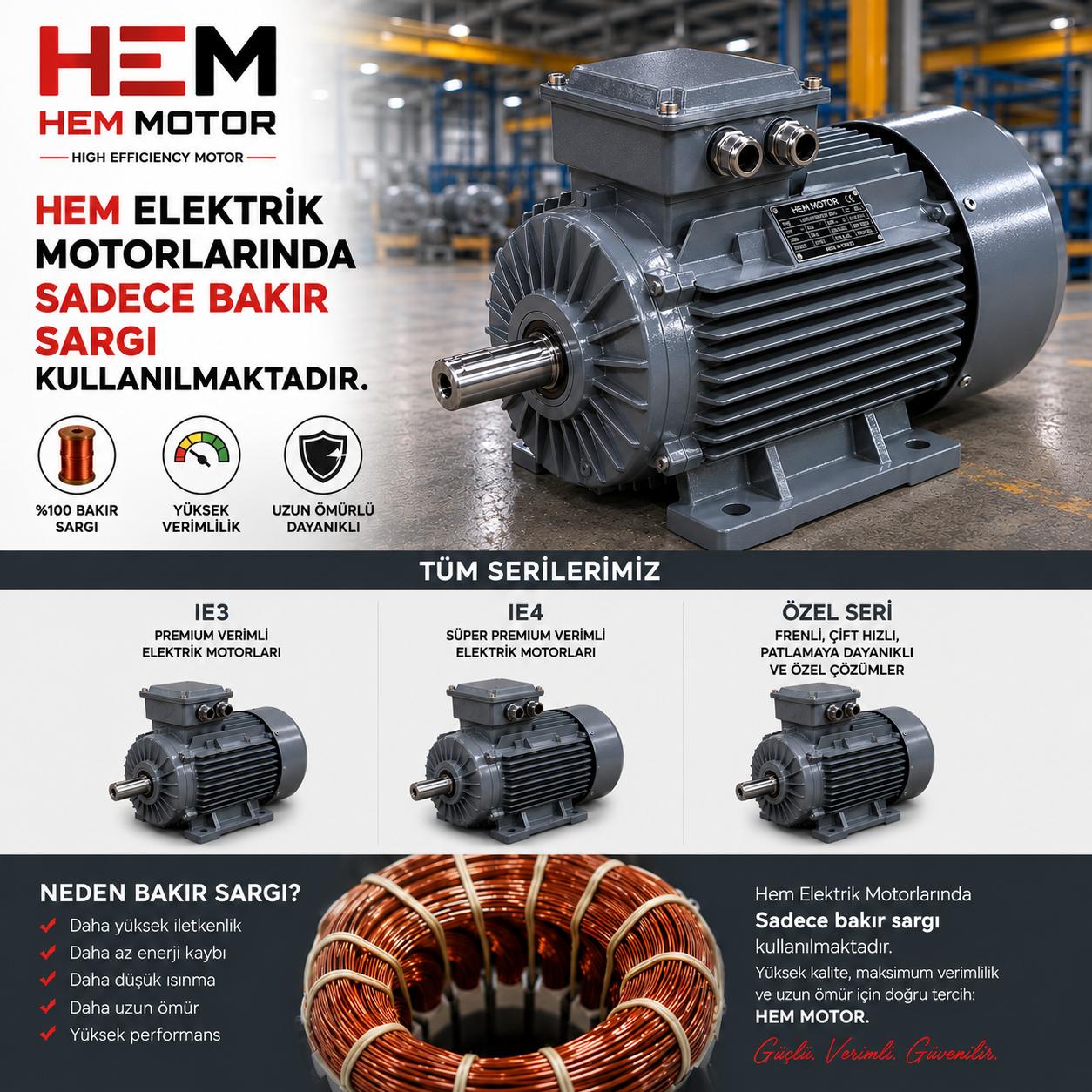

The service factor (SF) is a multiplier showing how far above its rated power an asynchronous motor can operate, briefly or continuously. A motor marked "SF 1.15" on its nameplate can carry 15% more than its rated power under certain conditions. In many purchasing decisions the service factor is misunderstood: some users treat SF as a free power reserve and run the motor continuously at that limit; others ignore SF altogether. The truth is that, understood correctly, the service factor is a valuable engineering margin, but used incorrectly it is a leading cause of premature failure and winding burnout. In this guide we cover the service factor through the SF 1.0 vs SF 1.15 distinction, the relationship between continuous overload temperature rise and life, the NEMA and IEC approaches, and "when not to trust SF", so you can size the motor correctly without treating SF as spare capacity.
What Exactly Is the Service Factor?
The service factor is the multiplier that, applied to the rated power, gives the maximum power the motor can deliver continuously without overheating. For example, a 4 kW SF 1.15 motor can theoretically be loaded up to 4 × 1.15 = 4.6 kW. But this extra power does not come for free:
- Temperature rises: A motor running at the SF limit heats up more than at rated load; winding temperature climbs.
- Efficiency and power factor drop: At overload the motor moves outside its rated point; efficiency and cosφ recede somewhat.
- Speed drops a little more: As load rises, slip increases and actual speed falls below rated speed.
- Life shortens: Continuous running at the SF limit shortens insulation life.
So SF is a buffer to cover short-term load peaks; it is not a continuous operating point. We also covered service factor and overload capacity specifically for IE3 motors in our article on service factor and overload capacity.
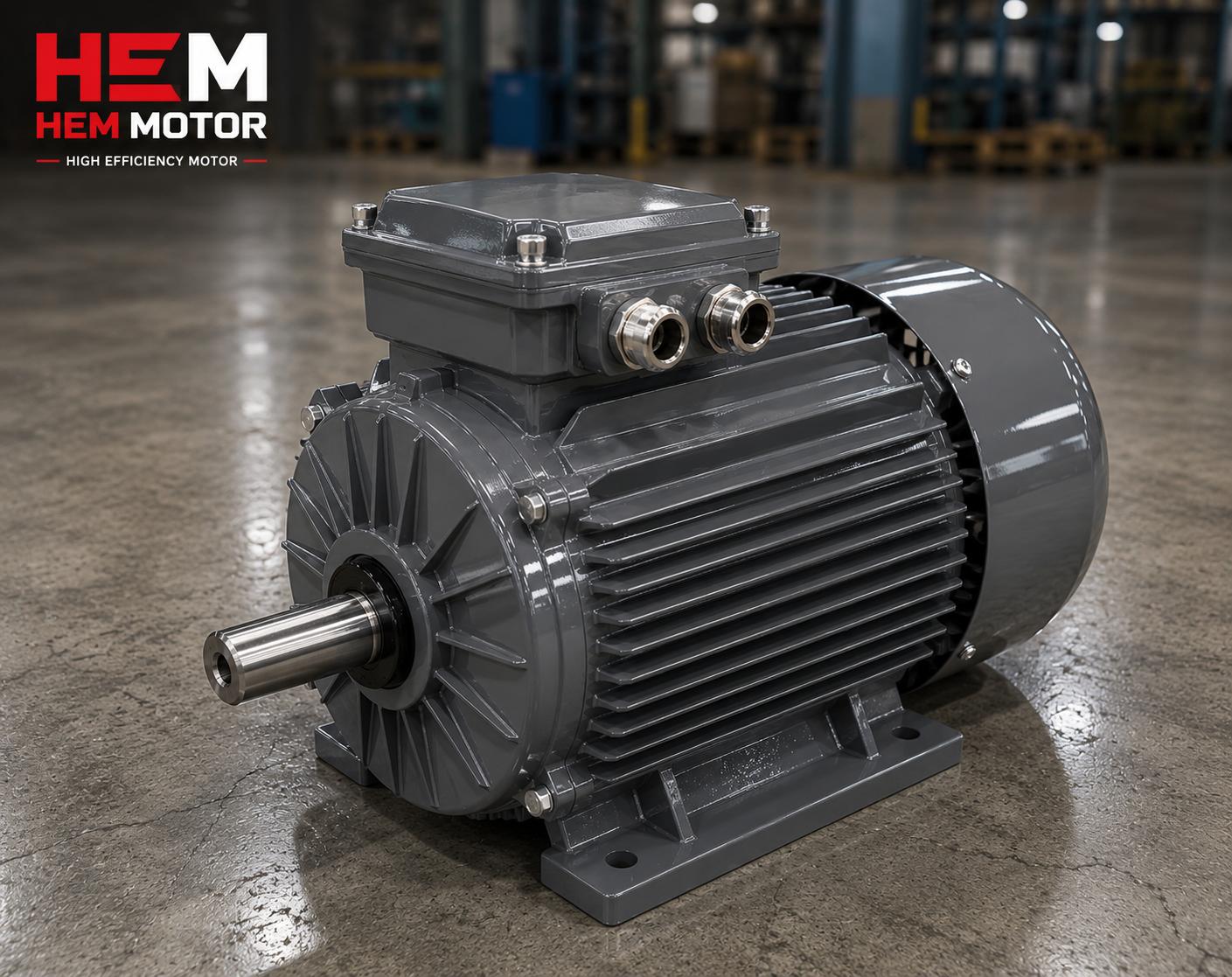
SF 1.0 vs SF 1.15: The Difference
The two most common values on the market are SF 1.0 and SF 1.15. The difference between them determines how much overload peak the motor can tolerate:
| Property | SF 1.0 | SF 1.15 |
|---|---|---|
| Continuous load limit | Rated power (100%) | Rated power (100%) |
| Short-term margin | None | 15% extra margin available |
| Tolerance to load peaks | Low | High |
| Typical use | Steady, predictable load | Pulsating, variable load |
| Thermal safety margin | Narrow | Wide |
Note: even with SF 1.15, the motor's continuous operating point is still the rated power. SF does not mean "run continuously at 115%"; it defines the margin by which the winding can survive sudden load peaks without burning. In practice, think of the 15% margin on an SF 1.15 motor as a seat belt against unexpected load increases.
Temperature Rise and Life Under Continuous Overload
The life of motor insulation depends directly on winding temperature. By the widely accepted "10°C rule", running continuously 10°C above the temperature allowed by the insulation class roughly halves insulation life. Continuous operation at the service factor limit can push winding temperature into this critical range.
| Operating Point | Winding Temperature Trend | Estimated Life Effect |
|---|---|---|
| 75% load | Below rated | Above rated life |
| 100% load (rated) | At design limit | Design life (reference) |
| 110% load | Marked rise | Shortening begins |
| 115% load (SF limit, continuous) | At/above limit | Marked shortening |
This table shows that continuous operation at the SF limit, even if it causes no short-term problem, consumes insulation life over the long term. You can find the insulation class (F/H) and temperature rise relationship in our article on insulation and thermal class, and the heating limit on intermittent loads in our article on S3/S4 intermittent duty.
NEMA and IEC: Two Different Service Factor Approaches
The service factor concept is handled slightly differently in the NEMA (North America) and IEC (Europe/international) standards:
- NEMA approach: The service factor is traditionally stated explicitly on the nameplate of NEMA motors, and SF 1.15 is common on general-purpose motors. SF is defined as a margin for continuous overload operation, but it is accepted that temperature rise is higher when running at the SF limit.
- IEC approach: Operation in IEC motors is defined more through duty types (S1-S9) and temperature-rise classes. The service factor is not always emphasized; most standard IEC motors are taken as SF 1.0, and overload capacity is managed through duty type and thermal class.
This difference matters in export projects and multi-country facilities: if you directly replace a NEMA SF 1.15 motor with an SF 1.0 IEC motor, you may lose the expected overload margin. We examined how the NEMA derating curve is applied in cases such as voltage unbalance in our article on derating under voltage unbalance.
When Should You Not Trust SF?
The service factor erodes quickly when certain conditions are violated. In the following cases you should not rely on the SF margin:
- High ambient temperature: SF values are usually given for a 40°C ambient. In a hotter ambient the thermal margin is already consumed; trusting SF is dangerous.
- High altitude: Above 1000 m the air thins and cooling weakens; the SF margin shrinks. We explained how to handle this in our article on derating at high altitude.
- Voltage/frequency deviation: Low voltage or unbalance heats the motor more; the SF margin erodes.
- Drive operation: Harmonics in a VFD supply cause extra heating; most manufacturers void SF in drive operation.
- Continuous SF limit: SF is for short peaks; running continuously at the SF limit consumes life.
Correct Sizing: Not Treating SF as Spare Capacity
The correct engineering approach is to select the motor for its real continuous load and treat the service factor as a buffer for unexpected peaks, not to cover the continuous load with the SF margin. So if you have a 4.6 kW continuous load, instead of saying "I'll get a 4 kW SF 1.15, it'll manage", the right choice is to select a motor rated 5.5 kW directly. The motor then runs inside its rated point, cooler and with longer life, while the SF margin remains reserved for genuine emergencies. We covered correct sizing, accounting for efficiency loss at low load, in our article on part and low load efficiency.
Frequently Asked Questions
Can I run an SF 1.15 motor continuously at 115% load?
No. SF 1.15 does not mean the motor's continuous operating point is 115%. The continuous operating point is still rated power (100%). The 15% margin is a safety reserve for sudden, short-term load peaks that the winding can survive without burning. Running continuously at the SF limit raises winding temperature and markedly shortens insulation life.
Is a motor with a higher service factor always better?
Not necessarily. A high SF is a valuable margin on pulsating and variable loads; but on a steady, predictable load a correctly sized SF 1.0 motor is perfectly adequate. What matters is selecting the motor for its real continuous load and treating SF as an emergency buffer, not as a way to cover the continuous load.
Does the service factor apply when running on a VFD?
Usually not. Because harmonics in a drive supply cause extra heating in the motor, most manufacturers void or reduce the SF margin in drive operation. In a drive application the correct approach is to size the motor to rated load, even with some thermal margin if needed, and not rely on SF.
The Relationship Between Service Factor and Duty Type (S1-S9)
The service factor should not be evaluated alone; it should be considered together with the motor's duty type (S1-S9). The duty type defines the motor's load-time profile: S1 continuous, S2 short-time, S3 intermittent periodic, S6 continuous-operation periodic duty, and so on. The service factor margin mainly gains meaning in S1 continuous operation, where it covers sudden load peaks. However, in duties with frequent start-stop such as S3/S4, the determining factor is thermal behavior and the SF margin can be misleading.
- S1 (continuous): The SF margin applies in its classic sense; it provides a buffer for short load peaks.
- S3/S4 (intermittent): The cyclic duration factor and number of starts are decisive; instead of relying on SF, selection should be made per duty type.
- S6 (continuous intermittent loaded): A loaded and no-load running cycle; average heating must be taken into account.
Correctly defining the duty type is a prerequisite for correctly interpreting the service factor. Relying on SF 1.15 in a frequent start-stop application can thermally overstress the motor.
Confusion Between Starting Torque, Overload and SF
The service factor is often confused with starting torque or pull-out torque; yet these are different concepts. The service factor defines the continuous/semi-continuous power margin, while pull-out torque shows the maximum torque the motor can withstand instantaneously. A motor can withstand short-term overtorques up to its pull-out torque; but this does not mean it can run continuously at the SF limit.
- Service factor: Continuous power margin (thermal concept).
- Pull-out torque: Instantaneous maximum torque capacity (mechanical concept).
- Starting torque: The motor's capacity to set the load in motion.
In correct motor selection all three parameters should be evaluated per the application. Pull-out torque margin stands out for pulsating loads; SF for the possibility of continuous overload; and starting torque for heavy starts.
Practical Examples of Using SF Correctly
To translate theory into practice, let us look at a few typical scenarios. These examples show when the service factor is valuable and when it is misleading:
| Scenario | SF Approach | Correct Decision |
|---|---|---|
| Steady-load pump, below 40°C ambient | SF 1.0 sufficient | Select for rated power |
| Conveyor with occasional load peaks | SF 1.15 valuable | Margin as emergency buffer |
| Crusher with expected continuous 110% load | Do not rely on SF | Select one power class up |
| Variable speed on a VFD | SF usually voided | Size by thermal margin |
| High altitude / hot ambient | SF eroded | Apply derating, reduce margin |
These examples set out a clear principle: SF is a safety margin for unforeseen short peaks; it is not a way to cover the continuous load. Correct sizing always starts from the real continuous load.
The Cost of Over- and Under-Sizing
Under-sizing the motor by leaning on the SF margin may look cheap in the short term but becomes expensive in the long run: winding burnout, unplanned downtime and premature replacement. Conversely, over-sizing also creates cost; a much larger motor recedes in efficiency and power factor at low load, and the initial investment rises. The right balance is to select the motor just above the real continuous load, leaving a sensible margin.
- Under-sizing: Overheating, short life, unexpected failure.
- Over-sizing: Efficiency and cosφ loss at low load, high initial cost.
- Correct sizing: Operation near the rated point, long life, best efficiency.
The Relationship With Insulation Class and Temperature Rise
At the heart of using the service factor correctly lies understanding the motor's insulation class and allowed temperature rise. Common insulation classes B (130°C), F (155°C) and H (180°C) define the maximum winding temperature. Although most modern motors have class F insulation, they are designed to a class B temperature rise; this leaves a thermal margin on the winding in normal operation. This margin forms the reserve usable for the service factor and ambient conditions.
- Class F insulation, class B rise: The most common combination; provides a wide thermal margin in normal operation.
- Class H insulation: Offers extra margin for high-temperature environments and heavy duty.
- Thermal margin: This margin can be consumed by high ambient temperature, altitude or SF load; all are spent from the same reserve.
The critical point is this: the thermal margin is a limited resource. If high ambient temperature, altitude and continuous SF load are all demanded at once, the margin erodes and winding temperature reaches a dangerous limit. Therefore the service factor is not an isolated power reserve; it is part of a shared thermal budget split with ambient conditions. Correct engineering requires planning this budget from the start.
Positioning SF Correctly in the Purchasing Decision
At the purchasing stage, the service factor should be seen as an engineering tool, not a marketing promise. A high-SF motor is always more expensive; this extra cost is only meaningful in a genuinely pulsating, variable-load application. In a steady-load application, a correctly sized standard motor is both more economical and sufficient.
- Analyze the load: First determine the application's real load profile (steady or pulsating).
- Base it on continuous load: Select the motor just above the continuous load; keep SF as an extra margin.
- Evaluate the environment: If temperature and altitude consume the margin, do not rely on SF; apply derating.
- Watch out if a drive is present: SF is usually void in a VFD system; select by thermal margin.
With this approach, you neither buy an unnecessarily large and expensive motor, nor risk under-sizing by leaning on the SF margin. A correctly positioned service factor protects both the motor's life and the operating economics.
Source a Correctly Sized Motor from Stock
Understanding the service factor correctly lets you choose a motor that is neither too small nor too large, which means both energy efficiency and long life. As HEM Motor we offer correctly sized motors across various service factors and duty types from manufacturer stock with fast delivery. To determine the motor that fits your load profile together and to request a tailored quote, get in touch; our technical team will assess SF and thermal margin for your application.