English
 Türkçe


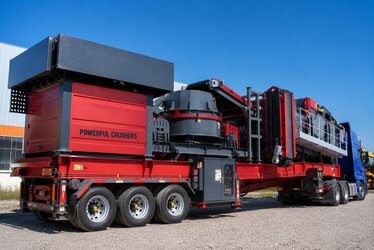
Crusher (stone crushing) plants present one of the harshest working environments in industry: high impact loads, constant dust, heavy oscillations and long running hours. Under these conditions, an unexpected stop of the main crusher motor means not just that motor stopping, but the entire line halting from feeder to screen. The cost of unplanned downtime is often many times the price of a motor. This is exactly where vibration monitoring and predictive maintenance come in: by continuously measuring the health of the motor and the drive train, they warn of a fault days or even weeks before it fully develops. In this guide we cover vibration monitoring on crusher motors through accelerometer sensor selection, FFT-based detection of bearing damage, unbalance and looseness, ISO 20816 trend tracking, temperature monitoring, and reducing downtime cost through early fault detection, so that with the right monitoring strategy you can turn unplanned stops into planned maintenance.
What Is Predictive Maintenance and Why Is It Critical on Crushers?
Maintenance strategies fall into three core approaches: reactive maintenance that responds after failure, scheduled periodic maintenance, and predictive maintenance that decides by measuring condition. In heavy, continuously running plants such as crushers, predictive maintenance stands out because:
- Downtime cost is very high: A stopped main crusher halts the whole line; the hourly loss is large.
- Faults develop gradually: Bearing damage, unbalance and looseness progress over weeks, not suddenly; they leave early traces in vibration.
- Access is difficult: Continuous manual checking is hard in a dusty, noisy environment; continuous sensor monitoring is more reliable.
- Planned downtime is cheap: Knowing a fault in advance lets you shift maintenance to a low-production period.
We covered the general approach to reducing motor failure and downtime cost in a crusher plant in our article on motor failure and downtime cost. Correct motor selection is the first link in this chain; our article on electric motor selection for crushers guides this.
The Accelerometer Sensor: What, Where, How?
The core sensor of vibration monitoring is the accelerometer. It measures the vibration acceleration of the motor housing, from which velocity (mm/s) and displacement (µm) can be derived. Sensor placement is critical on a crusher motor:
- Location: Sensors are usually placed at both bearing zones (motor drive-end and non-drive-end), in both radial and axial directions.
- Mounting: The most reliable mounting is direct stud fixing to the housing; magnetic mounting is used for spot measurements but reduces high-frequency response.
- Frequency range: Early bearing damage appears at high frequency (kHz), so a wide-band accelerometer is needed.
- Environmental durability: In the dusty, humid, impact-prone crusher environment, the sensor and cable must be IP-protected and mechanically robust.
For continuous monitoring, fixed-mounted sensors connect to a monitoring unit; for periodic checks, a handheld vibration meter can be used. The ideal strategy is a fixed sensor on the critical main crusher and periodic measurement on auxiliary motors.
FFT Analysis: Reading the Fault From Frequency
Although the vibration signal looks complex in the time domain, when it is split into frequency components by FFT (Fast Fourier Transform) each fault leaves its own fingerprint. Growing peaks at specific frequencies show which component is degrading:
| Fault Type | Typical Frequency Signature | Symptom | Likely Cause |
|---|---|---|---|
| Unbalance | 1x running frequency | Dominant high peak at 1x | Pulley/rotor balance loss, buildup |
| Misalignment | 1x and 2x running | Clear peak at 2x, axial vibration | Coupling/pulley misalignment |
| Mechanical looseness | 1x and its harmonics (2x,3x...) | Many harmonic peaks | Loose bolt, worn bearing seat |
| Bearing damage | Bearing pass frequencies (BPFO/BPFI), high frequency | Envelope peaks at high frequency | Ball/race damage, loss of lubrication |
| Electrical fault | 2x line frequency (100 Hz) | Peak at 100 Hz | Air-gap asymmetry, winding issue |
Envelope analysis is especially valuable for catching bearing damage early; while damage is still superficial, the bearing produces impact traces at high frequency. We covered bearing life and replacement logic in our article on bearing replacement, and the greasing interval in our article on bearing greasing and lubrication.
Trend Tracking and Acceptance Limits With ISO 20816
It is essential to evaluate vibration not by a single measurement but by its trend over time. The ISO 20816 standard (former ISO 10816) defines zone limits for machine vibration velocity (mm/s RMS): zone A (new/good condition), B (acceptable, suitable for continuous running), C (restricted, must be monitored), D (harmful, risk of damage). On a crusher motor, vibration velocity climbing over time from A to B and on to C is a strong sign of a developing fault.
- Trend, not absolute value: Even if a single high value triggers an alarm, what really matters is the rising tendency of the value.
- Baseline: The first measurement taken while the motor is healthy is the reference; deviation is judged against this line.
- Alarm and trip levels: Warning and shutdown thresholds are defined per the ISO zone limits.
We covered the role of vibration and balance acceptance values in correct motor selection in detail in our article on vibration and balance ISO 10816/20816. For monitoring to be valuable, it is important to start with a low-vibration, well-balanced motor.
Temperature Monitoring: The Second Eye Completing Vibration
While vibration catches mechanical faults early, temperature monitoring catches thermal issues (overload, loss of cooling, bearing heating, winding problems). Used together, they form a far more robust predictive picture:
- Winding temperature: Winding temperature is continuously monitored via PT100 or PTC thermistor; a sudden rise gives early warning.
- Bearing temperature: Bearing-zone temperature shows heating from loss of lubrication and overload.
- Thermal camera: Periodic thermography scans connection, terminal and bearing points.
We explained how to set up winding temperature monitoring with PT100 and thermistors in our article on motor temperature monitoring. When vibration and temperature are monitored together, both mechanical and thermal faults are caught early.
How Does Early Fault Detection Reduce Downtime Cost?
The core gain of predictive maintenance is turning a fault into planned maintenance. When the vibration trend enters zone C, the maintenance team can replace the bearing at the next planned stop; the motor does not stop unexpectedly in the field. This both eases spare-parts logistics and minimizes production loss. We examined the importance of vibration and balance quality acceptance limits on IE4 super premium motors in our article on vibration and balance (ISO 20816) quality acceptance; low initial vibration also makes predictive monitoring easier.
Frequently Asked Questions
Which vibration sensor should be used on a crusher motor?
The most common and reliable choice is a wide-band accelerometer. Because early bearing damage appears at high frequency (in the kHz range), the sensor must have good high-frequency response and be fixed directly to the housing with a stud mount. In the dusty, impact-prone crusher environment, the sensor and cable should also be IP-protected and mechanically robust.
How does FFT analysis reveal a bearing fault?
FFT splits the vibration signal into frequency components. Bearing damage creates peaks at pass frequencies tied to the bearing geometry (such as BPFO/BPFI) and in the high-frequency envelope region. The growth of these peaks over time shows the bearing is degrading before damage fully develops, so replacement can be shifted to a planned stop.
Why is ISO 20816 trend tracking more valuable than a single measurement?
Because machines have a natural vibration level and a single measurement can be misleading. ISO 20816 divides vibration velocity into zones A/B/C/D; what really matters is how the value rises over time from a healthy baseline. A rising trend is the most reliable sign of a developing fault and allows maintenance to be planned in advance.
Continuous Monitoring or Periodic Measurement?
Vibration monitoring is done by two core methods: continuous (online) monitoring with fixed sensors, and periodic (offline) measurement with handheld devices. Which to choose depends on the motor's criticality and downtime cost. Because the main crusher motor is critical in a crusher plant, a continuous monitoring investment more than pays for itself here; for auxiliary motors, periodic measurement may suffice.
| Feature | Continuous (Online) Monitoring | Periodic (Offline) Measurement |
|---|---|---|
| Sensor | Fixed-mounted, connected to a monitoring unit | Handheld, attached during measurement |
| Data frequency | Continuous/real-time | At set intervals (weekly/monthly) |
| Catching sudden faults | High (instant alarm) | Low (missed between measurements) |
| Initial investment | High | Low |
| Best suited to | Critical main crusher | Auxiliary motors |
The ideal strategy is often a combination of the two: continuous monitoring on critical motors, periodic scanning on secondary equipment. This keeps cost under control while continuously securing the most critical point.
Other Links in the Crusher Drive Train
Vibration monitoring should cover not just the motor but the whole drive train; because a fault often originates not from the motor itself but from connected elements. The critical points to monitor in a crusher drive train are:
- Belt-pulley: Multi-belt V-belt drives are common on crushers; belt tension and alignment reflect directly in vibration.
- Flywheel and eccentric: In jaw crushers the flywheel and eccentric mechanism produce a natural oscillation; abnormal changes must be monitored.
- Bearings: Both motor and crusher bearings work under heavy impact load; bearing monitoring is critical.
- Foundation and chassis: Loosening foundation bolts show up as low-frequency vibration.
The screen, feeder and conveyor motors beyond the main crusher should also be included in monitoring; we covered the selection of these motors in our article on screen, feeder and conveyor motors.
Sensor Protection Against Dust, Moisture and Impact
The crusher environment presents harsh conditions for vibration sensors: heavy dust, water-spray dust suppression systems, mechanical impact and a wide temperature range. The sensor and cabling withstanding these conditions is essential for the reliability of the monitoring system.
- IP-protected sensor: At least IP67 protection provides resistance to dust and water ingress.
- Protected cable: Armoured or conduit-routed cable should be used against mechanical impact and abrasion.
- Temperature resistance: The sensor should have an operating range suited to the ambient and bearing temperature.
- Robust mounting: Stud mounting provides a reliable connection that does not loosen under vibration.
Protecting the motor itself against dust and moisture is as important as monitoring; we examined motor protection in the quarry and mine environment in our article on motor protection in quarry and mine.
Steps to Roll Out Predictive Maintenance
Starting a predictive maintenance program in a crusher plant requires correct setup and a disciplined process. The following steps guide building a monitoring program from scratch:
- Identify critical equipment: First prioritize the motors with the highest downtime cost (main crusher).
- Take a baseline: Record the first measurements while the equipment is healthy; all comparisons are made against this.
- Define alarm thresholds: Set warning and shutdown levels per the ISO 20816 zones.
- Set up trend tracking: Record measurements regularly and monitor change over time.
- Plan maintenance: When the trend enters the critical zone, shift maintenance to a low-production period.
This disciplined process turns unplanned stops into planned maintenance over time, raising the plant's total efficiency and reliability.
Data Management and the Role of the Maintenance Team
Collecting vibration and temperature data is not enough on its own; correctly interpreting this data and turning it into decisions forms the real value of predictive maintenance. Data from many measurement points must be made meaningful through a trend-tracking system or software. The maintenance team's role in this process is critical.
- Regular recording: Measurements should be taken at regular intervals and under the same conditions; this is essential for comparability.
- Trend interpretation: Not a single value but the value's tendency over time should be interpreted; sudden jumps and slow rises point to different faults.
- Threshold management: Alarm and shutdown thresholds should be set in a balanced way that prevents false alarms but does not miss a real fault.
- Root-cause analysis: When a fault is caught, the part should not simply be replaced; the root cause (misalignment, unbalance, lack of lubrication) should be found and resolved.
A well-managed predictive maintenance program reveals the plant's fault history and weak points over time. This accumulation also improves future motor selections, maintenance periods and spare-parts stock. Thus monitoring builds not just instant protection but a long-term reliability culture. In the end the goal is clear: to minimize unplanned downtime and protect production continuity and plant profitability.
Starting Method and Its Relationship With Vibration
The vibration behavior of a crusher motor matters not only during operation but also during starting. Under the high-inertia crusher load, direct-on-line (DOL) starting stresses the motor and drive train with high starting current and sudden mechanical strain, which can cause premature wear in bearings and connections. A soft starter or star-delta starting smooths the start, reducing both electrical and mechanical shock.
- Direct (DOL): The simplest but harshest start; suitable at small power, creates mechanical strain on a heavy crusher.
- Soft starter: A gradual start; reduces mechanical shock and therefore initial vibration.
- Star-delta: Lowers the two-stage starting current; a slight torque fluctuation may occur at transition.
A soft start is valuable not only for energy and the grid but also for vibration monitoring; reducing sudden mechanical shock extends the life of bearings, which eases the burden on predictive maintenance.
Reduce Downtime With the Right Monitoring and the Right Motor
Vibration and temperature monitoring on a crusher motor seriously reduces production loss by turning unplanned stops into planned maintenance. But at the foundation of reliable monitoring is a low-vibration, well-balanced and correctly sized motor from the start. As HEM Motor we offer balanced and durable motors suited to crusher and heavy-industry applications from manufacturer stock with fast delivery. To determine the motor that fits your plant and to request a tailored quote, get in touch; our technical team will recommend the right solution for your application.