English
 Türkçe

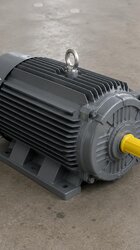

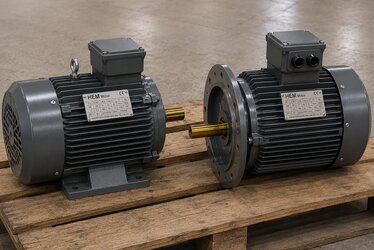
When ordering an electric motor we usually talk only about its power (kW) and speed; yet the value that actually defines the motor’s mechanical world is the frame size – the H dimension, which is the height of the shaft axis above the foot base. In the IEC standard frame sizes are defined in steps such as 56, 63, 71, 80, 90, 100, 112, 132, 160, 180, 200, 225, 250, 280, 315, 355, and this number is also the height in millimetres of the shaft centre above the foot (for example 132 frame = 132 mm shaft height). Within the same frame, different powers come out depending on the number of poles – that is, the speed; a 132M frame carries a different kW at 2 poles than at 4 poles. Moreover, as long as the frame stays the same, the connection dimensions (shaft diameter, foot hole spacing, flange holes) do not change – a critical advantage for replacement and mechanical fit. In this article we explain the IEC frame-power map, the power distribution by pole within the same frame, why connection dimensions stay fixed, and correct frame selection with concrete tables.
What Is the H Dimension (Frame Size)?
The H dimension is the perpendicular distance from the motor foot base to the centre of the shaft axis, given in millimetres. IEC 60072 ties this value to standard steps. The frame code carries a letter beside the H dimension:
- S (Short): short frame, the shortest foot spacing within the same H.
- M (Medium): medium frame.
- L (Long): long frame, the widest foot spacing within the same H.
For example 132S and 132M share the same shaft height (132 mm); only the foot spacing (B dimension) and therefore the power they deliver differ. For shaft diameter, nameplate reading and the frame-shaft relationship, our article on the IE3 motor shaft diameter and frame table (IEC 56-355) is a detailed reference.
IEC Frame-Power Map: Same Frame, Different Speed, Different kW
The table below shows the frame-power match for standard IE3-class 4-pole (1500 rpm) motors. These are the most common reference values in industry.
| Frame | 4-pole ~1500 rpm power (kW) | Shaft dia. (mm) | Approx. weight |
|---|---|---|---|
| 80 | 0.75 | 19 | ~9 kg |
| 90S / 90L | 1.1 / 1.5 | 24 | ~13-16 kg |
| 100L | 2.2 / 3.0 | 28 | ~22 kg |
| 112M | 4.0 | 28 | ~28 kg |
| 132S / 132M | 5.5 / 7.5 | 38 | ~45-55 kg |
| 160M / 160L | 11 / 15 | 42 | ~85-110 kg |
| 180M / 180L | 18.5 / 22 | 48 | ~150-170 kg |
| 200L | 30 | 55 | ~230 kg |
| 225S / 225M | 37 / 45 | 60 | ~270-310 kg |
| 250M | 55 | 65 | ~370 kg |
| 280S / 280M | 75 / 90 | 75 | ~500-570 kg |
| 315S / 315M / 315L | 110 / 132 / 160 | 80 | ~700-1000 kg |
The same frame carries a different power when the number of poles (speed) changes, because power is torque times speed; a slower motor delivers less power in the same frame. The table below shows typical power by pole for a 160 frame example.
| Frame 160 | 2-pole ~3000 rpm | 4-pole ~1500 rpm | 6-pole ~1000 rpm | 8-pole ~750 rpm |
|---|---|---|---|---|
| 160M | 11 kW | 11 kW | 7.5 kW | 5.5 kW |
| 160L | 18.5 kW | 15 kW | 11 kW | 7.5 kW |
As shown, the same frame carries fewer kW as speed drops, because delivering the same power at lower speed needs more torque and therefore a larger frame. For the speed-power-torque relationship, see our article on rated torque calculation (kW-rpm-torque). For power-speed selection from stock, the IE3 motor stock guide power-speed is helpful.
Why Do Connection Dimensions Stay Fixed When the Frame Stays the Same?
The strongest aspect of the IEC standard is that for a given frame the connection dimensions are fixed. A 132M frame’s shaft diameter, foot hole spacings (A, B dimensions), flange hole diameter and spigot diameter are the same across all makers. Thanks to this:
- When replacing an old motor with an equivalent, the foundation, coupling and sheave are not changed.
- Brand-independent equivalent selection becomes possible; the dimensions are guaranteed by IEC.
- When the mounting code (IM B3, B5, B14) combines with the frame, mechanical fit becomes clear.
This stability is golden, especially for fast replacement during a failure. For shaft-coupling-sheave dimensions see reading the nameplate ratings, and for weight-handling on cast-iron frames see frame IEC 56-355 weight handling. For cast-iron frame size-to-power matching, review our frame size power matching reference.
Correct Frame Selection: What to Watch For
- Power and speed together: not only kW but speed sets the frame; lower speed means a larger frame.
- Mounting type: footed (B3), flanged (B5), face-mount (B14) frame-flange fit must be checked.
- Shaft diameter and key: a shaft diameter compatible with the coupling/sheave bore comes with the frame.
- Thermal margin: for continuous full-load duty one frame larger is safer for thermal life.
- Efficiency class: for the same kW, IE3/IE4 frames are usually the same; equivalent selection becomes mechanically easy.
2-Pole, 4-Pole, 6-Pole: How Does Speed Enlarge the Frame?
A motor’s synchronous speed is set by the number of poles and the grid frequency: at 50 Hz, 2-pole ~3000 rpm, 4-pole ~1500 rpm, 6-pole ~1000 rpm, 8-pole ~750 rpm. Delivering the same power at lower speed means producing higher torque; and torque depends on the magnetic cross-section and the amount of copper inside the frame. So a 6- or 8-pole motor is typically one or two frames larger than a 2-pole motor of the same kW. Looking only at kW and ignoring speed at purchase ends in the wrong frame and mechanical mismatch.
| Poles | Synchronous speed (50 Hz) | Typical application | Frame trend for same kW |
|---|---|---|---|
| 2-pole | ~3000 rpm | Pump, fan, compressor | Smallest frame |
| 4-pole | ~1500 rpm | General-purpose drive | Standard |
| 6-pole | ~1000 rpm | Conveyor, mixer | One frame larger |
| 8-pole | ~750 rpm | Mill, heavy drive | Two frames larger |
The difference between 50 Hz and 60 Hz grids also affects speed and therefore power; this difference must be considered in export motors. Our articles on multi-voltage-frequency 50-60 Hz export compatibility and the 50-60 Hz effect on speed-power explain this topic.
Mounting Code (IM B3, B5, B14) and the Frame Combination
Choosing the frame size alone is not enough; the mounting type also determines mechanical fit. When IEC mounting codes combine with the frame, the connection becomes clear:
- IM B3: footed mounting; bolted to a foundation, the most common type.
- IM B5: large flange (FF) mounting; attached to the machine through the flange holes.
- IM B14: small face flange (FT); used on compact machines.
- IM B35: combined foot-and-flange mounting.
For each frame size the flange hole diameter and spigot diameter are fixed by IEC; this makes replacing a flanged motor with an equivalent of the same frame-flange type trouble-free. For reading the mounting code and ordering, our article on motor IM mounting code reading (IM B3, B5, V1) is a comprehensive guide. For shaft height and axial alignment on cast-iron frames, see our shaft height H dimension and axial alignment reference.
Common Mistakes in Frame Selection
Field experience shows recurring mistakes in frame selection. The most common is assuming the same frame applies by looking only at kW while the speed differs. Another is ignoring the S/M/L length difference (B dimension) even when the shaft height is the same and miscalculating the foundation hole spacing. A third is ordering a coupling/sheave without confirming the shaft diameter and key dimension.
- Ignoring speed and choosing the wrong frame.
- Confusing the S/M/L length difference and foot spacing.
- Not confirming the shaft diameter/key dimension.
- Ordering the wrong mounting type (B3/B5/B14).
- Choosing a frame right at the limit with no thermal margin.
Reading the nameplate values correctly prevents these mistakes; our articles on IE3 motor order code decoding and reading the nameplate ratings are guides here.
Frame, Weight and Transport Planning
The frame size is critical not only electrically but logistically. As the frame grows the motor weight rises fast; a 132 frame becomes impossible to carry by one person, while 250 and larger frames require a crane and forklift. So the correct frame choice also affects the lifting equipment at the installation site and the foundation design. On heavy-frame motors the lifting eyes, packaging and stacking must also be planned. For weight and handling on cast-iron frames, our articles on cast-iron motor frame IEC 56-355 weight handling and for transport-packaging transport, packaging, stacking and warehouse damage are practical guides.
| Frame range | Approx. weight | Handling method |
|---|---|---|
| 80 - 112 | 9 - 30 kg | Hand-carried |
| 132 - 160 | 45 - 110 kg | Two people / pallet |
| 180 - 225 | 150 - 310 kg | Forklift |
| 250 - 355 | 370 - 1000+ kg | Crane and lifting eye |
The correct frame choice affects not only the purchase cost but the installation and maintenance cost; an oversized frame is both expensive and needlessly heavy, while an undersized frame is stressed thermally and mechanically. For shaft-key-coupling matching, our article on shaft diameter, key and coupling completes the selection.
Equivalent Replacement and Brand-Independent Selection
The most practical benefit of the IEC frame standard is being able to replace an old motor with a brand-independent equivalent. When a motor installed years ago in a plant fails, it is enough to order a new motor with the same frame code (for example 160L), the same mounting type and the same kW-speed values; the foundation, coupling, sheave and wiring fit without change. This is a great advantage especially on lines where production must not stop. A few points need attention in equivalent selection: an exact match of frame code and mounting type, the same shaft diameter and length, an efficiency class (IE3/IE4) compatible with the need, and a terminal box orientation suited to the installation.
- Frame code and mounting type must match exactly.
- Shaft diameter and length must be the same.
- kW and speed values must suit the need.
- Efficiency class (IE3/IE4) and voltage must be confirmed.
- Terminal box orientation and cable entry must be checked.
For direct replacement of old-brand motors, our article on old-brand motor direct replacement and for equivalent connection dimensions our IE4 motor equivalent connection dimensions article explain this process step by step.
Frequently Asked Questions
Does a 132 frame always mean the same kW?
No. The 132 frame states that the shaft axis is 132 mm high; the power it delivers depends both on the S/M length and on the number of poles (speed). A 132M carries a typical 7.5 kW at 4 poles, higher at 2 poles and lower at 6 poles.
If I replace my old motor with the same-frame equivalent, will the mounting fit?
Yes. If the frame code (e.g. 160M) is the same, the shaft diameter, foot hole spacings and flange dimensions are fixed by IEC; the foundation, coupling and sheave fit without change. Just confirm the mounting type (B3/B5/B14) and shaft length.
Why is a larger frame sometimes needed for higher power?
A given frame has limited thermal and mechanical capacity. When more power is wanted, if the required torque and the corresponding copper/steel cross-section do not fit the frame, you move to the next frame up; this is needed for both cooling and shaft strength.
Supply the Motor at the Correct Frame and Power from Stock
Share your kW and speed need, or the frame code of the motor you are replacing (e.g. 132M, 160L); let the HEM Motor team deliver fast, from manufacturer stock, a motor at the correct frame and speed whose mounting matches exactly per the IEC frame-power map. Contact us for an uninterrupted supply with assured mechanical fit and get a tailored quote.