English
 Türkçe

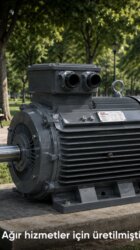
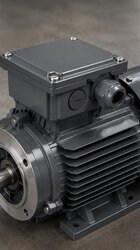
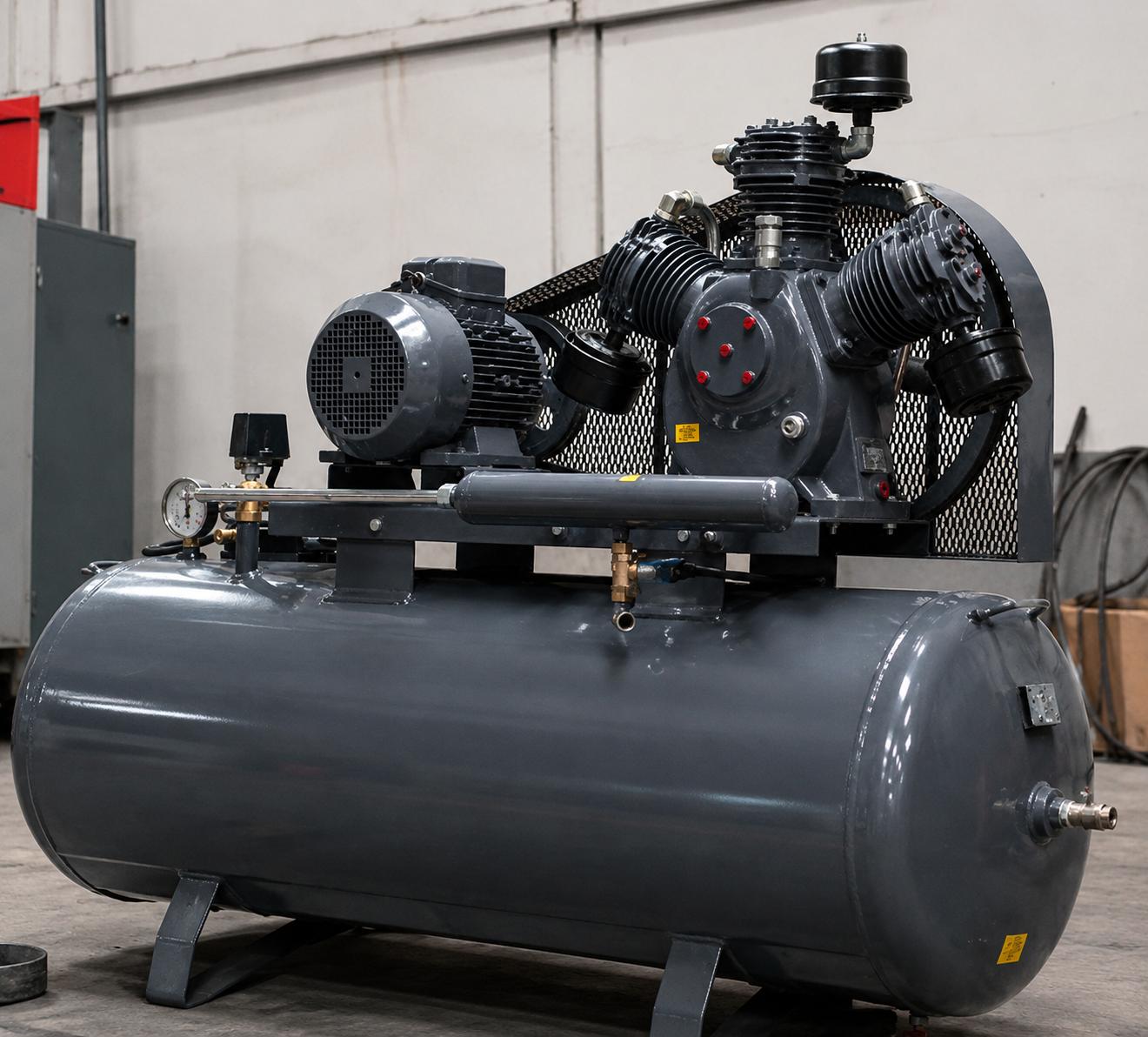

When a compressor motor burns out, the question on a plant manager's mind is usually not "which motor fits" but "which one can I find and have fitted by tomorrow." When compressed air production stops, the production line, paint shop, assembly station or pneumatic systems are paralysed at once, and every hour of downtime turns directly into loss. To make the right decision in this critical moment, you need to have identified the motor in your compressor before any failure, noted its nameplate values and prepared a sound replacement strategy. In this guide we explain step by step how motor matching is done for reciprocating and screw compressors, how to describe a standard-frame motor correctly from its nameplate, and how to procure the right replacement in a single pass.
Our aim is not merely to hand you a technical table, but to give you a method that lets you, without panic at the moment of failure, send your supplier a clear request and return to production as quickly as possible. A correctly selected compressor motor is one of your facility's most critical investments, both in terms of energy efficiency and long service life.
Rewind or New Motor? The Cost Illusion
When a motor burns out, the first solution that comes to mind is usually rewinding. At first glance it looks cheap compared to a new motor, but this decision has hidden costs. Each rewinding operation lowers the motor's nominal efficiency somewhat, because the original winding geometry and wire cross-section cannot be reproduced exactly. Furthermore, rewinding means a 3-7 day stop, during which production waits.
- Efficiency drop: Energy efficiency typically falls 1-3% with each rewind; for continuously running equipment like a compressor this means a serious annual electricity cost.
- Downtime: Transport to the rewinding workshop, waiting and reassembly usually take 3-7 working days.
- Loss of warranty: A rewound motor is no longer covered by the manufacturer's warranty and may also pose an insurance risk.
- Risk of re-failure: Rewind quality depends on the workshop; a poor-quality rewind can burn out again quickly.
A new standard-frame motor available from stock, on the other hand, can in most cases be fitted the same or next day, runs at full efficiency and is under warranty. For this reason, choosing an IEC standard-frame motor with high stock availability is generally more sensible in terms of total cost.
Reading the Nameplate Correctly: The Key to Replacement
Correct replacement comes from transferring the values on the motor's nameplate completely and accurately. Instead of telling your supplier "I need a compressor motor," conveying the following values clearly brings the right product in one pass.
1. Power (kW / HP)
The motor's nominal power is written on the nameplate in kW and often in HP. In reciprocating compressors power is usually between 1.5 kW and 15 kW, while in screw compressors it can start at 7.5 kW and rise to 250 kW and above. The power must match exactly; otherwise the compressor either delivers insufficient air or the motor is overloaded.
2. Speed and Number of Poles
Speed (for example 2900 rpm = 2 poles, 1450 rpm = 4 poles) directly affects the compressor type. Screw compressors generally use 2-pole high-speed motors, while large reciprocating compressors may use 4-pole motors with a belt-pulley system. The wrong speed completely changes the air flow rate.
3. Frame Type, Mounting and Shaft
Per the IEC standard, frame size (for example 90, 100L, 132M, 160L) determines the motor's physical dimensions. The mounting can be foot-mounted (B3), flanged (B5, B14) or combined (B35). Shaft diameter and length are critical for the pulley or coupling connection. If these three values do not match, the motor will not seat mechanically on the compressor.
4. Voltage, Frequency and Protection Class
In three-phase motors 400V / 50Hz is standard; the connection may be star (Y) or delta (Δ) and must be chosen according to the starting method. Protection class (IP55 is common) and insulation class (usually F) are important for the dusty, hot compressor environment.
Motor Matching in Reciprocating Compressors
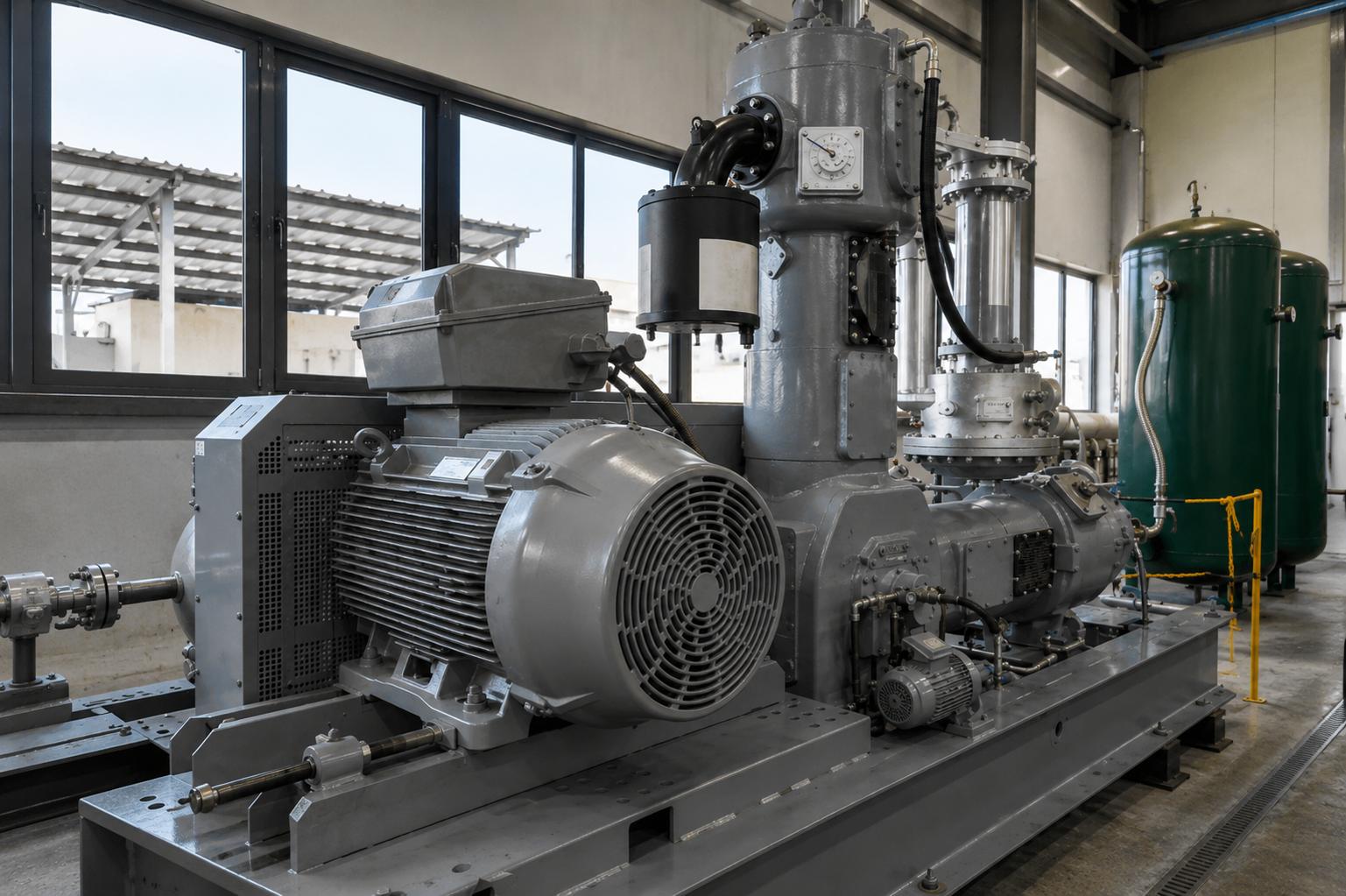
Reciprocating compressors generally run intermittently (load-unload) and demand high torque at start-up. For this reason, motors with high starting torque and resistance to frequent starting are preferred. Since most reciprocating compressors are driven by a belt-pulley system, the motor's shaft diameter and foot-mounting dimensions are critically important. When selecting a three-phase electric motor, F-class insulation and IP55 protection are recommended to limit winding heating under a frequent stop-start regime.
- If starting frequency is high, attention must be paid to the motor's permitted number of starts per hour.
- Belt tension increases the radial load on the shaft; therefore motors with strong bearings should be preferred.
- A pressure switch and thermal protection protect the motor from overload and prevent early failure.
Motor Matching in Screw Compressors
Screw compressors operate continuously, usually with direct coupling. Here the motor's shaft-coupling compatibility and axial alignment are very important. Screw systems often use a soft starter or variable speed drive (VFD/inverter); in inverter-driven systems the motor must be inverter-compatible, with winding insulation resistant to impulse voltages.
In continuously running screw compressors, efficiency determines a large part of the annual energy bill. Therefore choosing a screw compressor motor in the IE3 or IE4 efficiency class lowers the total cost of ownership even if the initial investment is slightly higher. In terms of stock and supply, having recorded the nameplate values of the motor in use in advance eliminates waiting time at the moment of failure. For up-to-date electric motor prices and stock availability, the healthiest approach is to clarify your technical specifications and request a quote.
The Right Replacement in One Pass: List to Send the Supplier
To avoid losing time when a failure occurs, the request you send your supplier should include: nominal power (kW/HP), speed (rpm), frame size (IEC frame), mounting type (B3/B5/B35), shaft diameter and length, voltage and frequency, phase type, protection class (IP), insulation class, and whether it will run with an inverter. A request with this clarity both guarantees the right product arrives and speeds up the supply process. For a wider product range you may also evaluate the standard-frame electric motor and IE3 efficiency motor options.
Why Did the Motor Burn? Root-Cause Analysis to Prevent Recurrence
Before fitting the new motor, understanding why the old one burned out is at least as important as the replacement itself. Otherwise the same cause will burn the new motor too within a short time. The most common burnout causes in compressor motors are:
- Overloading: A faulty safety valve, a dirty air filter or an incorrect pressure setting keeps the motor running above its limit. In this case you must not only replace the motor but also check the pressure and filter settings.
- Phase loss (single-phasing): If a three-phase motor loses one of its phases, the remaining two windings draw excessive current and burn within minutes. This is one of the most common causes of motor burnout and can be prevented with a phase-protection relay.
- Voltage imbalance: Even small voltage differences between phases cause disproportionate heating in the winding.
- Frequent start-stop: Especially in reciprocating compressors, a pressure switch operating in too narrow a band starts the motor dozens of times per hour; each start heats the winding.
- Bearing failure: A worn bearing strains the shaft, raises the motor current and indirectly burns the winding.
Every replacement done without addressing the root cause is a temporary fix. When buying the replacement motor from your supplier, also make sure the protection equipment (phase-protection relay, thermal-magnetic breaker, thermistor protection) is correctly selected.
Stock and Supply Strategy: Planning Ahead for Critical Equipment
For equipment forming the backbone of production like a compressor, a motor failure is a question of "when," not "whether." For this reason, forward-looking businesses record the nameplate data of their critical compressors in advance and build a supply plan. There are two common strategies: either keeping a spare motor in stock, or arranging fast-shipment assurance with a supplier in advance.
Stocking a spare motor makes sense for very critical, special-size motors; on continuous production lines where every minute is expensive, even a single day of downtime more than covers the cost of a spare. For standard-frame motors, fast replacement from stock is usually sufficient. In both cases, the critical point is that nameplate data is documented beforehand; trying to read the nameplate in a panic at the moment of failure wastes time.
Frequently Asked Questions
Is it more sensible to rewind or replace my burned compressor motor?
In continuously running compressors where efficiency matters, replacement is generally more sensible, especially if a new standard-frame motor is available from stock. Although rewinding looks cheap in the short term, the efficiency drop, loss of warranty and downtime raise the total cost.
When replacing the motor, is it enough for just the power value to match?
No. As well as power, the speed, frame size, mounting type, shaft dimensions and voltage must also match. If any of these values does not fit, the motor will not seat on the compressor mechanically or electrically. Conveying all nameplate values completely is the key to the right replacement in one pass.
Can I use any motor on an inverter-driven (VFD) screw compressor?
No. Motors that will run with an inverter must have winding insulation resistant to the impulse voltages (dv/dt) produced by the drive. A non-inverter-compatible motor can fail early. Therefore, when requesting a quote, always state that the motor will run with an inverter.