English
 Türkçe

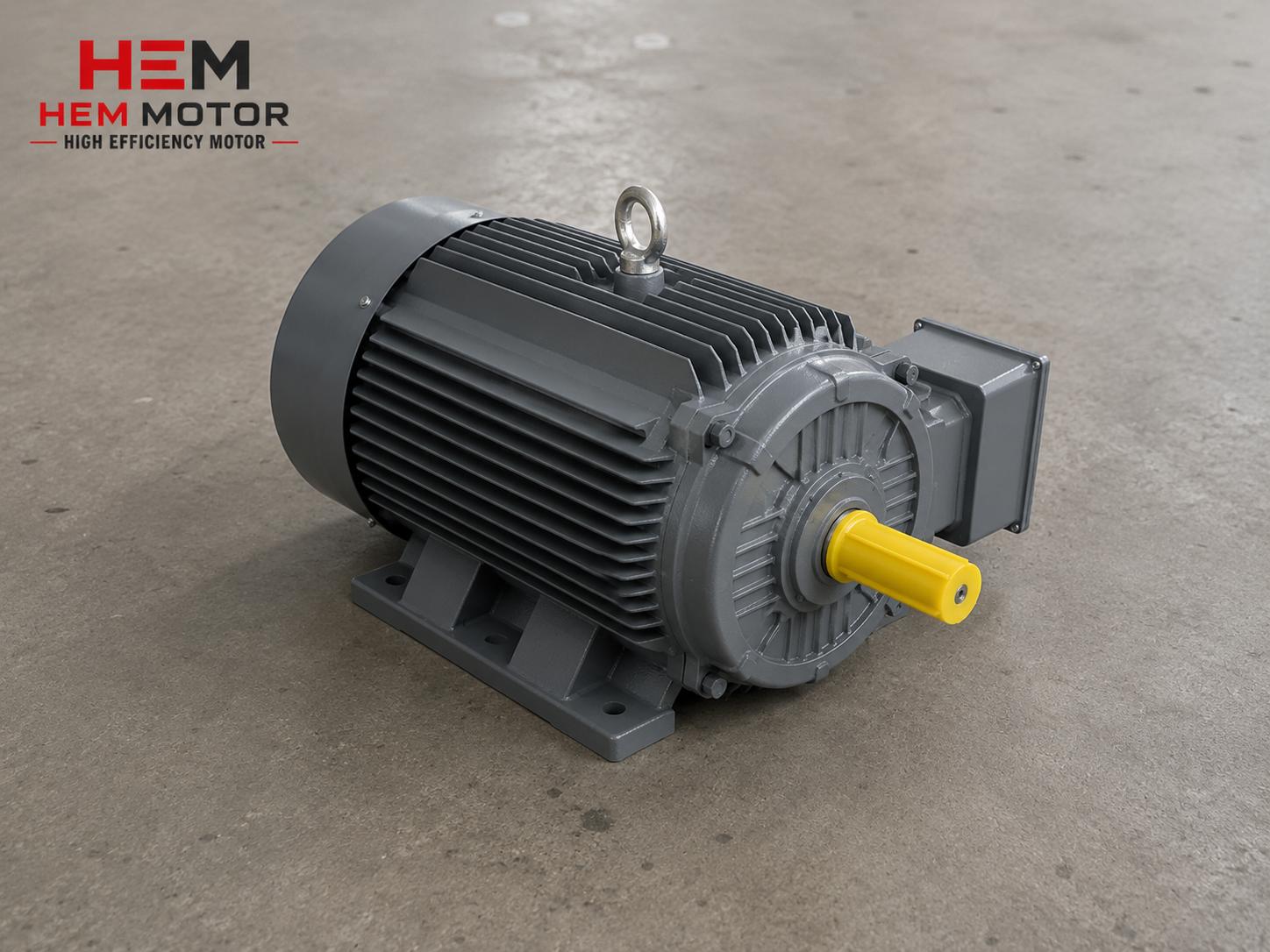

IE5 synchronous reluctance motors represent the efficiency class of the future with their magnet-free rotors and superior part-load efficiency; however, the most distinct difference of these motors from asynchronous motors is that they cannot start directly from the grid and must always start with a drive (VFD). Since the synchronous reluctance rotor has neither permanent magnets nor a cage winding, the classic mechanisms that produce torque at the moment of starting are absent; torque depends entirely on the drive knowing the rotor position correctly and applying the right current at the right moment. This makes the first start, starting torque, cogging (sticking) and the open-loop to closed-loop transition critical, especially during sensorless (encoderless) starting. In this article, as HEM Motor, we cover static torque and the first start on an IE5 synchronous reluctance motor, the challenges of sensorless starting, loads requiring high starting torque, and correct drive selection.
Why Can a Synchronous Reluctance Motor Not Run Without a Drive?
When an asynchronous motor is connected to the grid, the stator field induces current in the rotor and this induced current produces the starting torque; that is why it can start directly, without a drive. In a synchronous reluctance rotor there is no cage to induce current in nor a magnet to attract; the rotor only wants to align to the position of lowest magnetic reluctance. If connected directly to a fixed-frequency grid, the rotor cannot catch the rapidly rotating field, fails to synchronise and, as a result, does not turn. For this reason a synchronous reluctance motor needs a drive that ramps the frequency from zero in a controlled manner. The drive, by knowing or estimating the rotor position, excites the stator at the right moment and runs the motor at synchronous speed.
To see this fundamental principle in more detail, see our articles Why a Synchronous Reluctance Motor Cannot Run Without a Drive and, for the supply advantage of the magnet-free rotor, Magnet-Free Rotor: Supply and Cost Advantage.
The Physics of Static Torque and First Start
In a synchronous reluctance motor, torque arises from the difference in magnetic permeability (saliency) between the rotor's "d axis" (low reluctance) and "q axis" (high reluctance). To produce torque, the drive must know the spatial position of these rotor axes. At the moment of starting, while the motor is not yet turning, if this position is unknown, the drive may apply current in the wrong direction, producing negative torque, and the rotor first jerks the wrong way. This is the fundamental challenge of sensorless starting: determining the initial position of the stationary rotor without speed feedback.
- Starting torque: Full torque if rotor position is known correctly; weak or reverse torque if known wrongly.
- Cogging/sticking: The rotor tends to "stick" to the low-reluctance position, which can cause sticking at start.
- Static position uncertainty: In a sensorless system the rotor angle is initially unknown; the drive must estimate it.

How Is Rotor Position Determined at Sensorless Start?
Modern drives use two fundamental strategies to determine rotor position without an encoder:
| Method | Operating Region | Description |
|---|---|---|
| High-frequency injection (HFI) | Standstill and low speed | A high-frequency signal is injected into the stator and position is extracted from saliency |
| Back-EMF observation | Medium-high speed | Position estimation from the voltage generated by the turning rotor |
| Open-loop ramp | Start transition | Forced alignment with known current, then transition to closed loop |
Since back-EMF is not generated at standstill and very low speed, the saliency-based HFI method is critical for sensorless starting. The pronounced saliency of the synchronous reluctance rotor is the design feature that makes this method possible. To set this behaviour correctly via drive parametering and autotune, our article Drive Parametering: VFD Setting, Autotune and Commissioning is a direct guide.
Transition From Open Loop to Closed Loop
In sensorless systems the typical start scenario is to begin in open loop and switch to closed loop upon reaching a certain speed. In the open-loop stage, without measuring the rotor's actual position, the drive forcibly aligns the stator with a known current and slowly increases the frequency; the rotor follows this field. Once sufficient speed (usually a small percentage of rated speed) is reached, back-EMF becomes measurable and the drive switches to closed loop, i.e. position-feedback control. For this transition to be smooth, the drive must know the motor parameters (especially the d and q axis inductances) correctly; otherwise speed fluctuation, torque loss or loss of synchronisation occurs during transition.
This transition quality depends on correct motor-drive matching. For correct frame and drive matching by the frame-power table, see Frame-Power Table (IEC): Correct Frame and Drive Matching; for a commissioning checklist, Drive and Installation Compatibility: Commissioning provides practical support.
Loads Requiring High Starting Torque
Some loads demand a starting torque well above rated torque at the moment of start: conveyors starting full, mixers, crushers, positive-displacement pumps and mechanisms that may be jammed. In a sensorless synchronous reluctance system these loads are a serious design challenge, because producing high torque while the start position is uncertain is difficult. Two approaches stand out in such applications: either a drive with an advanced sensorless algorithm that can safely produce the starting torque is selected, or, in critical applications, position feedback (encoder) is added to eliminate the uncertainty entirely. An encoder maximises starting torque and prevents sticking, but adds cost and wiring.
| Load Type | Starting Torque Need | Recommended Solution |
|---|---|---|
| Fan, pump (centrifugal) | Low | Sensorless sufficient |
| Conveyor (empty) | Medium | Advanced sensorless |
| Full conveyor, mixer | High | Encoder recommended |
| Crusher, positive displacement | Very high | Encoder + proper sizing |
For the effect of the synchronous reluctance versus permanent magnet motor difference on starting behaviour, see Synchronous Reluctance and Permanent Magnet (PM) Motor Difference; for output speed and drive compatibility in geared drives, Geared Drive is valuable.
Correct Drive Selection
On an IE5 synchronous reluctance motor, the correct drive is as important as the motor itself. Points to watch when selecting a drive:
- SynRM support: The drive must have a synchronous reluctance motor control mode; a general V/f mode is insufficient.
- Sensorless start algorithm: Saliency-based position estimation (HFI) capability at low speed.
- Autotune: Ability to automatically learn the motor d/q inductances.
- Encoder option: A feedback input for loads requiring high starting torque.
- Correct power matching: A drive size suited to the motor's rated current and power factor.
The synchronous reluctance motor's different rated current and power factor compared with asynchronous affect drive and panel selection; for this, our article Rated Current and Power Factor: Difference From Asynchronous is important. To see the superior part-load efficiency curve, see Efficiency Curve: Why Superior at Part Load?
Comparison of Sensored and Sensorless Starting
When choosing a starting strategy in an IE5 synchronous reluctance system, it helps to see clearly the relative advantages and constraints of sensored (encoder) and sensorless solutions. The sensorless solution offers less wiring, lower cost and fewer points of failure; it is more than sufficient on low starting-torque applications such as fans, centrifugal pumps and light conveyors. By contrast, since the stationary rotor's initial position is found by estimation in a sensorless system, the performance limit may be reached on loads requiring very high and uncertain starting torque. The sensored solution, by knowing the rotor angle precisely at all times, can produce full torque from zero speed and eliminates sticking entirely on heavy-start loads such as full conveyors, mixers and crushers. The price of this is the extra encoder cost, shielded cable and additional tuning during commissioning. The right choice depends on the application's starting-torque profile and downtime cost.
| Criterion | Sensorless (HFI) | Sensored (Encoder) |
|---|---|---|
| Full torque at zero speed | Limited | Full |
| Cost | Low | Higher |
| Wiring/complexity | Less | More |
| Heavy start-load suitability | Medium | High |
| Sticking (cogging) risk | Present (parameter-dependent) | None |
To see panel and payback planning when replacing an old motor with IE5 and a drive, our article Retrofit Steps, Panel and Payback helps; for the IE5, IE4 and IE3 total cost comparison, TCO Comparison is valuable.
Thermal Behaviour and Low-Speed Starting
In sensorless starting, the motor remaining at very low speed for a long time requires attention regarding cooling. The synchronous reluctance motor's own fan produces insufficient airflow at low speed; if the motor stays long in the forced-alignment stage at high current, heat can accumulate in the winding. Therefore, on applications that start and stop frequently or continuously lift a heavy load at low speed, an external forced cooling fan should be considered. Correct parametering limits this heating by not keeping the start current and alignment time longer than necessary. In drive operation, the motor's thermal behaviour and correct sizing are as important as the starting strategy; otherwise the motor may be thermally stressed while producing the starting torque. For heating and correct sizing in drive operation, see Thermal Behaviour and Cooling.
The Saliency Design of the Synchronous Reluctance Rotor
Behind the feasibility of sensorless starting lies the special magnetic design of the synchronous reluctance rotor. The rotor is shaped with internal air gaps (flux barriers) such that magnetic flux passes easily along one axis (d axis, low reluctance) and is impeded along the perpendicular axis (q axis, high reluctance). The pronounced difference between these two axes, the saliency, is both the fundamental torque-producing mechanism and the feature that lets the drive "sense" the stationary rotor position via high-frequency signal injection. The more pronounced the saliency, the more reliable the sensorless position estimation; therefore a well-designed synchronous reluctance rotor offers both high efficiency and reliable sensorless starting. In a low-quality rotor, weak saliency both lowers efficiency and increases position uncertainty at sensorless start, raising the sticking risk. This shows why rotor quality is critical in motor selection. For the advantages of the magnet-free structure in maintenance and fault management, see Maintenance and Fault Management.
Frequently Asked Questions
Can an IE5 synchronous reluctance motor start without an encoder?
Yes, modern drives can estimate the stationary rotor position and start with saliency-based sensorless algorithms (HFI). However, on loads requiring high starting torque, an encoder maximises torque and prevents sticking.
Why does cogging (sticking) occur at start?
The synchronous reluctance rotor tends to stick to the position of lowest magnetic reluctance. If the drive cannot estimate the initial position correctly, the rotor may stick at this position or jerk the wrong way. Correct parametering and a sensorless algorithm prevent this.
On which loads is an encoder essential?
An encoder is recommended on loads requiring high and uncertain starting torque, such as conveyors starting full, mixers, crushers and positive-displacement pumps. Sensorless is sufficient on low starting-torque loads such as fans and centrifugal pumps.
Source the Right IE5 Motor and Drive Package Together
As HEM Motor, we evaluate IE5 synchronous reluctance motors as a package with the correct drive and, if needed, an encoder suited to your starting torque need; we clarify with you whether sensorless starting is sufficient or the application requires feedback. Share your load type, power and speed details; let us identify the correct motor-drive match and provide a tailored quote for fast delivery from manufacturer stock for a trouble-free commissioning. Contact us to request a quote.