English
 Türkçe

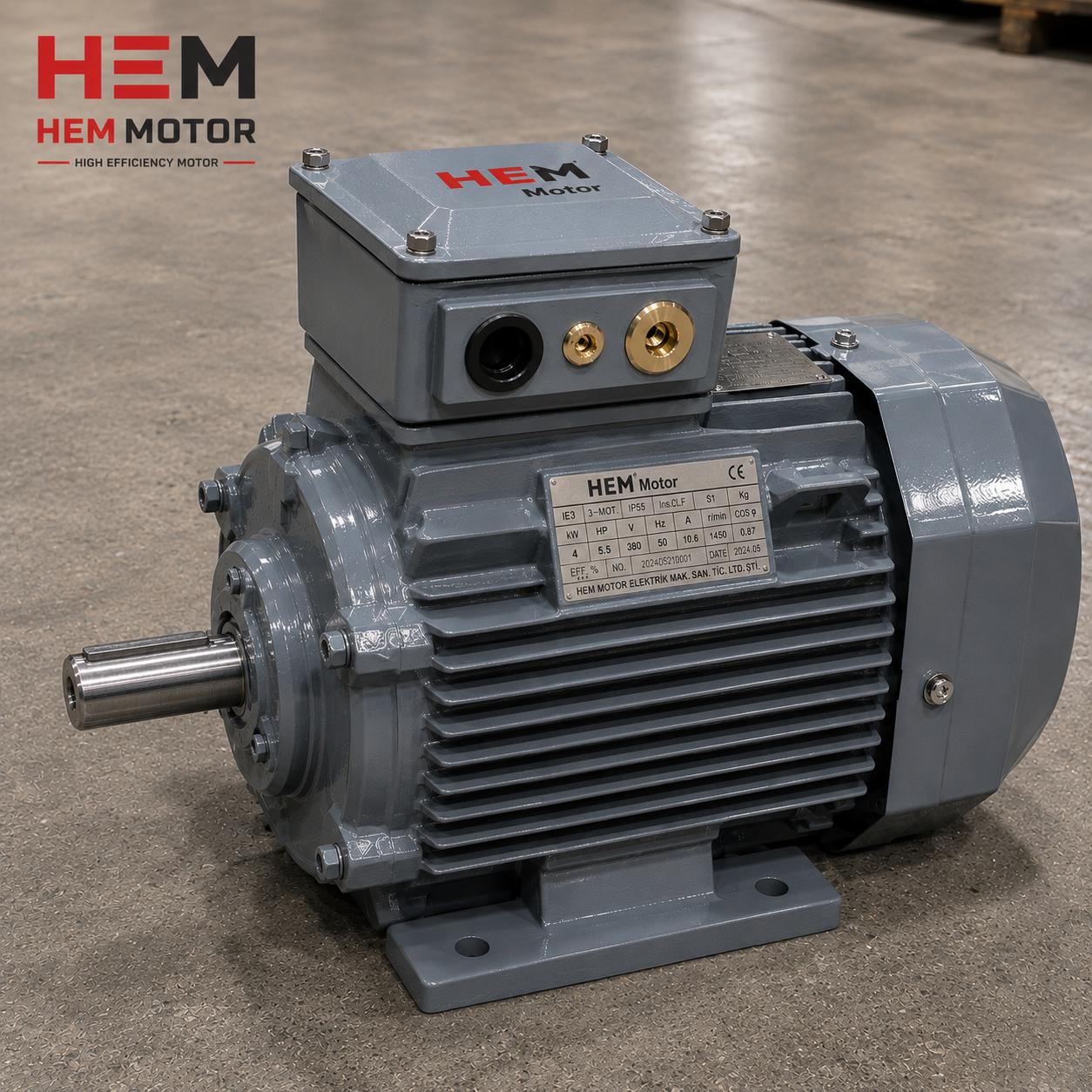

Protecting an electric motor is much more than fitting a fuse or a thermal relay. Modern motor protection relays contain multiple protection functions that detect, separately, the different fault types a motor can face. These functions are standardized with international ANSI/IEEE numbers: 49 for thermal overload, 46 for phase imbalance, 37 for low load/dry running, 48 for long start/stall, and 50 and 51 for overcurrent. Every motor and every application requires a different combination of these functions. In this article we cover, with HEM Motor engineering insight, the core ANSI functions of a motor protection relay, which fault each protects against, which ones are needed for which motor, the typical setting logic, and how to choose the right protection.
The vast majority of motor failures end in overheating and the breakdown of winding insulation. But the cause of this overheating can differ: overload, phase loss, imbalance, stall or long start. A good protection system catches each cause early with its own function and stops the motor before it burns out. ANSI function numbers are the way to express these different protection tasks in a common language, and they standardize relay and diagram reading.
Core ANSI Protection Functions
The table below summarizes the ANSI functions most often used in motor protection, the fault they protect against and their typical use. Most of these functions are combined into a single device inside a modern motor protection relay (MPR).
| ANSI No | Function | Protected fault | Typical use |
|---|---|---|---|
| 49 | Thermal overload | Continuous overload, heating | All motors |
| 46 | Phase imbalance / negative sequence | Phase loss, imbalance | Three-phase motors |
| 37 | Undercurrent / low load | Dry running, belt break | Pump, fan |
| 48 | Long start / stall | Jam, locked rotor | High-inertia loads |
| 50 | Instantaneous overcurrent | Short circuit | All motors |
| 51 | Time-delayed overcurrent | Overload, fault current | All motors |
To understand the basic logic of these functions, it helps to start with the classic protection elements. For the core duties of the thermal relay and fuse, our article on protection: thermal, relay and fuse selection is a good start. For sizing protection by rated current, our article on motor protection circuit breaker (MPCB) selection and setting goes straight to the point.
49 - Thermal Overload Protection
Function 49 is the heart of motor protection. By continuously monitoring the current the motor draws, it computes the motor's thermal model (heating-cooling behavior). If the current exceeds the rated value, the relay accumulates a thermal capacity; the larger the overload, the faster it trips. This is the electronic and far smarter version of the classic thermal relay. Because function 49 mimics the motor's real heating behavior, it correctly evaluates both small continuous overloads and large short-term overloads.
Function 49 should be present on all motors, because overload is the most common cause of failure. The setting is made according to the motor's rated current (FLA) and usually takes the service factor into account. When function 49 is used together with a PT100 and PTC thermistor embedded in the winding for temperature-class protection, two-layer protection is achieved through both current and direct temperature.
46 - Phase Imbalance and Negative Sequence Protection
In a three-phase motor, the loss of one phase or a voltage/current imbalance between phases is very dangerous for the motor. Phase imbalance creates a negative sequence current in the winding; this current forms a magnetic field rotating in the reverse direction and causes excessive heating in the rotor. Even a small voltage imbalance can turn into a much larger current imbalance and rapid heating. Function 46 detects this early by measuring the negative sequence component and protects the motor.
Function 46 is critical especially on grids where phase loss (single-phasing) is common. When a phase is lost, the motor may keep turning but draws excess current from the remaining two phases and burns out quickly. The 46 protection catches this within seconds. For the effect of phase imbalance on winding heating at partial load, our article on phase current imbalance and protection gives detail.
37 - Low Load and Dry Running Protection
Function 37, unlike most protections, monitors the current dropping too low. In some applications low current is a sign of a fault. For example, a sudden drop in current in a pump indicates the water has been cut off (dry running); a dry-running pump can quickly burn its seal and impeller. In a fan or conveyor, low current may indicate that the belt has broken or the load has separated. Function 37 alarms or stops the motor when the current falls below a set lower limit.
This function is especially valuable in pump applications, because dry running is one of the most destructive faults for a pump and is not easily noticed from outside. The 37 protection is a simple but effective measure that prevents expensive pump damage.
48 - Long Start and Stall (Locked Rotor) Protection
Function 48 detects the motor's start taking longer than normal or suddenly jamming and stopping (stall) while running. In a normal start, the motor reaches rated speed within a certain time and the starting current drops. If the load is too heavy, the rotor is jammed or there is a mechanical problem, the motor cannot reach rated speed and keeps drawing high starting current continuously. This heats the winding very fast and can lead to burnout within minutes.
Function 48 monitors the starting time and current, and opens the circuit if the motor cannot reach speed within the set time. This is critical especially with high-inertia loads (large fan, centrifuge, mill), because with these loads the start is normally long anyway, and distinguishing a real jam from a normal long start requires setting. For locked rotor withstand time and thermal limit, our article on locked rotor withstand time (tE) and thermal limit is a directly relevant resource.
50 and 51 - Overcurrent Protection
Functions 50 and 51 protect against overcurrent with two different time characteristics. Function 50 is instantaneous overcurrent protection; it opens the circuit almost immediately when a very high current (short circuit) is detected. Function 51 is time-delayed (inverse-time) overcurrent protection; it trips faster the higher the current, and slower when the current is near the rated value. Together, these two cover both sudden short circuits and slowly developing overloads.
The 50/51 protection must be set to distinguish the starting current from the short-circuit current; otherwise an unnecessary trip occurs at every normal start. That is why the setting of function 50 is kept above the motor's starting current. To read the magnitude of the starting current from the nameplate, our article on locked rotor code letter (kVA/HP) and starting current is useful.
Which Function Is Needed for Which Motor?
Not every motor needs every function; the right protection is selected by application. As a general guide:
- All motors: 49 (thermal overload), 46 (phase imbalance), 50/51 (overcurrent) are the base protection.
- Pumps: In addition, 37 (dry running/low load) is strongly recommended.
- High-inertia loads (fan, centrifuge, mill): 48 (long start/stall) is critical.
- Large-power motors: Advanced functions such as differential protection (87M) are added.
- Critical processes: Combine temperature monitoring (PT100/PTC) with current-based protection.
In large-power motors, differential protection also comes into play for stator fault detection; on this our article on differential protection (87M) and CT selection offers detailed information.
Setting Logic
Correct setting of the protection functions is essential for the protection to work. Function 49 is set to the motor's FLA; function 50 above the starting current; function 48 slightly above the motor's normal starting time; and function 46 to a typical imbalance threshold (for example 20-40% negative sequence). If settings are too tight, nuisance trips occur; if too loose, the protection cannot do its job. Correct setting requires knowing the motor's nameplate values, starting behavior and load profile.
Current Transformers (CTs) and Measurement
The correct operation of a motor protection relay depends on it measuring the motor current accurately. In small motors the relay can read the current directly from the conductor passing through it; but in medium and large-power motors current transformers (CTs) are used. CTs scale the high motor current down to a small current suitable for the relay (for example 5 A or 1 A). The selection of the CT ratio is critical: if the ratio is too large, small current changes are lost and protection sensitivity drops; if the ratio is too small, the CT saturates at starting current and the measurement is erroneous. That is why the CT ratio must be selected to suit the motor's rated current.
Functions such as phase imbalance (46) and differential (87M) are especially sensitive to correct CT connection and correct phase sequencing. A wrongly connected CT can produce an imbalance or fault signal that does not really exist, leading to nuisance trips. Testing the CT connections and relay settings during commissioning is essential for the protection to work reliably.
Classic Thermal Relay vs Electronic Protection Relay
A traditional thermal relay (bimetal) works with a bimetallic strip heated by the current and provides protection only against overload (roughly function 49). It responds to phase imbalance in a limited way, lacks low-load or stall protection, and its setting is coarse. An electronic motor protection relay, on the other hand, provides all these functions digitally, far more precisely and adjustably; it also keeps a fault log, provides communication (Modbus etc.) and makes the motor's condition monitorable. In small and simple applications a bimetal thermal relay is still an economical solution; but for critical, large-power or multi-function protection motors the electronic relay is clearly superior.
- Bimetal thermal relay: Simple, economical; basic overload protection; for small motors.
- Electronic protection relay: Multi-function (49/46/37/48/50/51), precise setting, logging and communication.
- Temperature-based protection: Direct winding temperature via PT100/PTC; complements current protection.
Questions and Answers
Are functions 49 and 51 the same thing?
No. 51 is an overcurrent protection that trips with an inverse-time characteristic according to current magnitude. 49 is a thermal overload protection that computes the motor's thermal model and mimics its heating-cooling behavior. 49 takes the motor's real temperature history into account; 51 looks only at instantaneous current. The two complement each other.
Which protection function is most critical for a pump?
49 and 46 are base protection, but 37 (low load/dry running) has special importance for pumps. Dry running can destroy a pump within minutes and is not easily noticed from outside. Function 37 catches this from the current drop.
Does a single relay provide all functions?
A modern motor protection relay (MPR) combines most functions such as 49, 46, 37, 48, 50 and 51 in one device. For large-power motors, advanced functions such as 87M may require separate or more advanced relays. The right relay is selected according to the motor's power and the criticality of the application.
At HEM Motor we evaluate our motors together with the right protection solutions and offer engineering support in selecting the ANSI functions suited to your application. The right protection extends the motor's life and prevents unplanned downtime. Contact us for fast supply from stock and the right protection selection.