English
 Türkçe

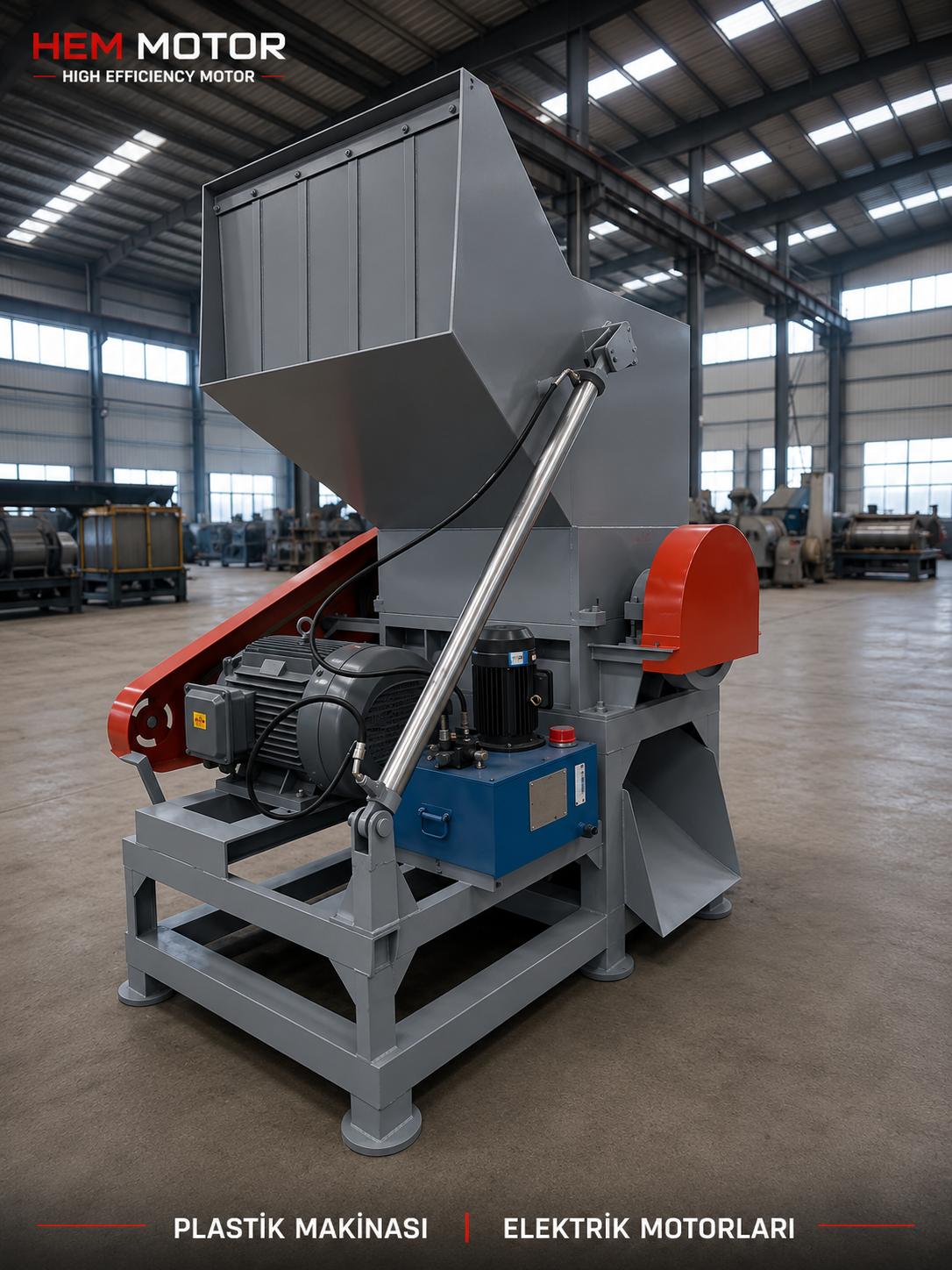

The efficiency of a crusher (stone crushing) plant largely depends on how steadily material is fed to the crusher. Weigh (belt) feeders and grizzly (grate) feeders take on exactly this task: they take raw material from the quarry or bunker and carry it to the crusher at a controlled rate. The drive motor of these feeders cannot be selected like an ordinary general-purpose motor; low speed, high starting torque, impact and variable load, sudden jams, heavy dust and harsh environmental conditions are all present together. A wrongly selected motor burns out continuously, stops on a jam or fails to feed the crusher properly. In this article we cover the selection of weigh and grizzly feeder drive motors in a crusher plant; the low-speed high-torque need, geared drive, impact and variable load endurance, dust and IP protection, and correct power-speed calculation. At HEM Motor we supply durable motors suited to heavy-industry conditions from stock with fast delivery.
Feeder Types: Weigh and Grizzly
Two feeder types stand out in crusher plants and each has a different drive character.
- Weigh (belt) feeder: A feeder that weighs the material while carrying it on a belt and controls the flow rate at the same time. The goal is to provide a steady, measured feed to the crusher. The drive is usually by a low-speed geared motor and the flow is often adjusted with a variable frequency drive.
- Grizzly (grate) feeder: Usually of the vibratory or chain/apron type, it carries coarse material to the crusher while screening out small grains through its grizzly bars. Here the load is far more impact-heavy; falling, wedging and sudden jamming of large rocks demand high starting torque and impact endurance from the motor.
In both cases the motor must drive the load at low speed and high torque; therefore the motor is mostly used together with a gearbox. The gearbox converts the high-speed motor to the low-speed high-torque output the feeder needs.
Low Speed, High Torque and Geared Drive
Feeders typically run at very low speed; the speed of the material on the belt is on the order of a few meters per minute. By contrast, a standard induction motor runs most efficiently around 1000-1500 rpm. A gearbox is used to bridge this gulf. The motor turns at high speed, the gearbox lowers the speed and raises the torque, providing the slow but powerful drive the feeder requires. For correct drive selection, not only the motor shaft power but also the gearbox ratio and output torque must be considered.
| Feeder type | Typical motor speed | Output speed (after gearbox) | Torque character | Load |
|---|---|---|---|---|
| Weigh belt feeder | 1500 rpm (4 pole) | Low (m/min level) | Steady-variable, controlled | Medium, balanced |
| Heavy-duty apron feeder | 1000 rpm (6 pole) | Very low | High starting, impact | Heavy, coarse rock |
| Vibratory grizzly | 1500 rpm (4 pole) | Vibration via drive unbalance | Continuous impact | Variable, screening |
In a geared drive it is common to connect the motor directly to the gearbox with a flange (B5) or combined (B35) mounting. For gearbox selection and output torque our monoblock geared motor and, for efficiency, our motor-gearbox combination articles will help.
Impact and Variable Load Endurance
The toughest test for a feeder motor is impact and variable load. Material from the quarry is not homogeneous; a large rock may suddenly drop, the belt may abruptly get heavier, or a block wedged in the grizzly may strain the feeder. In these cases the motor faces a torque demand far above its rated torque. A standard motor either stalls under this impact or draws excessive current and overheats. Therefore feeder motors should have high starting and pull-out (breakdown) torque (often Design H or reinforced rather than Design N) and be able to withstand short-term overload.
- High starting torque: To start under load, even full of material.
- High pull-out torque: To respond to a sudden impact without stalling.
- Service factor and thermal margin: To handle short-term overloads without overheating.
- Robust mechanical structure: Bearings and frame resistant to vibration and impact.
For starting and pull-out torque selection our torque classes (Design N/H) and starting torque and rated torque articles are useful. For service factor see our service factor and overload capacity guide.
Sudden Jamming and Protection
Sudden jamming is a frequent situation in grizzly and apron feeders; a large block wedged in the grate can lock the feeder in an instant. In this case the motor tries to force a non-turning load and falls into a locked-rotor condition. If there is no protection, within seconds the motor is subjected to locked-rotor current (LRA) and the winding can overheat and burn. Therefore correct thermal and electronic protection is vital in feeder motors.
- Thermal overload relay: Protects the motor at continuous overcurrent.
- PTC thermistor / PT100: Provides early intervention by monitoring winding temperature directly.
- Torque limit with a variable frequency drive: The drive can stop or alarm when torque exceeds a set limit; it detects a jam early.
- Mechanical slip clutch: Can prevent mechanical damage by disengaging the drive at overload.
For locked-rotor and starting current our starting current and LRA, and for winding temperature monitoring our protection with PT100 and thermistor articles offer detail.
Dust, IP Protection and Frame Selection
A crusher plant is one of the dustiest environments in industry. Fine stone dust gets everywhere; it fills the motor's cooling fins, seeps into the terminal box and, if it reaches the bearings, causes premature failure. Therefore the protection class (IP) and frame material are very important in feeder motors. Standard IP55 protection is the lower limit for most applications; where there is heavy dust and wash water, IP65 or higher protection may be required. As a frame material, cast iron is far more durable than aluminum in open-field and heavy-impact conditions.
| Condition | Recommended IP | Frame | Extra measure |
|---|---|---|---|
| Indoor, moderate dust | IP55 | Cast iron | Regular cleaning |
| Open field, heavy dust | IP65 | Cast iron | Guard cowl, sealing |
| Wash-down / humid | IP66 | Cast iron | Drainage, special seal |
In dusty and hot environments the insulation class also matters; an F or H class winding provides longer life at high temperature. For the right choice in dusty and hot environments see our insulation class in hot and dusty environments and cast iron and open field articles, and for the fan cowl and dust protection our fan cowl and protection guard guide.
Correct Power and Speed Selection
The power of the feeder drive motor is determined by the flow rate of the material to be carried, the belt length and incline, the material density and friction. If power is undersized the motor runs continuously overloaded and burns out; if oversized, unnecessary cost and low part-load efficiency arise. Speed depends on the output speed the feeder needs and the gearbox ratio. In most feeders a 4-pole (1500 rpm) or 6-pole (1000 rpm) motor is preferred together with a suitable gearbox. When a variable frequency drive is used, the flow can be adjusted over a wide range and additional protection is provided by torque limiting at the moment of a jam.
- Calculate the shaft power according to material flow, belt incline and density.
- Do not neglect the starting torque need (starting full).
- Determine the gearbox ratio according to the output speed.
- In drive use, consider the torque limit and low-speed cooling.
For torque calculation our torque from kW and speed, and for braked and heavy drive our brake motor supply articles will help.
Starting Method and the Variable Frequency Drive
The starting method in feeder motors directly affects both the mechanical system and the crushing process. In direct-on-line (DOL) starting the motor is connected to full voltage at once; this means high starting current and a hard torque shock. In a feeder that starts full, that is with material on it, this hard start strains the belt, chain and gearbox. Therefore a soft starter or a variable frequency drive is mostly preferred in heavy-duty feeders. A soft starter softens the starting shock by raising the voltage gradually; a variable frequency drive provides both a soft start and the ability to adjust the feed rate.
The biggest advantage a variable frequency drive provides in feeders is that the flow can be controlled to the process need. The feed speed can be raised or lowered according to the crusher's capacity; thus the crusher is neither starved nor choked. Also, the drive's torque-limit function forms an extra safety layer that protects the motor and the mechanism on a sudden jam. However, since motor cooling can weaken in low-speed drive operation, an external forced cooling fan or a larger power should be considered when needed. You can find the difference between starting methods in our star-delta versus soft starter article and the basics of drive operation in our VFD with asynchronous motor article.
- Direct-on-line (DOL): Simple but hard start; suitable for small, balanced loads.
- Soft starter: Softens the starting shock; protects mechanical life.
- Variable frequency drive: Soft start + flow adjustment + torque limit; the most flexible and protected solution.
Maintenance, Vibration and Long Life
A crusher feeder motor works at one of the toughest points of the plant, under continuous vibration and impact. Therefore regular maintenance directly determines motor life. Vibration over time loosens bolts, wears bearings and disturbs alignment; so the mounting bolt torque should be checked periodically and vibration levels measured. Since dust buildup weakens cooling, the motor's cooling fins and fan cowl should be cleaned regularly. In geared systems the oil level and oil condition should also be monitored.
The bearings are the most critical mechanical part of a feeder motor. Continuous impact load and vibration can shorten bearing life compared with a standard application; so reinforced bearing selection and the correct greasing interval are important. Monitoring winding temperature with a PT100 or PTC provides early warning against both a sudden jam and gradual overload. A properly installed and regularly maintained feeder motor runs reliably for many years despite the harsh conditions. For a maintenance schedule our periodic maintenance schedule and for vibration acceptance values our vibration and balance (ISO 10816) articles will help.
Frequently Asked Questions
Why should I select the feeder motor with a gearbox?
Because feeders run at very low speed and high torque, while a standard motor is efficient at high speed. The gearbox lowers the motor's high speed and raises the torque, providing the slow, powerful drive the feeder needs. Low-speed direct drive without a gearbox is both inefficient and impractical. The right solution is to select a suitably powered motor together with a gearbox of the correct ratio.
How do I prevent the motor from burning out on a sudden jam?
On a sudden jam the motor falls into a locked-rotor condition and draws very high current. To prevent this, a thermal overload relay, winding temperature monitoring with a PTC thermistor or PT100 and, if possible, a torque limit in the variable frequency drive should be used. A mechanical slip clutch can also protect both the motor and the feeder by disengaging the drive. When these protections are used together, a jam ends in a safe stop rather than a burnout.
Which protection class should I choose in a dusty environment?
Standard IP55 is the lower limit for most indoor, moderately dusty applications. In open field and heavy dust IP65 is recommended, and where there is wash water or humidity, IP66. As a frame material, cast iron is the most suitable for open field in terms of impact and corrosion resistance. As an insulation class, F or H provides longer life in hot and dusty environments.
Get Your Crusher Feeder Motor from HEM Motor
For your weigh or grizzly feeder drive motor needs, let us determine the right power, speed, mounting type and protection class together. With HEM Motor's broad manufacturer stock and fast delivery, we supply motors suited to heavy-industry conditions, resistant to impact load and dust, quickly. Share your plant's feed rate, belt dimensions and environmental conditions; contact us to request a quote for the most suitable motor.