English
 Türkçe

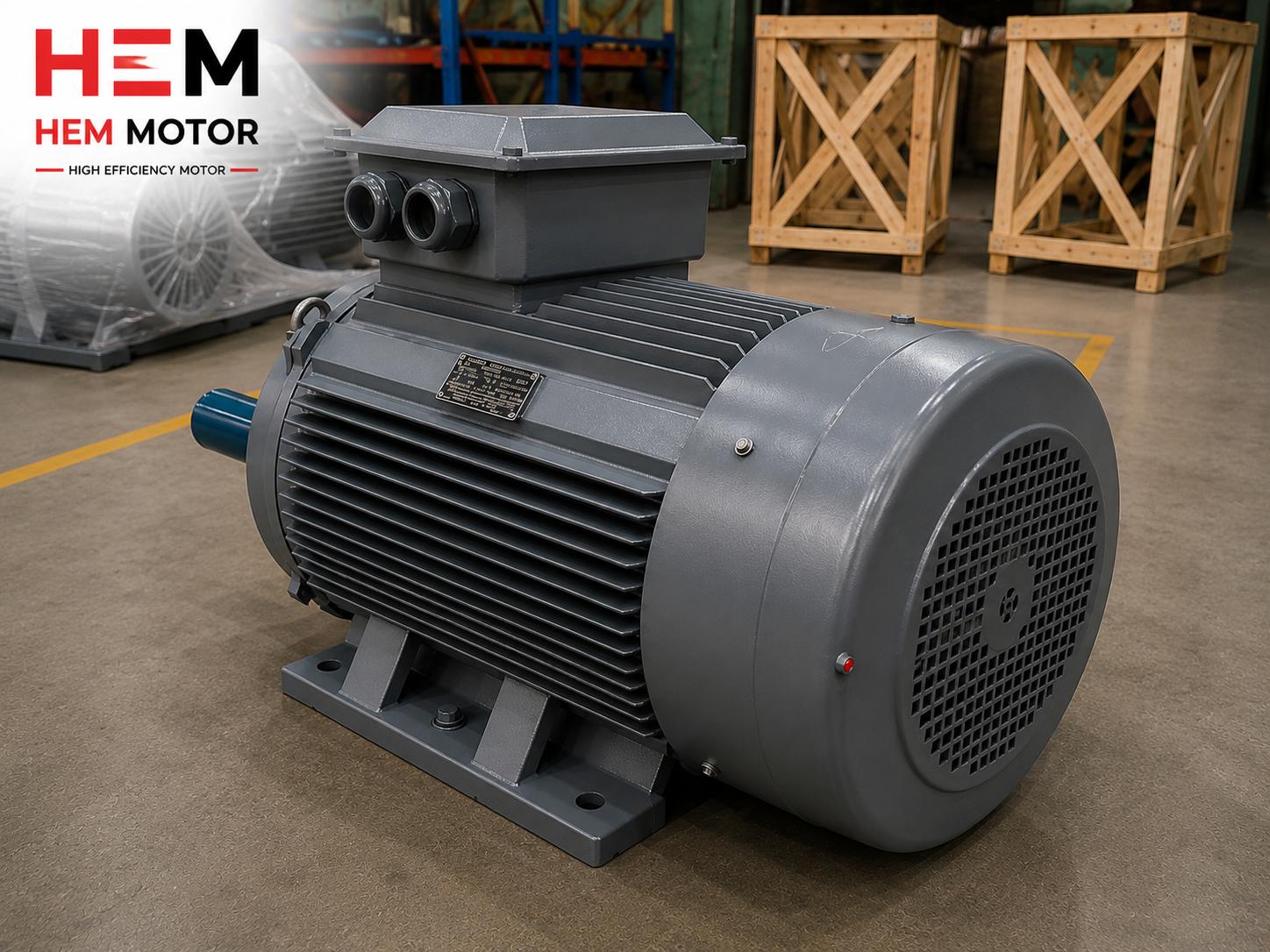

Specifying 12 poles and roughly 500 rpm on a cast iron motor is not an ordinary order. It means the motor will run at very low speed but deliver very high torque, and it is often the way to drive a load directly while eliminating the gearbox entirely (direct drive). In applications such as large industrial fans, slow process agitators, mill drives and cooling towers, 12-pole motors offer a clean, reliable solution that removes the initial cost of a reducer, its periodic maintenance, oil changes and per-stage efficiency loss. But this choice is not free: compared with a 4- or 6-pole motor of the same power, the frame grows noticeably larger, efficiency and power factor drop somewhat, and weight and price increase. In this article we look in detail, with HEM Motor engineering insight, at where a 12-pole 500 rpm cast iron motor makes sense, how it compares with 8- and 10-pole alternatives, why the cast iron frame is critical in these applications, and how to make the right selection.
As the pole count rises, the synchronous speed falls. On a 50 Hz grid, 2 poles give 3000, 4 poles 1500, 6 poles 1000, 8 poles 750, 10 poles 600 and 12 poles 500 rpm synchronous speed. In an induction motor the actual speed is slightly below this due to slip; for example, a 12-pole motor settles at a rated speed of roughly 480-495 rpm. Lower speed means higher torque at the same power, because mechanical power is the product of torque and angular velocity (P = T·ω). Halve the speed and the torque must double to carry the same power. That is exactly where both the appeal and the engineering difficulty of the 12-pole motor come from: to produce the high torque, the motor's magnetic circuit, iron cross-section and winding copper must all grow.
After reading this article you will be able to clarify whether your load truly needs 12 poles or 8/10 poles, whether direct drive or a geared solution suits better, and why the cast iron frame is the undisputed choice.
Why Choose 12 Poles at 500 rpm?
Some loads are inherently slow and high-torque. A large cooling tower fan, a process mixer or a ball mill wants to turn at only a few hundred rpm. Instead of obtaining that speed from a 1500 rpm motor through a gearbox, driving it directly with a 500 rpm motor is both mechanically simpler and more reliable in the long run. A gearbox is a gear stage; every stage brings lubrication, sealing, heat and typically a 2-4% efficiency loss. In multi-stage reducers this loss grows further. Direct drive has no such stage at all; the motor shaft turns the load directly.
The concrete advantages of direct drive are:
- Gearless direct drive: No gearbox, intermediate coupling or extra bearing needed; the system is simplified and has fewer failure points.
- Low noise and vibration: A slowly turning load runs quieter; gear rattle and imbalance effects disappear.
- High starting torque: Lifts high-inertia loads (large fan blades, a full mixer) smoothly.
- Long life: Low speed reduces wear on bearings and sealing elements; lubrication intervals extend.
- Low maintenance cost: Periodic items such as gear oil, seals and gear wear are eliminated.
For this reason, even when its initial investment is close to or sometimes higher than a 4-pole plus gearbox solution, the 12-pole direct-drive motor often wins on total cost of ownership (TCO). Especially in 24/7 processes where downtime is costly, the reliability of the gearless solution becomes decisive.
The Relationship Between Pole Count, Speed and Torque
The table below shows synchronous speed by pole count on a 50 Hz grid and the approximate rated torque for the same power (30 kW as an example). Torque values are derived from P = 2·π·n·T / 60 and are approximate; in a real motor there is slight deviation due to slip and efficiency. The table visually reveals how torque, and therefore frame size, grows as the pole count rises.
| Poles | Synchronous speed (rpm) | Approx. torque at 30 kW (Nm) | Typical frame trend | Typical use |
|---|---|---|---|---|
| 2 | 3000 | ~95 | Smallest frame | Pump, fan (high speed) |
| 4 | 1500 | ~191 | Small frame | General drive |
| 6 | 1000 | ~286 | Medium frame | Conveyor, crusher |
| 8 | 750 | ~382 | Large frame | Fan, mixer |
| 10 | 600 | ~477 | Larger frame | Large fan, mill |
| 12 | 500 | ~573 | Largest frame | Cooling tower, mill |
As the table shows, at the same power the torque roughly triples when the pole count goes from 4 to 12. To transmit this high torque, the motor's magnetizing current, air-gap geometry, iron cross-section and therefore frame size all grow. That is why a 12-pole 30 kW motor is noticeably larger, heavier and more expensive than a 4-pole 30 kW one. For the right power and pole choice, our guide on selecting a geared motor by output speed and torque directly helps compare direct drive with a geared solution. For the mathematics of torque, see our article on torque (Nm) from kW and rpm.
Why Do Efficiency and Power Factor Drop?
In low-speed, multi-pole motors the magnetic circuit contains more pole pairs, and a separate magnetic path must be established for each pole. This raises the reactive current needed for magnetizing (building the magnetic field). The increased reactive current lowers the power factor (cosφ); a power factor that is typically 0.85-0.90 in 2-4 pole motors can fall to the 0.70-0.78 range in 12-pole motors. Likewise, iron losses rise relatively, and efficiency drops by a few points versus an equivalent 4-pole motor. This does not mean the motor is bad; it is simply the physics of giving up part of the electrical efficiency at low speed. Still, when the gearbox is eliminated, overall system efficiency often turns in favour of direct drive.
Comparison with 8 and 10 Poles: When to Step Up to 12?
If the application can run in the 600-750 rpm range, an 8- or 10-pole motor is usually more economical and efficient, because the frame stays smaller, the power factor higher and the price lower. You only step up to 12 poles when the load genuinely needs very low speed around 500 rpm, or when eliminating the gearbox entirely is a critical requirement. As a practical rule: first determine the speed the load requires clearly, then choose the pole count whose synchronous speed is closest to it. Choosing more poles than needed means buying an unnecessarily large, heavy and expensive motor. To understand the speed-power balance and frequency effect, our article on running below 50 Hz and the V/f curve is useful.
Why Is Cast Iron Frame Rigidity Critical?
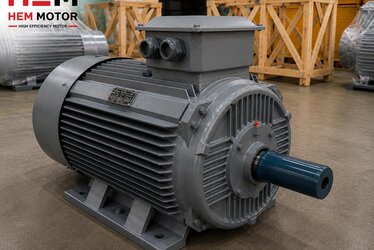
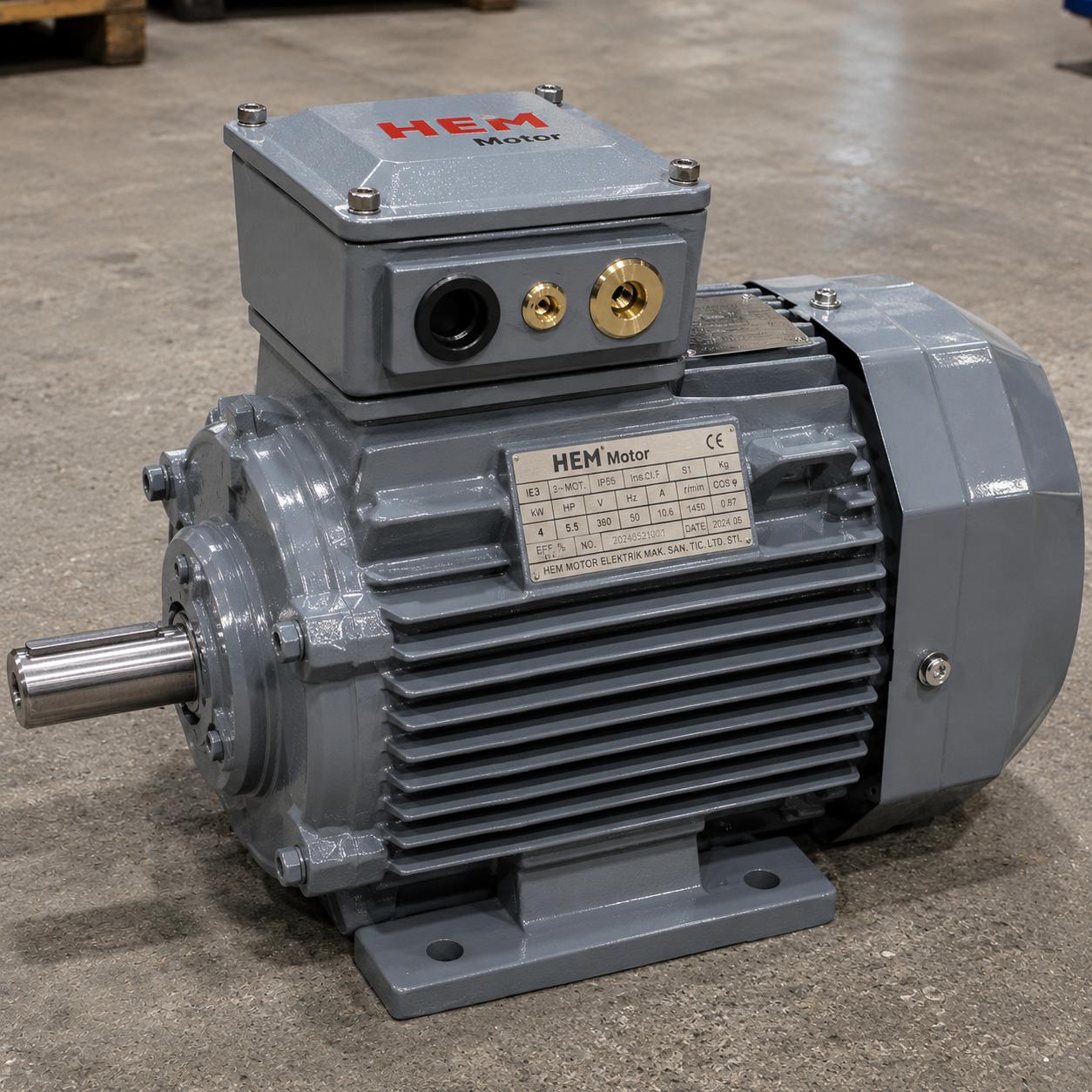
In low-speed, high-torque motors the mechanical stress on the frame is large. High torque reflects back onto the frame as a reaction force through the shaft and bearings; moreover, loads such as large fans or mills inevitably produce vibration. A cast iron (grey cast iron) frame has far higher rigidity and vibration-damping capacity than an aluminium frame. The graphite structure of cast iron damps vibration energy by converting it to heat through internal friction. As a result, under vibrating, heavy loads such as large fans or mills the frame does not deform, alignment is preserved and bearings stay long-lived.
- High mechanical rigidity: The frame does not flex under high torque reaction; the shaft axis does not shift.
- Vibration damping: The high internal friction of cast iron absorbs vibration and lowers noise.
- Heavy-duty durability: Suited to impact and pulsating loads such as mills, crushers and mixers.
- Thermal stability: Because internal fan cooling weakens at low speed, the high thermal mass and broad finned surface of the cast frame is an advantage.
- Outdoor durability: More resistant to corrosion and mechanical impact than aluminium; suitable for humid environments such as cooling towers.
Since the cooling effect of the internal (shaft-mounted) fan diminishes at low speed, thermal limits in these motors must be evaluated carefully. The F/H insulation class and, if needed, an external (forced/independently driven) cooling fan become important here. Protection with PT100 and PTC thermistors embedded in the winding is a standard measure in large, low-speed motors.
Which Applications Need 12 Poles?
The areas where 12-pole 500 rpm cast iron motors are most often used are:
- Large industrial and axial fans: Large-diameter, low-speed blades requiring high air flow.
- Cooling tower fans: Quiet, reliable, low-maintenance operation with gearless direct drive.
- Process mixers (agitators): High torque, low speed in dense and viscous mixtures.
- Ball/rod mill drives: Heavy, very high inertia, impact loads.
- Ventilation and flue gas fans: High-flow systems with low noise requirements.
- Slow conveyor and screen drives: Low-speed systems needing high starting torque.
The common denominator of these applications is that the load's natural operating speed is low and it wants smooth starting with high torque. This profile is exactly where the 12-pole direct-drive motor is strong. To evaluate starting torque and inertia effect, our article on starting torque and rated torque (DOL) provides guidance.
A Checklist for the Right Selection
When selecting a 12-pole 500 rpm motor, follow these steps: first determine the load's real operating speed and torque-speed curve; then calculate the inertia (GD² or J); clarify the starting frequency and duty type; compare the total cost of the geared and gearless solutions; finally choose the protection class and cooling method according to ambient conditions (humidity, dust, temperature). When these steps are skipped, you either buy an oversized motor or end up with a system that struggles and overheats at start.
Questions and Answers
Why is a 12-pole motor less efficient than a 4-pole one?
Carrying the same power at low speed requires higher torque and therefore higher magnetizing current. The multi-pole magnetic circuit draws more reactive current for magnetizing; this raises iron losses and reactive load, slightly lowering efficiency and power factor. On the other hand, because it eliminates the gearbox, overall system efficiency often still stays high.
Is 12 poles at 500 rpm better than 4 poles plus a gearbox?
It depends. If very low speed, high reliability, low maintenance and quiet operation are wanted, the 12-pole direct drive is advantageous. If a smaller frame, low initial cost and flexible output speed matter more, a geared 4-pole may be preferred. The application's vibration, noise, maintenance and continuity needs decide.
Is a cast iron frame mandatory over aluminium?
In this power and torque class, practically yes. High torque reaction, vibration and heavy-duty conditions require the rigidity and damping of the cast frame. While aluminium is enough at small powers, the cast iron frame is effectively standard in large, low-speed motors.
At HEM Motor we offer cast iron framed, low-speed high-torque motors in various pole and power classes from stock and with fast supply. With manufacturer assurance and a wide stock network, let us determine the right pole count together based on your application's speed, torque and inertia requirements. Contact us to request a quote and for engineering support; the right motor selection determines both your initial investment and your operating cost for years to come.