English
 Türkçe


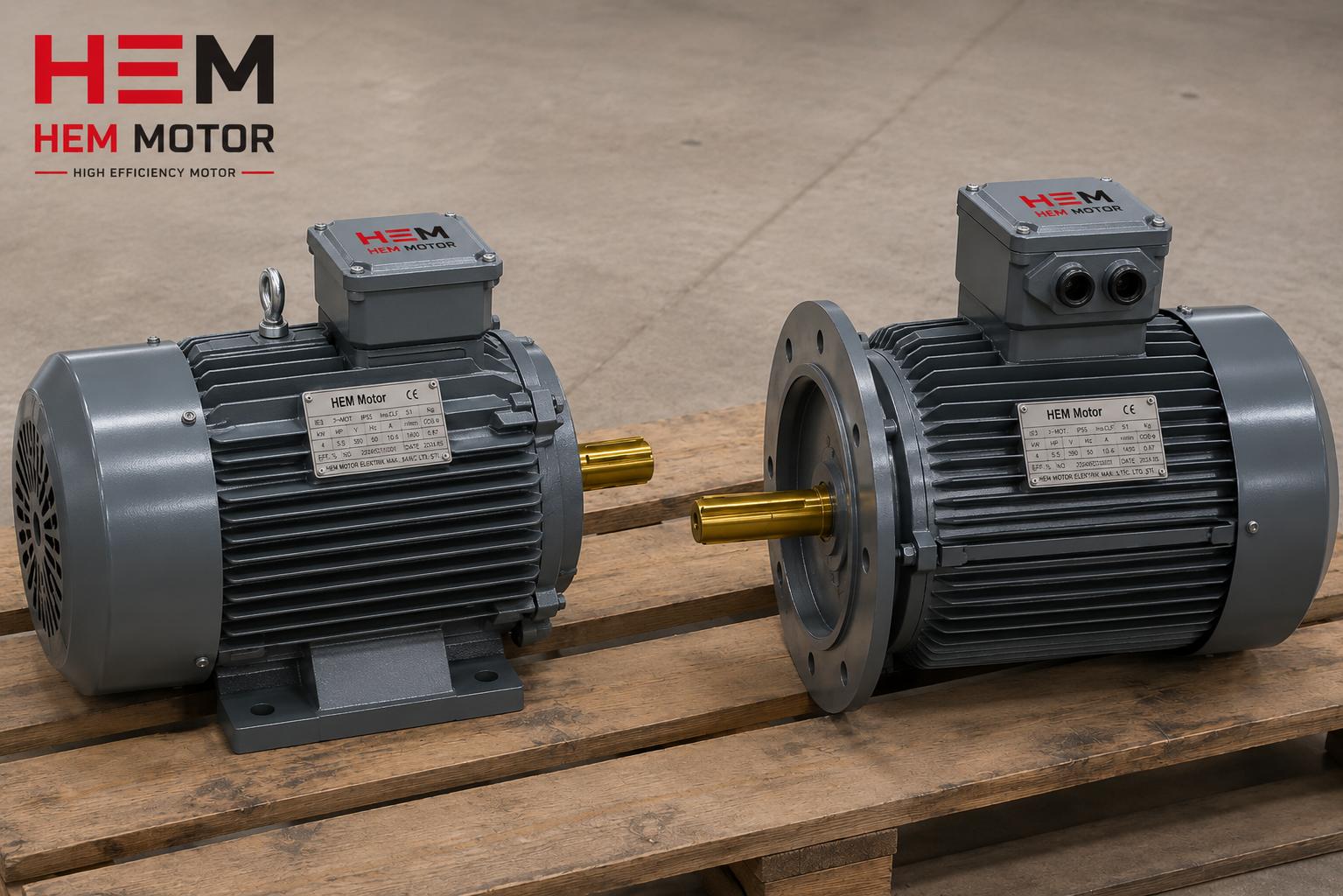
When you connect a cast iron motor to a machine, most failures actually begin at the shaft end. If the shaft diameter is not within the correct tolerance, if the keyway is non-standard, or if the coupling sits loosely, then no matter how high the motor quality is, vibration, overheating and premature bearing damage become inevitable. In this article we cover shaft-end dimensions on cast iron motors, k6 and m6 interference fits, DIN 6885 / IEC 60072 key and keyway dimensions, coupling-pulley-gear interference, and error-free assembly methods in field-practical terms. The goal is to share a verification routine that eliminates loose-fit risk and ensures correct coupling matching.
On cast iron motors built to IEC standards, the shaft-end diameter is determined by the frame size and is given clearly in the catalogue for the DE (drive end) side. What matters is the tolerance to which this nominal diameter is machined. Because what holds the coupling or pulley is not the nominal value of the shaft, but that tolerance band measured in thousandths of a millimetre.
Shaft Diameter Tolerance: What Are k6 and m6 Interference Fits?
On electric motors the shaft end is machined to a transition fit or light interference fit according to the ISO 286 system. IEC 60072-1 sets the tolerance class by shaft diameter range: shafts from 11 mm to 28 mm use j6, those from 38 mm to 48 mm use k6, and larger shafts use the m6 class depending on load. In practice k6 is the most common choice for cast iron motor shafts above 28 mm.
k6 means the shaft is a few microns larger than nominal; so when the coupling hub is fitted onto the shaft a slight tightness results. m6 provides a stronger interference fit and is preferred in high-torque, shock-load or reversing applications. Thanks to this tightness the key only transmits torque; centring the shaft and damping vibration is handled by the fit itself.
| Shaft diameter range (mm) | IEC tolerance class | Typical upper deviation (µm) | Key width b (DIN 6885) | Keyway depth t1 (mm) |
|---|---|---|---|---|
| 11 - 28 | j6 | +9 / -4 | 4 - 8 mm | 2.5 - 4.0 |
| 38 - 48 | k6 | +18 / +2 | 10 - 14 mm | 5.0 - 5.5 |
| 55 - 75 | k6 | +21 / +2 | 16 - 20 mm | 6.0 - 7.5 |
| 80 - 110 | m6 | +25 / +13 | 22 - 28 mm | 9.0 - 10.0 |
| 120 - 165 | m6 | +28 / +15 | 32 - 40 mm | 11.0 - 13.0 |
The table values are for nominal guidance; for the exact figure always evaluate the motor catalogue together with the bore tolerance of the machine coupling (usually H7). An H7/k6 pairing is a classic transition fit, ideal for removable couplings. To see the frame-power relationship around shaft-end dimensions in more detail, see our article on cast iron frame size and power matching.
Key and Keyway: DIN 6885 / IEC 60072 Dimensions
The key is the rectangular-section steel part that transmits torque from the motor shaft to the coupling or pulley. On cast iron motors the key and keyway dimensions are machined to DIN 6885-1 (equivalent to ISO/R 773). Key width b, height h, and keyway depths t1 (shaft side) and t2 (hub side) are tabulated against shaft diameter.
- Key width tolerance: Usually machined N9; it ensures the key seats in the keyway without lateral play.
- Balancing method: On cast iron motors the rotor is balanced with a half key. The coupling must therefore be balanced on the same half-key basis; otherwise vibration appears at high speed.
- Key length: Chosen shorter than the shaft-end length so the coupling seats without bottoming against the shoulder.
- Material: C45 tempered steel is common; 42CrMo4 is preferred for high-torque applications.
The half-key balancing detail is critical for quiet running. In high-speed, vibration-sensitive plants the limits in our article on vibration and balance (ISO 10816) acceptance values should be the reference.
Coupling, Pulley and Gear Interference Fits
The type of element seated on the shaft end directly determines the fit tightness and the assembly method. Tightness preferences differ for flexible couplings, rigid couplings, pulleys and direct gears:
- Flexible coupling: H7/k6 transition fit is common; removability and alignment tolerance matter.
- Rigid coupling / high torque: H7/m6 or tighter; provides strong torque transmission together with the key.
- Pulley (belt-pulley): Since radial load is high, an interference fit and correct pulley position are critical.
- Direct gear: Usually interference fit plus key; in some cases a shrink fit is applied.
Choosing the coupling type is decisive not only for the fit but also for alignment and vibration. For the answer to the flexible-versus-rigid question, our guide on flexible and rigid coupling selection and shaft alignment offers a practical decision table. For the radial load limit on the shaft end in belt-pulley applications, see our article on the shaft radial and axial load limit.
Assembly: Thermal Fitting or Press?
Fitting an interference-fit coupling onto a shaft is not a hammer job. Wrong assembly damages the shaft shoulder, the bearing and the coupling all at once. There are two correct methods:
- Thermal (heat) fitting: The coupling hub is heated to 80-120 °C in an induction heater or oil bath, expands, and slides onto the shaft easily. As it cools, the interference fit forms by itself. It is fast and damage-free, without conducting heat into the bearing.
- Press fitting: Axial force is applied with a hydraulic press or a puller fixture screwed into the threaded hole at the shaft end. Force is never transmitted through the bearing.
Cast iron motor shaft ends usually have a centre hole and thread machined to DIN 332; this thread is used to draw the coupling on. Before assembly, the shaft and hub surfaces must be clean, burr-free and lightly oiled.
Why Is a Loose Fit Dangerous?
If the fit stays loose, torque loads only the key; fretting in the keyway, wear on the shaft and a steadily growing gap appear. The result is rising vibration, key breakage, keyway widening and, in the worst case, shearing of the shaft end. The strength of the cast iron body does not compensate for this error; the problem is at the shaft-hub interface.
| Symptom | Likely cause | Correct fix |
|---|---|---|
| Knocking noise at start | Loose coupling / wide keyway | Measure the fit, correct-tolerance hub |
| High radial vibration | Coupling not half-key balanced | Half-key based balancing |
| Fretting marks in keyway | Torque carried by key only | Restore k6/m6 interference fit |
| Premature bearing damage | Force through bearing in assembly | Thermal fitting or press fixture |
Checklist for Correct Coupling Matching
- Measure the shaft diameter with a micrometer; verify the real tolerance (k6/m6), not the nominal value.
- Measure the coupling hub bore; it should be H7, and confirm the pairing (H7/k6).
- Confirm key and keyway width to DIN 6885; the key length should be shorter than the shaft end.
- Order the coupling balanced on a half-key basis.
- Assemble by thermal fitting or with a press fixture; do not transmit force through the bearing.
- Check alignment with a dial gauge or laser; keep axial and radial runout within limits.
Frequently Asked Questions
Should I choose k6 or m6 on a cast iron motor shaft?
For standard coupling and pulley applications, k6 is sufficient and the most common choice for shafts in the 38-75 mm range. If there is high torque, shock load or frequent reversing and the shaft diameter is above 80 mm, m6 provides a safer interference fit. For the final decision, evaluate the shaft tolerance in the motor catalogue together with the coupling bore tolerance.
Can I hammer the coupling on?
No. Impact causes permanent damage to the bearing, shaft and coupling hub, and produces brinelling (indentation) in ball bearings. The correct method is to heat the coupling hub to 80-120 °C for thermal fitting, or to press it on with a puller fixture screwed into the threaded hole at the shaft end.
What do I do if the keyway is non-standard?
The special keyway dimension on an old machine may not match the DIN 6885 standard on the new motor. In that case either the coupling hub is machined to the new standard key, or the shaft end is ordered special. In addition to standard IEC shaft ends, custom shaft-end and key options can also be supplied from HEM Motor stock.
Shaft-End Dimensions and the IEC Frame Relationship
On cast iron motors the shaft end is not just a diameter; the diameter (D), shaft-end length (E), key width (F) and key height (GA) form a set together, and all of them are locked to the frame size in the IEC 60072-1 table. For example, the standard shaft end for a 132 frame gives 38 mm diameter and 80 mm length, while a 160 frame moves to 42 mm diameter and 110 mm length. This standardisation is the single most important factor allowing motors from different manufacturers to be interchanged with the same coupling. In a replacement order, even if the frame is the same, the shaft-end length must be checked; some special motors may have a short or long shaft end machined.
Reading the shaft-end dimensions from the correct table is especially critical when replacing an old motor with an equivalent. If you want to see the frame-shaft relationship with an IEC reference, our article on the shaft diameter and frame table (IEC 56-355) offers a detailed reference. For special applications requiring double-ended drive, the ordering notes in our article on the double shaft and shaft-end/key option provide guidance.
Fit Calculation: How Is Tightness Determined?
How "tight" a fit is depends on the difference between the real diameter of the shaft and the real diameter of the hub bore. Since the upper deviation on k6 shafts is positive, a small interference or near-zero clearance arises relative to an H7 bore; this is a transition fit. On m6 the interference is always positive, meaning it always requires some force. The designer calculates the minimum required interference considering the torque to be transmitted and the friction coefficient involved, then selects the tolerance class that delivers this interference.
- Low torque, frequent removal: j6 or k6, together with a removable coupling.
- Medium-high torque: k6 as standard; most pump-fan applications run with this class.
- High torque, shock, reversing: m6 or shrink fit; the key remains only as a safety margin.
As tightness increases, assembly and removal become harder; therefore an excessively tight choice is also a mistake. The right balance is a fit that safely transmits torque but can still be removed during maintenance.
Alignment: A Correct Fit Alone Is Not Enough
Even if the shaft tolerance and key are flawless, if there is misalignment between the motor and machine shafts, the coupling, bearing and shaft are stressed. Parallel (offset) and angular misalignment must be kept within the limits given by the coupling manufacturer. Flexible couplings tolerate a degree of misalignment, while rigid couplings demand almost zero. A check made with a laser alignment tool or dial gauge is the final and most critical step of assembly. A misaligned system produces vibration despite a correct fit and shortens bearing life.
Corrosion, Storage and Shaft-End Protection
On motors waiting in stock or running outdoors, the shaft end is a region exposed to corrosion. On motors leaving the factory the shaft end is usually coated with a rust preventive and protected with a plastic cap. This protection is cleaned off before assembly, but if re-storage is needed the shaft end must be oiled again. A corroded shaft surface spoils the real value of the interference fit and can make removing the coupling impossible. On motors to be stored for long periods, shaft-end protection, moisture management and bearing care must be planned together.
- The shaft end should be protected with a rust preventive and the plastic cap kept in place.
- Just before assembly the surface should be cleaned and lightly oiled.
- If there are corrosion marks, an authorised service assessment is preferable to fine sanding.
- On cast iron motors running outdoors the shaft end should be checked regularly.
When correct tolerance, correct key and correct assembly come together, a cast iron motor runs vibration-free for years. For a shaft-end, key and coupling match suited to your project, request a price and technical quotation from the HEM Motor team; standard IEC frames and custom shaft options are supplied from stock with fast delivery.