English
 Türkçe

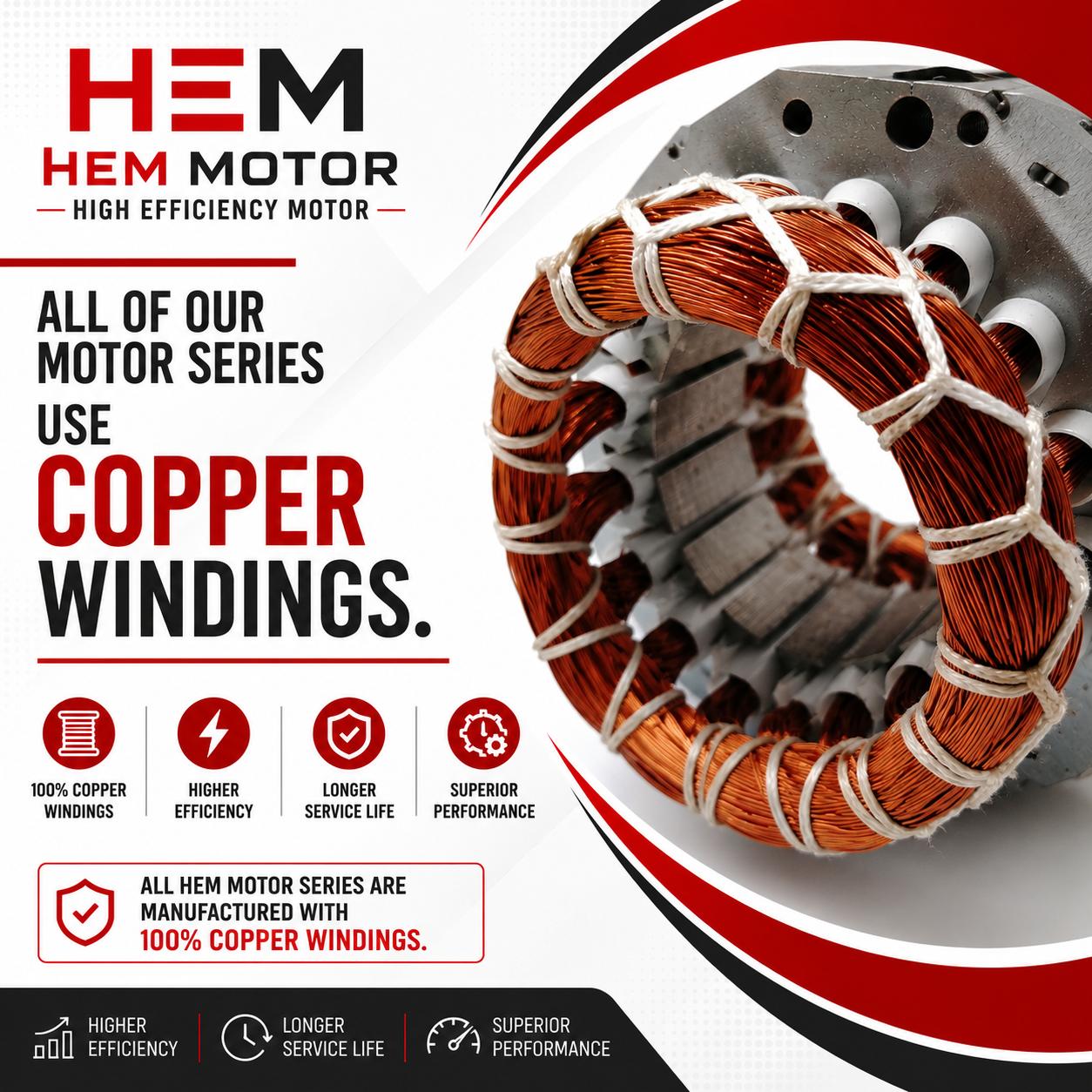

When buying a high-efficiency motor it is natural to focus on the efficiency class on the nameplate (IE3, IE4, IE5); however another critical property that determines whether the motor runs reliably for years is often overlooked: how the insulation class is matched with the temperature rise class. There is an increasingly common approach, preferred by quality manufacturers: producing the motor with Class H insulation and using it at a Class F temperature rise. Although this sounds like a technical detail, it is a design decision that directly determines the motor's life, its margin against high ambient temperature and overload, and its long-term reliability. In this article we cover, with technical tables, the insulation classes (B, F, H), the concept of temperature rise (ΔT), what the thermal margin means, how insulation life doubles, and how the low-loss advantage of an efficient motor strengthens this equation.
High-efficiency motors, by their design, produce fewer losses; that is, they deliver the same power while heating up less. This low heating already keeps the winding cool. When Class H insulation material is added on top and the motor is run only at a Class F temperature rise, a wide thermal margin forms between the temperature the winding material can withstand and the temperature it actually reaches. This margin is the guarantee of the motor's long life and its resilience to demanding conditions. Below we explain these concepts step by step.
Insulation Classes and Temperature Rise: Basic Concepts
A motor's winding insulation is classified according to the maximum continuous temperature it can withstand. The common classes and the permitted maximum winding temperatures are: Class B 130°C, Class F 155°C, Class H 180°C. These temperatures define the limit the insulation material can withstand over its normal life (usually with a 20,000-hour reference).
Temperature rise (ΔT) is a different concept: it expresses how far above the ambient temperature the winding rises while the motor runs. Standards assume a 40°C reference ambient temperature. The total temperature of a winding is thought of as = ambient temperature + temperature rise + hot-spot allowance. Temperature rise classes are also shown with letters: Class B rise ~80 K, Class F rise ~105 K, Class H rise ~125 K. Here K (Kelvin) expresses the temperature difference.
| Class | Max. Winding Temp. | Permitted Temperature Rise (ΔT) | Hot-Spot Allowance |
|---|---|---|---|
| B | 130°C | ~80 K | ~10 K |
| F | 155°C | ~105 K | ~10 K |
| H | 180°C | ~125 K | ~15 K |
What Does Using Class H Insulation at Class F Rise Mean?
Now let us come to the crucial point. When a motor is produced with Class H insulation materials, its winding can withstand up to 180°C. However, the motor is designed and sized so that at rated load the winding temperature rises only by the Class F rise (~105 K); that is, in a 40°C ambient the winding reaches a total of about 145°C. Yet Class H insulation can withstand 180°C. The ~35°C difference is an unused thermal margin.
This thermal margin gives the motor three important advantages:
- Long insulation life: Running below the insulation limit means the insulation ages much more slowly.
- High ambient temperature margin: Even if the ambient exceeds 40°C (for example a hot plant at 55°C), the motor still stays below the insulation limit.
- Overload margin: Even if temporary overloads or voltage unbalance heat the winding extra, the thermal margin absorbs this excess.
Why Does Insulation Life Double?
The ageing of insulation materials depends exponentially on temperature. According to the generally accepted rule (Montsinger / the 10-degree rule), every ~10°C drop in winding operating temperature roughly doubles the insulation life. Conversely, every 10°C rise halves the life. Using Class H insulation at a Class F rise keeps the winding about 35°C below the insulation limit; this means roughly a several-fold increase in life.
In practice this means: the same motor, with the H/F configuration, runs much longer without a winding failure than with the F/F configuration. On a continuously running production line that is costly to stop, this difference means a large reduction in unplanned downtime and winding-renewal costs. Insulation life is one of the most important factors determining the motor's real service life; therefore the thermal margin is a direct investment in operational reliability.
High Ambient Temperature and Overload Margin
Standard motor ratings are given for a 40°C ambient temperature. But real plants are not always in this ideal condition: foundries, glass factories, boiler rooms, attics and the interiors of panels can rise to 50-60°C. As the ambient temperature rises, the winding's total temperature also rises and a standard F/F motor approaches the insulation limit; in this case the motor's power must be reduced (derated). Yet an H/F-configured motor, thanks to its thermal margin, can stay below the insulation limit even at high ambient temperature; in most cases the need for derating is reduced or eliminated.
Similarly, in real plants, temporary overloads, voltage unbalance, frequent starting or phase-current imbalance at partial load can heat the winding more than expected. The H/F thermal margin absorbs these unexpected heatings and keeps the motor below the insulation limit. So the thermal margin not only extends life; it also makes the motor resilient to the unpredictable conditions of the real world.
| Configuration | Insulation Material | Temperature Rise | Thermal Margin | Advantage |
|---|---|---|---|---|
| B / B | Class B | ~80 K | None | Basic, economical |
| F / F | Class F | ~105 K | None | Standard industrial |
| F / B | Class F | ~80 K | ~25 K | Long life, medium margin |
| H / F | Class H | ~105 K | ~35 K | Highest life and resilience margin |
Hot Plants and Sector Examples
The value of the thermal margin becomes especially clear in sectors where the ambient temperature is high. In foundries and metal-processing plants, motors near melting furnaces are continuously exposed to high radiant heat; here the H/F configuration ensures the motor operates safely even at high ambient temperature. In glass and ceramic factories, temperatures around the kilns easily exceed 50°C. In cement and lime plants, high temperature and dust occur together. In boiler rooms and steam plants, the environment is continuously hot. In textile finishing lines, high temperatures prevail around stenter machines and drying ovens. In all these environments a standard F/F motor frequently requires derating or ages prematurely by approaching the insulation limit; whereas an H/F-configured efficient motor runs comfortably in these conditions thanks to its thermal margin.
Another critical point is panel-interior and enclosed-space mounting. Even if the motor runs cool in the open air, in an enclosed panel or a poorly ventilated space the ambient temperature can be much higher than expected. In this case the nameplate values become misleading and the actual winding temperature turns out higher than estimated. The H/F thermal margin protects the motor against these unforeseen temperature rises and prevents unplanned failures. Therefore when selecting a motor, one must assess not only the nominal ambient temperature but also the micro-environment the motor will actually be in.
How Does the Efficient Motor's Low-Loss Advantage Strengthen This Equation?
The best part is that high-efficiency motors naturally support this thermal margin strategy. As efficiency increases, the loss (and therefore heat) produced by the motor decreases. An IE4 or IE5 motor delivers the same power while heating up less than a standard motor, because its iron, copper and friction losses are lower. This low loss means the winding already runs cooler.
When this natural coolness of the efficient motor is combined with the H/F thermal margin, the result is striking: the winding both heats less thanks to the low loss and benefits from the high temperature limit of Class H insulation. The two effects superimpose to create an extraordinary thermal safety margin. This explains why a high-efficiency motor is a superior investment both for energy savings and for long life and reliability. An efficient motor does not just lower the electricity bill; combined with the right insulation configuration, it also lowers the total cost of ownership.
Common Misconceptions
There are several misconceptions about the thermal margin frequently encountered in the field. The first is the idea that "a higher insulation class is always better"; yet the advantage comes not from the insulation material being high on its own, but from it being correctly matched with the operating temperature. A motor produced with Class H material but pushed all the way to a Class H rise offers no thermal margin at all. The second is the assumption that "my motor does not run hot, so there is no problem"; the winding temperature cannot be felt by hand, and even if the frame surface looks cool, the temperature inside the winding may be near the insulation limit. The third is the fallacy that "if the efficiency class is high, no insulation is needed"; efficiency and insulation are two separate dimensions that complement each other, and one does not replace the other.
Another misconception is the idea that the thermal margin is "wasted capacity". In fact this margin is not wasted; it is an insurance that allows the motor to operate safely under real-world conditions (high ambient, overload, voltage fluctuation). A motor without a thermal margin, even if it delivers the same power on paper, is far more fragile under real conditions. The correct engineering approach is to select the motor not only for ideal laboratory conditions but for the real environment in which it will operate; the H/F configuration is precisely the product of this philosophy.
Choosing the Right Class: Pre-Order Assessment
- Ambient temperature: is it above 40°C (hot plant, panel interior, roof) — increases the importance of thermal margin.
- Operating regime: continuous, frequent starting, possibility of overload.
- Voltage quality: unbalance or fluctuation increases heating.
- Target insulation life and reliability expectation.
- Efficiency class (IE3/IE4/IE5) — low loss strengthens the thermal margin.
Frequently Asked Questions
Is Class H insulation always better?
Class H insulation withstands a higher temperature; however the real advantage comes from using it at a Class F temperature rise. This configuration leaves a wide thermal margin between the insulation limit and the actual operating temperature. Simply using Class H material and pushing the motor to the limit at a Class H rise does not give this advantage; the point is the correct matching of material with operating temperature.
Does the thermal margin really double the insulation life?
According to the generally accepted rule, every ~10°C drop in winding operating temperature roughly doubles the insulation life. The H/F configuration keeps the winding about 35°C below the insulation limit; this can mean a several-fold increase in life. The actual gain varies with the operating temperature and load, but the direction is always in favour of long life.
Why is the thermal margin easier to achieve on a high-efficiency motor?
Because high-efficiency motors produce fewer losses, they deliver the same power while heating up less. This low heating already keeps the winding cool; when Class H insulation is added, the thermal margin naturally widens. So on an efficient motor, low loss and a high insulation class superimpose to create an extraordinary thermal safety margin.
Conclusion and Supply
On a high-efficiency motor, using Class H insulation at a Class F temperature rise is a superior design approach that, thanks to the low temperature rise and wide thermal margin, significantly extends insulation life and provides resilience against high ambient temperature and overload. The low-loss advantage of the efficient motor naturally strengthens this thermal margin; the result is a motor that offers both energy savings and long life and reliability. HEM Motor supplies its high-efficiency motors with a suitable insulation class and thermal margin configuration, for hot and demanding environments, from stock with fast delivery. Share your ambient temperature and operating regime and request a quote for an insulation and thermal margin configuration suited to your application.
Related content: efficiency class and right sizing, IE4 insulation and thermal class (F/H) temperature rise, winding and insulation class (F/H), ambient temperature and power derating and efficiency losses: iron, copper, friction.